

A recent study published in Nutrients from researchers at Tokyo University of Science has discovered that pairing specific plant compounds can amplify their anti-inflammatory effects by several hundred-fold compared to using them alone.

(...) a research team led by Professor Gen-ichiro Arimura from the Department of Biological Science and Technology, Tokyo University of Science, Japan, investigated how combinations of familiar plant-derived compounds produce anti-inflammatory effect in immune cells. Their study, published in Volume 18, Issue 3 of the journal Nutrients on January 23, 2026, examined whether pairing compounds found in mint, eucalyptus, and chili peppers could suppress inflammatory signals more effectively than using each compound independently.
The researchers focused on macrophages, a type of immune cell that plays a central role in inflammation by producing small signaling proteins called cytokines, which promote inflammation. In their experiments, murine macrophages were stimulated with lipopolysaccharide, a bacterial component commonly used to trigger inflammation in cellular studies. The team then treated these cells with menthol (from mint), 1,8-cineole (from eucalyptus), capsaicin (from chili peppers), and β-eudesmol (from hops and gingers), both individually and in carefully controlled combinations.
Using gene expression analysis, protein level measurements, and calcium imaging analysis, the researchers examined how these compounds affected key inflammatory biomarkers. They also tested whether the plant compounds acted through transient receptor potential (TRP) channels; these are proteins in the cell membrane that sense chemical and physical stimuli and help regulate calcium signaling, which is important for immune cell activation.
When used alone, capsaicin stood out as the most potent anti-inflammatory compound. However, the most striking synergistic results appeared for compound combinations. "When capsaicin and menthol or 1,8-cineole were used together, their anti-inflammatory effect increased several hundred-fold compared to when each compound was used alone," highlights Prof. Arimura.
Further experiments aided in elucidating the mechanism behind the synergistic function. Menthol and 1,8-cineole acted through TRP channels and calcium signaling, whereas capsaicin has been suggested to suppress inflammation through a different pathway independent of TRP. "We demonstrated that this synergistic effect is not a coincidence, but is based on a novel mode of action resulting from the simultaneous activation of different intracellular signaling pathways," says Prof. Arimura. "This provides clear molecular-level evidence for the empirically known effects of combining food ingredients."
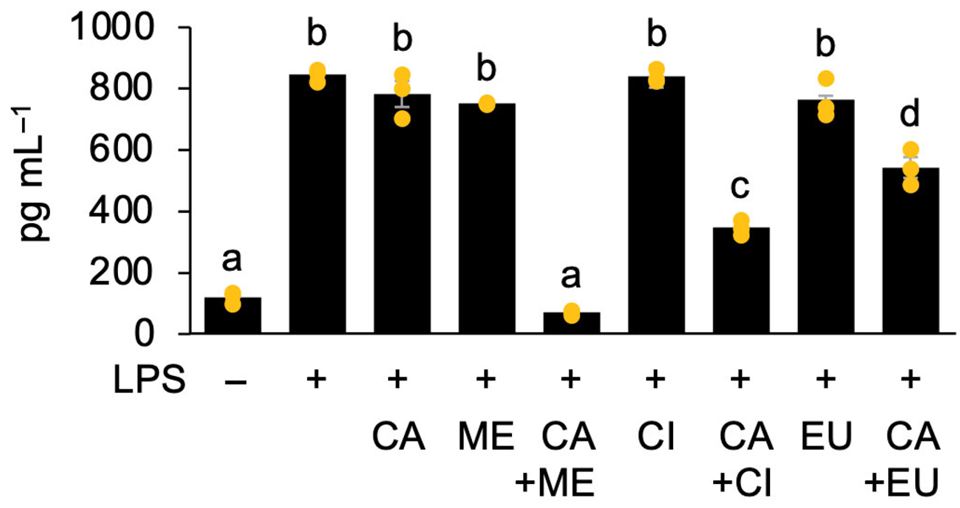
Image title: Anti-inflammatory effects of capsaicin in combination with other natural compounds
Image caption: This plot shows the measured TNF-α protein concentration released by macrophages as an indicator of inflammation. Combining capsaicin (CA) with either menthol (ME) or 1,8-cineole (CI) drastically reduced inflammation levels induced by bacterial lipopolysaccharide protein.
Image credit: Professor Gen-ichiro Arimura from Tokyo University of Science, Japan
1. Capsaicin (the heat)
----------------------------------------
There is also the well known Golden Milk

 manaturopathe.com
Steeped in the ancient traditions of Ayurveda, this warm, spiced drink is not only a delicious way to start or wind down your day, but also offers health benefits, thanks to Golden Milk's main star ingredient, turmeric. Golden milk, also known as turmeric milk, and haldi doodh in hindi, is a traditional Indian drink that has become a beloved health tonic worldwide. Served warm in a mug, the result is a bright yellow creamy drink that is anti-inflammatory and can help regulate blood sugar levels and reduce risk of several diseases.
Turmeric: Putting the Gold in Golden Milk
Turmeric gives golden milk its namesake color. With its active compound curcumin, turmeric is an anti-inflammatory and antioxidant herb. When combined with black pepper, the bioavailability of curcumin is significantly enhanced, making this drink a health elixir great for reducing inflammation, boosting immunity, and even improving mood and cognitive function.
Duke University reviewed 700 research papers on turmeric's health advantages and found that turmeric surpasses numerous pharmaceuticals in combating various chronic and debilitating illnesses, all while causing hardly any negative side effects. The Andrew Weil Center for Integrative Medicine includes the evidence behind turmeric's health benefits in many of our programs, including our online, self-paced, Wellness & Lifestyle Series for health professionals and those passionate about wellness.
Golden Milk Recipe
Ingredients:
1 cup of milk (plant-based or dairy)
1 teaspoon turmeric powder
1/2 teaspoon ground cinnamon
1/4 teaspoon grated ginger
A pinch of ground black pepper
Optional:
Up to 1 teaspoon of maple syrup (adjust to taste)
1/2 teaspoon vanilla extract
Instructions:
Unveiling Powerful Synergies Between Plant Compounds That Dramatically Reduce Inflammation | Tokyo University of Science
Researchers discover that familiar food ingredients can work together inside immune cells to drastically boost each othe...
www.tus.ac.jp
Scientists discover spice synergy that boosts anti-inflammation 100x
Chronic inflammation often works quietly in the background but can fuel serious diseases like diabetes, heart disease, and cancer. New research reveals that everyday plant compounds—like menthol from mint, cineole from eucalyptus, and capsaicin from chili peppers—can team up inside immune cells...
www.sciencedaily.com
(...) a research team led by Professor Gen-ichiro Arimura from the Department of Biological Science and Technology, Tokyo University of Science, Japan, investigated how combinations of familiar plant-derived compounds produce anti-inflammatory effect in immune cells. Their study, published in Volume 18, Issue 3 of the journal Nutrients on January 23, 2026, examined whether pairing compounds found in mint, eucalyptus, and chili peppers could suppress inflammatory signals more effectively than using each compound independently.
The researchers focused on macrophages, a type of immune cell that plays a central role in inflammation by producing small signaling proteins called cytokines, which promote inflammation. In their experiments, murine macrophages were stimulated with lipopolysaccharide, a bacterial component commonly used to trigger inflammation in cellular studies. The team then treated these cells with menthol (from mint), 1,8-cineole (from eucalyptus), capsaicin (from chili peppers), and β-eudesmol (from hops and gingers), both individually and in carefully controlled combinations.
Using gene expression analysis, protein level measurements, and calcium imaging analysis, the researchers examined how these compounds affected key inflammatory biomarkers. They also tested whether the plant compounds acted through transient receptor potential (TRP) channels; these are proteins in the cell membrane that sense chemical and physical stimuli and help regulate calcium signaling, which is important for immune cell activation.
When used alone, capsaicin stood out as the most potent anti-inflammatory compound. However, the most striking synergistic results appeared for compound combinations. "When capsaicin and menthol or 1,8-cineole were used together, their anti-inflammatory effect increased several hundred-fold compared to when each compound was used alone," highlights Prof. Arimura.
Further experiments aided in elucidating the mechanism behind the synergistic function. Menthol and 1,8-cineole acted through TRP channels and calcium signaling, whereas capsaicin has been suggested to suppress inflammation through a different pathway independent of TRP. "We demonstrated that this synergistic effect is not a coincidence, but is based on a novel mode of action resulting from the simultaneous activation of different intracellular signaling pathways," says Prof. Arimura. "This provides clear molecular-level evidence for the empirically known effects of combining food ingredients."
Image title: Anti-inflammatory effects of capsaicin in combination with other natural compounds
Image caption: This plot shows the measured TNF-α protein concentration released by macrophages as an indicator of inflammation. Combining capsaicin (CA) with either menthol (ME) or 1,8-cineole (CI) drastically reduced inflammation levels induced by bacterial lipopolysaccharide protein.
Image credit: Professor Gen-ichiro Arimura from Tokyo University of Science, Japan
1. Capsaicin (the heat)
- Fresh or dried chili peppers (jalapeño, cayenne, Thai bird’s eye, habanero—whatever heat level you like).
- Chili flakes, cayenne powder, chili powder, or hot sauce.
- How to use: Stir into soups, stir-fries, curries, eggs, roasted veggies, or marinades. A pinch goes a long way.
- Fresh mint leaves (peppermint or spearmint) or dried mint.
- Simple ways:
- Chop fresh mint and scatter over spicy dishes right before serving (the cooling contrast is delicious).
- Add to smoothies, salads, or yogurt.
- Brew mint tea and stir in a tiny pinch of cayenne.
----------------------------------------
There is also the well known Golden Milk
Dominique Abran Naturopathe — Vidéo: recette de Lait d'or
MaNaturopathe.com vous présente le lait d'or, une boisson merveilleuse: anti-inflammatoire, anti-cancéreuse, anti-oxydante. À boire le matin ou en soirée.
manaturopathe.com
Steeped in the ancient traditions of Ayurveda, this warm, spiced drink is not only a delicious way to start or wind down your day, but also offers health benefits, thanks to Golden Milk's main star ingredient, turmeric. Golden milk, also known as turmeric milk, and haldi doodh in hindi, is a traditional Indian drink that has become a beloved health tonic worldwide. Served warm in a mug, the result is a bright yellow creamy drink that is anti-inflammatory and can help regulate blood sugar levels and reduce risk of several diseases.
Turmeric: Putting the Gold in Golden Milk
Turmeric gives golden milk its namesake color. With its active compound curcumin, turmeric is an anti-inflammatory and antioxidant herb. When combined with black pepper, the bioavailability of curcumin is significantly enhanced, making this drink a health elixir great for reducing inflammation, boosting immunity, and even improving mood and cognitive function.
Duke University reviewed 700 research papers on turmeric's health advantages and found that turmeric surpasses numerous pharmaceuticals in combating various chronic and debilitating illnesses, all while causing hardly any negative side effects. The Andrew Weil Center for Integrative Medicine includes the evidence behind turmeric's health benefits in many of our programs, including our online, self-paced, Wellness & Lifestyle Series for health professionals and those passionate about wellness.
Golden Milk Recipe
Ingredients:
1 cup of milk (plant-based or dairy)
1 teaspoon turmeric powder
1/2 teaspoon ground cinnamon
1/4 teaspoon grated ginger
A pinch of ground black pepper
Optional:
Up to 1 teaspoon of maple syrup (adjust to taste)
1/2 teaspoon vanilla extract
Instructions:
- Begin by gently heating your choice of milk in a small saucepan over medium heat.
- As the milk warms, whisk in the turmeric, cinnamon, ginger, black pepper, and optional vanilla.
- Allow the mixture to simmer gently without reaching a boil, for about 10 minutes.
- Remove from heat and stir in optional maple syrup to taste.
- To reduce chunks and get a smoother texture, strain the milk through a fine sieve into your favorite mug.
- Sprinkle golden milk with a bit of ground cinnamon and enjoy.


