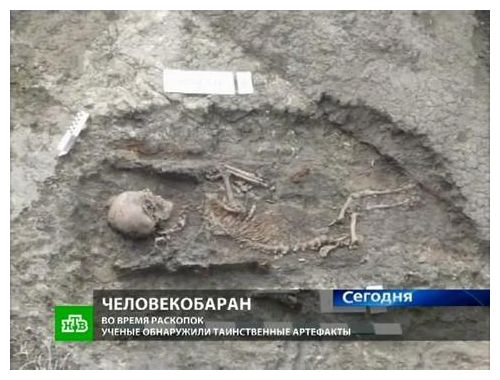
Bizarre skeletons unearthed in Russia: Human-Animal creature and giant horse

Cosmos

Ambassador
Ambassador
FOTCM Member
I just came across this very interesting article:

http://www.sott.net/article/275866-Bizarre-skeletons-unearthed-in-Russian-mound-satyr-and-giant-horse

Take a close look at the picture of the "goat like body with a human head":

1A1T5G.jpg


and especially the video that is provided:


In which you can see this skeleton being displayed on a table and later the big horse is also being discussed.
 
Very interesting. Regarding the "satyr" skeleton, could it be that whomever it was had been decapitated, then buried with the body of a goat as some kind of funerary ritual? It was difficult for me to understand whether or not it was a composite skeleton, or if there was evidence that it was one whole organism.
 
interesting find! I suppose we need some sort of scientific testing to see if this is indeed a man-animal hybrid. I remember the Cs mentioning that this kind of experimentation was happening at the time of atlantis. Would be interesting to see if there is a connection to atlantis and any alleged ancient groups in Russia doing this sort of stuff.
 
Ark watched it and he confirms that it is serious. The researchers think that the human head with goat body was some kind of ritualistic burial of a human head with a goat body, but they are not excluding that they could have been all of a piece in life.

The nearby horse was 2 meters tall - that's kinda like a really big Clydesdale, shire horse, or something in that class.
 
It'd be very strange if it were the remains of a single organism. First of all, what's the benefit of engineering a human with the body of a goat? And why would it be buried with a large war horse? Was this the tomb of some sort of ancient Goatpoleon?

To me, the limbs on the "satyr" look like they could be withered or malformed, perhaps intentionally. The fact that an enormous war horse was given a ceremonial burial with it suggests to me that it belonged to the "satyr", meaning "he" may have been some kind of war leader, as unlikely as that may be. Perhaps the "satyr" was equipped with some sort of prosthetic limbs? I know, it would probably be out of place in that time period, but then again so would genetic engineering.
 
this reminds me of the horse ritual that is described in the Vedas, which is the surviving religious text from the Vedic era, approx 1500 B.C or earlier I think.

I don't know if it is substantiated archeologically, but part of the ritual is that that the queen of the tribe would simulate copulation with the sacrificed (dead) horse. Probably the significance of this is beyond a literal union of the horse and man, but that's why this goat-human finding reminds me of it.

Here is the description from wikipedia

The Ashvamedha could only be conducted by a king (rājā). Its object was the acquisition of power and glory, the sovereignty over neighbouring provinces, and general prosperity of the kingdom.

The horse to be sacrificed must be a stallion, more than 24, but less than 100 years old. The horse is sprinkled with water, and the Adhvaryu and the sacrificer whisper mantras into its ear. The horse is then set loose towards the North-East, to roam around wherever it chooses, for the period of one year (or half a year, according to some commentators). The horse is associated with the Sun, and its yearly course. If the horse wanders into neighbouring provinces hostile to the sacrificer, they must be subjugated. The wandering horse is attended by a hundred young men, sons of princes or high court officials, charged with guarding the horse from all dangers and inconvenience. During the absence of the horse, an uninterrupted series of ceremonies is performed in the sacrificer's home.

After the return of the horse, more ceremonies are performed. The horse is yoked to a gilded chariot, together with three other horses, and RV 1.6.1,2 (YV VSM 23.5,6) is recited. The horse is then driven into water and bathed. After this, it is anointed with ghee by the chief queen and two other royal consorts. The chief queen anoints the fore-quarters, and the others the barrel and the hind-quarters. They also embellish the horse's head, neck, and tail with golden ornaments. The sacrificer offers the horse the remains of the night's oblation of grain.

After this, the horse, a hornless he-goat, a wild ox (go-mrga, Bos gavaeus) are bound to sacrificial stakes near the fire, and seventeen other animals are attached to the horse. A great number of animals, both tame and wild, are tied to other stakes, according to a commentator 609 in total (YV VSM 24 consists of an exact enumeration).

Then the horse is slaughtered (YV VSM 23.15, tr. Griffith)

Steed, from thy body, of thyself, sacrifice and accept thyself.
Thy greatness can be gained by none but thee.
The chief queen ritually calls on the king's fellow wives for pity. The queens walk around the dead horse reciting mantras. The chief queen then has to mimic copulation with the dead horse, while the other queens ritually utter obscenities.[3]

On the next morning, the priests raise the queen from the place where she has spent the night with the horse. With the Dadhikra verse (RV 4.39.6, YV VSM 23.32), a verse used as a purifier after obscene language.
 
Back
Top Bottom