Brown dwarfs & iron rain

  • Thread starter Thread starter Alchemy1
  • Start date Start date
A

Alchemy1

Guest
Somehow I missed this news release from back in 2002:

Sciencedaily.com said:
Source: University Of California - Los Angeles

Posted: May 27, 2002

Astronomers Find Jupiter-Like Weather On Brown Dwarfs
For the first time, researchers have observed planet-like weather acting as a major influence on objects outside our solar system, scientists from UCLA and NASA report May 23.

The UCLA-NASA team has found cloudy, stormy atmospheres on brown dwarfs, the celestial bodies that are less massive than stars but have more mass than giant planets like Jupiter. The discovery will give scientists better tools for interpreting atmospheres and weather on brown dwarfs or on planets around other stars.

"The best analogy to what we witness on these objects are the storm patterns on Jupiter," said Adam Burgasser, astronomer at UCLA and lead author of the study. "But I suspect the weather on these more massive brown dwarfs makes the Great Red Spot look like a small squall."

The UCLA-NASA findings will be reported in the June 1 issue of the Astrophysical Journal Letters.

Jupiter's Great Red Spot is a massive storm more than 15,000 miles across and with winds of up to 270 miles per hour. Burgasser teamed with planetary scientist Mark Marley, meteorologist Andrew Ackerman of NASA Ames Research Center in California's Silicon Valley, and other collaborators to propose how weather phenomena could account for puzzling observations of brown dwarfs.

"We had been thinking about what storms might do to the appearance of brown dwarfs," Marley said. "And when Adam showed us the new data, we realized there was a pretty good fit." The team calculated that using a model with breaks or holes in the cloudy atmosphere solved the mysterious observations of cooling brown dwarfs.

Brown dwarfs, only recently observed members of the skies, are "failed stars at best," Ackerman said. Not massive enough to sustain the burning of hydrogen, like stars, brown dwarfs go through cooling stages that scientists observe with infrared energy-detecting telescopes. They appear as a faint glow, like an ember from a fire that gives off both heat and light energy as it dims.

Astronomers expected brown dwarfs, like most objects in the universe, to grow steadily fainter as they cool. However, new observations showed that during a relatively short phase, brown dwarfs appear to get brighter as they cool. The explanation lies in the clouds.

At least 25,000 times fainter than the sun, brown dwarfs are still incredibly hot, with temperatures as high as 3,140 degrees Fahrenheit (2,000 degrees Kelvin). At such high temperatures, substances such as iron and sand are in gaseous form. As brown dwarfs cool, these gases condense in the atmosphere into liquid droplets to form clouds, similar to water clouds on Earth. As the brown dwarf cools further, atmospheric weather patterns cause a rapid clearing of the clouds; as the clouds are whisked away by the storms, bright infrared light from the hotter atmosphere beneath the clouds escapes, accounting for the unusual brightening of the brown dwarfs.

"The model developed by the group for the first time matches the characteristics of a very broad range of brown dwarfs, but only if cloud clearing is considered," Burgasser said. "While many groups have hinted that cloud structures and weather phenomena should be present, we believe we have actually shown that weather is present and can be quite dramatic."


By using Earth's weather as a starting point, Ackerman helped the team work the storms including wind, downdrafts and iron rain into their calculations. "The astrophysicists needed some help understanding rain because it's not an important process in most stars," Ackerman said. "We used observations and simulations of terrestrial clouds to estimate the effect of iron rain on the thickness of an iron cloud."

The study will help researchers determine the makeup of atmospheres outside our solar system.

"Brown dwarfs have traditionally been studied like stars, but it's more of a continuum," Marley said. "If you line a mug shot of Jupiter up with these guys, it is just a very low-mass brown dwarf."

Brown dwarfs serve as a training ground for scientists to learn how to interpret observations of planet-like objects around other stars, Marley said. "Everybody wants to find brown dwarfs that are even colder and have water clouds just like Earth. Once we find those, that will be a good test of our understanding."


###NASA, the National Science Foundation and the Hubble Postdoctoral Fellowship funded this study, and supplied much of the data. Other collaborating institutions include Vanderbilt University, Nashville, Tenn.; Washington University, St. Louis; U.S. Naval Observatory, Washington, D.C.; and California Institute of Technology, Pasadena, Calif.

More information about this study is available at: http://www.journals.uchicago.edu/ApJ/journal/contents/ApJL/v571n2.html
And then this, from almost 8 years ago to the day (11 July, 1998):

extract from C's session said:
[...]
Q: (A) So, we have the idea. Next question concerning this companion star; we were told that its mass is less than the sun, can we have a figure on how much less?
A: 56 percent of the mass of the sun.
Q: (A) Okay, if this is really so, then when it really starts to approach the solar system, and they rotate in tandem, it means that the sun will really start to feel its gravity, and because of this, the solar system will start to move with respect to other stars, so all the constellations will shift, is this correct?
A: More like a slight "wobble" effect.
Q: (L) Will that be perceptible to us here on the Earth?
A: Only through measurements.
Q: (T) There have been a lot of reports of late regarding major solar activity, solar flares, solar winds, etc. The surface of the sun has a whole lot going on. The last I heard, one of the two satellites observing the sun, one of them is gone. Is this an effect from the sun itself, or is this an effect of the approaching brown dwarf?
A: The sun.
Q: (T) As the brown dwarf approaches, will it intensify the solar flare activity?
A: The effect on the physical orientation of the sun from the periodic passage of its companion is to flatten the sphere slightly. This returns to its original spherical shape with the retreat.
Q: (L) Is this flattening of the sphere of the sun going to have any noticeable effects in terms of enhanced, accelerated, or magnified radiation from the sun?
A: No.
Q: (T) Solar flares or anything like that?
A: No.
Q: (T) So there is not going to be any appreciable effect on the planet from this as far as the sun goes?
A: The sun's gravity increases, thus inhibiting flares.
Q: (T) Inhibiting flares is good. (L) Not necessarily. Solar minimums have been periods of ice ages. (T) One of the recent crop circles this year shows what the crop circle interpreters say is an image of the sun with a large solar flare coming off of it. It is supposed to be a warning to us that the surface of the sun has become unstable...
A: All events intersect.
Q: (A) Okay, I would like to ask what kind of effects other than just gravity we should expect from the close passage of this star? Any particular electro-magnetic, gamma radiation, or what to look for? In which part of the spectrum?
A: Radiation emits from those cosmic bodies which radiate.
Q: (L) Are you saying that the brown star does not radiate?
A: Yes.
Q: (L) If it doesn't radiate, what does it do?
A: Its radioactive field is severely limited as the "fire" went out long ago. It does not give off light.
Q: (J) It's a brown star. (T) One or two steps away from being a collapsing black hole. (L) Well, that's friendly, especially after watching "Event Horizon" last night!
A: No. Black holes only form from 1st magnitude stars.
Q: (A) We have been told that there is going to be a change of the magnetic field of the earth. Does this mean that the magnetic pole will shift?
A: Yes.
Q: (A) About this shift of the poles, is it going to be a complete pole reversal?
A: Yes.
Q: (A) What is going to happen inside Earth that could cause this magnetic pole reversal?
A: Is caused by disturbances in the mineral content of the substrata rock, brought on by the interaction of Earth with outside forces.
Q: (L) What specific outside forces?
A: Those already discussed.
Q: (L) What is going to be the specific mechanism of this disturbance? Can you describe for us the steps by which this pole reversal will take place?
A: Pole reversal is cyclical anyway, these events merely serve as trigger mechanism.
Q: (L) Let me ask it this way: is there a charge that builds up in the mineral substrata that requires discharge, or that becomes excited to the point that it discharges and then reverses? Is this what we are talking about in terms of the mechanism?
A: Examine what is needed to magnetize metal. Ask Arkadiusz.
Q: (A) What is needed to magnetize metal. One has to align the spins of the atoms which means one has to strike the metal, or one has to bring a magnetic field close. (T) Strike as in annealing... heating and striking metal or rock which causes the crystalline structure to decompose so that the metal becomes pliable. Then, each time it is hit, it reforms until it cools again. (L) Is this what we are talking about here?
A: Close.
Q: (A) One can also have an external magnetic field to align. But, where is it going to come from?
A: Guess.
Q: (L) The wave?
A: All are interconnected.
Q: (T) Now, this is just a thought: where would an external magnetic field strong enough to do something like that come from? On the earth, if you supercharge the ionosphere, you create an extremely intense magnetic field. That's what the ionosphere basically is. That is what the HAARP group of programs is about. That is what Tesla was into - the ionosphere - cause there is a large charge there. (L) Is the HAARP project involved here?
A: No.
Q: (T) They are monkeying around with that stuff. (L) Do the people in charge of the HAARP project know about all of this and are they constructing this HAARP array to utilize this energy in some way?
A: Those who know are at foundation.
Q: (T) To protect us?
A: HAARP is for mind control. It is hoped it can be successful in 4th density too!
Q: (L) Well, if these people are aware that this sort of thing is getting ready to happen... never mind. (A) We have been told that this magnetic disturbance is closely related to this realm border crossing, and you asked us the question 'what is the root of realm' and it is reality. Now, realm has an m at the end. Does this have something to do with magnetic?
A: Realm border is when the reality shifts for all.
Q: (A) Yes, but why is this reality shift related to magnetic field disturbance? What is the connection?
A: Your physiology and etheric orientation are both tied into the magnetic state of your environment.
Q: (L) Okay, you said before that the magnetic field is going to reverse...
A: Magnetic poles reverse.
Q: (L) Okay, what is the magnetic field going to do. It is going to change in some way. Is it going to increase, decrease... is this to a degree - something other than direction - amplification? (T) Will anything change in the strength of the field?
A: Let us illustrate. Now: Earth. [A circle is drawn with radiating spikes all around fairly close to the surface.] Earth after: [A circle is drawn with double radiating spikes with those in polar regions considerably longer than the others.]
Q: (T) So, it is the same, except it is larger?
A: Close.
Q: (T) Are you indicating that the magnetic field will be stronger?
A: Broader and larger.
Q: (L) What is the cross in the middle?
A: Geodirectional grid reference. You incorrectly added circle on side. Lines of magnetic field alignment should be shown as longer at poles. "Crosshairs" in illustration are for directional reference only.
Q: (T) Does this mean it will be stronger also?
A: Larger and broader.
Q: (A) People work near strong magnets much stronger than the Earth's magnetic field, yet nothing happens to them that we can see.
A: Not true. Body chemistry is altered. Is not long term or permanent exposure.
[...]
 
It is not clear to me what was your point. What did you want to say putting together a piece from astronomy research about brown dwarfs and a piece form the transcripts where a brown dwarf is being mentioned. What both pieces have in common except of both having the term "brown dwarf"?
Can you elaborate on this?
 
Ark said:
It is not clear to me what was your point. What did you want to say putting together a piece from astronomy research about brown dwarfs and a piece form the transcripts where a brown dwarf is being mentioned. What both pieces have in common except of both having the term "brown dwarf"?
Can you elaborate on this?
Ark--

Yes, at the core it was really nothing more than that. The points that came to mind at the time:

a) comparison between C's & 'science':

Sciencedaily said:
[...] Brown dwarfs, only recently observed members of the skies, are "failed stars at best," Ackerman said. Not massive enough to sustain the burning of hydrogen, like stars, brown dwarfs go through cooling stages that scientists observe with infrared energy-detecting telescopes. They appear as a faint glow, like an ember from a fire that gives off both heat and light energy as it dims.
C's said:
Q: (A) Okay, I would like to ask what kind of effects other than just gravity we should expect from the close passage of this star? Any particular electro-magnetic, gamma radiation, or what to look for? In which part of the spectrum?
A: Radiation emits from those cosmic bodies which radiate.
Q: (L) Are you saying that the brown star does not radiate?
A: Yes.
Q: (L) If it doesn't radiate, what does it do?
A: Its radioactive field is severely limited as the "fire" went out long ago. It does not give off light.
These statements are obviously not the same, but I guess I would see the latter statement, if taken at face value, implying that the brown dwarf in our system --- should one exist --- being perhaps further along the scale than the scientists mentioned in this article might suspect.

b) mention that the brown dwarf may 'flare up' along its path towards eventual dimming:

Sciencedaily.com said:
[...]
However, new observations showed that during a relatively short phase, brown dwarfs appear to get brighter as they cool. The explanation lies in the clouds. [...]
While I did not have the time to look up the reference, my sometimes faulty memory does recall a session and/or article where it was asked whether the potential sighting of a brown dwarf actually occurred in the late 17th or 18th century (apologies for imprecision). While I recall this being attributed to the brown dwarf being at perihelion, this article may add a further possibility for the 'brightening'. I can see no reason why these would necessarily be mutually exclusive events.

All FWIW. Does this help elaborate, or only further muddy the waters?
 
Seems to me that this article and the C's transcripts are contradictory, although the C's were referring to the 'twin Sun' and possibly the theory in this article could apply to Brown dwarfs at a different stage in their development.


Sciencedaily.com said:
Source: University Of California - Los Angeles

Brown dwarfs, only recently observed members of the skies, are "failed stars at best," Ackerman said. Not massive enough to sustain the burning of hydrogen, like stars, brown dwarfs go through cooling stages that scientists observe with infrared energy-detecting telescopes. They appear as a faint glow, like an ember from a fire that gives off both heat and light energy as it dims.


At least 25,000 times fainter than the sun, brown dwarfs are still incredibly hot, with temperatures as high as 3,140 degrees Fahrenheit (2,000 degrees Kelvin). At such high temperatures, substances such as iron and sand are in gaseous form. As brown dwarfs cool, these gases condense in the atmosphere into liquid droplets to form clouds, similar to water clouds on Earth. As the brown dwarf cools further, atmospheric weather patterns cause a rapid clearing of the clouds; as the clouds are whisked away by the storms, bright infrared light from the hotter atmosphere beneath the clouds escapes, accounting for the unusual brightening of the brown dwarfs.
extract from C's session said:
Q: (L) Are you saying that the brown star does not radiate?
A: Yes.
Q: (L) If it doesn't radiate, what does it do?
A: Its radioactive field is severely limited as the "fire" went out long ago. It does not give off light.
 
It all depends on what is understood by "radiation":

The defining characteristic of a brown dwarf is the mass is low enough that the central temperature never gets high enough to ignite hydrogen fusion," Mathieu explains.

However, brown dwarfs do glow, says Stassun, because of the powerful gravitational forces at play as the star contracts with age.

Source
What they do is "glow". Can glowing be considered as "radiation"? Certainly so. But there is no "nuclear induced radiation". Moreover their temperature (therefore the "glow") depends on their age, their mass, and on who know what kind of external factors.
 
Ben-

Yes I agree, and that was what I was trying to say in my response in part a). If the C's session is accurate, then I would infer that our brown dwarf (if it exists) is much, much further along the dimming line such that it no longer radiates. What I did find interesting is the aforementioned brightening; this might help account for the the possible Earth-based viewing a couple of centuries ago. Again, this brightening may be entirely due to perihelion, or perhaps they worked in tandem together.
 
Alchemy1 - You posted while I was typing, so we essentially said the same thing!
 
Alchemy1 said:
Ben-

If the C's session is accurate, then I would infer that our brown dwarf (if it exists) is much, much further along the dimming line such that it no longer radiates. What I did find interesting is the aforementioned brightening; this might help account for the the possible Earth-based viewing a couple of centuries ago. Again, this brightening may be entirely due to perihelion, or perhaps they worked in tandem together.
It may be useful to note that the conventional understanding of a brown dwarf is of a star not part of the main Star Sequence, which is generally thought to have a mass no larger than 0.084 SM, a much smaller mass than "brown" dwarf the C's talk about.
 
summer school at the vatican observatory,,, ( hope I'm not repeating this from any where else on
forum) but I was reading up on Brown Dwarfs and the vatican is hosting at their observatory
this summer ( June 9th thru July 6th 2007 ) Topics to include Extrasolar planets and Brown Dwarfs.
Castel Gandolfo near Rome Italy . . .
clavius.as.arizona.edu/vo/R1024/VOSS2007.html
 
Re: Brown dwarfs & iron rain

... fwiw, today, on Ben Davidson's Suspicious0bservers YT page (S0 News January 8, 2014: Star Storms, Spaceweather _http://www.youtube.com/watch?v=pM2-9c5ysYY), there was a topic discussed similar to the one posted originally in this here thread, together with the following link to a NASA article:

Stormy Stars? NASA's Spitzer Probes Weather on Brown Dwarfs
(_http://www.nasa.gov/jpl/spitzer/brown-dwarf-20140107/#.Us0Us_3HJO4)
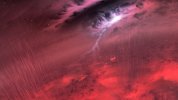
Swirling, stormy clouds may be ever-present on cool celestial orbs called brown dwarfs. New observations from NASA's Spitzer Space Telescope suggest that most brown dwarfs are roiling with one or more planet-size storms akin to Jupiter's "Great Red Spot."

"As the brown dwarfs spin on their axis, the alternation of what we think are cloud-free and cloudy regions produces a periodic brightness variation that we can observe," said Stanimir Metchev of the University of Western Ontario, Canada. "These are signs of patchiness in the cloud cover."

Metchev is principal investigator of the brown dwarf research. The results were presented at a news conference today at the 223rd annual meeting of the American Astronomical Society in Washington by Metchev's colleague, Aren Heinze, of Stony Brook University, New York.

Brown dwarfs form as stars do, but lack the mass to fuse atoms continually and blossom into full-fledged stars. They are, in some ways, the massive kin to Jupiter.

Scientists think that the cloudy regions on brown dwarfs take the form of torrential storms, accompanied by winds and, possibly, lightning more violent than that at Jupiter or any other planet in our solar system. However, the brown dwarfs studied so far are too hot for water rain; instead, astronomers believe the rain in these storms, like the clouds themselves, is made of hot sand, molten iron or salts.

In a Spitzer program named "Weather on Other Worlds," astronomers used the infrared space telescope to watch 44 brown dwarfs as they rotated on their axis for up to 20 hours. Previous results had suggested that some brown dwarfs have turbulent weather, so the scientists had expected to see a small fraction vary in brightness over time. However, to their surprise, half of the brown dwarfs showed the variations. When you take into account that half of the objects would be oriented in such a way that their storms would be either hidden or always in view and unchanging, the results indicate that most, if not all, brown dwarfs are racked by storms.

"We needed Spitzer to do this," said Metchev. "Spitzer is in space, above the thermal glow of the Earth's atmosphere, and it has the sensitivity required to see variations in the brown dwarfs' brightness."

The results led to another surprise as well. Some of the brown dwarfs rotated much more slowly than any previously measured, a finding that could not have been possible without Spitzer's long, uninterrupted observations from space. Astronomers had thought that brown dwarfs sped up to very fast rotations when they formed and contracted, and that this rotation didn't wind down with age.

"We don't yet know why these particular brown dwarfs spin so slowly, but several interesting possibilities exist," said Heinze. "A brown dwarf that rotates slowly may have formed in an unusual way -- or it may even have been slowed down by the gravity of a yet-undiscovered planet in a close orbit around it."

The work may lead to a better understanding of not just brown dwarfs but their "little brothers": the gas-giant planets. Researchers say that studying the weather on brown dwarfs will open new windows onto weather on planets outside our solar system, which are harder to study under the glare of their stars. Brown dwarfs are weather laboratories for planets, and, according to the new results, those laboratories are everywhere.

Other researchers on the team include: Daniel Apai and Davin Flateau of the University of Arizona, Tucson; Mark Marley of NASA Ames Research Center, Moffett Field; Jacqueline Radigan of the Space Telescope Science Institute, Baltimore, Md.; Etienne Artigau of Universite de Montreal, Canada; Adam Burgasser of University of California San Diego; Peter Plavchan of NASA's Exoplanet Science Institute at the California Institute of Technology, Pasadena; and Bertrand Goldman of Max-Planck Institute for Astronomy, Germany.

NASA's Jet Propulsion Laboratory, Pasadena, Calif., manages the Spitzer Space Telescope mission for NASA's Science Mission Directorate, Washington. Science operations are conducted at the Spitzer Science Center at the California Institute of Technology in Pasadena. Spacecraft operations are based at Lockheed Martin Space Systems Company, Littleton, Colorado. Data are archived at the Infrared Science Archive housed at the Infrared Processing and Analysis Center at Caltech. Caltech manages JPL for NASA. For more information about Spitzer, visit _http://spitzer.caltech.edu and _http://www.nasa.gov/spitzer .

Interestingly, enough, there is another article (and a posting for it I just put up here) coming from the NASA website (talked about in yesterday's S0 update) about GRB (Gamma Ray Burst) "gravitational lensing" phenomena, which makes me wonder if we can suppose these topics are related to the sorts of observations talked about on this thread started by psychegram: "Secret Observation Programs" ... just a thought (hope it's not noisy) ... fwiw ...
 

Attachments

  • brown_dwarfs_stormy_stars.jpg
    brown_dwarfs_stormy_stars.jpg
    295.2 KB · Views: 88
Back
Top Bottom