

stardust
Jedi Master
http://www.oism.org/pproject/s33p36.htm#Message5981
It is the last public place where the smokers could smoke.
One can hope that tobacco will grow faster too ...
One must say that to Bruxelles : now they want to fordid the cafés and bars to heat their winter's terraces because they "release to much CO2 and consum to much energy"...FERTILIZATION OF PLANTS BY CO2
How high will the CO2 concentration of the atmosphere ultimately rise if mankind continues to increase the use of coal, oil, and natural gas? At ultimate equilibrium with the ocean and other reservoirs there will probably be very little increase. The current rise is a non-equilibrium result of the rate of approach to equilibrium.
One reservoir that would moderate the increase is especially important. Plant life provides a large sink for CO2. Using current knowledge about the increased growth rates of plants and assuming increased CO2 release as compared to current emissions, it has been estimated that atmospheric CO2 levels may rise to about 600 ppm before leveling off. At that level, CO2 absorption by increased Earth biomass is able to absorb about 10 Gt C per year (100). At present, this absorption is estimated to be about 3 Gt C per year (57).
About 30% of this projected rise from 295 to 600 ppm has already taken place, without causing unfavorable climate changes. Moreover, the radiative effects of CO2 are logarithmic (101,102), so more than 40% of any climatic influences have already occurred.
As atmospheric CO2 increases, plant growth rates increase. Also, leaves transpire less and lose less water as CO2 increases, so that plants are able to grow under drier conditions. Animal life, which depends upon plant life for food, increases proportionally.
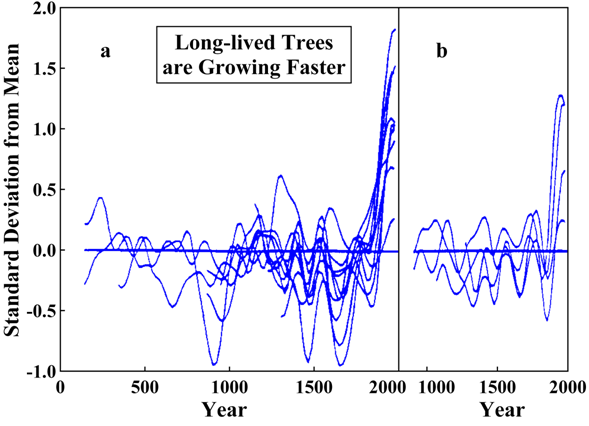
Figure 21: Standard deviation from the mean of tree ring widths for (a) bristlecone pine, limber pine, and fox tail pine in the Great Basin of California, Nevada, and Arizona and (b) bristlecone pine in Colorado (110). Tree ring widths were averaged in 20-year segments and then normalized so that the means of prior tree growth were zero. The deviations from the means are shown in units of standard deviations of those means.
Figures 21 to 24 show examples of experimentally measured increases in the growth of plants. These examples are representative of a very large research literature on this subject (103-109). As Figure 21 shows, long-lived 1,000- to 2,000-year-old pine trees have shown a sharp increase in growth during the past half-century. Figure 22 shows the 40% increase in the forests of the United States that has taken place since 1950. Much of this increase is due to the increase in atmospheric CO2 that has already occurred. In addition, it has been reported that Amazonian rain forests are increasing their vegetation by about 900 pounds of carbon per acre per year (113), or approximately 2 tons of biomass per acre per year. Trees respond to CO2 fertilization more strongly than do most other plants, but all plants respond to some extent.
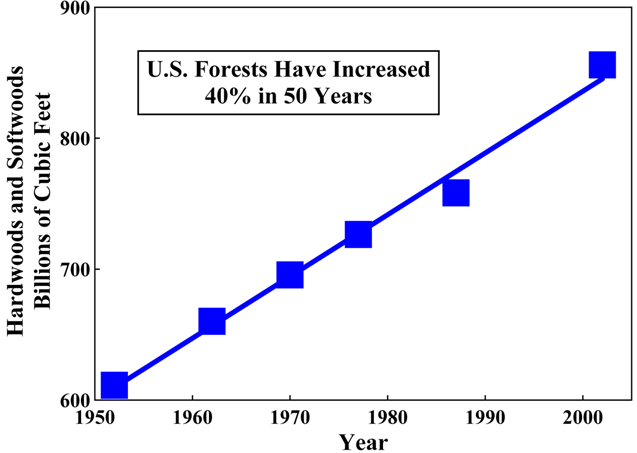
Figure 22: Inventories of standing hardwood and softwood timber in the United States compiled in Forest Resources of the United States, 2002, U.S. Department of Agriculture Forest Service (111,112). The linear trend cited in 1998 (1) with an increase of 30% has continued. The increase is now 40%. The amount of U.S. timber is rising almost 1% per year.
Since plant response to CO2 fertilization is nearly linear with respect to CO2 concentration over the range from 300 to 600 ppm, as seen in Figure 23, experimental measurements at different levels of CO2 enrichment can be extrapolated. This has been done in Figure 24 in order to illustrate CO2 growth enhancements calculated for the atmospheric increase of about 88 ppm that has already taken place and those expected from a projected total increase of 305 ppm.
Wheat growth is accelerated by increased atmospheric CO2, especially under dry conditions. Figure 24 shows the response of wheat grown under wet conditions versus that of wheat stressed by lack of water. The underlying data is from open-field experiments. Wheat was grown in the usual way, but the atmospheric CO2 concentrations of circular sections of the fields were increased by arrays of computer-controlled equipment that released CO2 into the air to hold the levels as specified (115,116). Orange and young pine tree growth enhancement (117-119) with two atmospheric CO2 increases – that which has already occurred since 1885 and that projected for the next two centuries – is also shown. The relative growth enhancement of trees by CO2 diminishes with age. Figure 24 shows young trees.
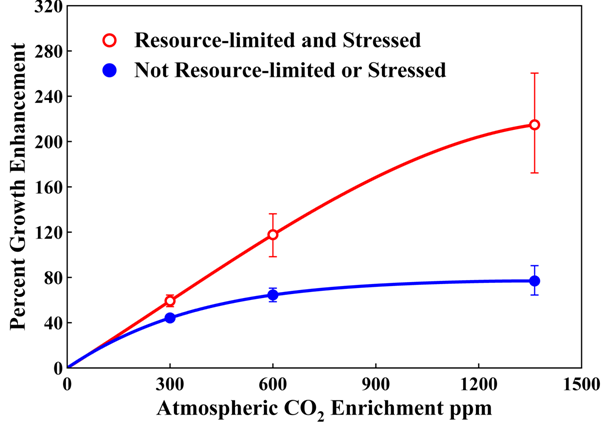
Figure 23: Summary data from 279 published experiments in which plants of all types were grown under paired stressed (open red circles) and unstressed (closed blue circles) conditions (114). There were 208, 50, and 21 sets at 300, 600, and an average of about 1350 ppm CO2, respectively. The plant mixture in the 279 studies was slightly biased toward plant types that respond less to CO2 fertilization than does the actual global mixture. Therefore, the figure underestimates the expected global response. CO2 enrichment also allows plants to grow in drier regions, further increasing the response.
Figure 23 summarizes 279 experiments in which plants of various types were raised under CO2-enhanced conditions. Plants under stress from less-than-ideal conditions – a common occurrence in nature – respond more to CO2 fertilization. The selections of species in Figure 23 were biased toward plants that respond less to CO2 fertilization than does the mixture actually covering the Earth, so Figure 23 underestimates the effects of global CO2 enhancement.
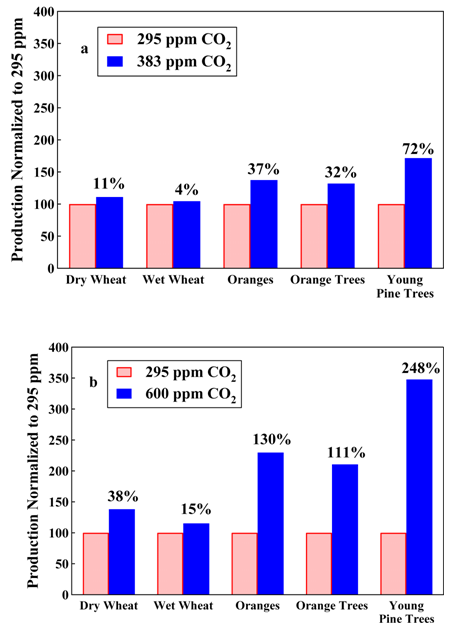
Figure 24: Calculated (1,2) growth rate enhancement of wheat, young orange trees, and very young pine trees already taking place as a result of atmospheric enrichment by CO2 from 1885 to 2007 (a), and expected as a result of atmospheric enrichment by CO2 to a level of 600 ppm (b).
Clearly, the green revolution in agriculture has already benefitted from CO2 fertilization, and benefits in the future will be even greater. Animal life is increasing proportionally, as shown by studies of 51 terrestrial (120) and 22 aquatic ecosystems (121). Moreover, as shown by a study of 94 terrestrial ecosystems on all continents except Antarctica (122), species richness – biodiversity – is more positively correlated with productivity – the total quantity of plant life per acre – than with anything else.
Atmospheric CO2 is required for life by both plants and animals. It is the sole source of carbon in all of the protein, carbohydrate, fat, and other organic molecules of which living things are constructed.
Plants extract carbon from atmospheric CO2 and are thereby fertilized. Animals obtain their carbon from plants. Without atmospheric CO2, none of the life we see on Earth would exist.
Water, oxygen, and carbon dioxide are the three most important substances that make life possible.
They are surely not environmental pollutants.
It is the last public place where the smokers could smoke.
One can hope that tobacco will grow faster too ...


