Digital Natives

Mountain Crown

The Living Force
Youth 'cannot live' without web

A survey of 16 to 24 year olds has found that
75% of them feel they "couldn't live"
without the internet.
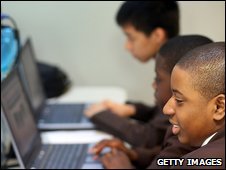
_46543830_youthcomputers.jpg

The 16-24 age group has been dubbed "digital natives"

The report, published by online charity YouthNet, also found that four out of five young people used the web to look for advice.

About one third added that they felt no need to talk to a person face to face about their problems because of the resources available online.

The findings will be unveiled at the Houses of Parliament on Wednesday.

Despite high-profile examples of internet security breaches, such as the recent incident of phishing email scams, 76% of the survey group thought the internet was a safe place "as long as you know what you're doing".

"Probably the middle-aged are the most vulnerable," said Open University psychologist Graham Jones.

"I think children, teenagers and people under their mid-20s have grown up with technology and they understand it deeply.

"So-called silver surfers have got time to learn about it and understand it as well. One of the biggest problems for children is not that they are vulnerable but that their parents don't know what they're doing."

'Digital natives'

The survey, funded by the Nominet Trust - a charity that encourages the safe use of the internet - looked at how the web influences the well-being of people aged between 16 and 24.

Its author, Professor Michael Hulme of Lancaster University, names this age group "digital natives" as they have grown up in an environment rich with computer and mobile technology.

"For young people the internet is part of the fabric of their world and does not exist in isolation from the physical world," he said.

Youthnet, set up by the broadcaster Martyn Lewis in 1995, runs websites offering advice, information and volunteering opportunities to young people.

"The need for a safer, trusted [online] place has never been greater," said Fiona Dawes, Youthnet's chief executive.

"Youthnet will be taking the insights of this report to heart as we plan the future of our services."

_http://news.bbc.co.uk/2/hi/technology/8305731.stm
 
Keep us and our children distracted and trapped by a virtual world so we totally forgetting the real world. :scared:
I see internet is a "Tower of Babel". So much information so many disinfo one can go mad before trying to understand what is what.
'Virtual reality' term is a misleading because there is no such thing either you are in the real world or you enter into a virtual world.
Everything is ponerized, of course this is why it's made to keep us and our children asleep.
I noticed from the first time we got internet, I was addicted to it. I changed a lot after my husband find the Forum and cassiopaea.org.
Very easy to get addicted to something. Could be food(junk food), TV, pills, internet or you name it!
Especially children are very vulnerable because they don't have an experience to make any difference what is distracting and entropic or what is creative and beneficial for the mind.

I just had to read this again:

[quote author=Cassiopaea Glossary]Entropy


In physics, entropy refers to the amount of order in a given system. Irreversible processes, such as combustion increase entropy. This means that energy is more evenly distributed inside the system after the process. A log can burn but will not 'unburn' itself. The energy stored in the chemical bonds in the molecules composing the log is dissipated in the form of light and heat, entropy has increased. See any physics text for a more formal definition.

The QFS uses the term entropy in a special meaning. Entropy is used to mean fall into chaos, specially societally and individually. Entropy is the opposite of creation. Creation involves ordering things so as to create meaning. Increase of entropy or destruction destroys meaning and increases sameness. A societal collapse and the accompanying reverting from civilized into purely survival oriented behavior is an example of increased entropy in this sense.

In a metaphysical sense, subjectivity and wishful thinking represent entropy. This is so because the divide between the perception and reality is in itself a form of chaos and loss of information and cohesion. Service to self (STS) is associated with the concept of entropy in the sense that this seeks to limit the free will of others and deprive them of their energy and creative potential. By exploiting others, the STS entity may create a local peak of power and order or cohesion but this is at the expense of greater depletion of the potential of the exploited. Thus entropy increases in the system as a whole. [/quote]

Thanks MC, very interesting article.
 
Back
Top Bottom