does a nuclear blast have an "eye of the storm"?

Sol Logos

The Living Force
Just wanted to ask those that have a much better grasp of physics if it is possible that these stories below are explained by a safe zone on a nuclear bomb blast at ground zero. What I mean is does an eye of the storm exist comparable to a thermonuclear blast like in Hiroshima?

The first is the story of a bunch of Jesuits that were reported to survive the blast at Hiroshima. Here's an image of I believe their church:
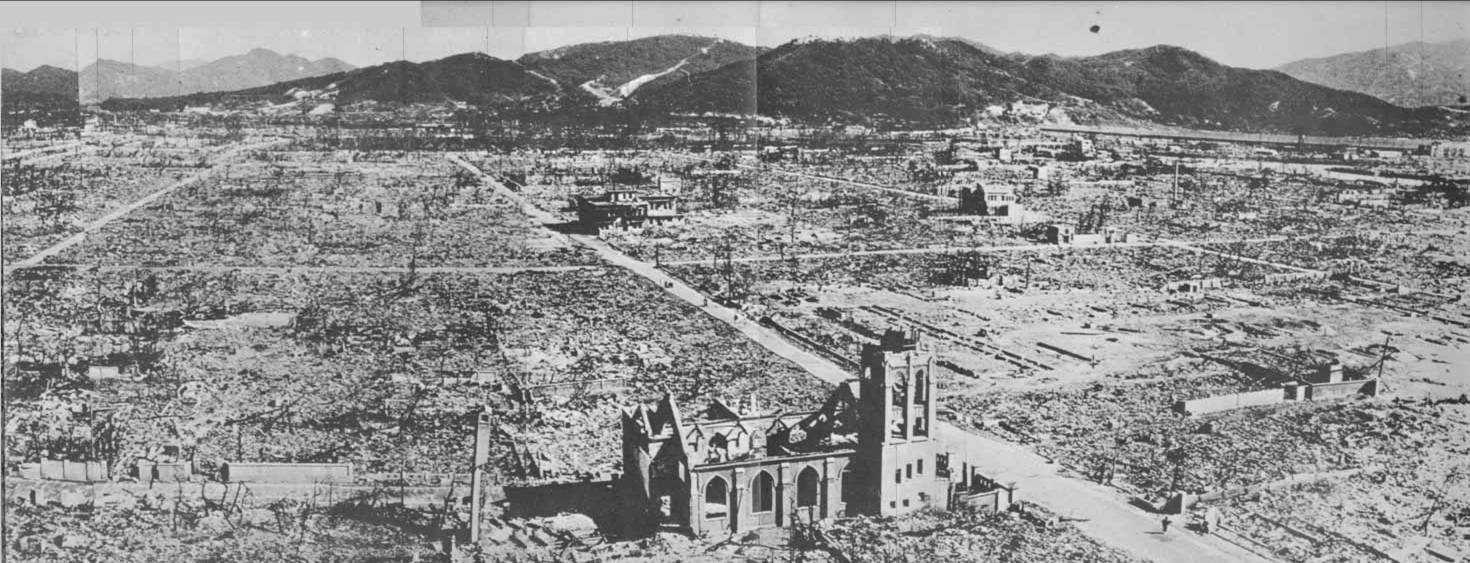
Hiroshima+2.jpg


Here's a link to one of the stories of them: _http://www.holysouls.com/sar/rosarymiracle.htm

BTW I don't subscribe to it being a miracle. Some research Ive done on the Jesuits leads me to believe they are a sinister bunch, so for all intent and purposes the story itself could be a fabrication.

Then there's this archive footage of US servicemen standing beneath a bomb blast. If this happened, there must have been some calculations made to deem it safe for them to do this (whether correct or not).
_http://www.npr.org/blogs/krulwich/2012/07/16/156851175/five-men-agree-to-stand-directly-under-an-exploding-nuclear-bombfive-men-agree-to-stand-directly-under-an-exploding-nuclear-bomb

Also there's this story of an unlucky or very lucky man, depending on how you look at it, who was apparently on ground zero for both blasts that occurred in Japan at the end of the war.
_http://www.theguardian.com/world/2009/mar/25/hiroshima-nagasaki-survivor-japan

So question I'm wondering about is if it is physically possible for there being a "safe zone" on such blasts?
 
One thing to remember about the blasts at Nagasaki and Hiroshima is that the Japanese buildings were largely made from paper.
They can withstand earthquakes, building in this way, but the firestorm after the nuclear blasts wiped out most of the towns.
You can see from the photo that the building standing is made out of bricks.
The story of the three little pigs comes to mind: "I'll huff and I'll puff.."

I have also read that tale of the POW who survived Hiroshima and was transferred to Nagasaki, only to cop it again.
I can't say if it is true, but it makes good copy.

I once read "We of Nagasaki" a poignant tale from one survivor's point of view.
It was worth reading.

Personally, I have been to the MonteBello Islands where the Brits tested their A-bombs.
They were still hot.
The sands were brilliant white, and the waters were crystal clear, and that was twenty years later.
 
alkhemst said:
So question I'm wondering about is if it is physically possible for there being a "safe zone" on such blasts?
I think there is no safe zone.
Just remember Chernobyl and enormous consequences.
One of the most famous symbols of the destruction of the environment that caused the Chernobyl disaster are called. red forest. The name refers to trees that are dried after absorbing large doses of radiation after the accident within 10 kilometers around the plant. Part of the forest is in the cleared result of the accident, crashed and was buried along with nuclear waste. Severely damaged trees for years to show signs of recovery. However newly trees show a multitude of deformation in growth and development, as a result of radiation exposure. A special kind of danger are forest fires. As the plants absorbed a multitude of radioactive isotopes, fires they are released into the smoke in the wind-blown into new regions.
"Red Forest" - a pine forest damaged by radiation took on an eerie
red color. Such vegetation extends to within about 10 miles of
accident.
For people who were near the scene of the accident, radiation was disastrous. Most exposed died from radiation within a period of three weeks. Because of the accident was evacuated all 50 000 inhabitants Prypjata day after, and in the days that followed the circle of 30 km, with headquarters at the crash site, were evacuated about 135,000 people. Are later further expanded and today is known as the Forbidden Zone.
 
casper said:
alkhemst said:
So question I'm wondering about is if it is physically possible for there being a "safe zone" on such blasts?
I think there is no safe zone.
Just remember Chernobyl and enormous consequences.
Chernobyl was just a nuclear reactor meltdown, as was Fukushima. Nuclear bombs are much worse.

There is no area near a critical nuclear event that is safe. The shell of the Jesuit church at Hiroshima survived because its walls were made of stone or concrete, but its roof was destroyed by blast or fire.

Also, the nuclear fission bombs at Hiroshima and Nagasaki were relatively small, with yields of merely about 15 kilotons of TNT, give or take a couple kilotons. Modern thermonuclear fusion weapons are much more powerful, with yields ranging from at least tens to hundreds of kilotons, up to megatons.

Here's a recent article describing the effects of a hypothetical nuclear weapon detonated over NYC: http://mwcnews.net/focus/politics/50600-nuclear-bomb.html . In summary, the initial nuclear reaction would release enough hard radiation in the form of gamma rays to kill *everything* under the fireball not shielded by meters of earth almost instantly, the same fireball would vaporize most everything it touched, the heat radiated from the fireball would instantly ignite fires throughout a radius of about 10 miles, the blast shockwave would destroy most buildings for miles, and the subsequent hurricane force firestorm would complete the destruction the city. Then there's the fallout downwind....

There is no safe zone.
 
griffin said:
casper said:
alkhemst said:
So question I'm wondering about is if it is physically possible for there being a "safe zone" on such blasts?
I think there is no safe zone.
Just remember Chernobyl and enormous consequences.
Chernobyl was just a nuclear reactor meltdown, as was Fukushima. Nuclear bombs are much worse.
Of course we are much more devastating nuclear bomb, for example I gave Chernobyl because of recent history, lower intensity, and again, made a huge material damage, many people were killed, some immediately, some quickly as a result of radiation
 
Thanks for the replies. It doesn't look like there's a safe area under the explosion at the hypercenter, I later found out its called.

There's a story here about survivors of Hiroshima. One guy was under the bomb, 300 feet from the hypercenter.

http://gizmodo.com/5606053/this-it-how-it-feels-to-be-under-a-nuclear-attack

Reading these stories was very saddening to say the least.
 
Wilfred Burchett was the first western journalist to visit Hiroshima, 1 month after the bombing. He writes something about an epicenter where less destruction occurred. Although some buildings were still standing, most or all of these buildings were still burnt out by fire after the blast.

In the centre of the city I found that the buildings seen from the distance were only skeletons, having been gutted by the fire which swept through after most of the city had disappeared in a great swirling pillar of dust and flame. In the burned-out Fukuoka department store (now rebuilt on the same spot) a temporary police headquarters had been installed. It was there that we went to explain who I was and what I wanted. The atmosphere was very tense and the police looked at me with cold hostility.
[. . .]
All balustrades and stone facings had disappeared from the bridges. There were no remnants of broken walls, no large chunks of rubble or blocks of stone and concrete, no craters, as one usually finds in a bombed city. It was destruction by pulverization followed by fire. The reason that some buildings were still standing in the centre, according to the police, was that they were in the epicenter of the explosion, directly under the bomb as it parachuted down and thus in a relative safety zone as the explosive force expanded outward from the epicenter.
- Wilfred Buchett, "The Atomic Plague", in At the Barricades: Forty Years on the Cutting Edge of History (1981). Reprinted in Tell Me No Lies: Investigative Journalism and its Triumphs, edited by John Pilger, (London: Jonathan Cape, 2004).
 
Back
Top Bottom