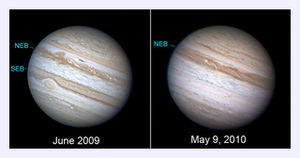
Jupiter Loses it's South Equatorial Belt (SEB)

Vulcan59

SuperModerator
Moderator
FOTCM Member
Strange happenings going on, on Jupiter. In case you've missed it, the article link below. Wonder if it's related to last year's comet strike on Jupiter or it's something new altogether.

http://www.sott.net/articles/show/208317-Jupiter-loses-one-of-its-belts

Jupiter_SEB_fade_panel_Wesley_.jpg
 
Well, that is BIG news (no pun intended). I think that belt has been there for hundreds of years, right? And what about the associated spot?

And people think that we are just experiencing "global warming" because of human activity!
 
The article says it does something like this "every 15 years" or so. Well, I've never heard a WORD about any such thing and I've been following Jupiter and reading astronomy stuff for years. Can anybody find any reference to this phenomenon elsewhere?
 
Well, there's this over at Wikipedia (_http://en.wikipedia.org/wiki/Atmosphere_of_Jupiter#Disturbances)
The normal pattern of bands and zones is sometimes disrupted for periods of time. One particular class of disruption are long-lived darkenings of the South Tropical Zone, normally referred to as "South Tropical Disturbances" (STD). The longest lived STD in recorded history was followed from 1901 until 1939, having been first seen by Percy B. Molesworth on February 28, 1901. It took the form of darkening over part of the normally bright South Tropical zone. Several similar disturbances in the South Tropical Zone have been recorded since then.
 
the article also says that this band disappearing is a 'surprise' which doesn't match up with the "every 3 to 15 years" line. And no, I never heard of such a thing before either.

However:

---

http://en.wikipedia.org/wiki/Atmosphere_of_Jupiter

The NEB is one of the most active belts on the planet. It is characterized by anticyclonic white ovals and cyclonic "barges" (also known as "brown ovals"), with the former usually forming farther north than the latter; as in the NTropZ, most of these features are relatively short-lived. Like the South Equatorial Belt (SEB), the NEB has sometimes dramatically faded and "revived". The timescale of these changes is about 25 years.[33]

Rogers (1995), pp. 125–130.

Rogers, J.H. (1995). The Giant Planet Jupiter. Cambridge: Cambridge University Press. ISBN 0521410088. OCLC 219591510.

---

http://www.sciencedirect.com/science?_ob=ArticleURL&_udi=B6WGF-45MH0WT-43&_user=10&_coverDate=05%2F31%2F1996&_rdoc=1&_fmt=high&_orig=search&_sort=d&_docanchor=&view=c&_searchStrId=1330797383&_rerunOrigin=google&_acct=C000050221&_version=1&_urlVersion=0&_userid=10&md5=a3109f6c85521646a4993ae9190f3c71

The South Equatorial Belt of Jupiter, I: Its Life Cycle

Abstract

The South Equatorial Belt (SEB) of Jupiter, located between latitudes not, vert, similar10°S and not, vert, similar20°S, represents the archetype of a cyclically changing band between the belt and zone stages. A new analysis of the historical records has been performed, using various published observations and additional data in visual wavelengths, which permit characterization of cloud morphology patterns, the zonal and meridional motions, the zonal wind velocities, and the spatial and temporal scales of the variability of the SEB. For uniformity and clarity each phase of the cycle has been denoted with its proper nomenclature based on the traditional one. The following sequential stages can be distinguished: (i) Zone-like, global “fade” aspect (SEBF); (ii) Outbreak of activity with one or more independent sources in different longitudes but fixed latitudes (SEBD0), followed by the development and zonal expansion of a disturbance to planetary scale within the cyclonic band (SEBD); (iii) Propagation of the activity and formation of new disturbances in adjacent regions, tropical (20°S to 26°S, STrZD) and equatorial (5°S to 10°S, EZs activity). This phase, denoted globally as SEBD1 does not always develop after the SEBD; (iv) Normal belt-like stage (SEB), a period during which secondary outbursts simulating in some respects the SEBD can take place (also the STrZD and EZs disturbances can be present); (v) The cycle is completed with a rapid return to the SEBF phase. A new comprehensive list that includes quantitative data and detailed commentaries of all the documented events has been compiled. We propose and discuss possible dynamical scenarios involved in each one of these phases. In an accompanying paper (part II) the recent SEBD phase, whose onset occurred on April 6, 1993, is described in detail. The data presented in that paper describes the most thoroughly documented event to date and is based on our observations in the specral range from 400 to 890 nm, which will serve as a guide for comparisons with simultaneous observations by other teams performed at other wavelengths.
 
Here is another article that seems to suggest that Jupiter losing it's belt is "not quite right" and yet apparently it does disappear every 10 to 15 years. That begs the question as to why it is "not quite right"? - Source

* Belt started fading last year
* Jupiter disappears for three months
* Jupiter reappears without belt

THERE'S something not quite right about Jupiter at the moment.

Interplanetary observers have noted that the gas giant has looked a little naked of late - it's lost one of its iconic stripes.

It's noticeable for anyone with even a "relatively small telescope", according to The Planetary Society, although what constitutes a "small telescope" for the Planetary Society doesn't necessarily mean it will fit under a Christmas tree.

Jupiter's disrobing began somewhere around June last year when the South Equatorial Belt began to fade.

By May this year, it had disappeared completely, leaving only the North Equatorial Belt protecting Jupiter's modesty.

It was common knowledge that the belt was disappearing, but flirty Jupiter ducked behind the sun for three months and it was only in recent weeks that eager observers could see to what extent it's belt had vanished.

Noted Jupiter watcher Anthony Wesley - the man who discovered its "scar" last year - has tracked the disappearing belt from his Murrumbateman back yard.

It's his before-and-after photos which are the most likely you'll come across on the web if you search for the phenomenon.

"It was obvious last year that it was fading. It was closely observed by anyone watching Jupiter," he said.

"There was a big rush on to find out what had changed once it came back into view."

Mr Wesley said while it was a mystery as to what had caused the belt to fade, the most likely explanation was that it was linked to storm activity that preceded the change.

While exciting for astronomers, it was also well-known that Jupiter lost or regained one of its belts every 10 or 15 years.

"The question now is when will the South Equatorial belt erupt back into activity and reappear?" Mr Wesley said, adding that it could be anywhere up to 15 years.

Although when it happens, it would be "a matter of days or a week".

"There'll be a great planet-wide eruption of storm activity at that latitude, then the normal dark belt will appear," he said.

"Nobody really knows when it will happen, but there'll certainly be a lot watching."

And if you're looking for the best view of Jupiter with its pants down, Mr Wesley said it will be closest to Earth on September 24.

"Every Jupiter-watcher has that day on their calendar," he said.
my bold
 
Laura said:
Can we find any 15 to 20 year old images?

The oldest photos I could find :

May 18, 1994
http://www2.jpl.nasa.gov/sl9/gif/hst1.gif
http://www2.jpl.nasa.gov/sl9/image1.html

Feb. 13, 1995
http://www2.jpl.nasa.gov/sl9/gif/hst41.gif
http://www2.jpl.nasa.gov/sl9/image382.html
 
I found an article that has some pictures of Jupiter taken in Feb 1990. They did show the south belt disappear. However, they also said that such event is rather remarkable.

The article can be downloaded from this link: http://drop.io/2d6atbq
 
Just a thought

The sun is supposed to go through a sunspot cycle every 11 years or so and just as it effect's us here it would have some effect on Jupiter.
 
My little musing:

from the SOTT article:
The origin of all these belts and zones comes from deep below the planet. Bubbles of warmer air rise to the upper atmosphere and condense into clouds where they're are blown into alternating bands by 350+ mile per hour winds. Jupiter's rapid rotation is at the source of its ferocious winds -- a day on the planet whisks by in just 9.9 hours. This speedy spin coupled with Jupiter's gaseous nature is also the reason the planet is flattened like a squashed meatball instead of being more nearly spherical.

Could there be something out there -- a large body maybe -- that is making Jupiter's spin slow down causing the band to disappear? Perhaps so, but it seems that the northern band would be disappearing as well, or at least becoming less dense. Anyway, this could be entirely off but it was my first thought when reading the article.
 
I asked one of the authors ("Astro Bob") of these "3-15 cycle" articles for references, and he provided this link:
http://astro.christone.net/dp40/dps2008.pdf

Which in turn references this for the quote:
http://books.google.com/books?id=SO48AAAAIAAJ&dq=%22the+giant+planet+jupiter%22&printsec=frontcover&source=bn&hl=en&ei=lWvyS_-wGI6WrAe-n9iMDQ&sa=X&oi=book_result&ct=result&resnum=4&ved=0CCoQ6AEwAw#v=onepage&q&f=false

It's a whole book, and I haven't had the time to read it online (it's scanned) to find exactly where it talks about these cycles.

The PDF linked above also references an article titled "The Southern Equatorial Belt of Jupiter, I: Its life cycle", which sounds very applicable, but it's unfortunately not available online.
 
Back
Top Bottom