NASA, Global Astronomers Await Rare Nova Explosion

JGeropoulas

The Living Force

A bright nova — an explosion from a collapsed star known as a white dwarf — occurs in the Milky Way’s Corona Borealis constellation’s “Blaze Star” about every 80 years, according to NASA. The constellation, also known as the Northern Crown, is home to T Coronae Borealis, which was nicknamed the Blaze Star for its recurring bright light.

“It’s a once-in-a-lifetime event that will create a lot of new astronomers out there. Hounsell, an assistant research scientist specializing in nova events at the space agency’s Goddard Space Flight Center in Maryland, noted that astronomers do not “typically” see a repeated outburst in a human lifetime “and rarely one so relatively close to our own system. It’s incredibly exciting to have this front-row seat,” she added.

According to William J. Cooke from NASA’s Meteoroid Environments Office, the Blaze Star is one of just ten recurrent novae in the galaxy. Its last eruption was in 1946 — the year of the first United Nations meeting.

The nova was first recorded in 1217 by a German monk named Abbott Burchard, according to NASA.
 
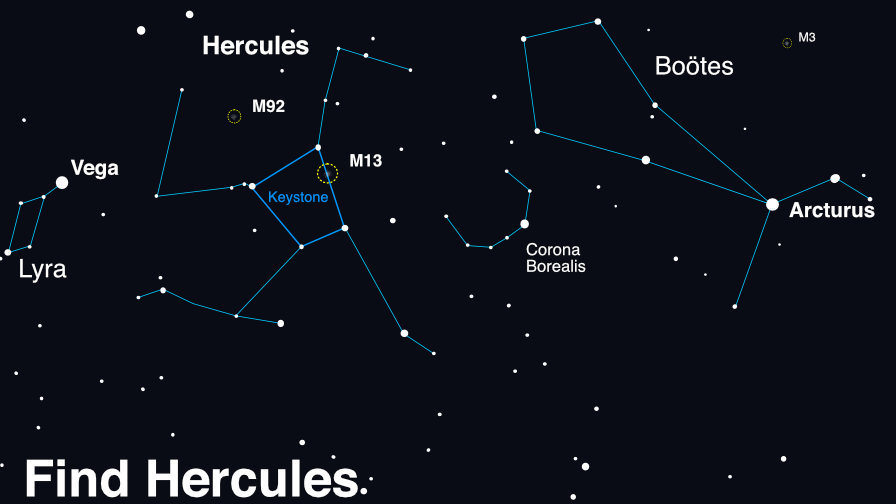
Here's a little more on how to find the location in the night sky. It'd be a nice idea to identify the stars of the Corona Borealis constellation for a while until a "new star" appears
The easiest way is to use Stellarium, set the local position and local time, search for the star (T CrB) and constellation, and go outside to locate them. It's fun :)
 
Last edited:
Hi guys,

Just came across this article tonight during my daily round up, and I thought it was a rather interesting one, there's a cosmic phenomena being expected sometime this year before September.

Around the world this summer, professional and amateur astronomers alike will be fixed on one small constellation deep in the night sky. But it’s not the seven stars of Corona Borealis, the “Northern Crown,” that have sparked such fascination.

It’s a dark spot among them where an impending nova event – so bright it will be visible on Earth with the naked eye – is poised to occur.

It’s a once-in-a-lifetime event that will create a lot of new astronomers out there, giving young people a cosmic event they can observe for themselves, ask their own questions, and collect their own data,” said Dr. Rebekah Hounsell, an assistant research scientist specializing in nova events at NASA’s Goddard Space Flight Center in Greenbelt, Maryland. “It’ll fuel the next generation of scientists.”

Finding T Coronae Borealis​

findhercules-nsn896.jpg


The first recorded sighting of the T CrB nova was more than 800 years ago, in autumn 1217, when a man named Burchard, abbot of Ursberg, Germany, noted his observance of “a faint star that for a time shone with great light.”

The T CrB nova was last seen from Earth in 1946. Its behavior over the past decade appears strikingly similar to observed behavior in a similar timeframe leading up to the 1946 eruption. If the pattern continues, some researchers say, the nova event could occur by September 2024.
 
novacyg093500952-print.jpg

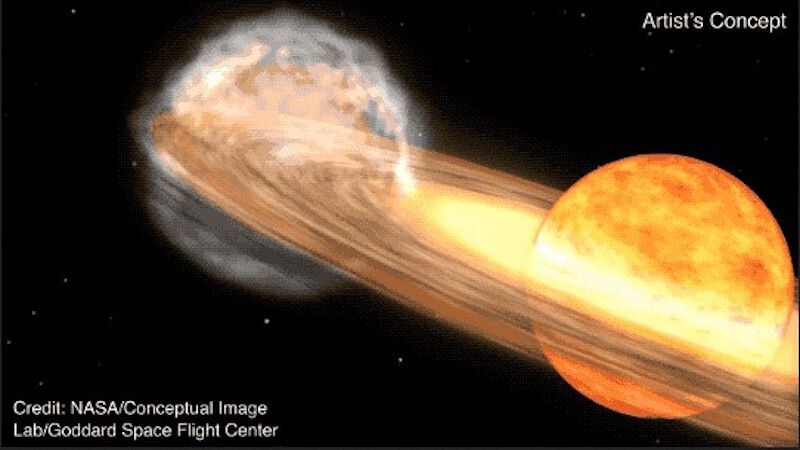
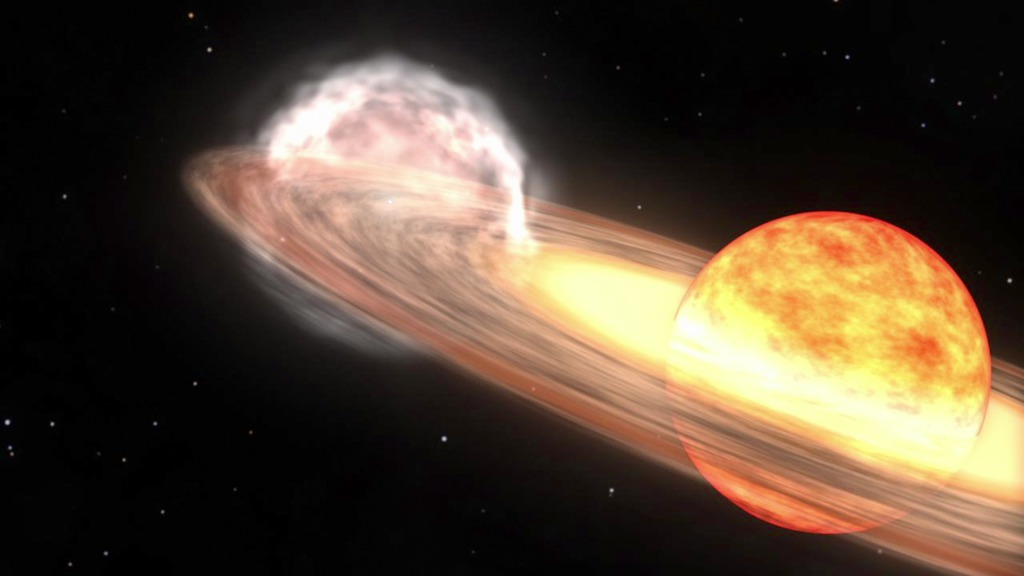
A red giant star and white dwarf orbit each other in this animation of a nova similar to T Coronae Borealis. The red giant is a large sphere in shades of red, orange, and white, with the side facing the white dwarf the lightest shades. The white dwarf is hidden in a bright glow of white and yellows, which represent an accretion disk around the star. A stream of material, shown as a diffuse cloud of red, flows from the red giant to the white dwarf. When the red giant moves behind the white dwarf, a nova explosion on the white dwarf ignites, creating a ball of ejected nova material shown in pale orange. After the fog of material clears, a small white spot remains, indicating that the white dwarf has survived the explosion.
NASA/Goddard Space Flight Center

I was reading the description from NASA. It reminds me about the twin sun hypothesis of our solar system.

Will it be similar to what will happen if the companion star comes closer to our sun? Our sun will discharge and send material to the companion star so that a nova event may happen at one point.

Then it should be quite visible🤔
 
i have been thinking about this event. i was watching a blokes patreon where he was talking about this event possibly co-insiding with an issue in the money system. I cant share the video as it was a patreon account. But the main jist was , the previous two recorded events of the T Coronae Borealis happening where February 9th 1946 and May 12 1866. 9th of Feb was the date Stalin gave a speech about the incompatibility of communisim and capatilism. Beginnings of the cold war. The following date, May 12, 1866 a large finanical panic in happened in london. His premise was that billionares use astrology when it comes to getting things happening and so his thesis was that this event could be another such event. Also pretty interesting given the market crash and the issues Japan are having. Will be interesting to see if a global event happens on the same day as the exploding star.
 
Here are couple of curious news items specifically about T Coronae Borealis nova and supernovas in general:

T Coronae Borealis nova shows significant changes in the spectrum!

Astronomers from the Carl Schwarzschild Observatory (Tautenburg, Germany) report that they have detected dramatic changes in the spectrum of the re-emerging new T Coronae Borealis nova.

Astronomers from the Karl Schwarzschild Observatory (Tautenburg, Germany) report (ATel #17030: A sudden increase of the accretion rate in T Coronae Borialis) that they have found dramatic changes in the spectrum of the recurrent new T of the Northern Corona, which is expected to flare in the next few years. It flares once every 80 years (1886 and 1946).

Previously, astronomers expected the flare to occur in 2024 (AstroAlert | Наблюдательная астрономия), but it did not. Back then, predictions were made based on changes in the brightness of the star.

Now we see that the emission lines have increased dramatically over the last month - this may indicate an increased temperature (40,000K) and an increased rate of gas falling from the donor star (red giant) to the white dwarf (or accretion disk).

It is impossible to say exactly when the T N Corona outburst will occur, but clearly it will happen in the next few months to years.

The animation shows a new model from NASA (NASA Scientific Visualization Studio | T Coronae Borealis Nova Animations) of what should happen during a T Coronae Borealis nova flare.

And this one is also very curious. A connection between supernovas and viruses:

Cosmic radiation from supernova altered virus evolution in Africa, study proposes​

Recent undergraduate student led research linking explosions of a star and of viruses on Earth

Isolated by mountains along the East African Rift is Lake Tanganyika. Over 400 miles long, it is the continent’s deepest lake and accounts for 16% of the world’s available freshwater. Between two and three million years ago, the number of virus species infecting fish in that immense lake exploded, and in a new study, UC Santa Cruz researchers propose that this explosion was perhaps triggered by the explosion of a distant star.

The new paper, led by recent undergraduate student Caitlyn Nojiri and co-authored by astronomy and astrophysics professor Enrico Ramirez-Ruiz and postdoctoral fellow Noémie Globus, examined iron isotopes to identify a 2.5 million-year-old supernova. The researchers connected this stellar explosion to a surge of radiation that pummeled Earth around the same time, and they assert that the blast was powerful enough to break the DNA of living creatures—possibly driving those viruses in Lake Tanganyika to mutate into new species. Their paper was published on January 15 in the journal Astrophysical Journal Letters.

“It's really cool to find ways in which these super distant things could impact our lives or the planet’s habitability,” said Nojiri (2024, physics [astrophysics], mathematical theory and computation).

From deep space to ocean floor

Their research started on the seafloor, where a radioactive form of iron produced by exploding stars is found. They aged the element, known as iron-60, by seeing how much of it had already broken down into nonradioactive forms. The iron-60 was actually of two different ages. Some formed 2.5 million years ago, while other atoms were 6.5 million years old.

They then sleuthed the origin of the iron by backtracking the past movements of celestial bodies. Right now, our solar system is in the middle of a massive patch of relatively open space called the Local Bubble. The Earth entered the bubble and passed through its stardust-rich exterior about 6.5 million years ago, which seeded the planet with the older iron-60. Then between 2 and 3 million years ago, one of our neighboring stars exploded with tremendous force, providing our planet with the other cohort of radioactive iron.

“The iron-60 is a way to trace back when the supernovae were occurring,” Nojiri said. From two to three million years ago, we think that a supernova happened nearby.”

Cosmic correlation to mutations

When Nojiri and colleagues simulated what that supernova was like, they found that it hammered the Earth with cosmic rays for 100,000 years following the blast. The model perfectly explained a previously recorded spike in radiation impacting Earth around that time, which had been puzzling astronomers for years.

“She was invited to give a CCAPP Seminar at Ohio State just after the paper came out,” said Ramirez-Ruiz, adding that Nojiri was the first UC Santa Cruz undergraduate to ever be invited to give a talk in that important venue.

Their supernova simulation raised other questions because its cosmic rays likely bombarded Earth with enough intensity to snap strands of DNA in half. “We saw from other papers that radiation can damage DNA,” Nojiri said. “That could be an accelerant for evolutionary changes or mutations in cells.”

Meanwhile, the authors came upon a study of virus diversity in one of Africa’s Rift Valley lakes. “We can't say that they are connected, but they have a similar timeframe,” Nojiri said. “We thought it was interesting that there was an increased diversification in the viruses.”
 
Back
Top Bottom