New Incandescent Bulbs More Efficient than LEDs?

Scottie said:
Normally, a 0.5 PF would mean a severe disbalance in the grid (say, if we're talking about an inductive or capacitive load). But an LED bulb at 0.5 PF is simply not using half the AC cycle, but otherwise it's prolly pretty close to a resistive load when it's conducting (i.e. lit up). If it's basically "off" or "mostly resistive", then is that really 0.5PF in the traditional sense? Which is why I don't understand the push for higher PF bulbs in the USA...

Answering myself:

Okay, if only half the AC cycle is used, then what happens with the other half? Nothing! That might be problematic - at least from an electric company's POV.

On the other hand, what if half the 0.5 PF bulbs used the "top half" of the AC waveform, and the other 50% of bulbs used the "bottom half"? On average, it would balance out. Maybe...

But from MY point of view, I only pay for power used, and the simpler design isn't generating all the extraneous noise / EMF.

But we still have the capacitive coupling issue, which is basically "unknown".
 
Now, hang on a minute... Why not just put a full wave bridge rectifier in an LED bulb?

100Hz (less human-visible flicker), PF = 1, no silly electronics...

Obviously, I'm missing something...
 
Refer to my last post. There needs to be something to lower the voltage for the LED. You could use a series resistor, but the resistor would be passing something like 115V 20mA (2.3W) and the LED would be something like 5V 20mA (0.1W). These are just guesses since I don't really know what a lighting LED takes for power, but the idea is true. The resistor would need to be physically large and would be wasting most of the power as heat.

Generally a power transformer is used to step down the voltage, but they are expensive chunks of iron and are not small enough to put in the base of an LED bulb.

I do know of one way the voltage could be lowered without wasting energy, perhaps it is already in use.

As for capacitive coupling, a plain rectifier LED bulb would hardly be any worse than an incandescent.

Power factor can be improved by using a full wave rectifier, and also how you design the rectifier.

That article was written in California I believe, so I think the bulbs he tested must have been from the US.
 
Even the cars with LEDs are starting to flicker: https://www.youtube.com/watch?v=AhpQSLac3HM
Pay attention at 00:57, 2:43, 3:09, 59:01.

Not to mention the flickering tablets that they all have inside today. Flicker, flicker, all around us. :/
 
Most LED bulbs today work off the (full wave) rectified AC. The raw DC is chopped at a pretty high frequency (50kHz and up) to be downconverted ("buck converter") and fed to a string of 10-30 individual LED chips. Incidentally the downconversion is regulated for current, not voltage. Coils and capacitors cause the resulting DC to be fairly flat, i.e. not flickering. When you turn the bulb off, there is a recognizable afterglow which tells you there is likely no flicker when in operation.


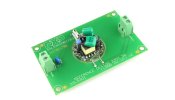
Here is a typical, practical circuitry. The central, round part is designed to fit inside a standard socket.

I am using OSRAM LED bulbs plus some cheap Chinese no-names. For reading I still use incandescent halogens however. What I wonder about is the light spectrum of typical LEDs. In fact, to compensate for the preponderance of blue in the native LED spectrum, they are covered with a mix of phosphors glowing yellow-orange. The mixing proportion determines the "temperature" of the light. So, the overall spectrum has two peaks, one blue and one yellow-orange.
One question is how long until the phosphors degrade, leaving only the blue peak.

On the subject of flicker, it is definitely perceivable in modern car taillights. I find it very annoying, and I wonder if it has any effect on people susceptible to epileptic seizures.
 

Attachments

  • SSL5301DB1183_Top.JPG
    SSL5301DB1183_Top.JPG
    764.8 KB · Views: 44
asino said:
Most LED bulbs today work off the (full wave) rectified AC. The raw DC is chopped at a pretty high frequency (50kHz and up) to be downconverted ("buck converter") and fed to a string of 10-30 individual LED chips. Incidentally the downconversion is regulated for current, not voltage. Coils and capacitors cause the resulting DC to be fairly flat, i.e. not flickering. When you turn the bulb off, there is a recognizable afterglow which tells you there is likely no flicker when in operation.

The afterglow has nothing to do with flicker, it is the afterglow of the phosphors that make a white LED white.

picture.php
 
rs said:
asino said:
...When you turn the bulb off, there is a recognizable afterglow which tells you there is likely no flicker when in operation.

The afterglow has nothing to do with flicker[...].

The afterglow has a lot to do with the absence of flicker in normal operation. That's what I meant to say.
Analogous to the incandescent bulb, where the thermal inertia of the filament smooths over the 50Hz valleys, i.e. the flicker.

Nice picture BTW, shows the difference between white LED and sunlight.
 
Thanks for the info Asino.

So then the phosphors could emit smooth light while the LED colors are actually flickering more?

I doubt anyone could perceive a 50KHz flickering LED, however if the buck converter output doesn't stay constant with input voltage, then there can still be 60Hz/120Hz flickering. I suspect this is the case because modern LED bulbs are designed to be compatible with light dimmers, and for this they must respond to voltage input somehow.

The app note for the Phillips LED driver:

http://www.nxp.com/documents/application_note/AN11533.pdf

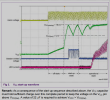
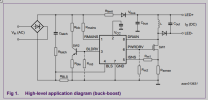
Attached are the schematic and a chart of the voltages/currents given in the app note. You can see that the LED current is not constant, it still flickers at 120Hz!!! With all their marvellous technology and design genius, NXP for some reason decided that their LEDs should flicker... That may be correctable by adding a capacitor.

Also, notice that there are no DC storage caps after the rectifier. This LED driver is intended to run at any input voltage, specifically in order to eliminate the need for one! It is also for power factor correction; the LED driver is intended to draw energy in phase and in proportion with the input voltage at all times, so by design it cannot have constant output.
 

Attachments

  • LED Driver Voltage graphs.png
    LED Driver Voltage graphs.png
    376.9 KB · Views: 60
  • NXP LED Driver schematic.png
    NXP LED Driver schematic.png
    42 KB · Views: 55
monotonic said:
Thanks for the info Asino.

So then the phosphors could emit smooth light while the LED colors are actually flickering more?

I doubt anyone could perceive a 50KHz flickering LED, however if the buck converter output doesn't stay constant with input voltage, then there can still be 60Hz/120Hz flickering. I suspect this is the case because modern LED bulbs are designed to be compatible with light dimmers, and for this they must respond to voltage input somehow.

The app note for the Phillips LED driver:

http://www.nxp.com/documents/application_note/AN11533.pdf

Attached are the schematic and a chart of the voltages/currents given in the app note. You can see that the LED current is not constant, it still flickers at 120Hz!!! With all their marvellous technology and design genius, NXP for some reason decided that their LEDs should flicker... That may be correctable by adding a capacitor.

Also, notice that there are no DC storage caps after the rectifier. This LED driver is intended to run at any input voltage, specifically in order to eliminate the need for one! It is also for power factor correction; the LED driver is intended to draw energy in phase and in proportion with the input voltage at all times, so by design it cannot have constant output.

Thanks monotonic. If anything, one can appreciate the effort put into designing such a chip. What at first looks like a no-brainer can become a real tour-de-force.
To your comments:

- notice that the voltage path after the FW rectifier has a first section without capacitors, then another labeled Vbus after R(limit) and the diode which does indeed have a cap, Cbus. Later there is Cout after the downconversion. That's why the dimmer sensing can still happen reliably in the first section, while the output is potentially flicker-free.
BTW the graphs are meant to show the startup phase, probably without the Cbus and Cout for clarity.

- the chip in question has several configuration options; one in particular described in chapter 7 of the application note from your link:

7.1 Operating principle for low ripple
In low ripple mode, a relatively large bus capacitor buffers the bus voltage. As a result,
there is always enough voltage present to make the converter switch and convert power
continuously. This voltage eliminates the time period in the mains cycle where the output
current must be buffered with a large output capacitor. So there is no ripple or very limited
ripple at 100 Hz or 120 Hz frequencies. So, a small output buffer capacitor can be used.
No modulation method in the mains frequency domain is superposed on the current
control loop.
a.k.a RTFDS! ;)

In conclusion, I wouldn't say that NXP decided that LEDs should flicker. They left that as an option to the bulb manufacturer.
All this is relative of course: there are dozens of manufacturers of such chips, with a variable mix of features and shortcomings.
 
Back
Top Bottom