New Mozart piano music discovered

Ellipse

The Living Force
FOTCM Member
BBC
23 July 2009 16:33 UK


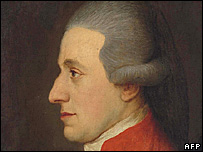
Two piano pieces have been identified as the work of Wolfgang Amadeus Mozart, experts in the Austrian city of Salzburg say.
_44497639_mozart_afp203b.jpg


The compositions have long been in the possession of the International Mozarteum Foundation in the city, the organisation said.

Few details are being released until an official presentation in a week's time.

In January, a piece by Mozart which had lain undiscovered in a French library for years, had its first performance.

Prolific

A spokeswoman for the Mozarteum Foundation said full details of the most recently identified works would only be made public on 2 August.

She said the music would be performed on Mozart's original fortepiano.

Mozart left more than 600 known pieces of music before his death in 1791 at the age of 35.

He had begun composing at the age of five and his works include operas, chamber music, choral pieces and piano concertos.

The two-minute-long piece performed in public in January for the first time was played by violinist Daniel Cuiller before a small audience in Nantes, western France.

The sheet music had been found by staff at the city's library, and authenticated as the work of Mozart in September 2008.


http://news.bbc.co.uk/2/hi/entertainment/arts_and_culture/8165645.stm
 
Thanks for posting that Ellipse. I was unaware of that and I consider myself a Mozart fan!


Dr Ulrich Leisinger from the Mozarteum University in Salzburg, who authenticated the score, said it was an important discovery.

"The first four lines constitute a whole piece, and that's what is interesting.
The second portion seems unfinished and rushed according to specialists.

"There are three lines of music missing," Dr Leisinger said. "You can see traces of it, but we don't know where the missing part is today."

The two-minute-long piece performed in public in January for the first time was played by violinist Daniel Cuiller before a small audience in Nantes, western France.
Source: _http://news.bbc.co.uk/2/hi/entertainment/arts_and_culture/7845752.stm


A little extra info for the possible interest value:

Mozart was born when music was taking a turn from the sudden changes in style and trills of Baroque music to the simple, balanced, and non-emotional form[1].

Also during this period, the modern symphony orchestra is born and for the first time, instrumental music was more important than vocal music[2].

The Mozart effect helps you study:[3]

In 1998 the Journal of Neurological Research reported that Mozart piano sonatas played to rats for weeks before and after birth significantly improved their maze-solving abilities.

Whether that idea is valid or not, as for myself, I find that listening to Mozart's Piano concerto no.21 induces a mental state that somehow seems better for studying. I recommend anyone to try it at least once.

Mozart's Piano concerto no.21:
_http://www.youtube.com/watch?v=df-eLzao63I


--------------------------------------------------------
[1]
_http://www.hypermusic.ca/hist/classical.html
[2]
The classical symphony is renowned for its rigid structure, harmonic relationships, orchestration, and balance.
Vocal music in the Classical period was centered in opera. Two styles of opera continued to be developed during this period: opera seria and opera buffa. Opera buffa became much more popular during this period due to Mozart's contribution to this style
_http://classicalmusic.about.com/od/classicalperiod/Classical_Period_Music_from_1750_to_1820.htm
[3]
The Mozart effect refers to a set of research results that indicate that listening to Mozart's music may induce a short-term improvement on the performance of certain kinds of mental tasks known as "spatial-temporal reasoning (which is the ability to visualize spatial patterns and mentally manipulate them over a time-ordered sequence of spatial transformations).
This ability is important for generating and conceptualizing solutions to multi-step problems that arise in areas such as architecture, engineering, science, mathematics, art, games, and everyday life.
_http://en.wikipedia.org/wiki/Spatial-temporal_reasoning
_http://en.wikipedia.org/wiki/Mozart_effect
Also:
William Pryse-Phillips (2003). Companion to Clinical Neurology. Oxford University Press. ISBN 0195159381. , p. 611 defines the term as "Slight and transient improvement in spational[sic] reasoning skills detected in normal subjects as a result of exposure to the music of Mozart, specifically his sonata for two pianos (K448)."
 
What was also interesting about Mozart was there was
an episode (PBS Nature?) that when they "sang", and
it was slowed down, sounded like a Mozart or Bach
musical piece. Blew me away - "the birds invented
music first) or so they say. Is it also said by some
that music is mathematically related as demonstrated
by musical savants?

Did the C's say anything about "The Language of the Birds"?
If so, could it also mean: "The Language of the Gods" which
is also related to Mathematics?
 
Here's a link whera you can listen the two pieces: _http://www.rue89.com/droles-de-gammes/2009/08/02/ecoutez-les-deux-singles-que-mozart-vient-de-sortir

Pieces was written when Mozart was 7/8.
 
Thank you, Ellipse. I checked out the music.

Also, this is what I gathered from the site:

It is supposed that at the time this music was written, Mozart was too young to write the music that he composed, so his father did the notations. The piece titled 'Prelude' and the concert movement, “Molto Allegro”, seems to be the first movement of a Concerto for harpsichord and orchestra in G major, of which only the parts of the harpsichord are noted.

The pianist Robert D. Levin will compose an orchestral accompaniment for this part which will be played in January 2010 in Salzburg.

The works had been kept at the end of the “Book of music of Nannerl” (Wolfgang's sister), which was made/kept by their father for the children's 'pianistic education'.
Neither piece had an author's name, and both were previously regarded as anonymities until the Mozarteum University identified them as being of a very young Mozart.


I must admit I find myself curious as to how these short musical pieces were authenticated as the work of (Wolfgang) Mozart when Nannerl was, apparantly, no less talented.[1]


------------------------------------
[1]
In the shadow of her famous sibling, Wolfgang Amadeus Mozart, older sister Nannerl was perhaps no less talented but devoid of the opportunities of the time because of her sex and a controlling parent. At least this is the argument presented in this historical novel by Moser, author of numerous inspirational novels, including the Sister Circle series. As told by Nannerl in the first person, a demanding father channels his love and energies into his young son. Although Nannerl performs, her father denies her a chance at fame—and perhaps more important, the lion's share of his attention and love. He relentlessly tours Europe with his children, lying about their ages to make them seem like younger prodigies and exploiting them for large sums of money. Nannerl adores her father, but as she ages from a young adolescent into a woman, she seems numbingly resigned to a life of disappointment and frustration. As she moves into adulthood, more unhappy events occur, which are not quite satisfactorily developed in the novel's latter half. Moser's writing is smooth, and there are some fascinating historical details, but the story loses steam toward the end.
Source: From Publishers Weekly, an Editorial Review of the book: Mozart's Sister by Nancy Moser (Bethany House Publishers, September 2006)
_http://www.amazon.com/Mozarts-Sister-Nancy-Moser/dp/0764201239
 
Back
Top Bottom