Strange ice crystal formations in the fridge

Mark7

The Living Force
FOTCM Member
There was a bit of a side discussion on this important session post - http://cassiopaea.org/forum/index.php?topic=21918.420 about strong static electric effects. I had posted this in regard to some ice crystals forming in the ice cube trays in our fridge:

Mark said:
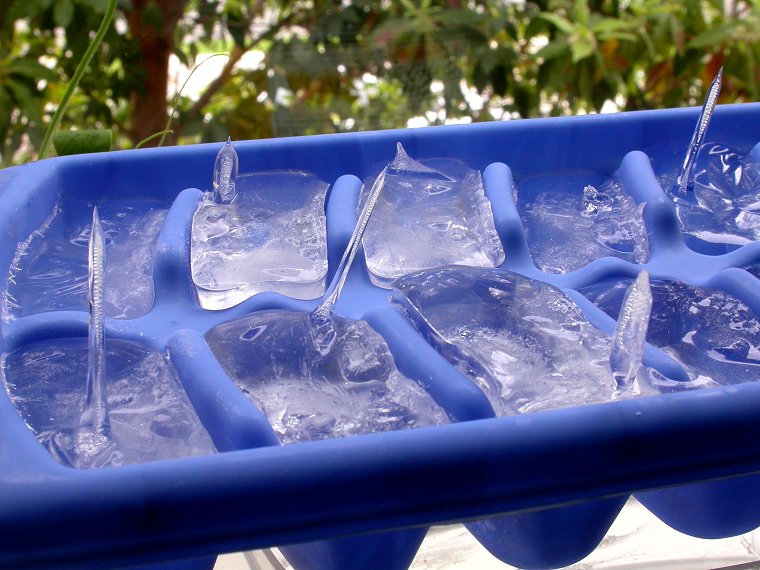
Seems like a lot of forum members are experiencing static-electric effects/shocks. I have noticed something a bit strange myself. 1" to 1.5" long, 2mm to about 6mm wide, tapering ice crystals are forming in the ice cube trays in the refrigerator. They grow out at all angles and don't appear every time. Sometimes there are one or two crystals and sometimes 8 or 10.

I have never seen this happen in this refrigerator until recently, (last few months), and I have never seen this happen in any other refrigerator before. It looks really strange.

May be something related to more electrostatic charged air and/or other changes in the atmosphere, or may be nothing, not sure, fwiw.

I have not had a "crop" of these form lately but I did manage to get a snapshot of this critter:

oksry8.jpg


Previous crystals, (all of them are amorphous), where basic spike shapes but this one decided to be different.

My guess is this is how freezing water behaves in a static field in low humidity conditions, with maybe an AC signal of some sort on top, and/or a magnetic field. These could all be generated as by products of the fridge/compressor action. A refrigerator is a grounded metal box so I'm not sure how external static electric, or other effects could contribute to these ice formations.

Kind of an interesting ice cube though. One forum member mentioned that this was happening in their fridge as well, and another asked that I post a picture so here it is.

Am I close as to what is causing this? By the time I got the tray out of the fridge and snapped the picture the tip of the thing was already melting, thus the drop of water on the end, but the thin "spike" was still at least about an inch or more in length when the picture was taken.

[edit: spelling]
 
Your guesstimate on the process involved makes sense at first think-through to me, but these days with so much change flooding through the world, who can say? Like you, I've never seen anything like that before, and with the ubiquity of freezer ice trays, you'd think we would have come across this kind of phenomenon before now. (. . ?)

Either way, the sci-geek in me is crying, "Ohhhh! That is SO cool!"

:)
 
Woodsman said:
Your guesstimate on the process involved makes sense at first think-through to me, but these days with so much change flooding through the world, who can say? Like you, I've never seen anything like that before, and with the ubiquity of freezer ice trays, you'd think we would have come across this kind of phenomenon before now. (. . ?)

Either way, the sci-geek in me is crying, "Ohhhh! That is SO cool!"

:)

That's why I asked for pic's ;D But seriously, I've never seen or heard of such before now... Could we have a pic in situ next time?
 
Hey Mark, were your critters similar to these? :)

multspikes.jpg

http://www.its.caltech.edu/~atomic/snowcrystals/icespikes/icespikes.htm
(visit the website for more pictures and links)

What are Ice Spikes?
Ice spikes are odd ice structures that occasionally grow out of ice cube trays. Unlike some of the strange things you might find growing in your refrigerator, ice spikes are made of nothing but ice. Ice spikes are the result of physics, not biology.
Here are some pictures I took of ice spikes that grew in my kitchen freezer. They look a lot like the limestone stalagmites found in caves, although there was no water dripping inside my freezer when these formed.
To see your own ice spikes, make ice cubes in an ordinary ice cube tray, in an ordinary household freezer, but using distilled water, which you can buy in most supermarkets for about a dollar a gallon. We've tried several different freezers, and almost always got some ice spikes to grow.

How do Ice Spikes Form?
Ice spikes grow as the water in an ice cube tray turns to ice. The water first freezes on the top surface, around the edges of what will become the ice cube. The ice slowly freezes in from the edges, until just a small hole is left unfrozen in the surface. At the same time, while the surface is freezing, more ice starts to form around the sides of the cube.
Since ice expands as it freezes, the ice freezing below the surface starts to push water up through the hole in the surface ice (see diagram). If the conditions are just right, then water will be forced out of the hole in the ice and it will freeze into an ice spike, a bit like lava pouring out of a hole in the ground to makes a volcano. But water does not flow down the sides of a thin spike, so in that way it is different from a volcano. Rather, the water freezes around the rim of the tube, and thus adds to its length. The spike can continue growing taller until all the water freezes, cutting off the supply, or until the tube freezes shut. The tallest spike we've seen growing in an ordinary ice cube tray was 56mm (2.2in) long.

Why Distilled Water?
Most ice cube trays produce a few spikes, but usually only if distilled water is used. Millions of people make ice cubes every day using ordinary tap water, and most don't see ice spikes. Oddly enough, some people often get plenty of ice spikes using ordinary tap water, but this appears to be rare.

I have some ideas about why distilled water might make ice spikes more readily than tap water, but so far I cannot explain why some tap waters make copious ice spikes. We measured the probability of ice spike formation as a function of salt (NaCl) concentration in distilled water, at a fixed temperature of -7C, which is shown in the graph at right. Very little salt is needed to kill the ice spikes. All tap waters contain relatively high concentrations of various mineral salts, so apparently different impurities have different effects on ice spike formation.

What Else Matters?
Temperature is certainly a factor when growing ice spikes, and we have done experiments that show that spikes are more likely to form when the temperature is just below freezing (see the graphs below). I'm not entirely sure why this is so, but I suspect that the ice tube freezes shut before the tube gets very long if the temperature is too low. So, if your ice cream is really hard, your freezer is too cold to make lots of ice spikes.
We've also found that ice spikes form more readily if we install a fan that blows the air in the freezer around. This is probably because the moving air provides some evaporative cooling that makes the top of the ice spike freeze more readily, so the tube can develop further before it freezes shut. At the optimum temperature, and with air blowing over the freezing ice, about half the cubes in an ice cube tray will develop ice spikes.
You can read more about the scientific side of ice spikes in our preprint (.pdf file).

The graphs on this page were produced by Kevin Lui (right), a undergraduate student at Caltech who spent a summer growing thousands of ice cubes to investigate the physics behind ice spike formation.

I was first introduced to the ice spike phenomenon by John Cooper, although a number of additional "sightings" have been posted at various times on the web, such as here and here. Click here for another informative ice spikes page from the University of Toronto.
 
Possibility of Being said:
Hey Mark, were your critters similar to these?

Yes! that's them.

the spike is hollow... so the droplet on my spike is the result of water pressing through. Wow!
So static electricity may not be involved... hmmm. Thanks for the post and link PoB.

I wonder what other forms these spikes may take on under different conditions.
 
Mark said:
I wonder what other forms these spikes may take on under different conditions.

If you follow the link in my previous post, you'll be directed to other sites and pictures. Among others, there is a gallery of images from New Scientist magazine:
http://www.newscientist.com/gallery/dn16404-ice-spikes

I personally find these pics interesting:

john-hough.jpg


tim-jones-1.jpg


The latter (or a very similar one) you can see on a video: http://www.youtube.com/watch?v=8thpORxDwWE

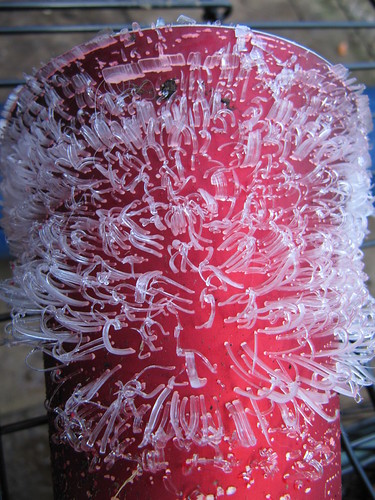
The most amazing though, I found on Flickr:

4385800190_770ce58fd8.jpg


(high resolution here)

From the description:
Ice on a plantpot. Never seen anything like it, have you? It's made from plaster and has been outside for months and these crystals had formed where there were chips in the paint and the plaster was exposed.

:)
 
Woodsman said:
Your guesstimate on the process involved makes sense at first think-through to me, but these days with so much change flooding through the world, who can say? Like you, I've never seen anything like that before, and with the ubiquity of freezer ice trays, you'd think we would have come across this kind of phenomenon before now. (. . ?)

Either way, the sci-geek in me is crying, "Ohhhh! That is SO cool!"

My guess was off, I did learn something though. It was actually a growing tube of ice forming with liquid water flowing through the middle, driven by the expansion of the freezing water.

... but it is cool. :)


Possibility of Being said:
I personally find these pics interesting:

Thanks for the pictures. The second one struck me with it's symmetry - it almost looks manufactured. It does look like different conditions create different formations.
 
Back
Top Bottom