Strange 'planet' in Sacramento Sky Jan 23rd 2014

There were many ancient reports of Venus appearing "horned" but how it would have been seen, I don't know. I do think it is Venus because of apparent time and direction (the sun has apparently set in that direction recently). Perhaps it appears horned due to atmospheric factors.
 
Perceval said:
Caught this video, can't find any other reference to the story. Anyone have any ideas?


I dunno what exactly it is, but it seems to be the real deal and no hoax.

Here is the actual source:

_http://www.kcra.com/weather/What-s-in-the-Sacramento-sky-It-s-not-the-moon/-/11798922/24073154/-/xg9u0rz/-/index.html
_http://www.kcra.com/weather/whats-in-the-sacramento-sky-its-not-the-moon/-/11798922/24073322/-/121yrcx/-/index.html

Edit:

In the comment section we can read:

It's the planet Venus, it is the only thing in the sky apart from the moon and Mercury (which is much smaller and currently only visible in the evening) which shows a phase like this.

I don't know enough to say one way or the other, but I tend to think that the commenter above may be right.

Look here:
http://en.wikipedia.org/wiki/Phases_of_Venus
 
In the video they say the Sun is coming up so it's very likely to be Venus.
 
mkrnhr said:
In the video they say the Sun is coming up so it's very likely to be Venus.

I didn't realize that Venus has switched from evening star to morning star. So since it has, I, too, think that this is Venus.
 
Nienna said:
mkrnhr said:
In the video they say the Sun is coming up so it's very likely to be Venus.

I didn't realize that Venus has switched from evening star to morning star. So since it has, I, too, think that this is Venus.

Venus has been named as both the "Morning Star' and the "Evening Star."

[quote author=Wikipedia]Venus "overtakes" the Earth every 584 days as it orbits the Sun.[2] As it does so, it changes from the "Evening Star", visible after sunset, to the "Morning Star", visible before sunrise[/quote]
 
Jerry said:
Nienna said:
mkrnhr said:
In the video they say the Sun is coming up so it's very likely to be Venus.

I didn't realize that Venus has switched from evening star to morning star. So since it has, I, too, think that this is Venus.

Venus has been named as both the "Morning Star' and the "Evening Star."

Yes, I'm aware of this that's why I used those terms, I just hadn't realized that it had done its switching from evening star to morning star.
 
So if it's Venus, how to explain the apparent partial eclipse of it?
 
Perceval said:
So if it's Venus, how to explain the apparent partial eclipse of it?

As I understand it, it's not an eclipse; that's like a horny phase of the Moon. Depends on the angle between Earth, Venus and Sun: which half of the planet is bright vs. which its side is facing us.

Added:
Wikipedia, Phases of Venus
http://en.wikipedia.org/wiki/Phases_of_Venus
 
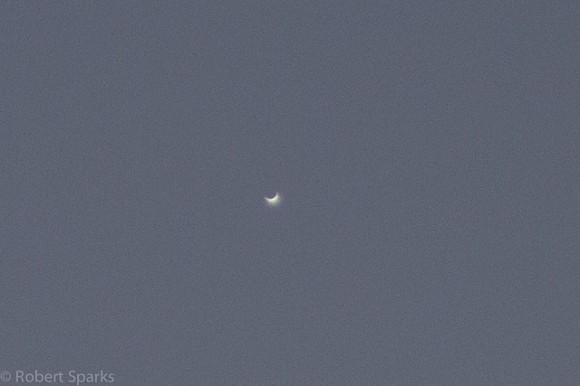
This picture is captioned as Crescent Venus on Dec. 31, 2013, seen from Arizona (link):

venus-sparks-580x386.jpg


And this is a video called Crescent Venus published on Jan 24, 2014: link.

They are similar to the image on the video posted by Perceval, but way thinner and the "horns" are oriented differently. I wouldn't know how to explain, for instance, the difference between Perceval's video and the one I linked above given that they were published almost on the same date (Jan 23 and 24).
 
Fwiw, my friend and I saw Venus yesterday in the SSE in the eleven o'clock position a half hour after sunrise.
No crescent though.
 
This might explain it, although the video report is from the 23rd Jan. while the article and image below is from the 2nd Jan.

_http://www.planetary.org/blogs/emily-lakdawalla/2014/01021305-two-crescents-new-moon-old-venus.html

In the western sky, a brand-new Moon has risen past a switfly plunging Venus crescent, making for some really beautiful sunset photos of the two thin crescents together.

Venus has been a brilliant beacon in the western sky for a while now; it's approaching Earth on the inside track of its race around the Sun, so even though its crescent is waning, its bright clouds still reflect sunshine brilliantly for a couple more days. But it'll be at inferior conjunction (essentially, between us and the Sun) on January 11, so by the end of the month will be a brilliant morning star.

PAil-VARADI-NAGY-20140102_hold_venusz_egyuttallas_hold_es_venusz_meret_canon1100d_fujival_montazs_1388685237_lg.jpg
 
I find it interesting that Venus has been appearing in a kind of upward facing crescent manner during her morning star phase.

I keep up with astrology and this discussion reminded me of the following article regarding the current Venus Retrograde which ends on the 31st:

"The Venus retrograde period lasts from December 21 2013 until January 31 2014. This is usually about forty days and forty nights. Forty is mentioned in the bible often, but most famously when Jesus was tempted by Satan in the wilderness for forty days. Could this be referring to the astrological phenomena of Venus retrograde? After all, Venus has two sides to her. She is the goddess of love and war according to the Babylonians. The word Lucifer (which is often confused with Satan) means light-bringer and refers to Venus in her morning star phase. The ancients said the first few days of her Lucifer phase was a particularly dangerous time. People born with Venus as a morning star are said to rush headlong into love affairs and are very passionate. Venus as an evening star is has more of the receptive, traditional meaning."

_http://darkstarastrology.com/venus-retrograde-2013/

:cool2:
 
I looked at Venus this morning. It was close to the moon. Both seem to be in a crescent phase as they are in a position at an angle to the rising sun leaving the part that is facing away from the sun, to be dark.

Of course, I could not see Venus as a crescent, as I do not have a telescope, but it makes sense that it would have that shape in the position it is in with relation to the sun.
 
Back
Top Bottom