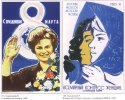
March 8th is celebrated as the International Women's Day and was adopted by the UN in 1975.
It began in the US with labour protests by women on different occasions and then a National Women's Day was institutet in 1909. Source _https://iwd.uchicago.edu/page/international-womens-day-history
In August 1910 during the Second International Socialist Women's Conference in Copenhagen
https://en.wikipedia.org/wiki/International_Socialist_Women%27s_Conferences#Copenhagen_1910
It was proposed by the Luise Zietz from Germany
_https://en.wikipedia.org/wiki/Luise_Zietz partly inspired by the American examples to organize a yearly international day of action. The proposal was supported by Clara Zetkin
_https://en.wikipedia.org/wiki/Clara_Zetkin _https://sv.wikipedia.org/wiki/Clara_Zetkin (In Swedish)_https://ru.wikipedia.org/wiki/Цеткин,_Клара (In Russian)
The biographies for Clara Zetkin varywith the Swedish having a Wiki silver star for quality. Other sources are
_http://socialistworker.org/2014/03/07/clara-zetkin-and-socialism
_http://p-i-f.livejournal.com/6536997.html
As one can read from the different renderings several credit Clara Zetkin rather than Luise Zietz with the idea.
Zetkin was a name Clara received through her husband Osip Zetkin _https://ru.wikipedia.org/wiki/Цеткин,_Осип (There are no sites in English and the Russian Wiki is the best). Osip Zetkin was a Russian revolutionary born in Northern Ukraine in a family of Jewish business people from Odessa.
To give an idea of the environment these people lived in there is:
The first demonstrations or celebrations in connections with the International Womens Day occured in March of 1911 in Austria (then the Austro-Hungarian Empire), Denmark, Germany, Switzerland. There were 1 million people, and it must have taken a lot of organisational talent to achieve at that time.
The first demonstrations relating to the International Women's Day in Russia occured in March of 1913. Later it became a National Holiday in 1918 and in the USSR, a day off in 1965.
Perhaps one reason that it became a really big day, was that the demonstrations on 23rd of February 1917 (after the Orthodox calender; March 8th after the present), led to the February revolution in Russia, which was later followed by the October revolution half a year later. In fact a few days after the February demonstration, the Tzar Nicholas II stepped down. Source: _https://www.timeanddate.com/holidays/russia/women-day]
One can read about the events on February 23rd/March 8th 1917 here: _https://www.rt.com/news/379830-1917-russian-revolution-begins/ It looks like a virtual travel back in time reporting, but one can find other descriptions of what happened.
On the 8th of March in Russia President has a message:
About other apects:
While writing this post I came across a page written by a theologian belonging to the Old Believers. Old Believers are groups of Orthodox Christians who opposed the church reforms in Russia in 17th century _https://orthodoxwiki.org/Old_Believers
The priest from the Old Believers has an interesting presention of the Womens International Day _http://starove.ru/news/ne-detskoe-8-marta-tsetkin-lyuksemburg-krylatyj-eros-i-revolyutsiya/ Including photos and old posters, he also has some comment from his station as a priest, but I won't get into that.
Some of the pages I visited to check and compare the presentation of the priest gave more details on Clara Zetkin and her friend and comrade, Rosa Luxembourg, a Polish Jew who later obtained German citizenship.
If Clara prooved a excellent gambler at 60 and a fiery speaker at 75, in her young days she earned the name Wild Clara among fellow revolutionaries for the way she argued for revolution. Source: _http://www.eg.ru/daily/politics/24401/ (In Russian)
Here is one more thread that can be followed from reading the article by the Old Believer:
The Workers opposition occured around 1922 according to _https://en.wikipedia.org/wiki/Alexander_Shlyapnikov, so I don't understand how this fits with her being a leader in the Down with Shame movement (_https://ru.wikipedia.org/wiki/Долой_стыд_(общество) only Russian) which we come to next, also since some claim she was sent to Norway, to hold the office of ambassador in 1923 following the dissolution of the Worker's Opposition.
Finally a last story that shows her as a builder of bridges between people:
Trying to gain an understanding of the background for the celebration of the International Womens Day, the 8th of March turned out to be a longer post than expected, and there is more one could say. The pictures of the posters are from _http://starove.ru/wp-content/uploads/2015/03/STAROVE.RU_collection_8-march-ussr08HQ.jpg and _http://starove.ru/wp-content/uploads/2015/03/STAROVE.RU_collection_8-march-ussr-1963.jpg The first one carries the word peace in different languages. The last one reads, in Russian (red) and English (black): "If not I and and not you, then who"? In the background there are some bombs with a red cross. My guess is that women are encouraged to act to preserve peace. This was during the cold war in 1963. It expresses some of the ugency and fear some people were experiencing, living under all these nuclear test bombs being exploding sending clouds of radioactive dust into the atmosphere. If you like to see pictures that are modern try for Russian "открытки Международный женский день" or for English just "greeting cards international womens day".
It began in the US with labour protests by women on different occasions and then a National Women's Day was institutet in 1909. Source _https://iwd.uchicago.edu/page/international-womens-day-history
In August 1910 during the Second International Socialist Women's Conference in Copenhagen
https://en.wikipedia.org/wiki/International_Socialist_Women%27s_Conferences#Copenhagen_1910
It was proposed by the Luise Zietz from Germany
_https://en.wikipedia.org/wiki/Luise_Zietz partly inspired by the American examples to organize a yearly international day of action. The proposal was supported by Clara Zetkin
_https://en.wikipedia.org/wiki/Clara_Zetkin _https://sv.wikipedia.org/wiki/Clara_Zetkin (In Swedish)_https://ru.wikipedia.org/wiki/Цеткин,_Клара (In Russian)
The biographies for Clara Zetkin varywith the Swedish having a Wiki silver star for quality. Other sources are
_http://socialistworker.org/2014/03/07/clara-zetkin-and-socialism
_http://p-i-f.livejournal.com/6536997.html
As one can read from the different renderings several credit Clara Zetkin rather than Luise Zietz with the idea.
Zetkin was a name Clara received through her husband Osip Zetkin _https://ru.wikipedia.org/wiki/Цеткин,_Осип (There are no sites in English and the Russian Wiki is the best). Osip Zetkin was a Russian revolutionary born in Northern Ukraine in a family of Jewish business people from Odessa.
To give an idea of the environment these people lived in there is:
_https://ru.wikipedia.org/wiki/Цеткин said:In Paris a young family often changed demountable apartments, without the opportunity regularly to pay for housing and earning temporary jobs: Osip published articles and notes in Newspapers of the left orientation, making translations and teaching foreign languages, and Clara gave private lessons and was washing the clothes of wealthy families. But most of the time Zecchini family lived in a tiny apartment in Montmartre. There were born their two sons, Maxim (in 1883) and Constantine (in 1885).
The first demonstrations or celebrations in connections with the International Womens Day occured in March of 1911 in Austria (then the Austro-Hungarian Empire), Denmark, Germany, Switzerland. There were 1 million people, and it must have taken a lot of organisational talent to achieve at that time.
The first demonstrations relating to the International Women's Day in Russia occured in March of 1913. Later it became a National Holiday in 1918 and in the USSR, a day off in 1965.
Perhaps one reason that it became a really big day, was that the demonstrations on 23rd of February 1917 (after the Orthodox calender; March 8th after the present), led to the February revolution in Russia, which was later followed by the October revolution half a year later. In fact a few days after the February demonstration, the Tzar Nicholas II stepped down. Source: _https://www.timeanddate.com/holidays/russia/women-day]
One can read about the events on February 23rd/March 8th 1917 here: _https://www.rt.com/news/379830-1917-russian-revolution-begins/ It looks like a virtual travel back in time reporting, but one can find other descriptions of what happened.
On the 8th of March in Russia President has a message:
Some phrases used in Russia in connection with the 8th of March: _http://masterrussian.com/russianculture/womens_day_march8.htmhttps://russian.rt.com/russia/news/365970-putin-pozdravil-8-marta said:In his congratulatory message, the Russian leader quoted the silver age poet Konstantin Balmont.
"Dear women of Russia: mothers, grandmothers, daughters, wives, girlfriends, loved ones and most favorite — please accept my sincere congratulations with International women's day. You fill this world with its beauty and vitality, his warm tenderness and generosity, creating an atmosphere of comfort, cordiality and harmony", — said Putin.
According to him, very vividly and accurately about the woman told silver age poet Konstantin Balmont: "a Woman with us when we are born, a Woman with us in our last hour. The woman — the banner, when we fight, the Woman — the joy of opened eyes."
Putin stressed that women and men have found inspiration and consolation. However, women need male support.
"We'll keep that in mind. And not only today", — said the Russian leader.
[...]
About other apects:
_https://www.timeanddate.com/holidays/russia/women-day said:Symbols
Spring flowers, especially tulips and lilies of the valley, and images of a mother with a child are the most common symbols of International Women’s Day in Russia. These symbols often appear on postcards that men traditionally give women on March 8.
While writing this post I came across a page written by a theologian belonging to the Old Believers. Old Believers are groups of Orthodox Christians who opposed the church reforms in Russia in 17th century _https://orthodoxwiki.org/Old_Believers
The priest from the Old Believers has an interesting presention of the Womens International Day _http://starove.ru/news/ne-detskoe-8-marta-tsetkin-lyuksemburg-krylatyj-eros-i-revolyutsiya/ Including photos and old posters, he also has some comment from his station as a priest, but I won't get into that.
Some of the pages I visited to check and compare the presentation of the priest gave more details on Clara Zetkin and her friend and comrade, Rosa Luxembourg, a Polish Jew who later obtained German citizenship.
These gamblers did not know that although this dressed up man was around 60 years old, he was a highly gifted person.Julia Bakeeva quoted on _http://wesservic.livejournal.com/4213721.html said:[...]
Clara Zetkin and Rosa Luxemburg renewed their friendship many years later, when both once again became lonely and decided to devote themselves to politics. Once they read the work of a young Marxist Vladimir Ulyanov, who hit them. The ladies wanted to meet him personally and went to Petersburg. But on the way they had been robbed. Not knowing what to do next, they went to an inn, where they saw men playing cards.
Clara played cards and decided to make some money. But men only made fun of her, saying that the Indian case is to bear children and to milk the cows. All night ideological fellow member, the indignant male chauvinism, reshapes found a man's suit and made from trimmed Roses [Comment: A bit of Hair from Rosa Luxembourg?] curl moustache and sideburns.
The next day Clara disguised as a man, defeated the gamblers to very large for those times the sum — 1200 rubles. Women easily reached St. Petersburg, met with Ulyanov and since then often been to Russia.
Finally, Clara Zetkin resisted Nazism - persistently even when she was 75 years old:_http://p-i-f.livejournal.com/6536997.html said:Clara from childhood demonstrated a thirst for knowledge and an excellent memory, which further enabled her to study for free at a private teaching school in Leipzig.
Do I need to mention that after the collapse of the USSR many street in Ukraine that had previously been named after Zetkin were renamed! You can find the list in the Russian wikipages about Clara Zetkin. True it happened elsewhere in the former USSR too, but Ukraine stands out, especially considering that Clara's husband after whom she took her name was a Ukrainian Jew or was it because of that?_http://p-i-f.livejournal.com/6536997.html said:In July 1932, when the early elections to the Reichstag the national socialists won the majority in the Parliament of Germany, Clara Zetkin was in Moscow. As the oldest Deputy of the Reichstag, she had the right to open the first session of a new Parliament and, despite poor health, she went to Berlin, where she made a fiery speech about the dangers of Nazism and called for the creation of a unified anti-fascist front. After left-wing parties in Germany was banned, Zetkin went into her last exile, this time to the Soviet Union.
[...]
Died Clara Zetkin 20 June 1933 in Moscow Archangel at the age of 76 years. In the funeral ceremony of the German revolutionaries was attended by 600 thousand people. Zetkin's ashes were placed in an urn in the Kremlin wall on red square in Moscow.
If Clara prooved a excellent gambler at 60 and a fiery speaker at 75, in her young days she earned the name Wild Clara among fellow revolutionaries for the way she argued for revolution. Source: _http://www.eg.ru/daily/politics/24401/ (In Russian)
Here is one more thread that can be followed from reading the article by the Old Believer:
Clara Zetkin has already been covered, but who as Alexandra Kollontai?_http://starove.ru/news/ne-detskoe-8-marta-tsetkin-lyuksemburg-krylatyj-eros-i-revolyutsiya/ said:The main initiators of the celebration of "international women's day" in Bolshevik Russia was immortalized in street names in many cities Clara Zetkin and Alexandra Kollontai. They repeatedly persuaded Lenin to make March 8 an official Communist holiday.
One may wonder if the opinion of Kollontai was completely independent of the opinion of Rosa Luxembourg, although hers was expressed before:_https://en.wikipedia.org/wiki/Alexandra_Kollontai said:Alexandra Mikhailovna Domontovich was born on March 31 [O.S. March 19]1872 in St. Petersburg. Her father, General Mikhail Alekseevich Domontovich, descended from a Ukrainian Cossack family that traced its ancestry back to the 13th century.[1]
[...]
Alexandra's mother, Alexandra Androvna Masalina-Mravinskaya,[a] the daughter of a Finnish peasant who had made a fortune selling wood, obtained a divorce from an unhappy arranged first marriage so that she could marry Domontovich, with whom she had fallen in love.[2]
[...]
Alexandra was a good student growing up, sharing her father's interest in history, and mastering a range of languages. She spoke French with her mother and sisters, English with her nanny, Finnish with the peasants at a family estate inherited from her maternal grandfather in Kuusa (in Muolaa, Grand Duchy of Finland), and was a student of German.[5] Alexandra sought to continue her schooling at a university, but her mother refused her permission, arguing that women had no real need for higher education, and that impressionable youngsters encountered too many dangerous radical ideas at universities in any event.[6] Instead, Alexandra was to be allowed to take an exam to gain certification as a school teacher before making her way into society to find a husband, as was the custom.[6]
[...]
She became a member of the Russian Social Democratic Labour Party, aged 27, in 1899. She was a witness of the popular rising in 1905 known as Bloody Sunday, at Saint Petersburg in front of the Winter Palace.
She went into exile, to Germany, in 1908[13] after publishing "Finland and Socialism", which called on the Finnish people to rise up against oppression within the Russian Empire. She visited England, France, and Germany, and became acquainted with Rosa Luxemburg and Karl Liebknecht.
[...]
At the time of the split in the Russian Social Democratic Labour Party into the Mensheviks under Julius Martov and the Bolsheviks under Vladimir Lenin in 1903, Kollontai did not side with either faction. It wasn't until 1915 that Kollontai officially joined the Bolshevik party.[16]
[...]
In the government, Kollontai increasingly became an internal critic of the Communist Party and joined with her friend, Alexander Shlyapnikov, to form a left-wing faction of the party that became known as the Workers' Opposition.[20] However, Lenin managed to dissolve the Workers' Opposition, after which Kollontai was more or less politically sidelined.
[...]
This was written probably only a few months before Rosa Luxembourg was killed on Januar 15th 1919. About the implication of this event:_http://starove.ru/news/ne-detskoe-8-marta-tsetkin-lyuksemburg-krylatyj-eros-i-revolyutsiya/ said:"With the suppression of free political life in the country, life in the Soviets inevitably more and more freezes. Without free elections, without unrestricted freedom of press and Assembly, without a free struggle of opinion, life dies out in all public institutions, is only a semblance of life in which only the bureaucracy remains valid element... Reigns and rules several dozen energetic and experienced party leaders. Among them really manages only a dozen of the most prominent people and only the select part of the working class from time to time going to meetings to applaud the speeches of leaders and unanimously to approve the proposed resolution. So is the dictatorship of a clique, a definite dictatorship, but not of the proletariat, and a bunch of politicians". R. Luxemburg, the Russian revolution. Critical evaluation of weakness (1918)
_http://www.spiegel.de/international/germany/remembering-rosa-luxemburg-still-popular-90-years-after-assassination-a-601475.html said:[...] historian Isaac Deutscher: "In her assassination Hohenzollern Germany celebrated its last triumph, and Nazi Germany its first."
The Workers opposition occured around 1922 according to _https://en.wikipedia.org/wiki/Alexander_Shlyapnikov, so I don't understand how this fits with her being a leader in the Down with Shame movement (_https://ru.wikipedia.org/wiki/Долой_стыд_(общество) only Russian) which we come to next, also since some claim she was sent to Norway, to hold the office of ambassador in 1923 following the dissolution of the Worker's Opposition.
Here one has some flavours of the Femen movement, it was if anything even more radical. Apart from these acts of activism, there was also other responsibilities for Kollontai:_http://starove.ru/news/ne-detskoe-8-marta-tsetkin-lyuksemburg-krylatyj-eros-i-revolyutsiya/ said:[...]
Kollontai also led the Soviet society "Down with shame", whose members in the 1920-ies naked went to Moscow and other cities. One of the most popular shares in the company was a Nude parade through the streets of Moscow and red Square, which itself was headed by 50-year-old Alexandra Kollontai.
The mastermind behind naked proletarians was a faithful son of the Leninist party and close friend of Leon Trotsky, Karl Radek, the head of the column of naked, marching on the red square near the walls of the sacred Kremlin. [...]
_https://ru.wikipedia.org/wiki/Коллонтай said:Being the most prominent woman in the Soviet administration, Kollontai was the initiator and head (1920) the women's departments of the Central Committee of the RCP(b), the purpose of which was the struggle for equal rights for women and men, combating illiteracy among the female population, to inform about new conditions of labour and organization of the family. The women's departments was disbanded in 1930. At the same time with the leadership of the women's departments Kollontai lectured at the University. Sverdlov and worked in the sections of the Comintern.
Finally a last story that shows her as a builder of bridges between people:
The last story shows some skill in handling a difficult situation, that is what a diplomat should be able to achieve._https://en.wikipedia.org/wiki/Alexandra_Kollontai said:While she was ambassador to Sweden, a stroke made it impossible for her to write; thus, she dictated her memories to the attaché Vladimir Yerofeev, who recorded her anecdotes.[29] One of them is the following: soon after the revolution, she was ambassador in Norway, who had recognized the Soviet Union, but de facto, not de jure; now, the formal recognition was what interested the Soviet authorities. In this delicate situation, came a delegation from Russia to sell a large quantity of timber. "The Norwegians offered a very low price; when she noted that the negotiation was at a standstill, she said: These gentlemen don't have the mandate to accept such a low price; neither have I; but the friendship of Norway is so important for us, that I will pay the difference." The Norwegian delegation retired to consult, after which they said: "We are not so impolite to accept your offer; we accept the Russian price."
Trying to gain an understanding of the background for the celebration of the International Womens Day, the 8th of March turned out to be a longer post than expected, and there is more one could say. The pictures of the posters are from _http://starove.ru/wp-content/uploads/2015/03/STAROVE.RU_collection_8-march-ussr08HQ.jpg and _http://starove.ru/wp-content/uploads/2015/03/STAROVE.RU_collection_8-march-ussr-1963.jpg The first one carries the word peace in different languages. The last one reads, in Russian (red) and English (black): "If not I and and not you, then who"? In the background there are some bombs with a red cross. My guess is that women are encouraged to act to preserve peace. This was during the cold war in 1963. It expresses some of the ugency and fear some people were experiencing, living under all these nuclear test bombs being exploding sending clouds of radioactive dust into the atmosphere. If you like to see pictures that are modern try for Russian "открытки Международный женский день" or for English just "greeting cards international womens day".