
http://www.newint.org/features/2010/01/01/keynote-population/
TOO MANY PEOPLE?
It’s about sex, it’s about death, it’s about resources. No wonder
population is such an emotive subject. But is the current panic about
population growth reasonable? Vanessa Baird investigates.

When she was young, my great aunt – a tiny sprightly woman who painted
vast canvasses – had wanted to become a nun. Then she met a Flemish
poet and they fell in love. She agreed to marry him on one condition: that
they have 12 children. True to the old baking tradition, they made 13.
Her niece, my mother, also briefly flirted with the holy life. Her tryst with
celibacy was equally convincing. As the eighth of her brood, I approach the
subject of global population with a touch of trepidation. By anyone’s standard
of reasonable family size I really shouldn’t be here.
But then the subject of population – and in particular population growth – is
one that seems capable of provoking all kinds of emotions.
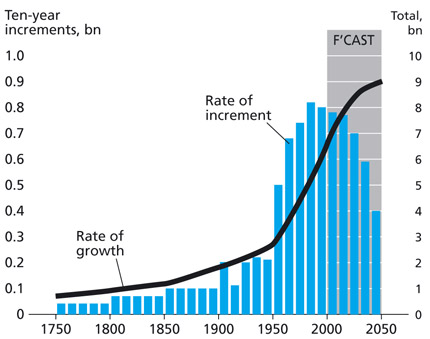
Today there are around 6.8 billion people occupying this planet. That’s up
from 5.9 a decade ago. By 2050 it is projected to top nine billion (see box,
below).
Talk of ‘overpopulation’ has been with us for some time. Already, in 1798,
when there were a mere 978 million people in the world, mathematician
Thomas Malthus was warning of an impending catastrophe as human
numbers exceeded the capacity to grow food.
Often the cause of concern is the speed at which others – be they people of
other races or social classes or religions or political allegiances – are
reproducing themselves, threatening, presumably, to disturb the wellbeing of
whatever dominant group the commentator belongs to.
This was epitomized recently by Michael Laws, Mayor of Wanganui District in
New Zealand, who proposed that in order to tackle the problems of child
abuse and murder, members of the ‘appalling underclass’ should be paid not
to have children. ‘If we gave $10,000 to certain people and said “we’ll
voluntarily sterilize you” then all of society would be better off,’ he told the
Dominion Post newspaper.
Most contemporary worries about population are less offensively expressed.
For many, the issue is primarily an environmental one. The logic is simple.
The more people there are, the more greenhouse gas is emitted, the more
damage is done. Any attempts to reduce carbon emissions will be negated
by runaway population growth.
This was echoed recently by the Financial Times when it called for an
international debate on population. A leader column argued: ‘World
population growth is making it harder to achieve cuts in carbon emissions’
and went on to quote a disputed London School of Economics study+
maintaining that spending on family planning is ‘five times more cost
effective at cutting carbon dioxide emissions than the conventional low
carbon technologies’.
The UK-based Optimum Population Trust goes further, suggesting that to
achieve sustainability we should be aiming to reduce global population by at
least 1.7 billion people.
How reasonable is all this? Is population really the big taboo that liberals
won’t touch? Or is today’s panic over population as irrational as earlier panics
turned out to be? I’m about to try and discover. First stop is Marrakech,
where 2,000 of the world’s leading demographers are gathering for the 16th
International Population Conference of the International Union for the
Scientific Study of Population (IUSSP).
+ Since found to be the work of a student funded by the Optimum
Population Trust.
The population panic
Are 2,000 demographers in denial?
Two small boys are picking olives off a tree in the central reservation on the
road leading to the Palais de Congrès in downtown Marrakech, where the
week-long international conference on population is about to begin. The boys
place the olives in a bag before moving on to the next tree.
That’s it! That’s what’s missing. Small boys!
I had been trying to work out why Morocco felt so different on this occasion
compared with my two previous visits to the country. The first, in 1975, left
me with a memory of being constantly besieged by gangs of small – and not
so small – boys. They were offering their services as guides or porters or
protectors from other boys offering their services as guides, porters or
protectors...
On my second visit, in 1987, I was doing a feature for the UN Population Fund
which involved following the story of a woman who had just gone into labour.
Back in her village a couple of days after the birth, the young mother still
looked exhausted. She said she did not want any more children. Five was
enough. ‘She seems quite determined,’ I commented to the midwife who had
arranged the visit. She shrugged. ‘Maybe. But her husband wants to have
more. It’s a question of status for him.’
Since then, Morocco has experienced a sharp decline in its fertility rate.
Instead of women having seven or eight children, as they did in the 1960s and
1970s, they now have two or three.
Fertility dips
I flick though the two fat booklets provided for the population conference.
There are hundreds of sessions on many different aspects of the subject. But
there seems to be little relating to a global population explosion. Are these
researchers living in a bubble? Don’t they hear the raised voices of concern
outside their discipline?
As I continue looking, I’m relieved to see that from midweek onwards there
are some sessions on the link between population and environment.
But for the moment, the issue of ‘total fertility rate’ – that is how many
children women have during the span of their reproductive lives – seems to
be the focus of attention.
Since the 1970s fertility has declined considerably, not just in countries like
Morocco but worldwide. This makes for a global average of around 2.5
children per woman.
In 76 countries the fertility rate has actually sunk below replacement level –
which is set at around 2.1. This means that the current population is not
reproducing itself. It’s most noticeable in Europe but there are examples from
every continent, including Africa.
Keypoint - Fertility rates around the world
are falling. If this trend continues, it will
help stabilize global population size.
In developing countries the average fertility rate fell by half, from six to three
children, between 1950 and 2000. But in many countries of sub-Saharan and
western Africa, women are still having five or more children on average.
In terms of the big global numbers, what happens in India and China, the two
most populous countries, has the greatest impact. India today has a fertility
rate of 2.7 (down from 3.5 in 1997) and is expected to hit replacement level in
2027. China’s drop from 5 or 6 per woman before 1970 to around 1.5 today,
looks likely to persist. ‘The accumulated evidence suggests that lifting the one
child policy would not lead to a resurgence of uncontrollable population
growth,’ say researchers from the region. China, they say, ‘would benefit
from learning from its neighbours, Korea and Japan, how difficult it is to
induce people to increase childbearing once fertility has fallen to a very low
level.’2 As a consequence, China’s population should start shrinking by 2023.
According to the United Nations, 21 countries already had a declining
population in the period 2000-2005.


Chickens and eggs
The rapid extension of family planning and contraceptive use around the world
is to thank for this decline in fertility. Population worriers make much of the
projection of nine billion by 2050. But were it not for three decades of
successful family planning that figure would be closer to 16 billion, points out
Australian demographer Peter McDonald.
Here in Morocco, for example, only five per cent of women used contraception
in the late 1970s – today 63 per cent do.3 But another crucial factor is the
progress made in getting girls into school. This, more than anything, delays
childbearing, encourages greater spacing between children or even opens out
the option of not having children at all.
It’s the perfect chicken and egg. Education means lower fertility – and lower
fertility can mean more education. One of the immediate benefits of the
so-called ‘demographic dividend’ that comes with fewer children being born is
that school rolls fall, educational resources are not so over-stretched, and
there is, in theory at any rate, more money available per child for education.
In practice, the money may be wasted or misdirected. But in South Korea, for
example, where the demographic dividend was invested in education, the
results in terms of economic and social development over the past few
decades have been astounding.
The same felicitous connection exists between health provision and fertility
rates. Statistically, a child’s chance of survival improves hugely in a smaller
family where resources – both physical and emotional – tend to be more
concentrated. And if children have a better chance of surviving, their parents
will not feel they need to have so many. This is one of the reasons why in
countries where there is the greatest poverty – those of sub-Saharan Africa,
for example – women both have the most children and lose the most children
as infants.
No sex please, we’re Japanese
At lunch I get talking with a researcher from Italy, which (at 1.3) has the
lowest fertility rate in western Europe. She tells me: ‘The traditional idea of
motherhood is still very strong in Italy. Modern women who work and have
careers don’t want to be sucked into all that. They do not get enough support
from either the state or their partners, to be able to work and have children.’
In Japan too a growing number of women are childless, hence a national
fertility rate of just 1.2.
Young Japanese women are better educated than their mothers and have
more career opportunities. In spite of this, traditional, patriarchal family
values prevail. Though there is a ‘departure from marriage’ and a third of
marriages end in divorce, cohabitation is still frowned upon, as is having
children out of wedlock. The rate of celibacy is high for both sexes, compared
with the West.
In South Korea the taboo against unmarried women having children is so
strong that the overwhelming majority seek abortion or adoption. A woman
who chooses to go ahead with a pregnancy and, worse still, keep her child is
socially ostracized. She may lose her job, be rejected by her family and will
be denied state benefits available to other parents.
Despite such harsh attitudes towards single mothers, policymakers in the
region are getting anxious about falling fertility. According to Noriko Tsuya of
Japan’s Keio University: ‘The new Government is promising to beef up child
allowance by 2.5 times but so far attempts to encourage people to have
children are not really helping.’
The anxiety is partly fuelled by national, cultural, psychological fears. ‘A
population in decline suggests decay,’ observes demographer Paul Demeny of
the Population Council, a leading research NGO. ‘It is associated with the
collapse of ancient civilizations.’4 Perhaps a smaller population will reduce a
country’s clout on the world stage, the thinking goes. Or it might slow down
economic growth.
But even Japan’s pronounced fertility decline is ‘far from cataclysmic’,
according to Demeny. The country’s population is set to dip from 127 to 102
million in 2050 – still higher than its 1950 figure of 82 million.
For Demeny the global trend towards falling fertility means ‘we are moving
towards negative rates of growth, and stabilization at a lower population size.
A lower population will lessen ecological footprints.’
Numbers
But how does that tally with growing numbers of people in the world?
Remember that median projection of nine billion by 2050?
One effect of falling fertility is that our current population growth is temporary.
According to the UN projections, world population peaks in the latter half of
the century at about 9.2 billion, then declines and stabilizes. That’s not to
brush aside environmental concerns or the need to treat population
projections with caution. But it does put into perspective the alarmist claims
of runaway population growth.
One effect of smaller family size, however, is that it changes the age
structure of a population and that, coupled with people living longer, leads
to another source of mounting panic – population ageing. Which we
come to next...
1. United Nations Department of Social and Economic Affairs –
Population Division, World Population Prospects: the 2008 Revision,
New York 2009.
2. Noriko Tsuya, Minja Kim Choe, Wang Fen, ‘Below Replacement
Fertility in East Asia: Patterns , Factors and Policy Implications’, paper for IUSSP, Marrakech 2009.
3. Thérèse Locoh/Zahia Oudah-Bedidi, poster session at
IUSSP, Marrakech 2009.
4. Session 139 at IUSSP, Marrakech 2009.


