Bernhard
Jedi Master
Interesting to see this article on a major news outlet like BBC. Are being "warmed up" for something?
_http://news.bbc.co.uk/2/hi/science/nature/7470283.stm
Fire in the sky: Tunguska at 100
By Paul Rincon
Science reporter, BBC News
At 7:17am on 30 June 1908, an immense explosion tore through the forest of central Siberia.
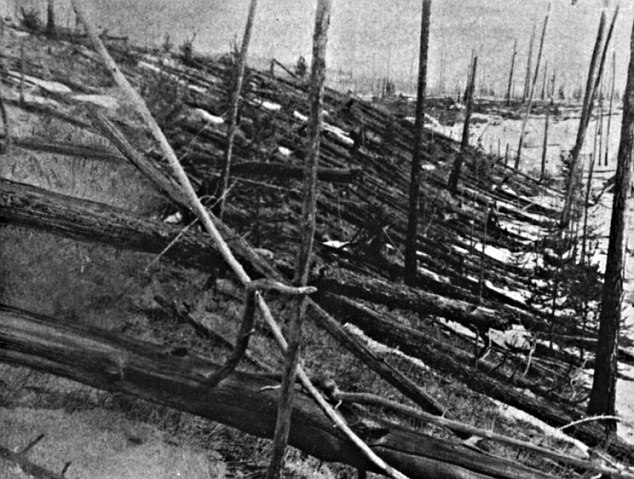
Some 80 million trees were flattened over an area of 2,000 square km (800 square miles) near the Tunguska River.
The blast was 1,000 times more powerful than the atomic bombs dropped on Hiroshima and Nagasaki and generated a shock wave that knocked people to the ground 60km from the epicentre.
The cause was an asteroid or comet just a few tens of metres across which detonated 5-10km above the ground.
Eyewitnesses recalled a brilliant fireball resembling a "flying star" ploughing across the cloudless June sky at an oblique angle.
"Tunguska reminds us that these impact events have occurred in the relatively recent past"
- Prof Richard Crowther, STFC
The plume of hot dust trailing the fireball gave rise to descriptions of a "pillar of fire", which was quickly replaced by a giant cloud of black smoke rising over the horizon.
"The sky split in two and fire appeared high and wide over the forest. The split in the sky grew larger, and the entire northern side was covered with fire," one local remembered.
"At that moment I became so hot that I couldn't bear it, as if my shirt was on fire… I wanted to tear off my shirt and throw it down, but then the sky slammed shut. A strong thump sounded, and I was thrown a few yards."
This eyewitness was lucky, but an elderly hunter who was much closer to the explosion died after being flung against a tree by the blast. That the airburst did not cause more casualties was in large part due to the remoteness of the area.
Bright light
To many, this event - the biggest space impact of modern times - serves as a reminder of the continuing threat posed to our planet by objects from space.
If the Tunguska "impactor" had exploded over a major city such as London, the death toll would have been up in the millions.
"Everything within the M25 would have been wiped out," Dr Mark Bailey, director of the Armagh Observatory in Northern Ireland, told BBC News.
The effects of Tunguska were not limited to Siberia. In London, it was possible to read newspapers and play cricket outdoors at midnight. This is now thought to have been due to sunlight scattered by dust from the fireball's plume.
The Russian mineralogist Leonid Kulik visited the region in 1921, interviewed local eyewitnesses and soon realised that a meteorite must have been the cause.
He persuaded the Russian authorities to fund an expedition to the region in 1927, during which he was able to explore the vast zones of fallen trees.
Scientific expeditions to Tunguska continue today
An aerial survey was carried out in 1938, revealing how the flattened trees were angled away from the epicentre of the explosion over a 50km-wide zone which formed a butterfly shape.
Trees at the epicentre were charred and stripped of their branches and bark, but were left standing, which would lead to them being coined "telegraph poles".
Some researchers think a comet would have been too fragile to have caused the Tunguska event, and that an asteroid is therefore the most likely candidate.
But Mark Bailey thinks some comets could contain chunks of tough material that could survive the plunge through Earth's atmosphere.
Meteor shower
Indeed, one theory proposes that the Tunguska object was a fragment of Comet Encke. This ball of ice and dust is responsible for a meteor shower called the Beta Taurids, which cascade into Earth's atmosphere in late June and July - the time of the Tunguska event.
Does Lake Cheko have anything to do with the Tunguska blast?
The absence of any crater connected with the Tunguska event has left the door open for some outlandish alternatives to the meteorite theory. A lump of anti-matter, a colliding black hole and - inevitably - an exploding alien spaceship have all been proposed as the possible source of the blast.
But in 2007, Giuseppe Longo, from the University of Bologna, Italy, and his colleagues, suggested they might have found something Leonid Kulik had missed all those years ago.
Lake Cheko does not appear on any maps of the area made before 1908; it also happens to lie North-West-West of the epicentre, on the general path taken by the impactor as it plummeted to Earth.
To Dr Longo, a radar signal from beneath the lake is suggestive of a dense object, possibly part of the Tunguska meteorite, buried about 10m down. The team plans to conduct an expedition to the area in 2009, to investigate this possibility.
"We have no positive proof it is an impact crater, we have come to this conclusion [about Lake Cheko] through the negation of other hypotheses," Dr Longo told BBC News last year.
But other researchers, including Gareth Collins and Phil Bland of Imperial College London, cast doubt on the idea Lake Cheko has anything to do with the Tunguska event.
They point to trees older than 100 years which are still standing around the rim of the lake (and, they say, should have been levelled by the impact) and the unusual shape of the lake itself, which, the researchers argue, is inconsistent with an impact origin.
Rock search
One hundred years on, the Tunguska event remains a vibrant area for study, especially in Russia. Last week, researchers gathered in Moscow for a scientific conference arranged to coincide with the anniversary.
Felled trees can still be seen today at the Tunguska site
Topics on the agenda were the continuing search for pieces of the space rock, the comet vs asteroid debate and the relationship of the event to the Beta Taurid meteor shower.
Dr Longo and colleagues presented a new tree-fall map, which they say is suggestive of two separate objects exploding in the atmosphere over Tunguska on 30 June.
The conference also heard presentations on other historic and prehistoric cosmic impacts and current strategies for tackling an asteroid headed for Earth.
An asteroid on the order of one kilometre in diameter hits the Earth roughly once every 100,000 years.
Space rocks about 10m across - roughly the size of the Tunguska object - are thought to hit our planet about once every 3,000 years.
But Mark Bailey suspects they might be more frequent than that. He has investigated another event in 1930 known as the "Brazilian Tunguska".
This little-known event was apparently caused by three large meteorites in the upper reaches of the Amazon. The fires it caused continued uninterrupted for weeks and depopulated hundreds of kilometres of jungle.
And in June 2002, US military satellites detected an explosion in the Earth's atmosphere with the energy of 12 kilotonnes of explosive. The event has been attributed to an asteroid which remained undetected as it approached our planet and plummeted through the atmosphere.
'Nuclear winter'
The international Spaceguard survey programme has been working to identify the Near-Earth Objects larger than 1km - the class of object could cause a "nuclear winter" if one were to strike the planet, possibly threatening civilisation.
Objects the size of the one that caused the Tunguska impact are too small to be seen by present-day surveys.
But there is no guarantee the next object will explode over the sea or a sparsely populated wilderness. This begs an obvious question: how prepared are we for the next one?
Dr Richard Crowther is head of the United Nations Near Earth Object (Neo) programme. He told the BBC News website: "Tunguska reminds us that these impact events have occurred in the relatively recent past.
"The surveys suggest that objects of this size are numerous enough to anticipate similar events in the relatively near future."
Many observers are concerned by what they regard as a lack of action to counter the threat posed by near-Earth asteroids.
California-based space advocacy group the Planetary Society recently awarded an Atlanta-based aerospace company $50,000 (£25,000) to design a spacecraft which could rendezvous with and track the path of the asteroid 99942 Apophis.
In 2029, this 270m-wide chunk of cosmic debris will closely approach the Earth - so close, in fact, it will be visible with the naked eye.
If this primordial behemoth passes through a precise region in space, or "keyhole", several hundred kilometres wide during this pass, it will strike Earth in 2036.
Asteroids larger than 1km have the potential to end civilisation on Earth
The Planetary Society initiated its tagging mission because, it says, Earth-based observations might not be sufficient to rule out an impact in 2036.
There are several technologies that could be used currently to tackle an asteroid heading on a collision course with Earth. One proposal is to use nuclear weapons to completely vapourise the object.
Another is to use a spacecraft to "push" the asteroid off course. This would involve a craft either slowing down or speeding up the object to ensure that it misses its appointment with the Earth's surface.
If, for some reason, the asteroid is not spotted in time, or the deflection mission arrives at its target too late, it might be necessary to nudge the space rock just enough so that it strikes the ocean, or a remote, thinly populated area on Earth.
Dr Crowther, who is based at the UK's Science and Technology Facilities Council (STFC), comments that Neos "do not recognise national boundaries".
For this reason among others, he said, it was important that any policy framework established to counter the asteroid threat "should encourage nations to work together to share data, expertise and resources to assess and mitigate the risk of a future impact".
_http://news.bbc.co.uk/2/hi/science/nature/7470283.stm
Fire in the sky: Tunguska at 100
By Paul Rincon
Science reporter, BBC News
At 7:17am on 30 June 1908, an immense explosion tore through the forest of central Siberia.
Some 80 million trees were flattened over an area of 2,000 square km (800 square miles) near the Tunguska River.
The blast was 1,000 times more powerful than the atomic bombs dropped on Hiroshima and Nagasaki and generated a shock wave that knocked people to the ground 60km from the epicentre.
The cause was an asteroid or comet just a few tens of metres across which detonated 5-10km above the ground.
Eyewitnesses recalled a brilliant fireball resembling a "flying star" ploughing across the cloudless June sky at an oblique angle.
"Tunguska reminds us that these impact events have occurred in the relatively recent past"
- Prof Richard Crowther, STFC
The plume of hot dust trailing the fireball gave rise to descriptions of a "pillar of fire", which was quickly replaced by a giant cloud of black smoke rising over the horizon.
"The sky split in two and fire appeared high and wide over the forest. The split in the sky grew larger, and the entire northern side was covered with fire," one local remembered.
"At that moment I became so hot that I couldn't bear it, as if my shirt was on fire… I wanted to tear off my shirt and throw it down, but then the sky slammed shut. A strong thump sounded, and I was thrown a few yards."
This eyewitness was lucky, but an elderly hunter who was much closer to the explosion died after being flung against a tree by the blast. That the airburst did not cause more casualties was in large part due to the remoteness of the area.
Bright light
To many, this event - the biggest space impact of modern times - serves as a reminder of the continuing threat posed to our planet by objects from space.
If the Tunguska "impactor" had exploded over a major city such as London, the death toll would have been up in the millions.
"Everything within the M25 would have been wiped out," Dr Mark Bailey, director of the Armagh Observatory in Northern Ireland, told BBC News.
The effects of Tunguska were not limited to Siberia. In London, it was possible to read newspapers and play cricket outdoors at midnight. This is now thought to have been due to sunlight scattered by dust from the fireball's plume.
The Russian mineralogist Leonid Kulik visited the region in 1921, interviewed local eyewitnesses and soon realised that a meteorite must have been the cause.
He persuaded the Russian authorities to fund an expedition to the region in 1927, during which he was able to explore the vast zones of fallen trees.
Scientific expeditions to Tunguska continue today
An aerial survey was carried out in 1938, revealing how the flattened trees were angled away from the epicentre of the explosion over a 50km-wide zone which formed a butterfly shape.
Trees at the epicentre were charred and stripped of their branches and bark, but were left standing, which would lead to them being coined "telegraph poles".
Some researchers think a comet would have been too fragile to have caused the Tunguska event, and that an asteroid is therefore the most likely candidate.
But Mark Bailey thinks some comets could contain chunks of tough material that could survive the plunge through Earth's atmosphere.
Meteor shower
Indeed, one theory proposes that the Tunguska object was a fragment of Comet Encke. This ball of ice and dust is responsible for a meteor shower called the Beta Taurids, which cascade into Earth's atmosphere in late June and July - the time of the Tunguska event.
Does Lake Cheko have anything to do with the Tunguska blast?
The absence of any crater connected with the Tunguska event has left the door open for some outlandish alternatives to the meteorite theory. A lump of anti-matter, a colliding black hole and - inevitably - an exploding alien spaceship have all been proposed as the possible source of the blast.
But in 2007, Giuseppe Longo, from the University of Bologna, Italy, and his colleagues, suggested they might have found something Leonid Kulik had missed all those years ago.
Lake Cheko does not appear on any maps of the area made before 1908; it also happens to lie North-West-West of the epicentre, on the general path taken by the impactor as it plummeted to Earth.
To Dr Longo, a radar signal from beneath the lake is suggestive of a dense object, possibly part of the Tunguska meteorite, buried about 10m down. The team plans to conduct an expedition to the area in 2009, to investigate this possibility.
"We have no positive proof it is an impact crater, we have come to this conclusion [about Lake Cheko] through the negation of other hypotheses," Dr Longo told BBC News last year.
But other researchers, including Gareth Collins and Phil Bland of Imperial College London, cast doubt on the idea Lake Cheko has anything to do with the Tunguska event.
They point to trees older than 100 years which are still standing around the rim of the lake (and, they say, should have been levelled by the impact) and the unusual shape of the lake itself, which, the researchers argue, is inconsistent with an impact origin.
Rock search
One hundred years on, the Tunguska event remains a vibrant area for study, especially in Russia. Last week, researchers gathered in Moscow for a scientific conference arranged to coincide with the anniversary.
Felled trees can still be seen today at the Tunguska site
Topics on the agenda were the continuing search for pieces of the space rock, the comet vs asteroid debate and the relationship of the event to the Beta Taurid meteor shower.
Dr Longo and colleagues presented a new tree-fall map, which they say is suggestive of two separate objects exploding in the atmosphere over Tunguska on 30 June.
The conference also heard presentations on other historic and prehistoric cosmic impacts and current strategies for tackling an asteroid headed for Earth.
An asteroid on the order of one kilometre in diameter hits the Earth roughly once every 100,000 years.
Space rocks about 10m across - roughly the size of the Tunguska object - are thought to hit our planet about once every 3,000 years.
But Mark Bailey suspects they might be more frequent than that. He has investigated another event in 1930 known as the "Brazilian Tunguska".
This little-known event was apparently caused by three large meteorites in the upper reaches of the Amazon. The fires it caused continued uninterrupted for weeks and depopulated hundreds of kilometres of jungle.
And in June 2002, US military satellites detected an explosion in the Earth's atmosphere with the energy of 12 kilotonnes of explosive. The event has been attributed to an asteroid which remained undetected as it approached our planet and plummeted through the atmosphere.
'Nuclear winter'
The international Spaceguard survey programme has been working to identify the Near-Earth Objects larger than 1km - the class of object could cause a "nuclear winter" if one were to strike the planet, possibly threatening civilisation.
Objects the size of the one that caused the Tunguska impact are too small to be seen by present-day surveys.
But there is no guarantee the next object will explode over the sea or a sparsely populated wilderness. This begs an obvious question: how prepared are we for the next one?
Dr Richard Crowther is head of the United Nations Near Earth Object (Neo) programme. He told the BBC News website: "Tunguska reminds us that these impact events have occurred in the relatively recent past.
"The surveys suggest that objects of this size are numerous enough to anticipate similar events in the relatively near future."
Many observers are concerned by what they regard as a lack of action to counter the threat posed by near-Earth asteroids.
California-based space advocacy group the Planetary Society recently awarded an Atlanta-based aerospace company $50,000 (£25,000) to design a spacecraft which could rendezvous with and track the path of the asteroid 99942 Apophis.
In 2029, this 270m-wide chunk of cosmic debris will closely approach the Earth - so close, in fact, it will be visible with the naked eye.
If this primordial behemoth passes through a precise region in space, or "keyhole", several hundred kilometres wide during this pass, it will strike Earth in 2036.
Asteroids larger than 1km have the potential to end civilisation on Earth
The Planetary Society initiated its tagging mission because, it says, Earth-based observations might not be sufficient to rule out an impact in 2036.
There are several technologies that could be used currently to tackle an asteroid heading on a collision course with Earth. One proposal is to use nuclear weapons to completely vapourise the object.
Another is to use a spacecraft to "push" the asteroid off course. This would involve a craft either slowing down or speeding up the object to ensure that it misses its appointment with the Earth's surface.
If, for some reason, the asteroid is not spotted in time, or the deflection mission arrives at its target too late, it might be necessary to nudge the space rock just enough so that it strikes the ocean, or a remote, thinly populated area on Earth.
Dr Crowther, who is based at the UK's Science and Technology Facilities Council (STFC), comments that Neos "do not recognise national boundaries".
For this reason among others, he said, it was important that any policy framework established to counter the asteroid threat "should encourage nations to work together to share data, expertise and resources to assess and mitigate the risk of a future impact".