Beautiful Art: architecture, paintings, sculptures, etc

AA1x5t46.jpg

Hi, this certainly does not equal some of the most beautiful paintings and architectures shown in this thread.
However, I came across this stele while searching for something else.
It was a Power Point presentation with comments at the bottom re Cinnabar use by the Iberians for their rituals in ancient times.

Not sure why this stele was there as it is obviously about something else than a ritual.

Does any of you know what this is? Where does it comes from? Is it about gods or other from of "aliens"? What are they eating? Fish? A hog is easily recognized on the table.
If anyone in this thread have seen this stele before, I would love to find out where it came from and what is it about. Thanks.
 
If anyone in this thread have seen this stele before, I would love to find out where it came from and what is it about. Thanks.
A quick Google search to find similar images says its of Iberian origin and a "Monumento de Pozo Moro" from the Mausoleum of Pozo Moro.

You can check the first link for more information. There are lots of further links for sources along with and different interpretations of what it represents.

One common topic seems to be that the Iberians are of Semitic origin and one webpage says:
Although their gods are unknown, it is known that the Iberians performed rituals for these gods that included: animal sacrifice, offerings, the use of psychotropic substances taken from plants such as mushrooms, group dancing, and much more.
Hope that helps for further search.
 
A quick Google search to find similar images says its of Iberian origin and a "Monumento de Pozo Moro" from the Mausoleum of Pozo Moro.

You can check the first link for more information. There are lots of further links for sources along with and different interpretations of what it represents.

One common topic seems to be that the Iberians are of Semitic origin and one webpage says:

Hope that helps for further search.
Thanks. These "images" are not pretty! Makes sense they would perform sacrifices for their gods! Gosh, what a world that was!
 
I put this video in the music section because the song is very pretty but I think here is where it should be because it talks about sculptures but retouched with AI. It is very well done and very beautiful. These are sculptures from the city where I live, Palmas de Gran Canaria.


Also, today I went with a group of seniors to a little city at the south of the island and I saw this sculpture. So sculptures are there and it is time to see them.
 

Attachments

  • IMG_20250325_123859.jpg
    IMG_20250325_123859.jpg
    1.2 MB · Views: 57
The evidence suggests that a few centuries ago, they knew how to shape marble.

The secret of "impossible" marble statues

(English subtitles)


Description of the video:

Let's start, as usual, with some background. The following sculptures, according to the official history, were made from a single piece of marble.

1. Maria Barberini Duglioli, Giuliano Finelli, 1626.
To admire, you have to go to the Louvre. Pay attention to the facial features and the collar of the dress.

2. The Abduction of Proserpina, Giovanni Bernini, 1621-1622.
To see this marble sculpture with your own eyes, head to Rome. It is in the Borghese Gallery.
Pay attention to the arms, legs, flexibility of the body - as if the sculpture is made of wax.

3. Ugolino and his sons, Jean-Baptiste Carpeau, 1857-1860.
For her, you have to go to New York. Far away, but worth it.
Pay attention to how the sculptor depicted the fear and despair of a man who had everything, but he, along with his four sons, was tricked into a tower and doomed to starvation.

4. Monumental cemetery Staglieno, Genoa, 1851.
Known for a huge number of highly artistic marble tombstones.
World-renowned sculptors have worked here at various times, including Leonardo Bistolfi, Giulio Monteverde and Eduardo Alfieri.

5. Despair, Jean-Joseph Perrault, 1868.
If you are planning to admire Maria Barberini Duglioli in the Louvre, do not forget about this sculpture.
Fingers ... This performance will not leave anyone indifferent.

6. Christ under the shroud, Giuseppe Sanmartino, Sansevero Chapel, Naples, 1752.
The chapel contains other famous sculptural masterpieces of the 18th century.
Finest work. Don't you think that the fabric moves at the slightest breath?

7. David, Michelangelo, Florence, 1501-1504.
The five-meter statue has long been perceived as a symbol of the Florentine Republic and one of the pinnacles of art. The original is in the Academy of Fine Arts in Florence.
The details of the sculpture are simply amazing.

Are such sculptures now made from a single piece of marble. They do it, and here is a video of the work of such a sculptor. They want to assure us that the author of the sculpture works with the same tools that were used 200-300 years ago. But look what kind of grinder it is at work. There was nothing of the kind among the old masters. And what other gadgets did this master use that we were not shown. And as we see from the result, the statue does not reach the level of the old masters in terms of detail. They were capable, the supporters of official history may say. But that doesn't sound very convincing. How was it possible to make, for example, such a composition:

The Disenchantment (after 1757) by Francesco Quirolo is the most famous of his works. The monument is valuable for the finest work on marble and pumice, from which the net is made. Quirolo was the only one of the Neapolitan masters who agreed to such a delicate work, while the rest refused, believing that with one touch of the chisel, the network would crumble to pieces.

There are very big doubts that such magnificence could have been done by hand, with a hammer, chisel and other similar tools. Many people have this doubt, and on this basis, many versions have appeared that it could not have done without alien technologies, but these statues were made of composite materials that our current civilization is just beginning to master. This version also has many questions and doubts.

I caught myself thinking that I do not believe in any of the other side. Maybe after all there was some kind of manufacturing secret that everyone forgot about.

Links to sources:
 
The evidence suggests that a few centuries ago, they knew how to shape marble.

The secret of "impossible" marble statues

(English subtitles)


Description of the video:

Let's start, as usual, with some background. The following sculptures, according to the official history, were made from a single piece of marble.

1. Maria Barberini Duglioli, Giuliano Finelli, 1626.
To admire, you have to go to the Louvre. Pay attention to the facial features and the collar of the dress.

2. The Abduction of Proserpina, Giovanni Bernini, 1621-1622.
To see this marble sculpture with your own eyes, head to Rome. It is in the Borghese Gallery.
Pay attention to the arms, legs, flexibility of the body - as if the sculpture is made of wax.

3. Ugolino and his sons, Jean-Baptiste Carpeau, 1857-1860.
For her, you have to go to New York. Far away, but worth it.
Pay attention to how the sculptor depicted the fear and despair of a man who had everything, but he, along with his four sons, was tricked into a tower and doomed to starvation.

4. Monumental cemetery Staglieno, Genoa, 1851.
Known for a huge number of highly artistic marble tombstones.
World-renowned sculptors have worked here at various times, including Leonardo Bistolfi, Giulio Monteverde and Eduardo Alfieri.

5. Despair, Jean-Joseph Perrault, 1868.
If you are planning to admire Maria Barberini Duglioli in the Louvre, do not forget about this sculpture.
Fingers ... This performance will not leave anyone indifferent.

6. Christ under the shroud, Giuseppe Sanmartino, Sansevero Chapel, Naples, 1752.
The chapel contains other famous sculptural masterpieces of the 18th century.
Finest work. Don't you think that the fabric moves at the slightest breath?

7. David, Michelangelo, Florence, 1501-1504.
The five-meter statue has long been perceived as a symbol of the Florentine Republic and one of the pinnacles of art. The original is in the Academy of Fine Arts in Florence.
The details of the sculpture are simply amazing.

Are such sculptures now made from a single piece of marble. They do it, and here is a video of the work of such a sculptor. They want to assure us that the author of the sculpture works with the same tools that were used 200-300 years ago. But look what kind of grinder it is at work. There was nothing of the kind among the old masters. And what other gadgets did this master use that we were not shown. And as we see from the result, the statue does not reach the level of the old masters in terms of detail. They were capable, the supporters of official history may say. But that doesn't sound very convincing. How was it possible to make, for example, such a composition:

The Disenchantment (after 1757) by Francesco Quirolo is the most famous of his works. The monument is valuable for the finest work on marble and pumice, from which the net is made. Quirolo was the only one of the Neapolitan masters who agreed to such a delicate work, while the rest refused, believing that with one touch of the chisel, the network would crumble to pieces.

There are very big doubts that such magnificence could have been done by hand, with a hammer, chisel and other similar tools. Many people have this doubt, and on this basis, many versions have appeared that it could not have done without alien technologies, but these statues were made of composite materials that our current civilization is just beginning to master. This version also has many questions and doubts.

I caught myself thinking that I do not believe in any of the other side. Maybe after all there was some kind of manufacturing secret that everyone forgot about.

Links to sources:
Thank you @Gaby for this video!
This is the main reason why I love going to churches, cemeteries, palaces, etc.
When I went to the Vatican Museum and the basilica, I almost had a case of Stendhal syndrome.


After minute 8:30, they may be talking about the decorative technique called “Scagliola”.
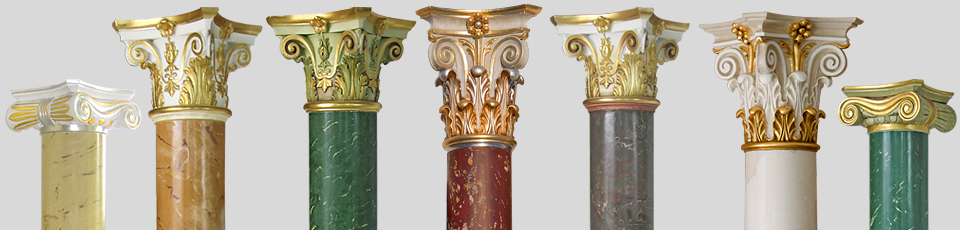
Scagliola is a composite substance made from plaster of Paris, glue and natural pigments, imitating marble and other hard stones. The material may be veined with colors and applied to a core, or desired pattern may be carved into a previously prepared scagliola matrix. The pattern's indentations are then filled with the colored, plaster-like scagliola composite, and then polished with flax oil for brightness, and wax for protection. The combination of materials and technique provides a complex texture, and richness of color not available in natural veined marbles.

Various colors and styles of scagliola columns

Scagliola Craft » Scagliola: Historical retrospect of a valuable art

Scagliola: Historical retrospect of a valuable art

There are only few people who are familiar with the art of Scagliola, a fascinating and special technique, that uses natural components, managing to render perfectly the result of valuable materials, such as marble, and other natural stones, semiprecious stones etc.

The history of Scagliola probably originates since the ancient Greeks and Romans, as Scagliola works have first appeared during those times.

The greatest flourish of the art of Scagliola was during the 16th – 17th century. During this transitional period, between the end of the Renaissance and the beginning of the Baroque era, emerges the Scagliola art. Italy is considered Scagliola’s birthplace, meanwhile the following years Scagliola’s wide spread in the rest of the Europe is observed. Guido Fassi (Carpi, 1585-1649) is considered as the most potential constructor of the new technique, who manages to create a perfect rendering of marble (a material of great importance, then and nowadays) by using natural components combined with a special technique. From then and on the utilization of this new method has started, beginning with historical buildings and cathedrals in Italy, Austria and Germany. Old cathedrals in Carpi, Gottro and Florence of Italy, the Residenz of Munich are some of a large number of works with Scagliola elements that stand until nowadays.

Scagliola

David Harrison


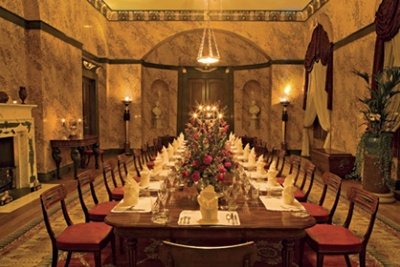
The Egyptian dining room at Goodwood Park

[td]


[/td]
[td]
Wyatt’s spectacular Egyptian dining room at Goodwood Park, which was completed by 1806 and covered up in 1906, reputedly following the objections of Edward VII. The scheme was preserved behind panelling and over-painting, and has recently been restored. (Photo: Courtesy of the Trustees of the Goodwood Collection)​


[/td]​


The term scagliola (pronounced scălliōla, with a silent g) derives from the Italian ‘scaglia’, a local name used in the Italian Alps for limestone (Oxford English Dictionary, 2012). Scagliola is a form of plaster, traditionally gypsum, which imitates decorative stone and has been widely used for the decoration of walls, columns, floors, fireplaces and table tops.
Artificial forms of decorative stone based on gypsum or lime plaster have a long history and were widely used in the ancient world. Recipes for their production can even be found in the works of the great Roman architect, Vitruvius.
The technique was rediscovered in the Renaissance and flourished on the continent in the Baroque and Rococo periods as a medium for the imitation of exotic marble and precious stone inlays. First introduced to Britain during the 17th century, rare surviving examples include a fireplace in the Queen’s Closet at Ham House, Surrey.
In Britain, however, the use of scagliola is more commonly associated with the imitation of the finest marbles on a much larger scale, without any joints or defects, and for columns and pilasters in particular. This use reached its zenith in the Regency period, typified by the extravagant bright scarlet and imitation lapis lazuli columns introduced by John Nash at Buckingham Palace in the 1820s (illustrated overleaf) and by the spectacular staircase hall of Charles Barry’s Reform Club, London in the 1830s.
In the latter part of the 19th century marezzo scagliola was developed in the US. It advanced the traditional methods of making scagliola by using Keene’s cement, a gypsum-based cement patented in 1838, rather than plaster. Both marezzo scagliola and traditional scagliola in America was prolific in the 19th century, although their use was generally confined to public buildings, such as state capitols, courthouses, churches and railway stations.

I also have the same question, how was it possible to create such monstrous hyperrealism in sculptures made more than three centuries ago?
As for ancient marble sculptures, I couldn't find any information about artificial or synthetic marble.
In any case, here is some information about “Il Disinganno,” a sculpture that surpasses the limits of sculptural technique made centuries ago.

Disinganno.jpg

 
I also have the same question, how was it possible to create such monstrous hyperrealism in sculptures made more than three centuries ago?
As for ancient marble sculptures, I couldn't find any information about artificial or synthetic marble.
In any case, here is some information about “Il Disinganno,” a sculpture that surpasses the limits of sculptural technique made centuries ago.
When I visited St. Pete, the tourist audios were clear that great chemists were at work to do the bulk of the most stupendous golden sculptures, placing them at the domes as if they were weightless when they're actually tons in weight. It makes sense that it would be applicable to all those amazing sculptures that just looked impossible to chisel away in a most intricate perfect sculpture.

Then a Russian friend gifted us with chemistry jewelry, cheap but just like the real thing with the exact chemical structures as precious stones, only that it was done in a lab. So I thought it was the done deal and common knowledge. Then I realized, that no, there's actually controversy about how they achieved perfection in the past.

I think the above ties in with the "World Fair" and how they displayed amazing sculptures in record time. They just knew how to do it.
 
Back
Top Bottom