Comet and Asteroids

This one put up a show 9 days ago

City-size, cold-volcano comet transforms into a glowing 'snail shell' after major explosive outburst

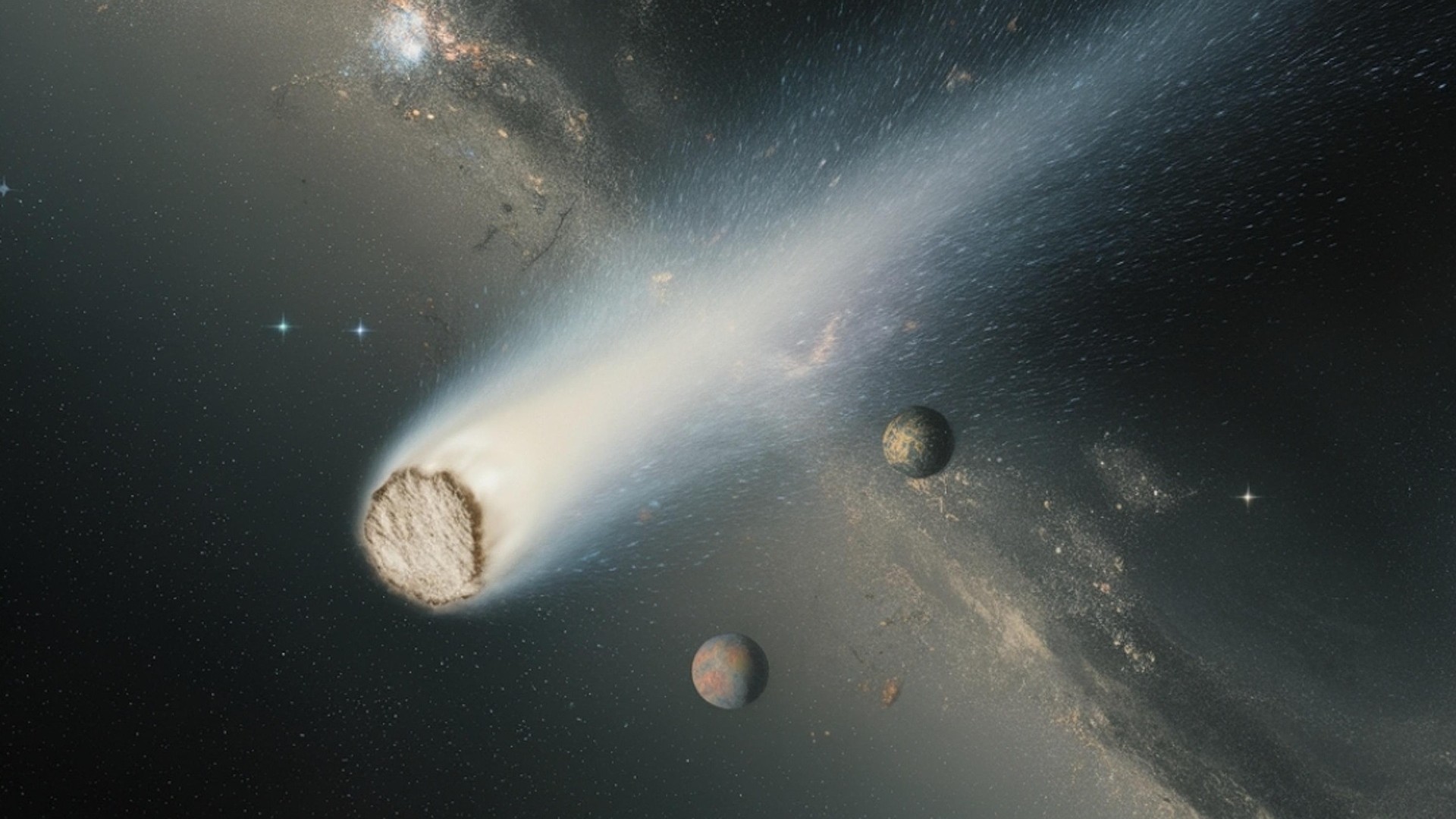
Following a massive cryovolcanic eruption, the mysterious Comet 29P/Schwassmann-Wachmann has been morphed into a giant spiral and is now shining 100 times brighter than normal.

bdreKMwvHDcsoH3DdUvMHG-650-80.jpg.webp


The cryovolcanic comet 29P/Schwassmann-Wachmann experienced a massive outburst on Feb. 10 and subsequently morphed into a giant spiral, similar to a snail shell or an ammonoid fossil. (Image credit: Eliot Herman)

On Feb. 10, Comet 29P experienced a sudden brightening event, roughly equivalent to a 100-fold increase in its luminosity, signaling that it had undergone a major eruptive event, according to Spaceweather.com.

This outburst is one of the comet's "top five" eruptions of the past two and a half decades, experts told Spaceweather.com, and it's the most powerful event since a quadruple eruption in October 2024, which caused Comet 29P to shine 300 times brighter than normal.

However, in the days following the explosive outburst, researchers began to notice something unusual about 29P's expanding coma: The reflective cloud was not evenly distributed around the comet as it typically would be. Instead, the cloud appeared to have stretched out into a rare spiral shape.
The unusual shape likely results from an internal rotation of the comet's interior relative to its nucleus, which causes cryomagma to unevenly spew out of a newly formed vent on its icy surface, according to Spaceweather.com.

This is very similar to the "devil comet," 12P/Pons-Brooks, which appeared to grow demonic horns during the initial eruptions of its solar flyby in late 2023, likely due to a notch on its surface that partially blocked the outflow of cryomagma, experts said at the time.

The interstellar comet 3I/ATLAS, which made headlines as it zoomed through the inner solar system last year, also displayed evidence of cryovolcanism and likely leaked cryomagma through multiple jets.

Though the shapes are very well described by the plasma discharge comet theory, including the horns.

Here is where it was when it got discharged:

brave_screenshot_theskylive.com.png
 
Comet MAPS approach close to the sun - Speculation that it could develop into a comet visible during the daylight around its perihelion on April 4th is entirely justified-
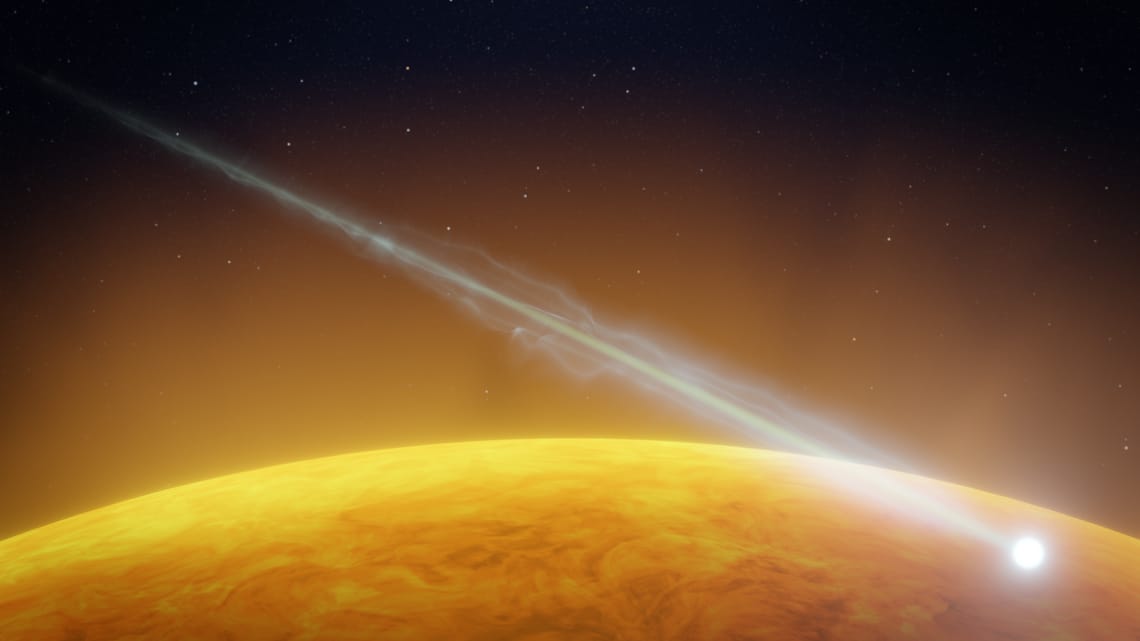
This comet's encounter with the sun will be very close. "The latest orbit indicates a perihelion of only ~160,000 km above the photosphere," says Qicheng Zhang of the Lowell Observatory in Flagstaff, Arizona. The corresponding distance for Comet Lovejoy was 140,000 km, about the same. Like Lovejoy, MAPS will pass well inside the sun's corona.

 
Comet MAPS approach close to the sun - Speculation that it could develop into a comet visible during the daylight around its perihelion on April 4th is entirely justified-
Here's another update on this Kreutz family comet:


Remember Comet Lovejoy (C/2011 W3)? On Dec.16, 2011, that comet skimmed the surface of the sun and survived, becoming a spectacular sight in the southern sky. The same thing could happen just weeks from now. This time the sungrazer is Comet MAPS (C/2026 A1), shown here in a photo from Farm Tivoli, Namibia:​

Gerald-Rhemann-Michael-Jager-2026A1feb10rhemannjaeger_1770851996_strip.jpg


"How bright will sungrazing Comet MAPS become?" wonders photographer Gerald Rhemann. "Since it was discovered on Jan. 13th, the comet has increased in brightness by 5 magnitudes (100-fold). Speculation that it could develop into a comet visible during the daylight around its perihelion (closest approach to the sun) on April 4th is entirely justified."

Rhemann's photo, which he took in collaboration with astrophotographer Michael Jäger, shows Comet MAPS passing by the "Robin's Egg Nebula" (NGC 1360) in the southern constellation Fornax. The comet has a 6 arcminute-wide green atmosphere and a jet-like tail 3 arcminutes long.

The comet's encounter with the sun will be extremely close. "The latest orbit indicates a perihelion of only ~160,000 km above the photosphere," says Qicheng Zhang of the Lowell Observatory in Flagstaff, Arizona. The corresponding distance for Comet Lovejoy was 140,000 km, about the same. Like Lovejoy, MAPS will pass well inside the sun's corona.

You can re-visit Comet Lovejoy's near-death dive in the Space Weather Archive: Dec. 16, 17, 18, 19, 20, 21, 22, 2011.

Whether or not Comet MAPS survives depends on the size and cohesion of its nucleus. "This remains highly uncertain for the time being," says Zhang. "We don't yet know if it is a typical small Kreutz sungrazer that will disintegrate before it gets to the sun--or something more substantial like Comet Lovejoy."

Monitoring is encouraged. The comet is currently 13th magnitude, putting it within range of mid-sized backyard telescopes under dark skies. Southern observers are favored, but some northerners can see it, too. Point your optics here. Sky maps: Feb. 27, 28, March 1.​
 
It's a shame that one of the best experts to study all this data, is now dead.

'Revolutionary': Vera C. Rubin Observatory found 800,000 objects of interest in a single night

The Vera C. Rubin Observatory sent scientists nearly 1 million astronomy alerts in one night, showing off changes in the sky. Eventually, the telescope is expected to reach 7 million alerts per night.

The newly commissioned Vera C. Rubin Observatory has issued 800,000 astronomy alerts in just one night — a staggering number of nightly discoveries that is expected to grow nearly tenfold by the end of this year.
The telescope, which scans the full sky from its perch atop Cerro Pachón mountain in Chile, produced the alerts to direct scientists to "new asteroids, exploding stars, and other changes in the night sky," representatives for the U.S. National Science Foundation (NSF) said in a statement.

And Rubin is just getting started, as scientists expect it will eventually issue 7 million alerts every night.
"By connecting scientists to a vast and continuous stream of information, [the observatory] will make it possible to follow the universe's events as they unfold, from the explosive to the most faint and fleeting," Luca Rizzi, an NSF program director for research infrastructure, said in the statement.

ejbXik3M47C4S3Mdoz3NJB-970-80.jpg.webp

A sample of five solar systems objects that changed in brightness or position during Rubin's nightly observations. According to the NSF: "As new images are taken, Rubin Observatory’s sophisticated software automatically compares each one with a template image. The template image, built by combining Rubin’s previous images of the same area in the same filter, is subtracted from the new image, leaving only the changes." (Image credit: NSF–DOE Vera C. Rubin Observatory/NOIRLab/SLAC/AURA)

These alerts will enable scientists to collaborate to an unprecedented degree, the NSF noted, because Rubin will spot information quickly for follow-up by other telescopes on the ground or in space. Rubin's alerts may also shed light on ongoing astronomical mysteries that require quick wayfinding to gather more information.

"Scientists will have a greater ability to catch supernovae in their earliest moments, discover and track asteroids to assess potential threats to Earth, and spot rare interstellar objects as they race through the solar system," NSF representatives wrote in the statement. "Scientists can then use these data to better understand the nature of dark matter, dark energy, and other unknown aspects of the universe."
Yeah, the not so rare interstellar objects.

Rubin's alert system is starting up shortly before the observatory begins a 10-year program, known as the Legacy Survey of Space and Time (LSST), later this year. Rubin will do nightly sky scans to generate an image of the entire Southern Hemisphere sky every few nights, using the largest-ever digital camera to spot any changes in the view overhead.

The timing is just perfect.
 
Comet MAPS approach close to the sun - Speculation that it could develop into a comet visible during the daylight around its perihelion on April 4th is entirely justified-

Stefan Burns shares his researched opinion on Comet Maps on the Kreutz sungrazer comet

Feb 15, 2026 #spaceweather #NASA #solaractivity
A new comet discovered on January 13th 2026, C/2026 A1 (MAPS) is from the Kreutz sungrazer family and will either way a very close perihelion to the Sun, or it may even impact the Sun! Because of its unique characteristics, it has the potential to become one of the Great Comets of history. Only time will tell, geophysicist Stefan Burns reports...
 
Back
Top Bottom