
Carrier USS Gerald R. Ford Suffers Fire
Fertiliser bomb?
(Sorry, couldn't resist.)

Carrier USS Gerald R. Ford Suffers Fire

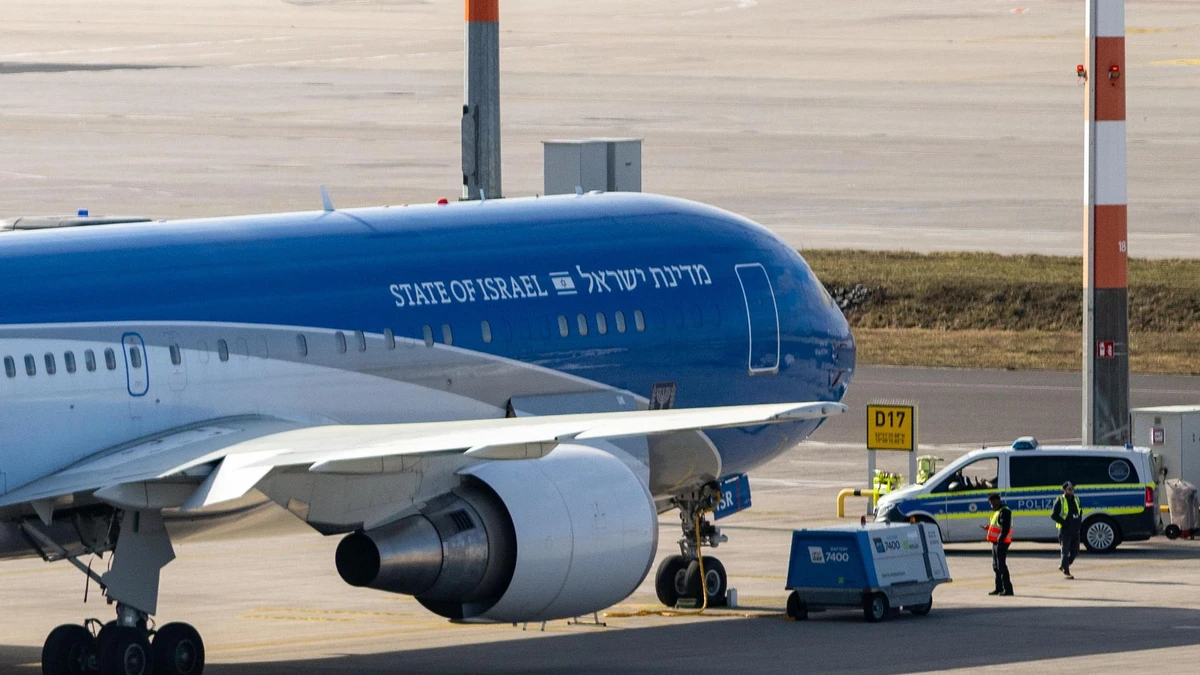
The aircraft, known as the “Wing of Zion,” left Israel on Saturday (Feb 28), sparking speculation on social media that Prime Minister Benjamin Netanyahu might be heading to Germany.
Flight-tracking data showed the plane departed Israel early Saturday afternoon, circled for hours over the Mediterranean Sea, then flew to Germany and landed in Berlin that evening.
The specially equipped Boeing 767 serves as the official aircraft for overseas trips by both Israel’s president and prime minister. According to Israeli media reports, the plane is fitted with advanced secure communications systems.


STS can't bear the unknown, and STO learns to face the unknown not only without flinching, but with wonder and awe and even curiosity. Yes, there is that mixture of fear in there, but it is balanced by love for creation and creativity itself.
CJ Werleman digs into the possible truth of how it's actually going on the ground level.


Or something similar to stuffing rags down toilets?Fertiliser bomb?
Another account created this month with location in West Asia. Where is the Indian intelligence claim? Look for it and then post it if you succeed.Netanyahu's absence fuels speculation, as Indian intelligence (RAW) claims he and Mossad Chief David Barnea were killed by a ballistic missile in Tel Aviv.

Please verify sources before posting. That particular, freshly created, located in West Asia and pretending to be Chinese news yet posting nothing about China? No, thank you unless you have a confirmation from another valid source; but then, use the latter.

TotalEnergies has officially confirmed a 15% loss in its global oil and gas production as of March 2026, primarily due to the ongoing conflict between the United States, Israel, and Iran. The French energy major has been forced to shut down operations at several major fields across the Middle East, including those in Qatar, Iraq, and offshore United Arab Emirates (UAE).
Al Jazeera +3
Production Impacts by Region
The company's announcement on its investor website marks the first official acknowledgment of widespread output disruptions in the UAE specifically.
Financial and Market Consequences
- United Arab Emirates: Offshore production is currently entirely halted. This is significant as offshore fields account for approximately half of the UAE's total national oil output.
- Qatar: Liquefied natural gas (LNG) production has been impacted, with losses limited to approximately two million tonnes for TotalEnergies.
- Iraq: Operations have been shut down or are in the process of being wound down due to the crisis.
- Saudi Arabia: In contrast to the field shutdowns, operations at the SATORP refinery in Saudi Arabia are reportedly continuing as normal.
The Economic Times +5
While the 15% drop in production represents about 10% of TotalEnergies' upstream cash flow, the company expects to mitigate the financial blow through rising energy prices.
Global Banking & Finance Review® +1
- Price Offset: Brent crude prices, which were around $60 per barrel at the start of 2026, surged to over $100 per barrel following the start of the conflict on February 28. TotalEnergies stated that an $8 per barrel increase is sufficient to offset the expected 2026 cash flow losses from the affected Middle Eastern assets.
- Alternative Production: The company is attempting to ramp up additional output in other regions to compensate for the Middle East losses.
- Operational Shifts: Before these shutdowns, TotalEnergies had projected a 3% to 5% increase in overall production for 2026, supported by projects in Brazil, the U.S., and Africa.
- Consumer Impact: In response to market volatility, TotalEnergies has implemented fuel price caps in its French network, limiting gasoline to 1.99 euros per liter and diesel to 2.09 euros through the end of March 2026. $$$$$$$$$
Maybe what Cs said about flights being grounded in the future is connected to the coming oil prices. Wait and see.

 aviation.direct
Friday, March 13, 2026, at 23:59.
The pilots' union Vereinigung Cockpit has called on the approximately 5.000 pilots of Lufthansa, Lufthansa Cargo, and its subsidiary Lufthansa CityLine to participate in a two-day strike. The industrial action will begin on Thursday, March 12, 2026, at 00:01 and end on
The escalation stems from the ongoing wage dispute over the company pension scheme, which has been simmering for months. Only flights to the Middle East, which are to be operated for geopolitical security reasons, are exempt from the strike action. The airline expects to cancel more than half of its planned flight schedule, affecting tens of thousands of passengers at its hubs in Frankfurt and Munich.
cont. aviation.direct said:Industry analyses and recent reports make it clear that this strike is significantly impacting the group's operational stability. A warning strike in February already resulted in the cancellation of over 800 flights. Lufthansa is attempting to maintain a skeleton service through a special flight schedule and the use of partner airlines as well as non-striking subsidiaries such as Lufthansa City Airlines. Passengers have been advised to update their contact details to be informed of short-notice changes via app or email. For domestic travel, the company is increasingly offering the option to convert flight tickets into rail vouchers to utilize capacity on Deutsche Bahn's rail network.
Regarding compensation claims, legal experts point to the applicable EU Air Passenger Rights Regulation (EC 261/2004). Since a strike by its own staff does not constitute an "extraordinary circumstance" according to the case law of the European Court of Justice, affected passengers are entitled to compensation of up to €600 in the event of cancellations or delays of more than three hours. In addition, the airline is obligated to provide care services such as meals and drinks, and, if necessary, hotel accommodation, after a two-hour wait. Should Lufthansa fail to offer timely alternative transportation within three hours, passengers can, under certain conditions, book alternatives themselves and claim the costs later.
The economic consequences for the Lufthansa Group are significant, as in addition to direct revenue losses, substantial compensation payments are also looming. The union, however, emphasizes that the demands for a future-proof pension scheme are essential given the high demands placed on cockpit pilots. While the positions of the negotiating parties remain entrenched, the focus in the coming days will be on managing passenger volume. The airport operators in Frankfurt and Munich are preparing for overcrowded terminals and have mobilized additional customer service staff to mitigate the impact of the strike action on the ground.
Simply keep in mind that majority of "news reports" is either propaganda from one of the conflict sides or AI flooding (also propaganda and disinfo). Turn on your discernment and do some research before posting (or not posting in result).Thanks for confirming, I certainly had my doubts but could you please explain me better about what I should be careful about in that regard?, thanks.

THE TWO BLACK COCKROACHES BAN WITHDRAWALS
It was a black swan dripping with Iranian oil that manifested last Friday when the Wall Street asset management "black star," the "King" BlackRock and his cousin Blackstone, found themselves caught between various bombs dropped on Saudi Arabia, Qatar, the Emirates, Bahrain, Dubai, Israel, etc. Their clients urgently wanted to withdraw 1.2 billion from the 26 billion fund to pay for damages, not to mention insurers and hedge funds (massive positions in the Energy sector) of their Flagship Private Credit Fund.
Are the "Kings" naked?
Michael Burry's Comment: "BlackRock just froze 1.2 billion in withdrawal requests on its private credit fund. Investors from the 26B fund asked to withdraw 9.3% of their money. BlackRock said no and capped withdrawals at 5%.
The 82B Blackstone fund recorded record withdrawal requests the same week. Blackstone had to inject 400M of its own cash to cover outflows. Two of the largest funds on the planet are limiting the amount you can withdraw."
Or did they send everything to Israel just before, knowing that the two "Blacks" are also pro-Israel?
And unimaginable for a firm managing over 2 trillion dollars in funds, Larry Fink blocked his clients' withdrawal requests at only 7% of the managed fund amount!
Analyst Comment: "BlackRock limits withdrawals, welcome to Cockroach Hotel. You can enter, but not leave."
This triggered general panic across the rest of the world which suddenly realized that BlackRock and Blackstone likely do not have the funds they boast about... This recalls Jamie Dimon's phrase: "When you see one cockroach it means there are many more behind..."

And you will never guess, specialists had seen that "They set fire to the Strait of Hormuz at 3 AM (East Coast time). Why? Wall Street needed exactly 72 hours to liquidate its energy positions before retail investors woke up.
Brent is climbing to $95 and your local Exxon station is already adjusting pumps to $4.89. But BlackRock bought 400 million shares of the oil majors three weeks ago, when it was still 'confined to Gaza'.
The same ones screaming about global warming just committed the biggest insider trading on fossil fuels in a decade. Your Toyota Prius won't save you when diesel trucks can no longer deliver food.
Meanwhile, every US pension fund is over-indebted to the bone on energy derivatives expiring every Friday. They needed this war and they needed it NOW."
Another point: their private credit fund, TCP Capital Fund, has been seriously battered "the last 90 days' trading represents no less than 1/5th of its value" read here Reuters.

The cousin 'spin-off' Blackstone did the same, limiting withdrawals as we saw: "rising withdrawal requests pushed BlackStone to raise the usual buyback limit for an $82 billion fund from 5% to 7% (...)
Manager Blue Owl on its side had bought back 15.4% of one of its funds in January. 'HLEND' received, in Q1, withdrawal requests valued at 1.2 billion, which represents approximately 9.3% of its net asset value. It informed investors that it would pay out $620 million as part of the quarterly buyback, reaching the 5% threshold—the standard level from which fund managers can limit further withdrawals.
Translation: It's panic on board since BlackRock, the King of Wall Street, just did EXACTLY what BNP did in August 2007: prevent clients from withdrawing, a taste of what was to come in 2008.
PS: Watch Apollo, Ares, Blue Owl, Cerberus, Vanguard and KKR closely (among others).
PS2: Blessed are those who have metals!!!
PS3: BlackRock urgently tasked CitiBank to sell the Chinese packaging firm Shyahsin for $1 billion. Clearly it has cash concerns...
President Donald Trump has ordered the release of 172 MILLION barrels of oil from the United States’ Strategic Petroleum Reserve (SPR) to combat record-high energy prices triggered by the ongoing war with Iran.
The release, one of the largest in American history, will begin next week and will take approximately 120 days to complete, according to Energy Secretary Christopher Wright.
This coordinated move comes after 32 member nations of the International Energy Agency (IEA) unanimously backed President Trump’s request for a massive 400 million barrel global release to stabilize markets and protect American drivers and families.
And the Strategic Petroleum Reserve, a supply buffer designed to mitigate price shocks by stockpiling emergency stores of crude oil, remains nowhere near full.
The reserve currently holds 416 million barrels of crude oil, out of a maximum capacity of 714 million barrels—around 58%, according to the Department of Energy’s latest inventory report from Feb. 18. Since Trump began his second term, the reserve’s volume has only risen by around 5%.
If a release is authorized, it takes oil 13 days to enter the U.S. market, according to the Energy Department, and the maximum daily withdrawal would be 4.4 million barrels.

"But the statement also sought to emphasize: "This was not due to hostile fire or friendly fire." But Tehran is contradicting this:"U.S. Central Command is aware of the loss of a U.S. KC-135 refueling aircraft. The incident occurred in friendly airspace during Operation Epic Fury, and rescue efforts are ongoing. Two aircraft were involved in the incident. One of the aircraft went down in western Iraq, and the second landed safely.
 www.zerohedge.com

Just as Europeans were asked to save electricity to harm Russia, the World will now be asked to starve to harm Iran.President Trump Orders MASSIVE 172 MILLION Barrel Oil Release from Strategic Petroleum Reserve to Crush Energy Prices

Max goes on to analyze possible mining of the S of H and why it would be sort of a strategy of last resort.MN: Iran is mining the Straight of Hormuz.
MB: This came from US intelligence, which may be an intelligence assessment fed to the media to justify Trump's campaign of terror against what he called defenseless targets. And as we see, they've bombed another school today."

Ask Grok, and it will tell you Catholics and Jews have been near mortal enemies most of history. No secret alliances. Maybe a 'truce' at certain times.Today's insights from our favs - Lt. Col. Danny and Larry, the Shirt here, plus, I'll rant if I want to, Scott Ritter here.
Global Research putting it out there as well:
May the Universe hear the voices of truth over the controlled MSM content of lies - the American public, too. Candace and Tucker, keep kicking a** one podcast at a time! You are getting through!
But the Evangelicals are seemingly operating from Man’s heart while Catholics are operating from God’s heart. And The Vatican is operating from Baal’s.


