Near-Earth objects and close calls

More information via XRAS.ru. Make sure to check their video compilation!


So they really need the war to disguise celestial intentions, eh?
A friend of mine who is a stargazer captured the meteor and noticed that the colour was more Orange/Pink rather than the usual Green/Blue.

He sent the pictures to NASA asking the question and they got back to him saying that it could have come from the Oort Cloud.
 

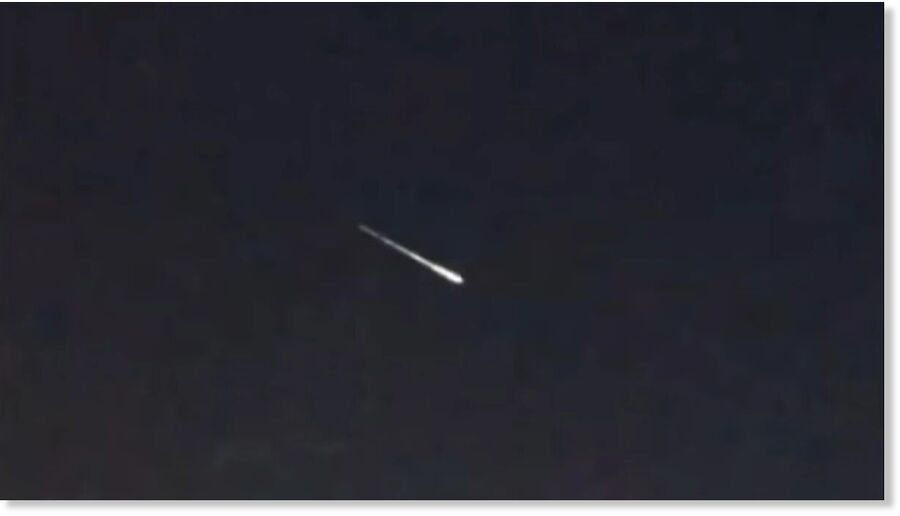
Long-duration fireball streaks across western Turkey skies, possibly an Earth-grazing meteor​

turkey_usak_province_fireball_.jpg


A bright fireball was observed over western Turkey on the evening of March 15, with residents across Uşak Province reporting a slow-moving luminous object crossing the night sky for more than 20 seconds.

Videos recorded by witnesses show a bright white to bluish-green object with a compact head and a narrow glowing tail moving across the sky at a shallow angle before fading from view. The long visible duration and smooth motion distinguish the event from typical meteors, which usually last only a few seconds.

Preliminary analysis suggests the object may have been an Earth-grazing meteor, a rare type of fireball that skims the upper atmosphere at very shallow angles.

Earth-grazing meteors enter the atmosphere at a shallow trajectory and travel hundreds of kilometers through the upper atmosphere before exiting again into space or continuing along a long atmospheric path. Because they remain at high altitude, they can remain visible for 10 to 40 seconds, significantly longer than most meteors.


Still images from the available videos show a single luminous body with a smooth, tapering plasma trail and no visible fragmentation. The emission color appears white to bluish-green, which is commonly produced when meteoroids vaporize and excite atmospheric gases at hypersonic speeds.

If the object traveled at typical meteoroid velocities of around 20 km/s (12.4 miles/s) and remained visible for about 20 seconds, it could have crossed approximately 400 km (250 miles) of sky. Events of this type can be visible over large areas and may have been seen from other parts of western Turkey or over the Aegean region.

Earth-grazing fireballs are rare but well documented. In such events, the meteoroid can skim the atmosphere at altitudes around 80 to 100 km (50 to 62 miles), and in some cases, the object survives the passage and returns to space on a modified orbit around the Sun.

There are currently no reports of damage, sonic booms, or meteorite falls associated with the event.

At the time of writing, the fireball had not yet appeared in reconstructed trajectory datasets from global meteor observation networks.

Further reports from other locations could help determine the fireball’s trajectory and confirm whether the object followed a grazing path through the upper atmosphere.

If you’ve witnessed the event, we invite you to submit a report to the International Meteor Organization.


How weird...
that thing (the proclaimed long-duration fireball) doesn't appear to move in any way...

More AI drama fun ?
They've been described and filmed before though, before AI was widespread or available. This one was presumably at 20 km/s.

And even slower ones have been described:

When one studies the NASA Bolide data, the slowest of those that are calculated is just below 10 km/s (9.8 km/s), thus significantly higher than 7 km/s.

Spaceweather reports 17 fireballs for today (March 17th 2026) over the U.S. Busier than usual.
 
Hera, a planetary defense investment mission launched on October 7th, 2024. Symbolical anniversary for the war on Gaza or not, the coincidence doesn't go unremarked.

Hera on course for asteroid rendezvous

A successful deep-space manoeuvre has put ESA’s Hera spacecraft on course for its rendezvous with the Didymos binary asteroid system later this year.

The European Space Agency’s (ESA) Hera spacecraft is on its way to the only asteroids in existence whose orbits have been deliberately altered by human action.

At the Didymos binary system, Hera will help scientists answer the questions remaining after NASA’s DART spacecraft impacted Didymos’ smaller moon Dimorphos. In doing so, Hera will help to transform asteroid deflection by kinetic impact into a well-understood and repeatable technique for protecting Earth.

Hera recently completed the second of two deep-space manoeuvres on its journey from Earth to Didymos. The manoeuvre burned 123 kg of onboard hydrazine fuel and changed the spacecraft’s velocity by 367 m/s – a change comparable to an object accelerating from stationary to supersonic flight.
Tracking data from ESA’s Estrack network of deep space antennas confirmed the success of the manoeuvre, and downlinked telemetry from the spacecraft shows that all subsystems performed as expected.

With the deep-space manoeuvre complete, the Hera team has its sights set on arrival at Didymos. Extensive onboard software updates have been designed to prepare the spacecraft for close-proximity operations at the asteroids.

The update adds and improves functionalities that Hera will need to carry out humankind’s first thorough survey of a binary asteroid, such as new software for Hera’s laser altimeter – which will continuously monitor its distance from the asteroids – and for the monitoring camera that will visually monitor and confirm the release of Hera’s two CubeSats.
Sounds like something that could be hacked.
Unlike larger deep-space destinations such as planets, Didymos and Dimorphos are small, dark and hard to see: Hera will need to actively search for the asteroids and keep them centred in its field of view as it navigates towards them.

The approach will last around three weeks and will test Hera’s guidance, navigation and control systems to the fullest.
Dark and hard to see, and these are in the "backyard".

Orbital_inclination_of_asteroid_Didymos_article.jpg

Hera’s deep space manoeuvre in February/March 2026 aligned the inclination of the spacecraft’s orbit around the Sun with that of the Didymos binary asteroid system.

Hera_mission_timeline_article.png
 
Interesting things happen not just on Earth. The sky is also active.

A meteor entered Earth's atmosphere over Ohio on March 17, 2026, not March 18, causing a loud boom and bright fireball visible across multiple states. NASA confirmed the event, identifying the object as a 7-ton asteroid about 6 feet in diameter that traveled at 45,000 mph before breaking apart over Valley City, Ohio, northwest of Medina.
Here's a summary of this fireball from LiveScience, summarizing data from NASA:

It was a 'daytime fireball' meteor.
It exploded with the equivalent force of 250 tons of TNT
It was also visible from space.
The 6-foot-wide (1.8 meters) asteroid entered Earth's atmosphere on Tuesday (March 17), at approximately 8:57 a.m. EDT, and began to burn up in the skies over Lake Erie in northern Ohio at a speed of around 40,000 mph (64,400 km/h)
It was seen from 15 states and also in Canada.

It was practically called during the last session:

Q: (Gaby) Astrophysicist Carl Grillmair, Caltech’s Infrared Processing and Analysis Center principal investigator, was killed this month at his home by a gunman. Was this gunman indeed the reported suspect, Freddy Snyder?

A: Yes

Q: (Gaby) Was he, as the Cs last month described the killer of plasma physicist Nuno Loureiro, a “human agent of chaos”?

A: Yes

Q: (Gaby) Ultimately, why was Grillmair killed?

A: Getting too close to explosive revelations.

Q: (Niall) On or about the third of this month, we heard a loud boom that shook windows and reverberated strongly. Officially it was a sonic boom from a jet. Was this the cause?

A: No

Q: (Niall) What was the cause?

A: Overhead fragment explosion. SPA. [See previous answer.]

Q: (Gaby) I also heard a loud boom at my work this week. Was it the same thing?

A: Yes.

Q: (Niall) Two separate booms in the same region. Two different days.

(Gaby) It must be getting crowded.

(Niall) Wow!

A: More of that to come!!
 
Here's a summary of this fireball from LiveScience, summarizing data from NASA:

It was a 'daytime fireball' meteor.
It exploded with the equivalent force of 250 tons of TNT
It was also visible from space.
The 6-foot-wide (1.8 meters) asteroid entered Earth's atmosphere on Tuesday (March 17), at approximately 8:57 a.m. EDT, and began to burn up in the skies over Lake Erie in northern Ohio at a speed of around 40,000 mph (64,400 km/h)
It was seen from 15 states and also in Canada.
It is up on the site of CNEOS which credits it with 0.37 kt of TNT in total impact energy, of which, judging from the above, two-thirds, or 250 tons of TNT was released through the explosion.

The article on SOTT about the fireball has several videos.
 
A documentary about the search for micrometeorites
In a DK paper, Politiken, there was, if translated:
With a magnet and a broom, the Norwegian jazz musician Jon Larsen managed to find stardust in the form of two micrometeorites on a sidewalk in Copenhagen. He was in the capital on the occasion of the premiere of a documentary film about his stubborn hunt for the solar system's smallest building blocks.

Norwegian jazz musician finds two micrometeorites on pavement in central Copenhagen
Lasse Foghsgaard, Science editor
[...]

It is a strange sight that meets us on Monday morning in front of the Danish Film Institute in central Copenhagen. The 67-year-old Norwegian jazz musician and citizen researcher Jon Larsen is in the process of sweeping gutters and pavements clean with a broom that could be mistaken for the Nimbus 2000 broom that Harry Potter flew around on in the legendary films.

When he has swept up a pile of dirt and removed cigarette butts, he repeatedly lowers a powerful magnet wrapped in a transparent freezer bag into the pile.
Jon Larsen's FB group Micrometeorites where a handful of very dedicated people post photos of what they find. Related is this FB page, Project Stardust There is a recent post were he interviewed an expert in paleomagnetology, Annique van der Boon, available through Patreon membership She says one should not use magnets to find star dust. The interviewer was not happy to hear that. My guess is that magnetic elements in a micrometeorite have a magnetic signature and one can interfere with that by using a strong magnet. However, magnets can be used to find micrometeorites, there probably is a trade off depending on what the interest is.

Looking for the documentary, the Norwegian director, Elizabeth Rasmussen, has a poster for the film on her FB:

645740509_18560393890063274_5448178484251245531_n.jpg

From the same FB, there was from June last year a last call for funding, and it showed that the effort has been rather prolonged and dedicated:
In 2016 I heard about a man who was collecting stardust on rooftops and in gutters. Fast forward 9 years and we are about to finish the film about Jon Larsen, Jan Braly Kihle and the material that created life on earth. If you would like to help us tell this story that is too good to be made up, have a look at our crowdfunding page:
A vimeo link to a two minute trailer that appears to embed for now:
A link to a review article on Screen Daily, which repeats some of what has been said, but there is also more:
‘We Are Stardust’ review: Absorbing doc follows Norwegian citizen scientist on hunt for cosmic dust
By Amber Wilkinson 13 March 2026
Dir: Elisabeth Rasmussen. Norway, Denmark. 2026. 101mins

Science, myth, music, art and philosophy all orbit around Jon Larsen, the magnetic heart of Elisabeth Rasmussen’s absorbing, informative documentary, which follows his hunt for stardust over 10 years. Armed only with a broom, a magnet, a handful of bags, and dogged determination, Larsen looks in everyday places (like roof gutters) for microscopic cosmic dust, known as micrometeorites, which date back to the inception of our solar system and can offer clues to life on Earth. Unsurprisingly, Larsen’s approach is not taken seriously by the scientific establishment, which spends billions on trying to collect this valuable dust.

Larsen’s enthusiasm is infectious

Rasmussen has been drawn to outsiders before, previously making punk profile The Heart Of Bruno Wizard. She’s hit the jackpot with Larsen, an affable and charismatic fellow Norwegian. who dreamed of being an artist before becoming a successful jazz musician and producer, and who has maintained a love of amateur geology since childhood. Larsen’s enthusiasm is infectious, and is already proving popular with festival programmers; the film screens at CPH:DOX immediately after its world premiere in Thessaloniki Documentary Film Festival’s Newcomers Competition. Rasmussen marries astrophysics to offbeat charm in ways that are likely to ensure good audience word of mouth wherever it plays, and could help We Are Stardust attract a specialist distributor.

Rather than starting immediately with hard science, Rasmussen lures in viewers by drawing on her own Sámi heritage and framing Larsen’s journey with the Sámi myth about the universe being founded by a cosmic reindeer, Gabba, descending from the heavens. These sorts of existential ideas are folded together with more concrete science, all well illustrated in accessible layman’s terms using VFX from London-based Little Shadow.

The time that Rasmussen has invested in this project shows in terms of the depth of her approach, which allows a biography of Larsen to gradually build as she follows him working at his hobby in his spare time, collecting and then carefully sifting his samples. Sweet scenes with his elderly mum – who recalls moving his childhood rock collection to the basement because she was concerned it would break through his bedroom floor – indicate that his love of citizen science is a lifelong obsession.

As Larsen’s hunt continues, he forms an alliance with Norwegian mineralogist Jan Braly Kihle, who has the pioneering photographic equipment to capture the potential micrometeorites on camera. (In a mark of a film that is as much about luck and personality as it is about science, Braly Khile’s involvement comes via his love of Larsen’s music.) As Larsen becomes convinced he has found what he was looking for – beautifully cinematic tiny objects that, when blown up on the big screen, look like ornate blown glass works of art – the question becomes whether he can convince anyone in the scientific establishment to even look at the evidence, let alone accept it.

Rasmussen encourages the viewer to join Larsen in his passion, mixing observational footage with well-thought-out explanatory sequences with veteran scientists, including Donald Brownlee. She also weaves in her own brush with death – which she documented more fully in her short film Phoenix – in a way that adds to the film’s existential underpinning and uniquely personal punch. A suitably complex score from Danish composer Philip Owusu, alive to the jazz background of Larsen, adds to the sense of scale and wonder.
Cineeurope.org has a couple articles:
THESSALONIKI DOCUMENTARY 2026
EXCLUSIVE: Trailer for Thessaloniki and CPH:DOX title
by Vladan Petkovic
27/02/2026 - Norwegian filmmaker Elisabeth Rasmussen accompanies jazz guitarist and amateur geologist Jon Larsen in his search for micrometeorites in urban environments
Norwegian filmmaker Elisabeth Rasmussen's second feature-length documentary, We Are Stardust [+], is set to world-premiere in Thessaloniki International Documentary Festival's Newcomers International Competition, before going on to the SCIENCE section at CPH:DOX. Cineuropa exclusively brings you the film's trailer.

For decades, scientists have spent billions searching outer space and the remotest places on Earth for stardust - tiny particles formed at the birth of our solar system. Norwegian jazz guitarist and amateur geologist Jon Larsen took a radically different approach: he searched for them in urban gutters.

After years of experimentation, Jon developed a method to identify genuine micrometeorites among terrestrial debris. His claims are initially met with scepticism and ridicule but his persistence leads to international recognition, global media coverage, and collaboration with leading cosmologists, including NASA scientists.

Rasmussen begins documenting Jon’s journey while exploring her own existential questions rooted in Sámi mythology and childhood memories of starry skies in the Arctic.

Interweaving a decade of observational footage, intimate conversations, interviews with leading scientists and breathtaking microscopic imagery, We Are Stardust moves from electron microscope laboratories to Nordic landscapes and into the vastness of the cosmos. Through innovative VFX and microscopic photography, the film reveals extraordinary beauty within particles invisible to the naked eye.

I want to take our audience on a journey with a man who does not give up on his outside-the-box thinking, even when everything seems impossible,” says Rasmussen. “I want to share the excitement and zest for discovering stardust that Jon’s micrometeorites reawakened in me. The connection I felt to the stars as a little girl was perhaps more real than I understood at the time. We are all part of something bigger, we are all connected. And that is magical, if you ask me.”

Lensed by Jannicke Mikkelsen and Jason Leeds, edited by Ash Jenkins and with a score composed by Philip Owusu, We Are Stardust was produced by Rasmussen, Benedikte Bredesen and Jamie Hever for Norway’s Wonderline Productions, and co-produced by Ulrik Gutkin for Copenhagen Film Company Short & Doc.
And:
Review: We Are Stardust
by Davide Abbatescianni
10/03/2026 - Elisabeth Rasmussen’s sophomore documentary follows a jazz musician-turned-amateur scientist whose search for micrometeorites in urban dust becomes a celebration of curiosity and discovery
[...]
Rasmussen’s promising debut reminds us that discovery often begins not with billion-dollar instruments pointed at distant galaxies, but with the simple act of looking closely at the world beneath our feet.
Other pages:
Micrometeorites.org
 
Back
Top Bottom