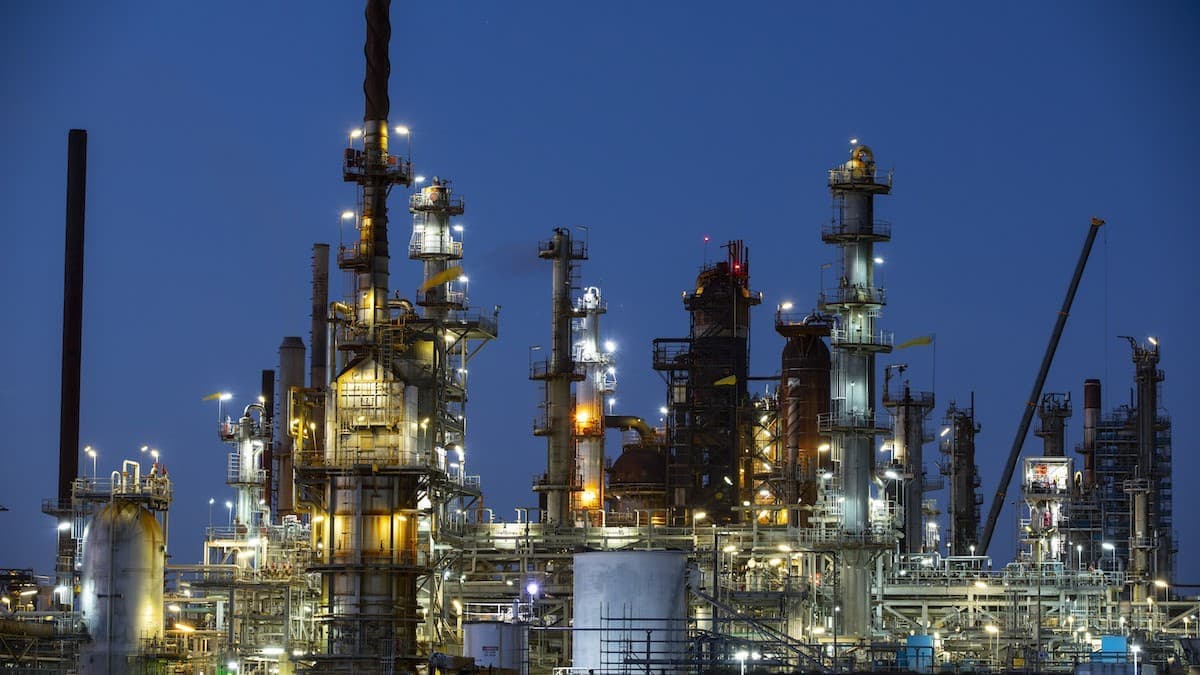
Fuel shortages around the world.

gottathink

The Living Force
FOTCM Member
Here we go again, let us in New Zealand lead this one out:

Back in the world of Levels 1-4. Here are the fuel alert levels, and when we might need them​

On Monday at 1pm, finance minister Nicola Willis sat down with reporters to give an update.
She said New Zealand is currently at Level 1, although moves to higher levels are possible. The key focus in Level 1 is preparation. Things are manageable now, but they could escalate.
Sound familiar?
No, this isn’t about Covid-19. You haven’t leaped back in time and there’s no pandemic threatening the country.


But there is something threatening to destabilise households - the price of fuel

With the conflict in Iran showing no signs of stopping, fuel prices are skyrocketing around the world. Here in New Zealand, 91 is already over $3.15 in some places and Air New Zealand is pro-actively cancelling flights.
In good news, the government has a framework to follow to manage stretched resources. The National Fuel Plan, which was developed by fuel companies, central and local government and released in 2024, lays out a response framework for the fuel sector when things get tight.
 
According to Triple AAA, fuel prices continue to spike in California and globally, causing a ripple effect with the ongoing war in Iran

Truckers are the first victims of the diesel-price shock​

Long-haul trucker Miguel Caveda recently spent around $1,800 on diesel fuel during a week on the road, about 40% more than he typically paid before the Iran war began.


The sudden surge in diesel prices has eroded Caveda’s profit and upended his business in other ways, too. He has started searching out lighter hauls and avoiding hilly routes that guzzle fuel. He is also keenly aware that the steeper fuel costs will eventually trickle into the prices consumers pay for goods he is carrying—from tires to watermelon—assuming his business survives.

“Any major repair, like, god forbid an engine failure or anything like that, I’m out of the business,” the Tampa, Fla.-based trucker said in an interview from a rest-stop in Charlotte, N.C., where he was transporting a load of empty bottles. “I’m out.”


Miguel Caveda

Miguel Caveda© Miguel Caveda

The average gallon of diesel crossed $5.20 nationwide on Saturday, up around 40% from a month ago, according to the AAA. Eight of the 10 states where diesel prices have shot up most compared with a month ago are in the Southeast—led by South Carolina, where prices have risen 51% since Feb. 21 and where Caveda paid $853 alone for 161 gallons at a station in Columbia on Monday.

Caveda and other small truck drivers—many who own their rigs and foot their fuel bill themselves—are feeling some of the first economic effects of the rapid surge in the cost of diesel, which is primarily produced from oil and generally more expensive than gasoline.

Higher diesel prices for a sustained period would, however, ripple throughout the broader supply chain and could lead companies to eventually increase the price of consumer goods, economists say.

The price of diesel and other oil derivatives affect the cost of “many, many things,” said Federal Reserve Chair Jerome Powell on Wednesday. The effects on core inflation, which excludes food and energy, are “real, and they’re material,” he added.

For most freight companies, a 40% surge in the price of diesel results in an overall cost increase of around 10%, said Erich Muehlegger, an economist at the University of California, Davis. The diesel price spike from Russia’s invasion of Ukraine in 2022, for instance, contributed to a significant increase in the cost of milk for consumers in California, according to UC Davis research.


Gasoline prices

Gasoline prices

Diesel is also used to power machinery used by the fishing, farming and construction industries, such as tractors and cranes. The higher costs those companies are beginning to pay won’t be felt by consumers immediately, but they have already begun to pass through the supply chain, Muehlegger said.

Companies looking to ship fresh food are more vulnerable as their products have to be refrigerated and transported quickly, so they can’t wait until prices come down, said Michael Adjemian, an economist at the University of Georgia. As a result, farmers will begin to charge more on the wholesale side, and the retailers who depend most on their products and can’t easily substitute them will charge consumers more, Adjemian said.

Other companies looking to transport consumer-packaged goods with less immediate demand might wait to ship them until the price spike subsides, or send their goods via train, which can take longer but uses less diesel.

In the near-term, this type of fuel surge could knock many small truck drivers out of business, straining the available capacity for shipping the same quantity of goods, said Avery Vise, vice president of trucking with FTR Transportation Intelligence.

The surge also affects larger freight carriers, many of which can by contract pass along added costs to the companies whose goods they are moving. That still presents a financial risk, because companies often pay their freight bills around 30 to 60 days after shipments, while the carriers pay the higher costs upfront, Vise said.

For Caveda, the Florida trucker, the rapid increase has strained his business and pushed his time-tested money-saving strategies to their limit.

He is turning his truck off as much as he can, hunting on his phone for the gas stations where he can use his company’s fuel discount cards, and avoiding routes that take him through places like West Virginia, where the rolling hills quickly chew through his fuel. But those steps only save $100 a week, at most, and haven’t stopped his credit-card debt from creeping to just below his $28,000 limit.
“You just have to pray you get a light load,” he said.

Aram Honore, who runs a small trucking business with two other drivers based in Sun City, Ariz., has become more selective with his freight since the cost of war began showing up at the diesel pump. He is opting for longer-haul treks, which open him up to landing more work, and avoiding taking any trips where he isn’t certain he will have a job to support his return home.

“Two weeks ago, I might have taken a random road to Florida, taking the chance that when I get there, I’m going to find someone coming back,” said Honore, who typically hauls freight such as auto parts and dried food in a 26-foot box truck. “Now, I can’t take that chance.”

The last time prices were this high was in 2022, following Russia’s invasion of Ukraine. But Honore noted that prices moved upward more slowly in the early days of that war: “It’s one thing when fuel prices go up. It’s another when it spikes.”

Erik Hagerling, an independent trucker based in Michigan, said the diesel price increase has cost him an extra $300 to $400 a week. Early this month, while buying 210 gallons in Ohio, he snapped a picture of the diesel pump as it crossed over $1,000. “This is insane,” he captioned the photo in a social-media post.

Hagerling says he is now trying to focus on driving for customers that are willing to pay a surcharge to cover at least some of the extra fuel cost. “It takes some of that pressure off,” but “we still have to eat some of it,” he said.

Write to Jared Mitovich at jared.mitovich@wsj.com and Jeanne Whalen at Jeanne.Whalen@wsj.com
 
My travelling to work would be doable without my car but not a nice prospect. I would have to walk 2 miles but all downhill. It would be tolerable for a short time but not something I would want to consider for a prolonged period. However it may become necessary if the fuel prices continue to rise and I am sure they will. It will have a knock on effect in so many areas, causing severe hardship to many. When things get painfully pinched is when there will be increasing demands for the war to end. Would the US and Israel listen. Their own economies would be just as affected.
 
There is some information suggesting oil could reach $150 a barrel.

Beyond Oil: The Global Supply Chains Broken by the Iran Conflict | OilPrice.com
By City A.M - Mar 25, 2026, 12:00 PM CDT
  • Qatar’s helium exports have been severely disrupted, putting pressure on chipmaking, medical imaging, and space industries.
  • Fertiliser prices have surged as Gulf supplies of urea and ammonia are hit during a crucial planting season.
  • The conflict could drive wider inflation through higher technology, healthcare, and food costs.
Since the start of the Middle Eastern conflict nearly a month ago, analysts have kept their eyes glued to the latest energy market data.

On 2 March, Iran declared the Strait of Hormuz, a waterway which is responsible for shipping roughly one fifth of the world’s oil and gas, was “closed” and oil prices have slipped out of control ever since.

Oil prices surged to over $110 (£82.14) per barrel, leading the US to launch an operation to reopen the strait, deploying jets and helicopters to the region.

But while the market tracks the oil price and fret over a potential fuel shortage, other commodities are also trapped in the Gulf and could have stinging repercussions.

Helium

Surprisingly to some, the range of applications for helium goes well beyond birthday balloons, with the gas also a key input in chip making, medical imaging and space technology.

Qatar supplies a third of the world’s helium, which passes through the strait, but the nation has been forced to halt production after war broke out, with the nation’s state-owned gas company saying that strikes on energy infrastructure would further cripple exports.

Helium is also deemed tricky to transport as it is stored in insulated containers for 35 to 48 days as a liquid.

After this time frame, molecules start to warm up and escape, becoming a gas once more and escape, meaning those stuck in the strait are quickly losing value and damaging the supply chain.

Helium is essential for manufacturing semiconductors, including the chips used in artificial intelligence models, and a shrinking supply could have a knock on effect for leading technology stocks who are already fighting fears of a potential AI bubble.

Other uses

Elsewhere, the medical technology industry uses helium in MRI machines to cool magnets, while the space industry uses the gas to purge rocket fuel tanks.

Its demand within the space industry is expected to grow as more private companies enter the fray, with both Elon Musk’s Space X and Jeff Bezos’s Blue Origin planning more frequent launches of their vehicles.

Thomas Abraham-James, founder and chief executive of Pulsar Helium, said: “What makes this particularly alarming is that the crisis presents not one problem for helium markets but two.

“Even where physical infrastructure remains intact, the effective closure of the Strait of Hormuz means that no product can reach market until hostilities cease.

“Qatar’s helium, used in everything from semiconductor fabrication and MRI machines to fibre optics and space launch vehicles, is therefore simultaneously impaired by structural plant damage on one hand and an export blockade on the other.

“Should the Strait reopen and tensions de-escalate, limited volumes may resume within weeks, but meaningful supply normalisation is likely months away at best and full restoration of damaged capacity years away.”

Fertiliser

The Strait of Hormuz is also responsible for carrying the fertiliser components that underpin around half of the world’s food supply.

The Gulf states account for 49 per cent of globally traded urea, a nitrogen-rich fertiliser used for a variety of crops, including wheat.

The price of urea has rocketed more than 40 per cent since the outbreak of the war in Iran, with the cost spike arriving during spring planting season for farmers across the Northern Hemisphere, meaning the effects are likely to trickle down to shoppers.

Away from soaring prices, the hold up of fertiliser also impacts overall food production as the inability to purchase the commodity could lead to a decline in crop yields.

Kelly Xu, commodity and energy strategist at Alpine Macro, said: “Beyond energy markets, the Iran conflict is increasingly spilling over into global fertilizer markets.

“Prices for key fertilizer products have already moved sharply higher. Since the onset of the Iran conflict, urea and ammonia prices have risen by roughly 50 per cent and 20 per cent, respectively.

“Sustained disruption risks amplifying pressure on agricultural markets. Farmers in the Northern Hemisphere are entering the spring planting season facing elevated input costs and uncertainty, raising the risk of lower application rates, weaker yields, and, ultimately, higher food inflation.”

The Gulf also contributes around 30 per cent of ammonia, another key fertiliser component, with a number of suppliers, including Qatar, forced to shut down production off the back of strikes and the strait closure.

By City AM

AI Overview
Analysts and financial leaders warn that oil prices could reach
$150 per barrel if current Middle Eastern conflicts, specifically the U.S.-Israeli war with Iran, remain protracted. BlackRock CEO Larry Fink cautioned on March 25, 2026, that if Iran continues to pose a threat to the Strait of Hormuz—through which one-fifth of the world's gas and crude supply passes—prices could stay near $150 for years.
Crude Oil Prices Today | OilPrice.com +2
Google Search
Drivers for a $150 Price Spike
The primary driver of current price volatility is the "war premium" and the risk of a major supply shock.
Yahoo Finance
  • Strait of Hormuz Closure: Shipments through this critical waterway have nearly stopped due to the conflict. A full shutdown of the Gulf could remove 15 million barrels per day from the market.
  • Infrastructure Damage: The International Energy Agency (IEA) reports the conflict has caused the "largest supply disruption in the history of the global oil market," with severe damage to at least 40 energy sites.
  • Targeted Attacks: Iran has reportedly hit critical facilities, including Qatar's Ras Laffan LNG facility, while Saudi Arabia's major Ras Tanura refinery was temporarily shut after a drone strike.
    Yahoo Finance UK +5
Economic Implications
A sustained price of $150 per barrel is widely expected to trigger a global recession.
Investing.com +1
  • GDP Impact: At $150, global oil expenditure would nearly double to approximately 5-6% of global GDP, a historical "danger zone" that typically leads to economic contraction.
  • Inflationary Pressure: Analysts predict a sustained $150 price for three months could push the U.S. Consumer Price Index to an annual pace of 6%.
  • Retail Fuel Costs: Gasoline prices could rise to between $4 and $5 per gallon in the U.S.. In the UK, petrol could hit £1.90 a litre, increasing annual fueling costs for typical drivers by over £500.
  • Sector Impacts: European naphtha crackers could become unprofitable, and unhedged airlines would face severe margin pressure as jet fuel prices approach $180 per barrel.
    Energy & Climate Intelligence Unit | ECIU +3
Counter-Arguments and Alternatives
Some analysts believe $150 is a stretch, noting that current market prices already discount a scenario where half of Persian Gulf exports are curtailed.
  • Demand Destruction: Higher prices eventually force consumers and businesses to slash consumption, which naturally brings prices down through an economic slowdown.
  • Shift to Renewables: Persistent $150 oil could accelerate a rapid global transition toward solar and wind energy.
  • Downside Potential: If a ceasefire is reached, some forecasts suggest oil could return to pre-conflict levels of around $70, or even slip to $50 by June 2026 as supply exceeds demand.
    MarketWatch +3


Fear-pron from France 24

France confirms oil crisis, says 30-40% Gulf energy infrastructure destroyed
Mar 25, 2026
A daily update on the latest business and economic news.
 
I paid AUD$3.159/l today for diesel!
I have a diesel car too and it’s getting ridiculous. It’s going to get to $4/L or more if this keeps up. 😩

Added: There is a “Two weeks to flatten the fuel curve” vibe these days, I’m just waiting for energy lockdowns of some type, they’d never let a good crisis go to waste.
 
Last edited:
If you are able, it might be a good idea for people to get some jerry cans and fill them with fuel to keep on hand if/when fuel shortages hit your area. You may want to but some jerry cans as they may be sold out soon!
Luckily, I bought about cca 70 to 100l of diesel and gasoline in plastic cans that are for fuel middle of last year, put them in garage that is always with half opened doors and added additives for yachts and boats that prolong life of fuel to 3,4 years and some cardboard under cans so to stop condensation. Bought fuel few years ago also but did not use it so it became stale so decided to buy new one. Also did buy 3 reserve gas bottles of 10kg that we use for cooking that can last for 6 months few years back. Recently I bought gas bottle for standard cooking use that I buy every month or so and the price spiked from 20e to 24e a bottle. I read few days ago article where they said that there is limit of 20l of fuel per household for home security reasons, yes right. Recenty also bought wood stove and attached it to chimney so to not be dependent on central heating that is dependent on electicity (and it is strong stove that can keep warm whole floor more or less) and ordered woods for winter because the prices of wood will go up, they were 70e m, now went 75e, but have to wait more then a week because there are many orders it seems.
 
Last edited:
Back
Top Bottom