The claim that the smell of gun powder was evident after the explosion by some of the wittiness.
From infobae.com America http://america.infobae.com/notas/34369-Argentina-investiga-la-caida-de-un-meteorito-en-un-barrio-de-Buenos-Aires
Argentina: doubt the fall of a meteorite in a neighborhood of Buenos Aires
During the morning, an explosion was heard several miles around Esteban Echeverría, in the southern province of Buenos Aires . The authorities confirmed the death of Silvia Espinoza Infantes, a 43-year- Peruvian nationality. There were also six persons injured .
A person who claimed to have photographed with your mobile phone (see picture related) what appears to be a small meteorite was arrested on Monday afternoon, charged with perjury after admitting he lied. Several neighbors had supported the version and claimed to have seen a blue fireball falling from the sky . Others said they "felt a strong smell of gunpowder" .
After initial speculation began to unravel the causes which led to a fatal explosion: the judicial authorities of expertise focused on the bottles that were in one of the addresses was the target of the explosion. Specifically, police seized a bottle of 45 kilos which was connected in a clandestine manner, ie without verification of the supervisory bodies to a furnace that was used to make pizzas. The preliminary results indicate that expertise of that connection would have occurred leak caused the explosion that caused the tragedy in the province of Buenos Aires.
During the morning, local people claimed that, after the fact, different cars did not work and said they suspected a celestial body , its electromagnetic charge.
The mysterious event happened to coincide with the comet's passage near the planet Elenin . On Tuesday September 27, be aligned with the Earth and the Sun and other esoteric interpreters claim that could harness serious consequences , such as earthquakes or even cause it to attract celestial bodies toward Earth.
Comet also Elenin it because of the fall of the NASA satellite , which fell last weekend near Canada, but whose whereabouts are unknown. Also it links to the earthquake in Japan and other global catastrophes .
Local newspaper in English:
http://www.buenosairesherald.com/article/79933/house-explosion-kills-1-injures-8
A woman died and eight people were injured in an overnight house explosion in Monte Grande, Buenos Aires province. According to police sources the cause of the violent explosion remains unknown. The blast occurred around 2 am at Los Andes and Vernet streets.
The wounded were taken Santamarina hospital. Seven people are being treated, one person has been cleared. The deceased woman was identified as 43-years-old Silvina Espinoza.
Neighbors’ accounts describe a ball of fire coming from the sky as the cause of the explosion. The chief of the firefighters, Guillermo Pérez, however, said the “causes remain unknown” and that “gas containers were found intact,” ruling out a gas related incident.
The blast caused destruction in several structures and cars surrounding the house.
Local newspaper in spanish with photos/video:
http://perfil.com.ar/fotogaleria/?filename=contenidos/2011/09/26/noticia_0016.html
It happened in Esteban Echeverría, the debris reached out to two blocks away, everything is produced by a detonation, whose origin could not be determined yet, ask for explanations about the young man who spread photos...........
http://www.infobae.com/notas/607758-Un-meteorito-provoco-la-tragedia.html
Interesting side note (a bit off topic): Apollo 17 crew and the smell of the moon dust was that of gunpowder.
The Mysterious Smell of Moondust: NASA Science News
http://science.nasa.gov/science-news/science-at-nasa/2006/30jan_smellofmoondust/
January 30, 2006: Moondust. "I wish I could send you some," says Apollo 17 astronaut Gene Cernan. Just a thimbleful scooped fresh off the lunar surface. "It's amazing stuff."
Feel it—it's soft like snow, yet strangely abrasive.
Taste it—"not half bad," according to Apollo 16 astronaut John Young.
Sniff it—"it smells like spent gunpowder," says Cernan.
How do you sniff moondust?
Every Apollo astronaut did it. They couldn't touch their noses to the lunar surface. But, after every moonwalk (or "EVA"), they would tramp the stuff back inside the lander. Moondust was incredibly clingy, sticking to boots, gloves and other exposed surfaces. No matter how hard they tried to brush their suits before re-entering the cabin, some dust (and sometimes a lot of dust) made its way inside.
Once their helmets and gloves were off, the astronauts could feel, smell and even taste the moon.
Schmitt offers yet another idea: The smell, and his reaction to it, could be a sign that moondust is chemically active.
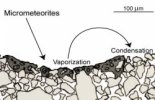
"Consider how moondust is formed," he says. "Meteoroids hit the moon, reducing rocks to jagged dust. It's a process of hammering and smashing." Broken molecules in the dust have "dangling bonds"--unsatisfied electrical connections that need atomic partners.
Bottom illustration: Moondust is formed by pounding; the "hammers" are meteoroids. Image credit: Prof. Larry Taylor, University of Tennessee. (More @ http://www.lpi.usra.edu/lunar_knowledge/LTaylor.pdf )
Inhale some moondust and what happens? The dangling bonds seek partners in the membranes of your nose. You get congested. You report
strange odors. Later, when the all the bonds are partnered-up, these sensations fade.
Another possibility is that moondust "burns" in the lunar lander's oxygen atmosphere. "Oxygen is very reactive," notes Lofgren, "and would readily combine with the dangling chemical bonds of the moondust." The process, called oxidation, is akin to burning. Although it happens too slowly for smoke or flames, the oxidation of moondust might produce an aroma like burnt gunpowder. (Note: Burnt and unburnt gunpowder do not smell the same. Apollo astronauts were specific. Moondust smells like burnt gunpowder.)
An Article from The Meteorite Exchange Network
http://www.meteorite-times.com/accretion-desk/hessle-sweden-its-a-baseball-its-a-lollypop-its-gunpowder-nope-its-just-a-new-years-day-meteorite/
Hessle, Sweden It’s a Baseball! It’s a Lollypop! It’s Gunpowder! Nope, it’s just a New Years Day Meteorite
A January 1, 1869 Witnessed Fall: Hessle, Sweden
According to the Catalogue of Meteorites, the Hessle meteorite shower occurred on January 1, 1869 at about 12:30 pm. In a single content-dense sentence the rest of the story of the fall is presented. Or is it? Let’s start with the CoM entry and go from there.
After detonations, a shower of stones, weighing from about 1.8kg to a few grams each, fell over an area about 3 x 9 miles; some fell upon ice a few inches thick without breaking it, and powdery, carbonaceous matter was found in association with the stones........Coutinued
Under the microscope, the powder contained “small spherical granules… and metallic particles extractible with the magnet.” But, the best test was yet to come. As any third grade boy would suggest, if something smells like gun powder, the it is only natural to compare it to the definitive property of gun powder.
In this case:
“and, when ignited, burnt away, leaving a reddish-brown ash.”
Do you get it? Hot meteorites landing in a pool of gunpowder? The implications are staggering!
Maybe meteorites were not only the precursor for iron sword blades, but also for guns. Just a thought.
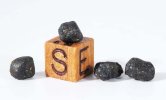
Last photo is related to the article in The Meteorite News Exchange http://www.meteorite-times.com/


 of course, expecting the truth is likely a very tall order and we'll be getting a lot of this instead
  ;D
;D

 that came of it. It is reminicent of spent gunpowder, smells good...To some. I gather this would also be dependant on the composition of the material.

