Brace Yourselves For War Between Iran and Israel

...a to također otvara vrata kibernetičkim napadima usmjerenim na platne sustave na Zapadu, za koje će se naravno okriviti Iran. Veliko resetiranje (konačno) počinje dobivati oblik.:rolleyes:

...and this also opens the door to cyberattacks targeting payment systems in the West, which of course will be blamed on Iran. The Great Reset is (finally) starting to

...and this also opens the door to cyberattacks targeting payment systems in the West, which of course will be blamed on Iran. The Great Reset is (finally) starting to take shape. :rolleyes:

Open 🤔
 
I've seen a couple of mentions and predictions on X that if the conflict continues and Strait of Hormuz is for the most part restricted for shipping to get through that the war will be used as an excuse to implement 'energy shortage lockdowns'.

Here is one as an example:
I'm calling it: there will be ENERGY LOCKDOWNS across Europe starting in approx 2-3 months time. Governments, to allow the US use of their military assets, will order their citizens to STAY AT HOME or use only walking & bicycles for travel to "SAVE OIL TO WIN THE WAR."

Any number of countries, and it is a lot, which get a lot of their energy from the Persian Gulf have a finite supply of natural gas and oil in stock. Once it is depleted then society is very severely affected. I read banded about that the impacts of the war, if it is to continue as it is right now, could end up being worse then Covid plandemic.

I wish I had saved an X post with a rundown of the countries and impacts and also a graphic of all the products and services that are affected by the oil and natural gas shock of no or a very limited supply from the Middle East. It is a lot of things that are essential for civilization to function properly.

Here is an article from Mike Adams that I think gives a pretty good rundown of some impacts, though it is pretty alarmist at some points. Maybe for good reason, if the conflict continues and the strait is closed for some time.


'Global Sulfur Crisis: The Chemical Achilles Heel of Modern Civilization Has Been Severed'

What I have been thinking and feeling for a couple days is that as was talked about for Covid during those times, where they were looking to try to lock everyone down indefinitely, it doesn't hurt to stock up on goods and anything you might need that you use regularly now, if you have the means, in case the war and current state of the energy situation worldwide continues to worsen.
 
will be used as an excuse to implement 'energy shortage lockdowns'.
Sounds like a prelude to 15 minute cities.

...and this also opens the door to cyberattacks targeting payment systems in the West, which of course will be blamed on Iran. The Great Reset is (finally) starting to take shape.
Can't help but think this is the real objective and not let's instigate the Second Coming.
 
I've seen a couple of mentions and predictions on X that if the conflict continues and Strait of Hormuz is for the most part restricted for shipping to get through that the war will be used as an excuse to implement 'energy shortage lockdowns'.

Here is one as an example:


Any number of countries, and it is a lot, which get a lot of their energy from the Persian Gulf have a finite supply of natural gas and oil in stock. Once it is depleted then society is very severely affected. I read banded about that the impacts of the war, if it is to continue as it is right now, could end up being worse then Covid plandemic.

I wish I had saved an X post with a rundown of the countries and impacts and also a graphic of all the products and services that are affected by the oil and natural gas shock of no or a very limited supply from the Middle East. It is a lot of things that are essential for civilization to function properly.

Here is an article from Mike Adams that I think gives a pretty good rundown of some impacts, though it is pretty alarmist at some points. Maybe for good reason, if the conflict continues and the strait is closed for some time.


'Global Sulfur Crisis: The Chemical Achilles Heel of Modern Civilization Has Been Severed'

What I have been thinking and feeling for a couple days is that as was talked about for Covid during those times, where they were looking to try to lock everyone down indefinitely, it doesn't hurt to stock up on goods and anything you might need that you use regularly now, if you have the means, in case the war and current state of the energy situation worldwide continues to worsen.

Yes, and there are also volcanoes with sulfuric acid and acid rain, and meteors and meteor dust. It will be, for some, an interesting transition to 4D, and also for those who perceive 3D
 
Keep telling us how inferior Iran is as a people - the mouse has outsmarted the cat!

(rumble Link)
1773252719448.png
 
Today's insights from our favs - Lt. Col. Danny and Larry, the Shirt here, plus, I'll rant if I want to, Scott Ritter here.

Global Research putting it out there as well:


May the Universe hear the voices of truth over the controlled MSM content of lies - the American public, too. Candace and Tucker, keep kicking a** one podcast at a time! You are getting through! ⚡🔥⚡
 
I've seen a couple of mentions and predictions on X that if the conflict continues and Strait of Hormuz is for the most part restricted for shipping to get through that the war will be used as an excuse to implement 'energy shortage lockdowns'.
About 8 years ago, towns in NE US started installing walking paths, sidewalks, and pedestrian signals at supermarket intersections, and they painted bicycle lanes on all the roads heading to and from supermarkets and any box store that sells food. There was no perceptible reason why this was being done. Someone/something certainly planned for some event in the future to require all these foot and bike paths leading towards food. I figured it was an engineered preparation for food shortages, but it seems the "energy shortage" proposition is a much better explanation.
 
I've seen a couple of mentions and predictions on X that if the conflict continues and Strait of Hormuz is for the most part restricted for shipping to get through that the war will be used as an excuse to implement 'energy shortage lockdowns'.

Here is one as an example:


They won't have to impose anything on the people. If they want to "save energy" i.e. oil and gas, they can just prevent it being delivered to public gas stations.
 
About 8 years ago, towns in NE US started installing walking paths, sidewalks, and pedestrian signals at supermarket intersections, and they painted bicycle lanes on all the roads heading to and from supermarkets and any box store that sells food. There was no perceptible reason why this was being done. Someone/something certainly planned for some event in the future to require all these foot and bike paths leading towards food. I figured it was an engineered preparation for food shortages, but it seems the "energy shortage" proposition is a much better explanation.
Congratulations! You've been Europeinized. 😁
 
Any number of countries, and it is a lot, which get a lot of their energy from the Persian Gulf have a finite supply of natural gas and oil in stock. Once it is depleted then society is very severely affected. I read banded about that the impacts of the war, if it is to continue as it is right now, could end up being worse then Covid plandemic.

I wish I had saved an X post with a rundown of the countries and impacts and also a graphic of all the products and services that are affected by the oil and natural gas shock of no or a very limited supply from the Middle East. It is a lot of things that are essential for civilization to function properly.

Here's an article by Larry Johnson that gives some idea of the countries that are the most vulnerable, and the ones that are the most insulated.


The Persian Gulf is the most consequential body of water in the global economy. Its narrow exit — the Strait of Hormuz, just 33 kilometres wide at its narrowest point — acts as a valve through which flows an extraordinary share of the world’s energy and agricultural inputs. A sustained closure of that valve by Iran will trigger an economic shock with few historical precedents.

Let’s look at the three commodity categories most exposed to such a disruption: crude oil and refined petroleum products, liquefied natural gas (LNG), and urea, the nitrogen fertiliser upon which modern agriculture depends. Together, these three flows underpin not just energy markets but global food security, industrial production, and the fiscal stability of dozens of nations.

The Strait of Hormuz: A Single Point of Failure

Roughly 20–21 million barrels of oil pass through the Strait of Hormuz every day, representing approximately 20% of global petroleum liquids consumption and around 30% of seaborne crude trade. The Gulf states bordering this corridor — Saudi Arabia, the United Arab Emirates, Kuwait, Iraq, Iran, and Qatar — collectively hold the majority of the world’s proven oil reserves and a dominant share of global LNG export capacity.

There is no adequate alternative. The East-West Pipeline across Saudi Arabia (Petroline) can carry around 5 million barrels per day, and the Habshan-Fujairah pipeline in the UAE adds limited bypass capacity. But these routes are insufficient to compensate for a full shutdown, and are themselves vulnerable to sabotage. For the first time in history the oil has stopped flowing.

Oil: The Immediate Shock

The abrupt closure of Persian Gulf oil exports will constitute the largest supply shock in the history of petroleum markets — larger in absolute terms than the 1973 Arab oil embargo or the Iranian Revolution of 1979, both of which removed far smaller volumes, if Iran maintains the blockade for a month or longer. The International Energy Agency estimates that OECD strategic reserves could theoretically cushion a disruption for several months, but the psychological and speculative impact on oil prices would be immediate and severe.

Analysts and historical precedent suggest that oil prices could spike to anywhere between $150 and $250 per barrel — or potentially higher if markets judged the disruption likely to be prolonged. At such prices, the consequences would radiate rapidly through the global economy:

Fuel costs and consumer prices. Petrol, diesel, aviation fuel, and heating oil prices have all surged. In major consuming economies — the United States, Europe, China, Japan, India — consumer price inflation will accelerate sharply with a prolonged disruption. Households will face dramatically higher energy bills and transport costs within weeks.

Industrial contraction. Energy-intensive manufacturing sectors — petrochemicals, cement, steel, aluminium, glass — will face crippling input cost increases. Many would reduce output or shut down. Supply chains across the global economy would seize as freight costs soared.

Aviation and shipping. Aviation fuel costs would make large swaths of commercial aviation economically unviable. Shipping freight rates, already elevated by fuel costs, would compound broader supply chain disruption.

Recession risk. Every major oil price shock since the 1970s has been followed by a global economic recession. A shock of this magnitude would almost certainly do the same. The IMF and World Bank have historically estimated that a $10 per barrel sustained rise in oil prices reduces global GDP growth by around 0.2–0.5 percentage points; a shock ten or twenty times larger would be categorically different in nature.

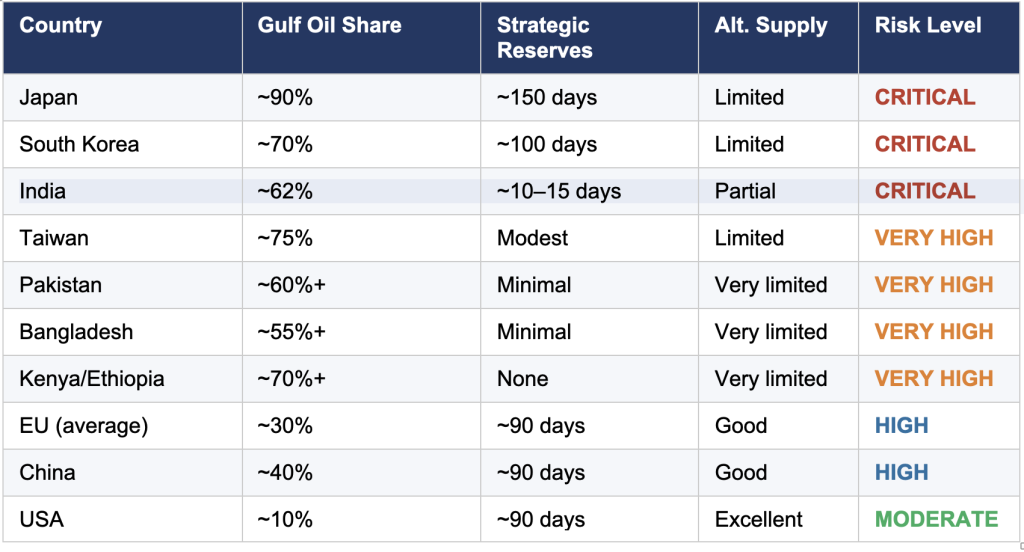
Here are the most vulnerable countries to this shock:

Japan

Japan is the world’s most structurally vulnerable major economy to a Gulf oil shock. It imports approximately 90% of its crude oil from the Middle East, with Saudi Arabia, the UAE, Kuwait, and Qatar as its dominant suppliers. Japan has almost no domestic oil production, very limited alternative import infrastructure, and a dense industrial base dependent on petroleum. Its strategic reserves — among the largest in the world at around 150 days of consumption — provide a buffer, but not immunity. A prolonged closure lasting more than six months would force severe rationing, industrial curtailment, and recession. Japan’s post-Fukushima decision to phase down nuclear power has deepened its vulnerability by reducing the one energy source that could partly substitute.

South Korea

South Korea imports over 70% of its crude from the Middle East, with the Gulf states as its largest suppliers. Like Japan, it has negligible domestic production. Its economy is heavily industrial — semiconductors, shipbuilding, petrochemicals, and steel — all energy-intensive sectors that would face rapid input cost crises. South Korea maintains strategic reserves of approximately 100 days. Its proximity to Japan means both nations would compete for limited alternative supply from West Africa, North America, and Russia, driving prices higher still.

India

India is the world’s third-largest oil importer and sources roughly 60–65% of its crude from the Gulf region, primarily Iraq, Saudi Arabia, and the UAE. It has limited domestic production and strategic reserves of only around 10–15 days — among the smallest relative to import volume of any major economy. India’s fuel subsidy architecture means the government would face enormous fiscal pressure as global oil prices surged, at the same moment that import costs were consuming foreign exchange reserves. For India’s 1.4 billion population — many of whom have limited financial buffers — the pass-through of energy and food cost increases would be devastating. India’s industrial heartland, its agricultural sector (which depends heavily on diesel for irrigation pumps), and its nascent manufacturing base would all be severely disrupted.

Taiwan

Taiwan imports almost all of its energy requirements and sources a significant majority of its oil from the Gulf. As the world’s primary producer of advanced semiconductors, a disruption to Taiwan’s energy supply would carry consequences far beyond its own economy — threatening global technology supply chains. Taiwan’s strategic reserves are modest, and alternative supply routes would be expensive and slow to establish.

Pakistan and Bangladesh

Both nations are heavily dependent on Gulf oil imports and have almost no strategic reserves, limited foreign exchange, and large populations with high fuel and food price sensitivity. Pakistan in particular has endured recurring foreign exchange crises; a surge in import costs would likely trigger a balance-of-payments collapse. For Bangladesh, fuel price increases would threaten the cost competitiveness of its garment sector — the backbone of its export economy — as well as the diesel-powered irrigation that supports its rice production.

Sub-Saharan Africa (Particularly Kenya, Ethiopia, Tanzania)

Many sub-Saharan African nations depend on Gulf oil for a large majority of their refined product imports, with minimal domestic refining capacity and no strategic stockpiles. Countries like Kenya, Ethiopia, and Tanzania would face acute fuel shortages, with knock-on effects on transport, electricity generation, and agricultural supply chains. Governments with limited foreign reserves would be unable to sustain imports at elevated prices for any prolonged period.

LNG: The Gas Markets Upended

Qatar is by some measures the world’s largest single exporter of liquefied natural gas, accounting for roughly 20–22% of global LNG trade. Together with the UAE and other Gulf producers, the Persian Gulf region represents a pillar of the global gas supply architecture. The disruption of this supply arrives into a global gas market already structurally tighter following Russia’s invasion of Ukraine and the reconfiguration of European energy supply.

Japan (Again the Most Exposed)

Japan is also the world’s largest or second-largest LNG importer, sourcing a dominant share from Qatar and other Gulf producers. LNG powers roughly a third of Japan’s electricity generation following its post-Fukushima nuclear drawdown. A loss of Gulf LNG would immediately threaten grid stability, with cascading effects across manufacturing, services, and residential supply. Japan has limited LNG storage capacity and no pipeline gas import option. The combined loss of Gulf oil and Gulf LNG would place Japan under extraordinary simultaneous pressure on two of its three primary energy sources.

South Korea

South Korea is consistently among the top three LNG importers globally, with Qatar one of its largest suppliers. Gas fires a substantial share of South Korea’s power generation. Like Japan, it has no pipeline import option and limited domestic gas production, making seaborne LNG the only supply mechanism. Power shortages would ripple through its semiconductor fabs and shipyards — both globally critical industries.

European Union — Particularly Germany, Italy, the Netherlands, Belgium, and France

European nations pivoted heavily toward LNG imports after Russia’s invasion of Ukraine severed their pipeline gas relationships. Qatar has emerged as one of Europe’s most important LNG suppliers. Germany, Italy, the Netherlands, Belgium, and France have all invested in LNG import terminals and contracted long-term Gulf supply. A Gulf LNG disruption would arrive into a European gas market with reduced pipeline alternatives from Russia, creating acute supply shortfalls particularly in winter months. Germany — Europe’s largest economy and its industrial engine — would face the most severe manufacturing impact, given its gas-intensive chemical, glass, and steel industries.

China

China has surpassed Japan as the world’s largest LNG importer in recent years. It sources a significant share of its LNG from Qatar and other Gulf exporters. However, China has a partial mitigant unavailable to most others: significant pipeline gas imports from Russia and Central Asia, which could be ramped up to partly offset Gulf LNG losses. This makes China more resilient than Japan or South Korea, but still substantially exposed, particularly for provinces distant from pipeline infrastructure where LNG-fired power dominates.

Pakistan

Pakistan has become deeply reliant on LNG imports to fuel its power sector following the depletion of domestic gas reserves. It sources the overwhelming majority of its LNG from Gulf producers. Power cuts — already a chronic problem — would become catastrophic. Industrial output, water pumping, and basic services would all be impaired. Pakistan’s fiscal position is too fragile to sustain premium spot LNG purchases on global markets for any extended period.

Urea: The Overlooked Catastrophe

Of the three commodity shocks, the disruption of urea exports from the Persian Gulf may be the least immediately visible — but could prove the most enduring in its consequences. Urea is the world’s most widely used nitrogen fertiliser. It is synthesised from natural gas via the Haber-Bosch process, and the Gulf states — particularly Saudi Arabia, Qatar, the UAE, and Oman — are among the world’s largest producers and exporters, collectively accounting for a significant share of global urea trade.

The dependency of modern agriculture on synthetic nitrogen fertiliser is difficult to overstate. It is estimated that roughly half of the nitrogen in the human body today passed through the Haber-Bosch process at some point — meaning that artificial fertiliser now sustains approximately half of the world’s population. A collapse in urea supply would threaten crop yields on a global scale.

Crop yield decline. Without adequate nitrogen fertiliser, yields of staple crops — wheat, rice, maize, soy — would fall dramatically within one to two growing seasons. The effect would not be uniform: wealthy agricultural nations with domestic fertiliser capacity or large stockpiles (the United States, Canada, parts of Europe) would be more insulated. The developing world, particularly sub-Saharan Africa and South and Southeast Asia, would face acute shortages.

Food price inflation. Global food prices, already elevated by conflict-related supply disruptions in recent years, would surge further. The Food and Agriculture Organisation’s food price index would likely break historical records. Bread, rice, and staple grain prices would become unaffordable for hundreds of millions of people.

Geopolitical instability. Historical evidence linking sharp food price spikes to political instability is robust. The Arab Spring of 2011 coincided with a period of record food prices. A global urea shortage and its downstream consequences for food security would heighten the risk of civil unrest, state fragility, and humanitarian crisis across numerous countries.

India

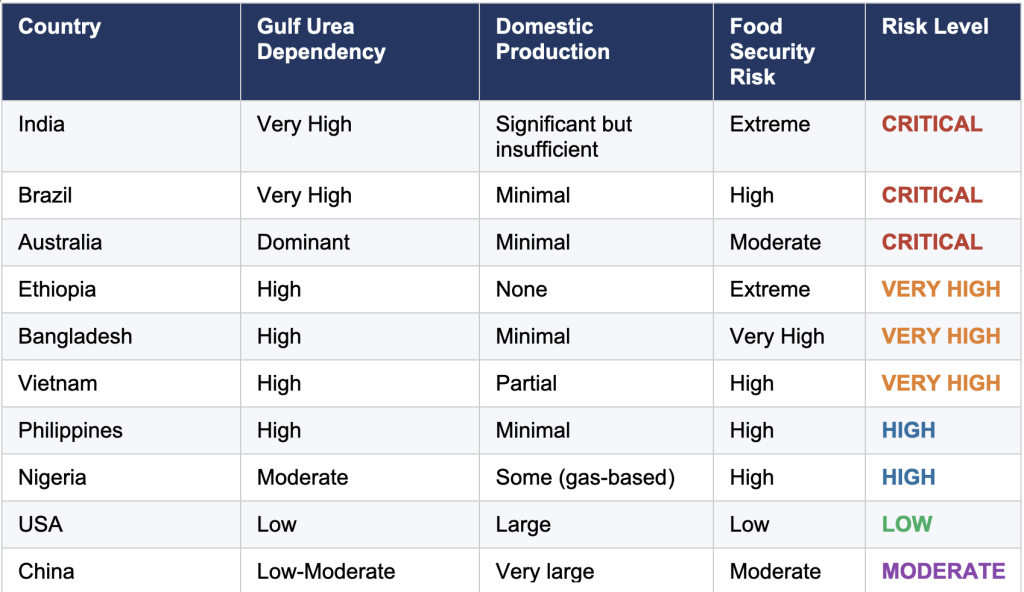
India is the world’s largest urea importer by volume, consuming enormous quantities to support its vast agricultural sector. Despite significant domestic urea production, India’s demand consistently outpaces supply, making it heavily reliant on Gulf imports, primarily from Oman, UAE, and Saudi Arabia. A supply cut would threaten yields of wheat, rice, and pulses across millions of smallholder farms. Given that Indian agriculture supports the livelihoods of roughly half the population, the social and political consequences of a fertiliser shortage would be profound. Food inflation would accelerate sharply and could threaten political stability.

Brazil

Brazil is among the world’s top urea importers, having dramatically expanded its agricultural output — it is now the world’s largest soy and beef exporter, and a major corn and sugar producer. Brazil produces almost no urea domestically at scale and imports a very large share from Gulf producers, particularly from the UAE and Qatar. A urea supply disruption would threaten Brazilian agricultural yields across the Cerrado and Amazon frontier regions, affecting both domestic food supply and Brazil’s critical role as a global food exporter. The consequences would ripple through global commodity markets.

Australia

Australia is one of the world’s most import-dependent nations for urea, sourcing the overwhelming majority from Gulf producers — particularly Qatar and the UAE. It has virtually no domestic urea production capacity. Australian wheat farmers, who produce a globally significant crop, apply large quantities of nitrogen fertiliser; a supply cut would reduce yields and threaten Australia’s agricultural export revenues. Australia is also the world’s largest diesel exhaust fluid (AdBlue) consumer relative to its size, as this urea-derived product is required by most modern diesel vehicles and engines — a secondary vulnerability that became apparent during a 2021 supply shock.

Sub-Saharan Africa (Ethiopia, Tanzania, Mozambique, Nigeria)

Subscribe to New Columns
Sub-Saharan African nations with significant smallholder agricultural sectors are acutely exposed to urea supply disruption. Most have no domestic production and rely heavily on Gulf imports, often through the Indian Ocean trade routes. Fertiliser usage rates in Africa are already among the world’s lowest — meaning yields are already suboptimal — but further supply cuts and price increases would price smallholder farmers out of the market entirely. In Ethiopia, Tanzania, Mozambique, and parts of Nigeria, this would translate directly into food production shortfalls, price spikes, and heightened hunger. The World Food Programme has repeatedly identified fertiliser availability as a critical determinant of food security across the region.

Southeast Asia — Vietnam, Thailand, Philippines

Southeast Asian rice-producing nations — Vietnam, Thailand, and the Philippines — rely heavily on imported urea to sustain their paddy yields. These countries are among the world’s largest rice exporters and form a critical buffer for global food markets. A collapse in their urea supply would reduce rice output, sending prices higher across Asia and the Middle East, where rice is a dietary staple for billions.

Urea Exposure: Country Risk Summary

The Compounding Effect

Several countries face acute exposure across all three commodity categories simultaneously. These nations represent the most extreme cases of vulnerability.

Japan: The Triple Threat

Japan is uniquely exposed on all three fronts: it is the world’s most Gulf-dependent major oil importer, one of the world’s largest LNG importers with no pipeline alternative, and a significant importer of Gulf urea for its rice and vegetable agriculture. A full Persian Gulf shutdown would represent an existential economic crisis for Japan, requiring emergency rationing, international assistance, and an accelerated nuclear restart programme. Japan’s government has long identified Gulf security as a core strategic interest — and for good reason.

India: Scale Makes It Uniquely Dangerous

India faces critical exposure on oil and urea, and significant exposure on LNG. What makes India’s situation particularly alarming is scale: with 1.4 billion people, a fuel subsidy system that creates enormous fiscal pressure when prices rise, minimal strategic reserves, and a large poor population with little financial resilience, the social consequences of a simultaneous oil and fertiliser shock would be catastrophic. India would face simultaneous fuel inflation, agricultural input collapse, food price spikes, and foreign exchange depletion. The political stability implications would extend well beyond India’s borders.

Pakistan: The Fragile State Scenario

Pakistan faces severe exposure on oil and LNG, and significant exposure on urea. Critically, Pakistan begins any crisis from a position of chronic fiscal and foreign exchange weakness. A Gulf shutdown would rapidly exhaust its ability to finance import bills, potentially triggering sovereign default, currency collapse, and widespread civil unrest. Pakistan’s nuclear arsenal makes its potential destabilisation a matter of global security concern, not merely an economic one.

South Korea and Taiwan: Industrial Economies at Risk

Both nations face extreme oil and LNG exposure, and their economies are globally systemically important in ways that extend their vulnerability internationally. South Korea’s steel, chemicals, and shipbuilding, and Taiwan’s semiconductor fabs, supply global industries. Their disruption would cascade through global manufacturing and technology supply chains in ways that a comparable shock to a less industrially specialised economy would not.

Which Countries Are Most Insulated?

Not all nations face equal exposure. Several are significantly better positioned to withstand a Gulf shutdown, either because they produce their own energy, have diversified supply, or hold large strategic reserves.

United States. The US has achieved near-energy-independence through its shale oil and gas revolution. It is a net oil exporter and the world’s largest LNG exporter. It produces large quantities of domestic urea. A Gulf shutdown would raise global prices and affect US consumers, but the supply shock would not directly threaten US energy security. The US is best placed of all major economies.

Canada. Canada is a major oil sands and pipeline gas producer, self-sufficient in energy and a significant fertiliser exporter. Its exposure to a Gulf shutdown is primarily through global price effects rather than supply disruption.

Russia. Russia produces large volumes of oil, gas, and urea, and will likely benefit economically from a Gulf shutdown through higher global prices for its exports. Its energy self-sufficiency is near-total.

Norway. A major oil and gas producer with minimal Gulf dependency. Norway would benefit from higher global energy prices.

Brazil (energy). Brazil’s deep-water oil production makes it largely self-sufficient in crude oil. Its LNG exposure is limited. Its vulnerability is concentrated in urea, where it is critically dependent (as described above).

Historical Context and Strategic Reserves

The 1973 oil embargo — which removed roughly 4 million barrels per day from global markets — caused a fourfold increase in oil prices and contributed to severe recessions across the industrialised world. The current potential disruption would be five times larger in volume terms. The 1979 Iranian Revolution removed approximately 4–5 million barrels per day temporarily; the Iran-Iraq War’s tanker attacks in the 1980s rattled markets without fully closing the Strait. No historical episode provides a true precedent for a complete, sustained Gulf shutdown.

Strategic petroleum reserves maintained by IEA member nations — totalling around 1.2–1.5 billion barrels — could theoretically replace several months of lost Gulf supply if fully released. In practice, coordinated release at the required scale has never been attempted, and the logistical, political, and market-calming challenges would be formidable. Strategic gas and fertiliser reserves are far more limited and will be exhausted much faster.

Conclusion

The Persian Gulf is not merely an important trade route — it is a structural dependency baked into the global economy over seven decades. The simultaneous disruption of oil, LNG, and urea flows from the region constitute a polycrisis of exceptional severity: an energy shock, an industrial shock, and a food security crisis arriving together, reinforcing one another, and challenging the capacity of governments, international institutions, and markets to respond.

Decades of optimisation around cost efficiency — concentrating energy production, fertiliser manufacture, and shipping in the most economical locations — has created a system that is efficient in stable conditions but catastrophically fragile under stress. If Iran is able to sustain the closure of the Strait of Hormuz for a month or more, it will enjoy significant leverage in negotiations to end the blockade.

How’s that for some uplifting analysis?
 
War on Banks:

1) "Iranian officials said US and Israeli strikes targeted a bank in Tehran overnight." (said to handle the soldiers salaries)

2) "Iran warned the attack gives it “free rein to target economic centers and banks” linked to the US and Israel."

3) "Authorities urged residents to stay at least one kilometer away from banks in the region."

"Iranian military officials warned that the United States and Israel have opened the door to attacks on financial infrastructure after strikes reportedly targeted a major bank in Tehran."
...and this also opens the door to cyberattacks targeting payment systems in the West, which of course will be blamed on Iran. The Great Reset is (finally) starting to take shape.
Indeed, as @Natus Videre mentioned, I thought exactly of this when the US and Israel bombing attacks targeted the banks.

I had heard that Iran was reputed for cyberattacks, but to be sure, I did some research to verify this information. So, according to this site
The Iran-Israel Cyber Standoff - The Hacktivist Front:
The Iran-Israel conflict experienced a significant escalation in cyber hacktivist activity between June 12-18, 2025, with over 35 distinct pro-Iranian groups launching coordinated attacks against Israeli infrastructure compared to only 4-5 identified pro-Israeli groups responding. This week-long surge follows the same tactical patterns observed throughout the broader June 2024-June 2025 period, demonstrating that hacktivist groups have not evolved their methodologies despite a full year of operations. The attacks predominantly consisted of DDoS assaults, website defacements, and claimed data breaches targeting government sites, military systems, and critical infrastructure, mirroring the unsophisticated approach used consistently over the past year. Most significantly, these recent attacks maintain the same pattern of exaggeration and disinformation that has characterized the broader hacktivist ecosystem, with groups continuing to take credit for unrelated service outages, recycle old data leaks, and inflate damage claims for media attention rather than achieving substantial operational impact.
It seems that Iranian cyber activists have a rather rudimentary approach.

However, when looking at the countries that are the most dangerous in terms of cyber aggression, they are those allied with Iran, namely Russia and China. According to this article from November 2024, Cyber Warfare Statistic: China and Russi Ranks the Most Dangerous Cyber Aggressive Countries. Here is some information regarding their technological "strike" capabilities::
Cyber warfare intensifies as the U.S. becomes the top target with 11.87% of global share, with China and Russia leading global attacks. Explore how these threats impact government agencies, elections, and global security.

[…]

Could the Third World War be a Cyber Warfare?

The U.S. ranks as the most targeted country, with cyberattacks expected to rise to 68%, while Russia emerges as the second most aggressive attacker, showcasing a significant increase in cyber aggression. Meanwhile, China is predicted to dominate global cyber warfare, leading with 18% of attacks.

With these powerful nations at the forefront, the stakes in cyber warfare are higher than ever, potentially reshaping global conflicts. The third world war might not be fought with conventional weapons but with keystrokes, code, and an invisible army of hackers.

1773280967394.png


1773281010880.png


These 2025 predictions are grounded in the analysis of historical data and current geopolitical trends. They highlight the expected dominance of China, Russia, and Iran in the evolving field of cyber warfare.

1773281028643.png


Conclusion

Cyber warfare is no longer a distant threat but a pressing reality that affects every aspect of our connected lives. The statistics we’ve examined paint a vivid picture of a world where digital conflicts shape global events, influencing economies, politics, and personal security.


As these threats continue to evolve, understanding the data behind them becomes crucial for staying ahead. By acknowledging the patterns and preparing for the future, we can better protect ourselves and our communities in this ever-changing digital landscape.
However, it should be taken into account that the article’s source is pro‑USA, so the information may be biased in order to implicate Russia, China, and India in election interference. Other, more objective sources would be needed.

Recently, there have been attacks by Iran against Israel, targeting Israel’s security cameras, as reported in this article.
Iran-linked hackers target IP cameras across Israel and Gulf states for military intelligence.
According to the Check Point Cyber Security Report 2026, cyber operations are increasingly used to support military activity and battle damage assessment (BDA). During the Israel-Iran tensions, researchers from Check Point Software Technologies observed a surge in attacks targeting IP cameras across Israel and Gulf countries, including the UAE, Qatar, Bahrain, and Kuwait, as well as Lebanon and Cyprus. The activity, attributed to Iran-linked actors, relied on VPN and VPS infrastructure to scan devices, mainly Hikvision and Dahua Technology cameras, for known vulnerabilities.

“During the ongoing conflict, we identified intensified targeting of IP cameras from two manufacturers starting on February 28, originating from infrastructure we attribute to Iranian threat actors.

The targeting extends across Israel, Qatar, Bahrain, Kuwait, the UAE, and Cyprus – countries that have also experienced significant missile activity linked to Iran. On March 1st, we additionally observed camera-targeting activity focused on specific areas in Lebanon.” states Check Point Software Technologies.”

The question I’m asking myself is whether Russia, China, or Iran have the capability to reach Western banks in order to create an economic shutdown.

While searching, I found this information that occurred in August 2024, where “independent hackers” reportedly attacked three major banks in Iran, according to Wikipedia:
In August 2024, an Iranian group called IRLeaks attacked Iranian banks. Policito described the attack as the “worst cyberattack” in Iranian history. According to Policito, the Iranian government was forced to pay millions of dollars to IRLeaks in ransom. Politico reported that 20 out of about 29 Iranian credit institutions fell in the attack. The Iranaian central bank, the Post Bank of Iran and the Bank of Industry and Mines were amongst the banks hit in the attack. The attackers were likely freelance hackers seeking financial gain. The attack occurred after the release of reports that Iranian hackers intervened in the 2024 presidential American elections.

Upon closer examination, it seems that this attack on banks in Iran occurred shortly after the accusations of Iranian hackers interfering in the U.S. elections.

However, in my opinion, I speculate that the group behind the bank attack, IRLeaks, could have been financed by the USA. Thus, this confirms the possibility of attacking banks and suggests that it would be easy to stage a false flag operation by the USA, where they would accuse one of the countries mentioned above (Iran, Russia, or China) of attacking certain major banks on U.S. soil.

Considering the information I found regarding countries with high rates of cyberattacks on other nations, it is possible that this information is biased and only serves to “justify” or provide “false data” that would be used to accuse these countries of such attacks. This, in turn, would give Western financial systems the opportunity to implement their famous “Great Reset”, rebooting the economy in a highly secure, fully digital version.

Regarding the World Economic Forum and their scenario of a cyberattack affecting the financial system, here is a summary of the information that ChatGPT provided me:
the World Economic Forum (WEF) considers that a scenario in which a cyberattack could significantly disrupt the financial or banking system is possible, and even a serious risk to the global economy. However, they also note that such an attack has not yet caused a complete collapse of the financial system.

Here is what their reports and associated institutions say.


1️⃣ Cyberattacks could threaten global financial stability​


According to an analysis published by the World Economic Forum, based on a report from the International Monetary Fund, cyberattacks represent a growing risk for banks and the global economy.
  • The financial sector is a prime target for hackers.
  • A major cyberattack could disrupt essential financial services and lead to a loss of confidence in the system.
  • That loss of confidence could then spread to the entire economy.
The report explains that incidents could, for example:
  • interrupt payment systems
  • prevent access to bank accounts
  • trigger mass withdrawals of money (bank runs)
  • create disruptions in financial markets.


2️⃣ Financial losses from cyberattacks are increasing rapidly​


The reports cited indicate that:
  • nearly 20% of global cyber incidents target the financial sector
  • direct losses exceed $12 billion since 2004
  • banks are among the most frequently targeted institutions.
Experts are particularly concerned about a very large incident affecting a critical infrastructure, for example:
  • a major international payment system
  • a financial clearing house
  • a cloud provider used by multiple banks.


3️⃣ The WEF sometimes refers to a “global cyber-crisis” scenario​


In its cybersecurity reports, the World Economic Forum explains that cyber risks are becoming systemic, meaning they can affect the entire economy and not just a single company.

For example:
  • cyber-enabled fraud and cyberattacks are now among the most significant threats to the global digital economy.
  • the interconnection between digital systems can create a domino effect if a major infrastructure fails.


4️⃣ But experts say a total collapse is unlikely​


Even though the risk exists, specialists explain that:
  • banks invest billions in cybersecurity
  • governments conduct cyber-crisis simulations
  • financial systems have backup and redundancy plans.
In other words, the threat is not ignored — it is actively being prepared for.


✅ Conclusion:

  • Yes, according to the World Economic Forum and the International Monetary Fund, a major cyberattack could seriously disrupt banks or the global economy.
  • However, so far no cyberattack has caused the collapse of the global economy, and financial institutions are actively preparing for such risks.

And despite all the information I found about this fear of cyberattacks and their wishful plan to implement a digital security system for all citizens promoted by the WEF, it made me think of the “mark of the beast” (Visa 666 card) as proposed by the C’s:

Session October 16 1994:
Q: (L) What is the meaning of the number 666 in the book of Revelation?

A: Visa.

Q: (L) You mean as in credit card?

A: Yes.

Q: (L) Are credit cards the work of what 666 represents?

A: Yes?

Q: (L) Should we get rid of all credit cards?

A: Up to you.

Q: (L) Would it be more to our advantage than not to disconnect ourselves from the credit system?

A: Isn't just credit also debit.

Q: (L) Is that an affirmative.

A: How are you going to do this?

Q: (L) Well, do you have any suggestions?

A: World will soon have nothing but credit and debit have you not heard of this new visa debit cards this is the future of money as controlled by the world banking system i.e. the brotherhood i.e. Lizards i.e. antichrist.

Q: (L) If I don't have a credit card then I don't have to belong to this system?

A: No. You will have no choices: belong or starve.

Q: (L) What happened to free will?

A: Brotherhood aka Lizards aka antichrist has interfered with free will for 309000 years. They are getting desperate as we near the change.

Q: (V) It has always been my nature to rebel against that which I did not feel was good for me. Is rebellion against this system possible?

A: If you are willing to leave the body.

Q: (L) Leave the body as in death, croak, kick the bucket?

A: Yes.

Q: (L) If we were to move...

A: Changes will follow turmoil be patient.

Q: (L) We would like to move into the country. Will it be possible to get along without this credit/debit card leading that kind of life?

A: No.

Q: (L) Are they going to have the kind of capability of controlling everything and everybody no matter where they are?

A: Yes.

Q: (L) Even if we moved to Guyana and built a log hut in the rain forest and didn't bother anybody, we'd still get sucked into this thing?

A: Laura you will feel the effect of the Lizard beings desperate push for total control no matter where you go.

Q: (L) That is inexpressibly depressing. Do you understand?

A: Why? Change will follow.

Q: (L) Will it follow soon?

A: You are slipping a bit. Refer to Literature "Bringers of the Dawn". Challenge will be ecstasy if viewed with proper perspective which is not, we repeat: not of third level reality, understand?

Anyway, no matter their scenarios or wishful plans, it seems that these are unlikely to materialize or will collapse before the Great Change.

Session February 25 2023
Q: (Ark) Will this be a hybrid: artificial intelligence with human DNA?

A: Humans wish to do that, but that will not be the outcome since the necessary technological infrastructure will collapse.

Q: (L) So, they're trying to go for these super-humans that they're gonna put electrodes in their brains and all this kinda stuff. But even if they do that, that will fail because...

(Joe) They won't have long enough to implement it before collapse.

(L) Yeah, because remember that other session when they said that all of these big moves were being made for people to be totally, completely controlled... and I mean, ya know, when they said that back... I don't remember when that session was. There was the session about the mark of the beast if anybody wants to pull that up. It was about 666 and "visa". I was complaining at the time, saying, "Oh my god!" And they said, "Why? Change will follow." I think that, put together with the idea that the technological infrastructure will collapse, will mean that the change that will follow will be kind of like a reversion to a more primitive state of existence. Is that...?

A: Somewhat, yes. But it will depend on location. Plus, remember that all these plans of 4D STS are much wishful thinking.

Q: (L) So you're saying that the plan to reduce the population by 94% is not necessarily what's going to happen?

A: Yes

Q: (L) But that is their plan.

A: Yes

Q: (L) That's what they would WISH to happen.

🙏 💖

 
Hegseth is the military command - and trusting CIA/Mossad "intelligence chiefs" may not be the best idea either. Though Trump is most likely lying anyway since it was Netanyahoo who dragged him and the US into this, as Rubio already admitted.
Maybe, but Americans needs to realise that it's not just one man (called Bibi) who's responsible.

Trump's Cabinet, Administration and The Legislator are infested with Zionists and their sympathisers and appologists. One person (much like Hitler) cannot make such a huge mess by themselves. They need supporters, sympathisers, enforcers, spys as well as access to resources.

Effectively the parasite that they are, needs support, the ability to spread, as well as a good "host" or "environment" to both multiply and infest.

My 'theory' (it's really just an idea) is that the Israeli Zionists infiltration into US politics and the Power Structure as well as the Intelligence Services (although they may have already been embedded there), began on the 14th July 1960. This was when LBJ was foised on JFK as his running mate for President. The rest, as they say, is history.

The thing that worries such a lot of people is that they ultimately not only self destruct, but weaken their "host" to such an extent that it may not recover..... at all. :scared:
 
Back
Top Bottom