Brace Yourselves For War Between Iran and Israel

Yeah it's AI... I actually couldn't handle watching it or even listening. It didn't have McGregor's 'essence' and 'human-ness'.
You can tell from the eyes - even though AI is clever and getting 'better' doing all it can to mimic human behaviour even down to making it look like MacGregor really is reading from a screen, and the skin on his neck was moving (that sounds creepy!) but the blinks and expressions are 'wrong': there are no natural pauses, no real change in tone, no 'breath'... no space for the listener to receive more deeply, to emphasise a point or even express genuine emotion (ie: concern) on some level.
In my experience, Col. Douglas MacGregor can’t get through a full minute of speaking without clearing his throat numerous times. Evidently “AI MacGregor” is not only a funhouse mirror distortion of the real man’s reasoning, but also magically healed his chronic cough!😂
 

Iran reportedly has no plans for new talks​


08:51 GMT
"Former Iranian Foreign Minister Mohammad Javad Zarif explained the failure of the talks by a quote from Vance, who earlier said, “they have chosen not to accept our terms.”

“Bingo. No negotiations – at least with Iran – will succeed based on ‘our/your terms’. The US must learn: you can’t dictate terms to Iran,”
he said, adding that “it’s not too late to learn.”

"US Vice President J.D. Vance, who led the US delegation, said Washington was “negotiating in good faith” and made its red lines “as clear as we possibly could,” but Iran has “chosen not to accept our terms.”


  • "Trump claimed the US was already working to reopen the Strait of Hormuz. “We have minesweepers out there. We’re sweeping the strait,” he said, after CENTCOM said that the US Navy destroyers USS Frank E. Petersen and USS Michael Murphy crossed the strait and operated in the Arabian Gulf as part of the mission."

  • "Iranian military spokesman Ebrahim Zolfaghari denied US claims of a minesweeping operation in Hormuz, insisting that any vessel seeking to pass through the key waterway requires permission from the Iranian armed forces."

10:50 GMT
"US Special Envoy Steve Witkoff and Trump’s son-in-law Jared Kushner remain in Islamabad “to continue talks,” according to Al Arabiya."

"Asked about his feelings for Trump, who he once supported, Carlson said he “feels sorry for him, as I do for all slaves.”"

 
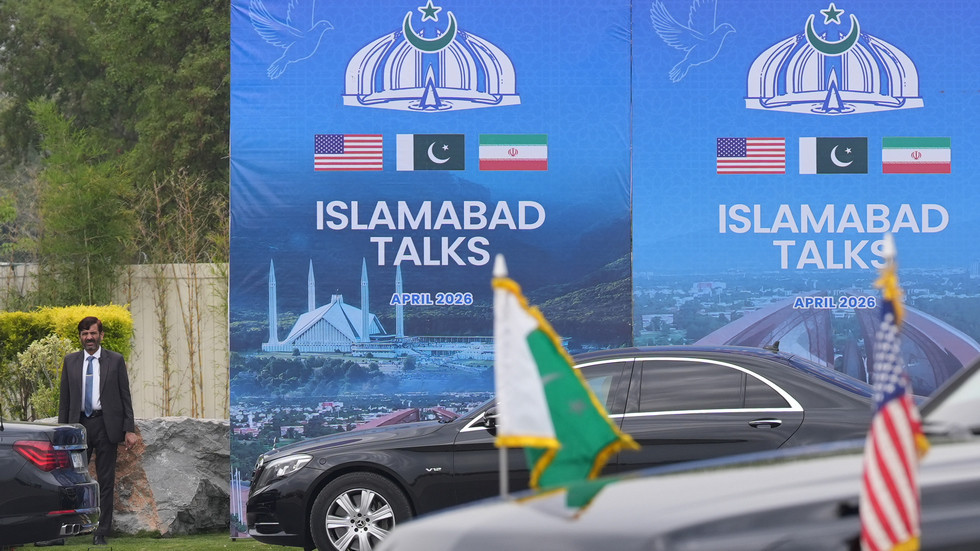
The high-stakes talks between the US and Iran in Islamabad were meant to turn the fragile two-week ceasefire into something lasting. Instead, the marathon talks, lasting some 21 hours, ended with no agreement between the warring parties.

The talks in Pakistan's capital, were the highest-level direct engagement between Iran and the US since the 1979 Islamic Revolution and the American embassy crisis in Tehran. Pakistan acted as "mediator". The stakes were huge. The US-Israeli war on Iran, which began on February 28, has already disrupted global oil supplies and pushed the Middle East to the brink.

While US President Donald Trump had been desperately seeking a way out, an even more desperate Pakistan invited the warring sides to its capital, even as the fragile two-week ceasefire was torn to shreds by the Israeli forces in southern Lebanon.

Experts, before the talks commenced in Islamabad, had pointed out that divisions, mistrust and the ground situation ensured the talks in Islamabad were always on shaky ground. Here are five key points to help you gauge the situation in which the talks in Islamabad were held, and why they failed.

1. RIGID STANCES, DEEP DIVIDES KEPT US, IRAN APART IN ISLAMABAD​

The core reason the US-Iran talks in Islamabad failed was that neither side was willing to compromise or move from its red lines.

The US demanded that Iran halt uranium enrichment and commit not to seek nuclear weapons in the future. Iran refused. It maintained that its nuclear programme was for peaceful civilian purposes.

After the talks, US Vice President JD Vance, who had flown to Islamabad for the negotiations, said, "We just could not get to a situation where the Iranians were willing to accept our terms". Vance, however, said that the American side was "quite flexible and accommodating".

Iran's foreign ministry called the US demands "excessive and unreasonable".

The conclusion of the talks in Islamabad has given an edge to Iran. Iran, which has shown a greater ability to endure pain and impose asymmetric economic costs on the US, felt no urgency to concede in the talks, experts say.

Former American Middle East negotiator Aaron David Miller told CNN that the Iranians "hold more cards than the Americans" after 21 hours of talks ended without an agreement.

"They are clearly in no hurry to make concessions," Miller told CNN, suggesting that Iran appeared to be operating on a slower timeline than the US.

2. WERE TALKS IN ISLAMABAD HELD IN CONDUCIVE ENVIRONMENT? TRUMP'S THREATS LOOMED LARGE​

Peace talks need trust. Or at least some calm, or a sense of it. While the negotiators from Iran and the US huddled in Islamabad, there was neither.

US President Donald Trump, who issued repeated threats to Iran and even said "the whole civilisation will die tonight", did not dial it down even hours before the talks began. While Iranian officials landed in Pakistan, Trump warned he would renew and intensify US strikes if a peace deal was not reached.

That hostile backdrop shaped the talks. Iran saw it as pressure, not diplomacy.

Analysts pointed out that the ceasefire itself came after the maximalist threats from Trump. Instead of building confidence, it hardened the position of Tehran. Iran entered the room wary. The US came in with firm demands. The gap between the two was meant to be widened.

3. DID ISRAEL'S LEBANON STRIKES BECOME A PEACE-BLOCKER?​

Even as Iran-US talks were underway in Pakistan, Israel continued strikes in Lebanon, the territory controlled by Hezbollah, the terror outfit which is part of Tehran's "Axis of Resistance".

Iran wanted the Israeli strikes on Lebanon to stop as a prerequisite for the peace talks. But Israeli Prime Minister Benjamin Netanyahu made it clear the bilateral ceasefire between the US and Iran did not apply to it. Israeli strikes continued on Lebanon.

Pakistan's Defence Minister Khwaja Asif provoked Israel with a tweet, which he later deleted, on the eve of the talks. Asif accused Israel of committing "genocide" in Lebanon. His post seeking the "annihilation of Israel" saw an angry reaction from Israeli PM Banjamin Natanyahu's office.

Meanwhile, the Israeli ambassador to India said that Pakistan was not a credible partner for the peace talks.

The Israeli attacks on Lebanon tested the fragile ceasefire as negotiations began. While Iran pushed for wider de-escalation, the US did not offer guarantees. That made compromise harder.

4. HOW STRAIT OF HORMUZ BECAME A DEAL-BREAKER​

The control of the Strait of Hormuz, which has been largely closed since February 28, turned into a major sticking point in the US-Iran talks.

Iran had earlier mined parts of the strait, which choked shipping and oil flows out of the Persian Gulf. The US wanted Hormuz to be immediately reopened. It saw this as non-negotiable, Trump said repeatedly. He even went on an expletives-laden rant on Truth Social, warning the Iranians that they would be "living in hell", if they didn't open the Strait.

But, Iran sees the Strait of Hormuz as a leverage. It wants relief from sanctions imposed on it and security guarantees first.

According to news agency Reuters, differences over the control of the Strait of Hormuz remained even after progress on other issues. CNN noted that the failure raises fresh concerns about reopening the strait.

Earlier, Trump had told the ABC that he was eyeing a joint venture with Iran to control the choke point and was looking to collect toll from the ships passing the strait. The Iranians have sought formal recognition of its and Oman's control over the strait. It also wants to retain the right to charge transit tolls or fees on shipping at the Strait of Hormuz.

Meanwhile, the US military command, CENTCOM, on Sunday said that two of its ships had travelled through the Strait of Hormuz. But the claim was denied by Iran.

But, the talks in Isamabad did not yield any concrete outcome with regard to the opening of the Strait of Hormuz, which was an immediate demand by the American side.

5. TRUST DEFICIT BETWEEN US, IRAN MADE PEACE TALKS FAIL?​

In the end, trust was the biggest decider in the peace talks in Islamabad. Years of hostility meant both sides doubted each other's intentions. Even before the talks, Iran's negotiator, Mohammad Bagher Ghalibaf said, "We have goodwill, but we do not trust".

That mindset was Iranian baggage that the negotiators carried for 21 hours of talks.

While the American Vice President, Vance, called the US proposal its "final and best", the Iranians saw them as being "one-sided".

It was immediately after the talks in Geneva, which were said to have been positive, that the US and Israel conducted deadly airstrikes on Iran on February 28. For Iran, peace talks also sound like a cover for military offensives.

Given the long history of hostility between the US and Iran, Washington's inability or refusal to rein in Israel's strikes on Lebanon, and its repeated demands that Tehran has already rejected, there was virtually no trust. So, every proposal by the US appeared like a trap. The concession, if at all offered, looked risky. The result was predictable. There was no deal.

The failure of the talks in Islamabad leaves the ceasefire even more fragile. Meanwhile, Pakistan says it will keep trying. But unless the core issues change, the outcome of talks might not.
In short, US is not in a position to negotiate, as it is a "middleman" to Israel. Meanwhile,
Cash-strapped Pakistan is set to receive USD 5 billion in financial support from Saudi Arabia and Qatar, providing a critical buffer for its fragile external position, according to a media report on Sunday.

The expected inflows come at a crucial juncture as Islamabad prepares to repay USD 3.5 billion to the United Arab Emirates (UAE) this month and faces pressure on its foreign exchange reserves, the Dawn newspaper said.


To avert pressure on Pakistan's weak foreign reserves, Saudi Arabia and Qatar will provide USD 5 billion in financial assistance, the report said, quoting sources in the finance ministry.

The development coincides with Finance Minister Muhammad Aurangzeb's visit to Washington to attend the IMF-World Bank Spring Meetings and advance Pakistan's economic diplomacy.

Aurangzeb will participate in the meetings scheduled from April 13 to 18, where he is expected to hold engagements with senior officials of the International Monetary Fund and the World Bank.

Policymakers view these interactions as part of a broader strategic outreach, with indications that traditional factors such as strict programme conditionalities or reliance on third-party guarantors, including the UAE, may carry less weight in the current context.

The IMF has stipulated that Pakistan's three key bilateral creditors – Saudi Arabia, China and the UAE – must maintain their cash deposits with the country until the completion of the ongoing three-year programme. It seems the UAE will be replaced by Qatar, the Dawn report said.

Ahead of his departure, Aurangzeb met Saudi finance minister Mohammed bin Abdullah Al-Jadaan in Islamabad, who also called on Prime Minister Shehbaz Sharif, reflecting continued support at a time when Pakistan has announced plans to clear its UAE debt.

Saudi Arabia remains a major source of concessional financing for Pakistan, having rolled over deposits amounting to USD 5 billion so far.

Pakistan has said it will repay USD 3.5 billion to the UAE by the end of April, a liability that had been rolled over since 2018.
 
Please correct me if my assessment of the (military) power levels is false, but I would assume that the Pentagon files do not contain craft or personnel of 4D STS (UT/Consortium) as those are out of their 3D minions' control.

Level 1 U.S. Armed Forces (Pentagon) comprising conventional and some unconventional weaponry, human personnel

Level 2 Deep State (CIA, NSA, secret societies) - advanced or reverse engineered craft and weapons, DUMBs in cooperation with 4D STS

Level 3 UT/Consort. 4D STS technology, milennia ahead - making use of Grays, hybrids and some mind-controlled enhanced 3 D types


The Consortium is giving to Israel by making use of the U.S.

What purpose has Israel served for 4D STS so far? Mainly gross large scale violence as food for their realm.
(When World War II as an abundant food source ended they immediately created Israel)

Now that Pakistan and Iran possess nuclear weapons they would have to restrain Israel from using their own nukes so as not to lose their primary source of food. They might even go so far as to interfere with Israel's missile electronics and incapacitate them.

Throwing Israel under the bus because it can no longer serve its purpose would entail creating new major havoc on a large scale.
What could it be?
How about a Christian/Islamic sectarian war in Western Europe?

"Please correct me if my assessment of the (military) power levels is false, but I would assume that the Pentagon files do not contain craft or personnel of 4D STS (UT/Consortium) as those are out of their 3D minions' control."

This is a difficult issue to penetrate. The C's have said that parts of the US MIC are working with 4D STS so there could be a layer of military personnel who are in the know about the Consortium and its assets. Remember that the Secret Government forces tried to co-opt Laura's brother who was in the US Navy. Hence, some US military personnel may have dual loyalties. We also know that intelligence operates on a "need to know basis".

Then there are the "undergrounders" who may have their own people in the Pentagon working alongside 3D human agents of the Secret Government. We know there is a whole secret world of undisclosed black (off the books) projects that many senior military officials and politicians are completely unaware of. Didn't the C's say that many scientific discoveries go directly to the Consortium. We are also having to take Gary McKinnon's word for what he saw bearing in mind that he is autistic.​
 
Last edited:
Every body knows "Fool me once, shame on you; fool me twice, shame on me". How many times Usrael cheated in the name of negotiations? The recent lebanon attack on lebanon after the announcement of truce killed 2000 people and injured 6000 people. Imagine the monstrocity of killing 2000 people in one attack? But still Iran went for negotiations despite unreconcilable huge differences. Why?

I guess Iran knows its vulnerabilities and I hope they know what they are doing. In a way, Russia too did similar type of negotiations knowing it is hopeless to believe in NATO puppets. I guess practicalities of War are lot more harsher distant spectators can imagine and wish.

I’d say it is a sign that Iran isn’t run by psychopaths, but by decent men who try everything they can to avoid war. They are showing the world, at least with those with eyes to see, the real nature of Israel and the US , who can’t help but to expose themselves as bad faith monsters.
 
What purpose has Israel served for 4D STS so far?

That is an interesting question which keeps coming back in my head. A way out would be that perhaps some people in the high politics of Israel - are part of Layer 2 or three.

But the main problem comes from Zionism IMO: if I check A. Lobaczewski, it explains the ideology is really th lowest of the lowest level of an overall process ("pathocracy") that which ultimately "eats" the ideology and annihilates it.

Harrison KOEHLI stated:

Pathocracy is a macrosocial expression of psychopathy. It has no fundamental relationship with either zionism or anti-zionism. In other words, a Jewish pathocracy is just as possible as an anti-Jewish pathocracy, or a pathocracy that has no relation to either.

I hope that I was clear enough before so as to show that "the ideology gets eaten during a process & disappears". This means an ideology serves as an intermediary step for something else - and that ultimately it's "pathocracy" that is the real "thing".

And so, the general result - pathocracy - has no fundamental relationship ... with Zionism (can replace this with other ideologies). Means - completely "else", something completely out of its scope and nature. This shows me Zionism stops being the real problem, at some stage. Technically speaking!

From what I understood, the ideology serves as an intermediary "step" for something else, then.

Israel is nowaday pushing for "kill all Arabs". Are they consciously bragging about Zionism (I mean seriously bragging) or is it theater? If yes, it means the whole fringe of Israeli who serve the Zionist cause - will get "replaced". What takes place is that "the pathocracy" (whatever this new challenger is in its essence), when it annihilates the initial ideology - preserves the name... In the case of Israel, the idea would be that at some point, "Zionism" stops having its original content, which becomes replaced by another "content"; but, the name remains, Zionism...

Sorry if you know all of this, but I am trying to formulate a few words so as to answer the question you've raised (because it is of my interest), via the elements I know of, and so trying to progress step-by step. Perhaps if my logic fails somebody can explain me where.

What purpose has Israel served for 4D STS so far?

The problem I see is that Israel is quite a something, perhaps quite an exception because it has always been extremely STS, and that "it sits at the apex ...". My concern is to understand if Israel remains bound to the pathocratic process. I think ... yes... And this would mean that even if the initial Israelis were complete hard core nutjobs - they wouldn't be able to prevent the takeover of their structure by pathocracy.

So my question is to know if Israel can suffer from pathology to the extent of shifting to a pathocracy. That is because from the start they are already very very mad and pathological.

But, well, Hitler's reign was a pathocracy; if Hitler's reign was a pathocracy, Israel can turn into it too. I think Israel won't be able to dodge it.

On that note, I assume it's already the case, but this is a wholly personal & subjective opinion.

I think that since the time, pathology has taken over Zionism, in Israel... so that what we see is already a facade. The name (Zionism) remains, but I think we are now in the further stages described by A. Lobaczewski. (Experts on the matter, please comment and correct, if possible, please!). It could be that all the strong "Amalek" statements are in fact psychopaths, who seized the Zionist ideology - and that they are leveraging it so as to fit their needs. That would be because there have been too bold statements on that "concept" (Amalek), while it's a farce... Spectating serious politicians, encouraging citizen about "Amalek" (whatever this stuff is lol)... Looks comical (if it wasn't that sad...). But ridiculous indeed.

I would say this has the ability to connect some dots and make sense of the whole "religious" & eschatological apparent "push". In fact, Israel is not really pushing for the escathology, and all people believing that this is what Israel does, would be stopping at the "facade", while inside is something completely different. If such a case, the present Israeli government would be pushing eschatological means, but without the belief in it, and only to push a different agenda, and to preserve the original facade (Zionism). But in this case, the power has changed and psychopaths (something else) is in charge.

So, that way, it's the evil from 4D STS who took over and Israel serves as a relay.

When the pathocracy starts to happen, the original tenants of the ideology are discarded, and a front person remains. Is anybody skilled in Israeli politics? If a pathocracy of Zionism kicks in, the initial people who had been carrying the Zionist ideology would have been discarded, for the preference of more psychopathic people. One problem is that the initial Zionists may have been already pathological enough - but the fact remains: at some point, the "team" is replaced, so I think we could spot this in studying the evolution of Israeli politics.

Sorry for the long post, but I think a correct assessment of the situation is than to discard Zionism & religious eschatologies as being the ultimate agenda: I think it cannot be else than an intermediary step.

Another question that which comes to mind: if a pathocracy developps in Israel, things will turn akin to Hitler, Mao and Stalin. From my perspective, it's then indigenous citizen who suffer (except in the case of Hitler, who decided to exterminate Jews). Mao and Stalin featured something like mass detention camps, enslavement, torture and mass deaths among their respective countries. I am wondering what could take place if Israel turns pathocratic: are they to start killing their own (I don't see this happening, so who knows?? Or go like Hitler?

Perhaps, the main goal of STS is to get rid of the semitic genes, and this matches Hitler. Perhaps, the Israeli pathocracy will try to attack Russia, which is a large semitic gene pool. This would explain why Russia does not waste its bullets against Ukraine.

This having been said - let us remind ourselves of "Benjamin Netanyahu", during whatever TV press conference, boldly asserting whatever take on whoever... He becomes the last wheel of the car... Irrelevant person, so not reflective of "Israel" agenda. This example shows a bit that we'd have to understand what those people are really on to. "Pathocracy" indicates a sort of change in the perspective, during the course of events, so that a firm black & white statement on the agenda, is not preferable. Perhaps we need to factor in "pre-pathocracy Zionism", during which Israel truly wanted to eschatologically exterminate Arabas, and then factor in a moment when something else (the parasite of Zionism) took this over, and started to developp a different agenda, inside.

Trying to make sense of A. Lobaczewski!
 
Back
Top Bottom