Brace Yourselves For War Between Iran and Israel

Honestly I wasn’t sure if this is the appropriate thread, but seeing as this is where the focus is, here goes.

Brian Berletic, as always, is continuing to hammer home his references to the policy paper Which Path To Persia. He makes a compelling point that if one zooms out and looks at the wide view, everything that the US is doing and has done, from Venezuela to Iran is in service to cutting off China. Unlike Andrei Martyanov, Berletic contends that Israel is in fact not “running the US” aggression towards Iran, but rather the blockades of both the Caribbean and the Persian Gulf are all steps in isolating the Chinese. The Strait of Malacca would be next, naturally.


So, when you say Trump has authorised pension funds to include alternative assets, I would need to know how Trump can override trustees' powers that are set out in the enabling trust deeds.

The two are not mutually exclusive.

As an example, here in Australia, when you run a Self Managed Superannuation Fund (SMSF), which is basically your own private pension plan, the government tells you what assets are eligible to be used in such funds, and which are not. In Australia, cryptos are not allowed in SMSFs, as far as I know. You are also not allowed to put you own dwelling into the account, etc.

Then the SMSF deed specifies which assets (among those eligible) will effectively be used, and in what percentage. Like for instance cash 0-100%, physical precious metals 0-75%, equities 0-100%, bonds 0-100%, etc.
 
The two are not mutually exclusive.

As an example, here in Australia, when you run a Self Managed Superannuation Fund (SMSF), which is basically your own private pension plan, the government tells you what assets are eligible to be used in such funds, and which are not. In Australia, cryptos are not allowed in SMSFs, as far as I know. You are also not allowed to put you own dwelling into the account, etc.

Then the SMSF deed specifies which assets (among those eligible) will effectively be used, and in what percentage. Like for instance cash 0-100%, physical precious metals 0-75%, equities 0-100%, bonds 0-100%, etc.

On this subject, Australia is set to use superannuation funds for defence spending. I'm sure that I've heard some Australian politician suggesting this as a possibility some time ago but I can't find any reference to an earlier suggestion.


From what I understand so far the idea is that defence investment from super funds will be voluntary. That's not the impression that I got from the earlier mentions that I recall.
 
Honestly I wasn’t sure if this is the appropriate thread, but seeing as this is where the focus is, here goes.

Brian Berletic, as always, is continuing to hammer home his references to the policy paper Which Path To Persia. He makes a compelling point that if one zooms out and looks at the wide view, everything that the US is doing and has done, from Venezuela to Iran is in service to cutting off China. Unlike Andrei Martyanov, Berletic contends that Israel is in fact not “running the US” aggression towards Iran, but rather the blockades of both the Caribbean and the Persian Gulf are all steps in isolating the Chinese. The Strait of Malacca would be next, naturally.


To add to this, Bessent recently sent out a warning that any institution helping Iran process oil funds will be sanctioned. To that tend, he sent some letters to a few banks in China, warning them that they will be sanctioned if they process Iranian funds. To be sure, the guy's some kind of economic genius. 'Since the sanctions on Russia and Iran worked so well - let's do China!'


Let me give you the bottomline up front… Despite positive developments in expanding the ceasefire to include Lebanon and Hezbollah, the Trump administration announced new sanctions on Iran that will end any chance of negotiations with Iran. Unless Trump reverses course, the US is likely to renew its attacks on Iran and will exacerbate the international economic crisis that was ignited by the closing of the Strait of Hormuz.

What a crazy day for intense diplomacy and deal making. Initially, there was a glimmer of hope. It started with the announcement of a ceasefire between Lebanon and Israel, but it was unclear whether that included Hezbollah. By 5 pm eastern daylight time, it was affirmed that this applied to Hezbollah and Israel, although the two sides continued firing at each other until the witching hour arrived.

Iran’s Foreign Ministry Spokesman, Ismael Baqaei, welcomed the development:

"The cessation of war in Lebanon was part of the ceasefire understanding between Iran and America.

From the very beginning, we emphasized the necessity of establishing a simultaneous ceasefire across the entire region, including Lebanon.

We commend the steadfastness of the Lebanese people and the resistance fighters in the face of aggression, and we thank Pakistan for its valuable efforts, especially during the past hours.

We express our solidarity with the Lebanese people and government and emphasize the necessity of the complete withdrawal of the Zionist entity from the occupied territories.

We stress the need for the release of prisoners, the return of the displaced, and the reconstruction of destroyed areas and infrastructure with the support of the international community."

While this is a welcome development, the Trump administration is rejecting another critical Iranian prerequisite for negotiations to end the war, i.e., Iran’s demand that sanctions be lifted. Instead of lifting sanctions, the US Secretary of the Treasury announced a new round of sweeping sanctions that are aimed at Iran and China.

Scott Bessent made several strong statements in on April 14–15 about intensifying economic pressure on Iran through sanctions, with a direct focus on China as Iran’s main oil buyer. Bessent described the new sanctions push as the “financial equivalent” of the earlier US/Israeli kinetic (military) strikes on Iran. He called it part of “Operation Economic Fury”, aimed at cutting off Iran’s revenue streams, especially from illicit oil sales and smuggling networks.

Bessent said that the US would impose secondary sanctions on any countries, companies, or financial institutions that continue buying Iranian oil or that allow Iranian money to flow through their accounts. He described this as a “very stern measure.” He explicitly warned: If Iranian funds are proven to be moving through a bank’s accounts, the US will apply secondary sanctions.

In the course of his diatribe, Bessent revealed that two Chinese banks have already received formal letters from the US Treasury. The letters state that if the banks are found processing Iranian transactions, they face the risk of secondary sanctions. He declined to name the banks. This comes alongside broader Treasury letters sent to financial institutions in China, Hong Kong, the UAE, and Oman.

Bessent went on to accuse China of hoarding oil during the conflict (instead of helping stabilize global markets), limiting exports of certain goods, and continuing to buy large volumes of Iranian crude (historically over 90% of Iran’s oil exports, accounting for about 8% of China’s energy needs). He compared this to China’s behavior during COVID-19 (hoarding medical supplies) and its past threats on rare earth exports, calling it a pattern of unreliability. Bessent stupidly believes the US naval blockade of the Strait of Hormuz, combined with the sanctions threat, will cause China to pause or stop buying Iranian oil. He stated that China “will no longer be able to obtain oil from Iran” under the new enforcement.

To make matters worse, Bessent announced that the Department of the Treasury is canceling sanctions waivers on Iranian (and Russian) oil, targeting Iran’s oil transportation infrastructure and elite smuggling networks (including the Shamkhani family), and working to freeze Iranian leadership funds held abroad. Gulf states are reportedly helping expose hidden Iranian accounts.

I want to emphasize that Bessent made these remarks during White House briefings shortly after a fragile ceasefire in the US-Iran conflict. He said that the goal is to maximize economic pain on the Iranian regime without necessarily resuming large-scale kinetic operations — essentially shifting from military strikes to “maximum pressure” via sanctions and blockades. China is the primary target because it has been Iran’s biggest customer for discounted oil. Bessent framed the policy as a coordinated whole-of-government approach under President Trump to cut off Iran’s funding for terrorism and proxies.

Unless Bessent reverses himself in the next 24 hours there will be no further negotiations between Iran and the United States. China played a critical role behind the scenes in bringing the US and Iran to Islamabad last Saturday for the first round of negotiations. Bessent’s explicit threats against China has enraged the Chinese and solidified their belief that the US is not a reliable negotiating partner. Nope… We’re the enemy.

Any hope that the US could use China to pressure Iran to open the Strait of Hormuz is dashed. This lame, feeble attempt to bully China is backfiring as I write this. Chinese financial analyst, Sean Foo, is gobsmacked by the audacity of Bessent’s threats. China has received the message. Unless the US reverses course, there will be no meeting between Xi Jinping and Trump in China.
 
To add to this, Bessent recently sent out a warning that any institution helping Iran process oil funds will be sanctioned. To that tend, he sent some letters to a few banks in China, warning them that they will be sanctioned if they process Iranian funds. To be sure, the guy's some kind of economic genius. 'Since the sanctions on Russia and Iran worked so well - let's do China!'

Larry Johnson, on the money!
 

Strait of Hormuz open for everyone – Iran​

Tehran has announced the complete reopening of the waterway for the entire duration of the ceasefire in Lebanon
Published 17 Apr, 2026 13:04 | Updated 17 Apr, 2026 13:39
Strait of Hormuz open for everyone – Iran

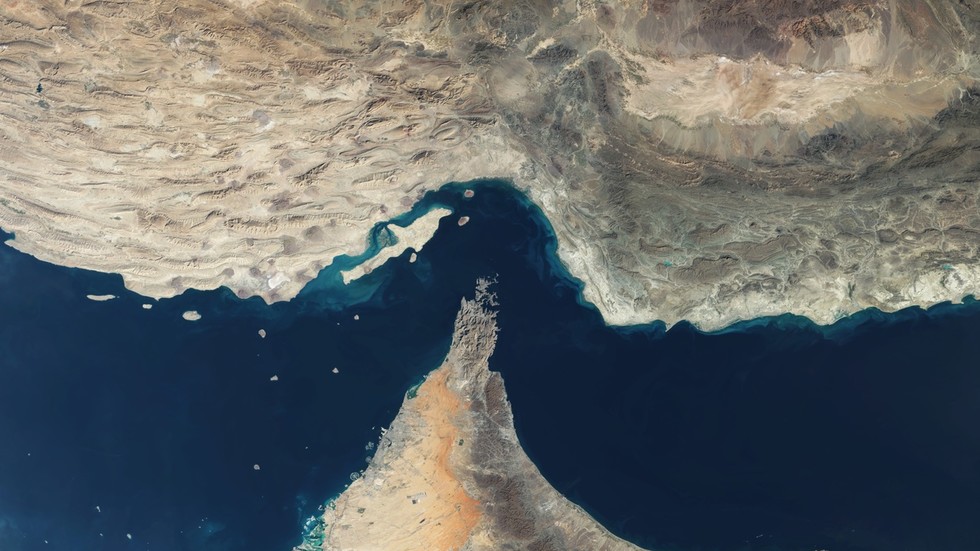
A satellite view of the Strait of Hormuz. © Getty Images / Gallo Images; Orbital Horizon; Copernicus Sentinel Data 2025
Passage for all commercial vessels through the Strait of Hormuz is now completely open, Iranian Foreign Minister Seyed Abbas Araghchi declared on Friday. He added that the waterway will remain open for the remainder of the ceasefire in Lebanon.

Araghchi’s announcement came shortly after a 10-day truce came into force between the Israel Defense Forces (IDF) and the Hezbollah militant group in Lebanon, which has been one of the major obstacles to a peace deal between Iran and the US.

Writing on X, the Iranian minister stated that “in line with the ceasefire in Lebanon, the passage for all commercial vessels through Strait of Hormuz is declared completely open for the remaining period of ceasefire.”

He noted however, that the vessels would be allowed to move along the “coordinated route as already announced by Ports and Maritime Organisation of the Islamic Rep. of Iran,” suggesting that the strait will remain under Tehran’s control.

Israel-Lebanon ceasefire takes effect: As it happened
Read more
Israel-Lebanon ceasefire takes effect: As it happened

US President Donald Trump has responded to Araghchi’s announcement on his Truth Social account, appearing to thank Tehran for fully reopening the “strait of Iran.”

The Strait of Hormuz has been shut down ever since the US and Israel launched an unprovoked attack on Iran in late February. The closure has driven up energy prices and rattled the global economy, disrupting one of the world’s most important trade arteries, which handles around 20% of global crude exports.

In the minutes following Araghchi’s announcement, oil prices plummeted by more than 10%, with Crude oil dropping to just over $83 per barrel and Brent coming in at around $88.
 
Back
Top Bottom