
You are using an out of date browser. It may not display this or other websites correctly.
You should upgrade or use an alternative browser.
You should upgrade or use an alternative browser.
Brace Yourselves For War Between Iran and Israel
- Thread starter Ocean
- Start date


The internet has erupted with memes following Donald Trump's last-minute indefinite extension to the ceasefire with Iran and his decision to keep the Strait of Hormuz closed.
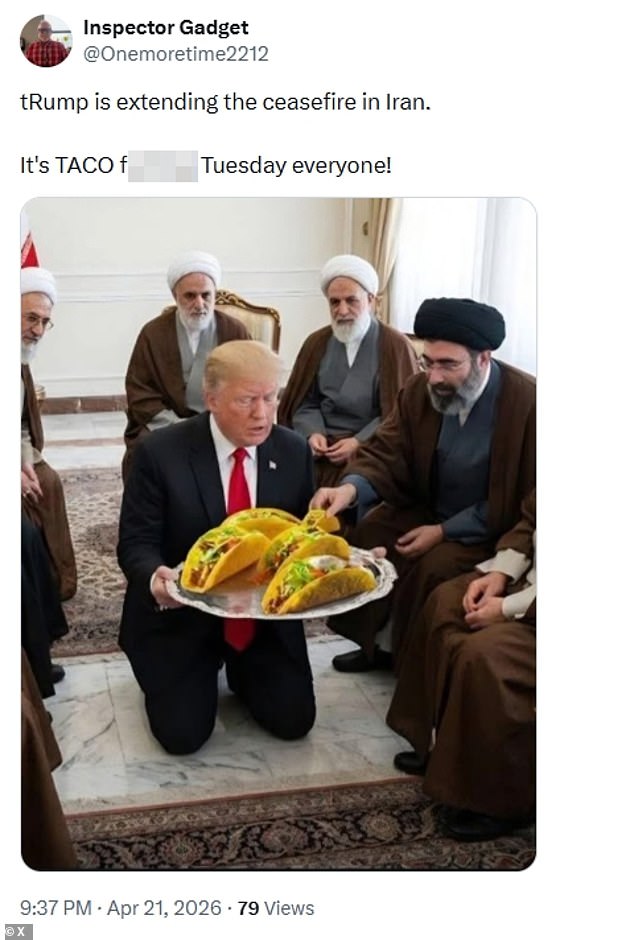
It's Iran war Groundhog Day!
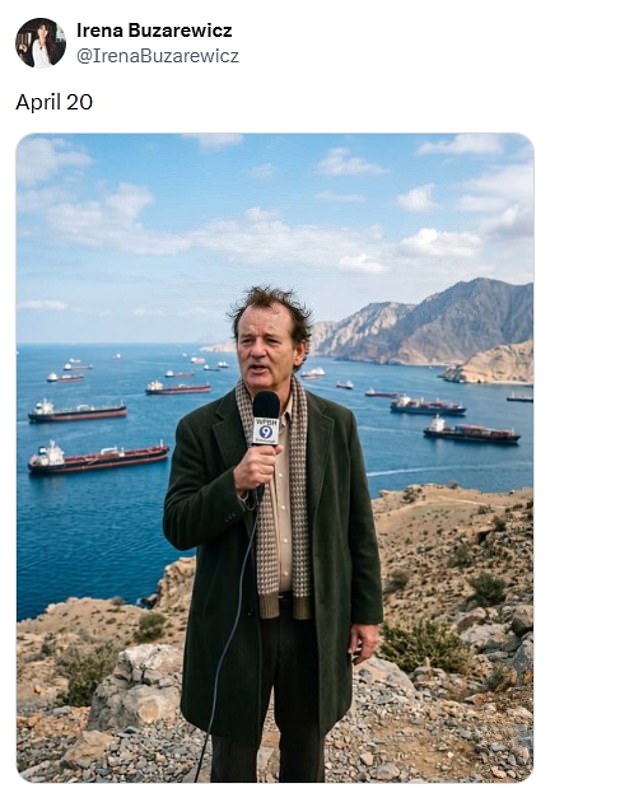
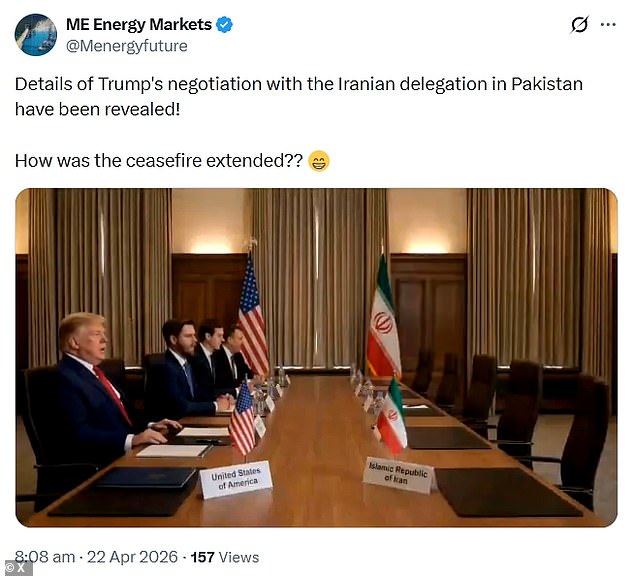

So meme - so meme.
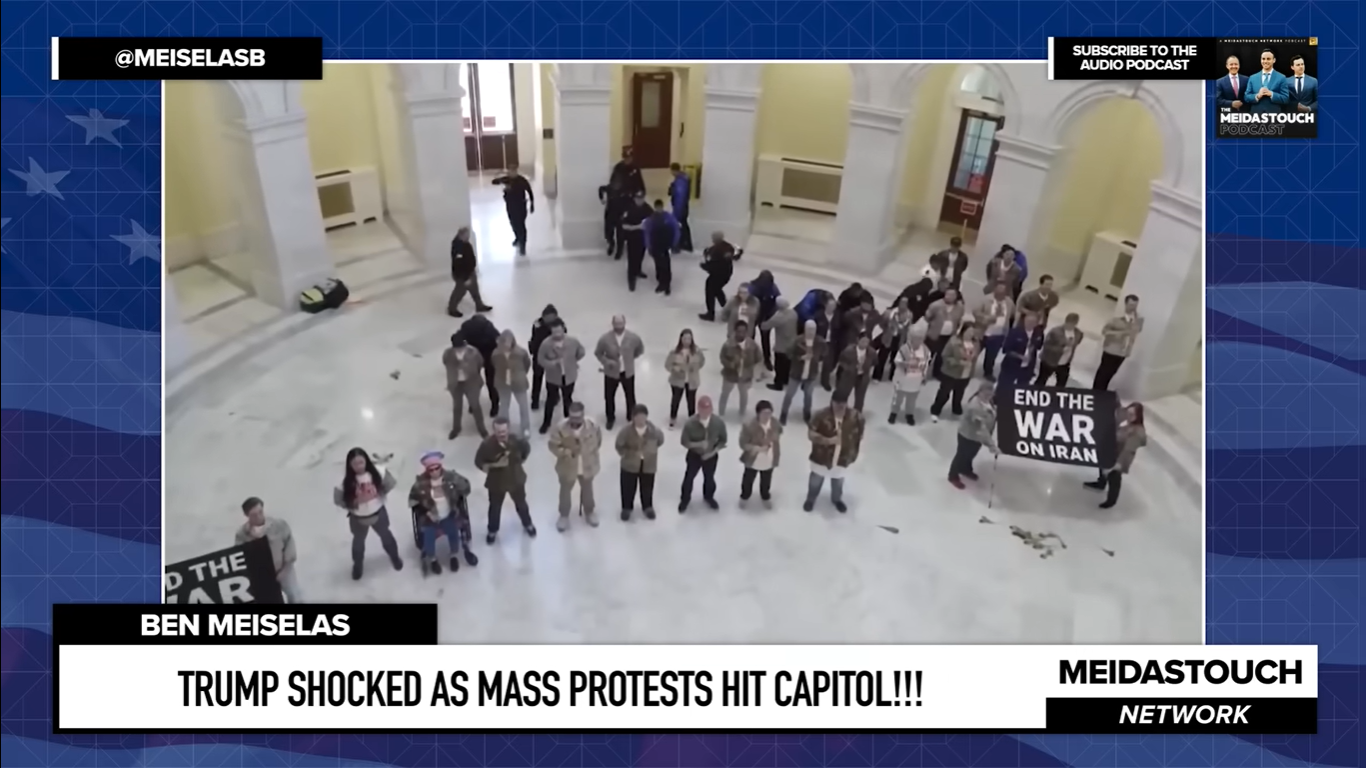
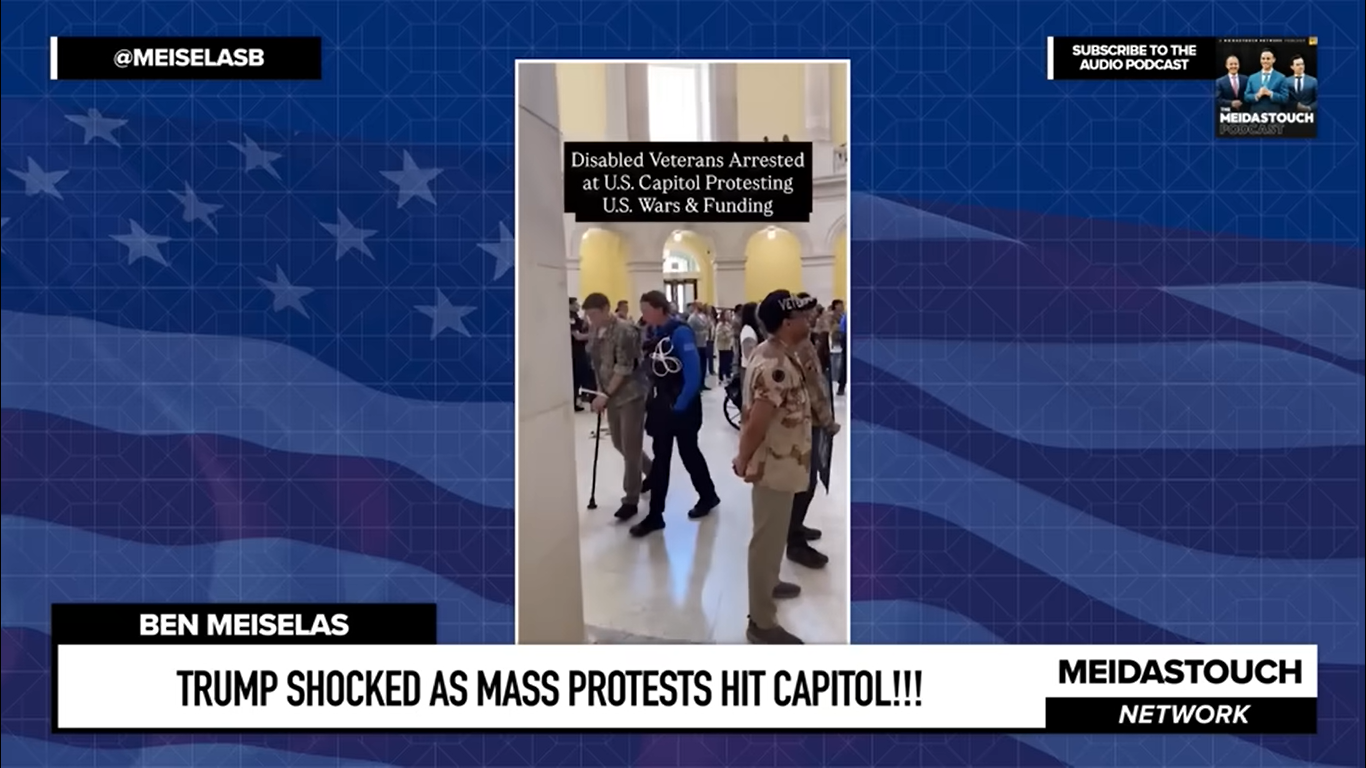
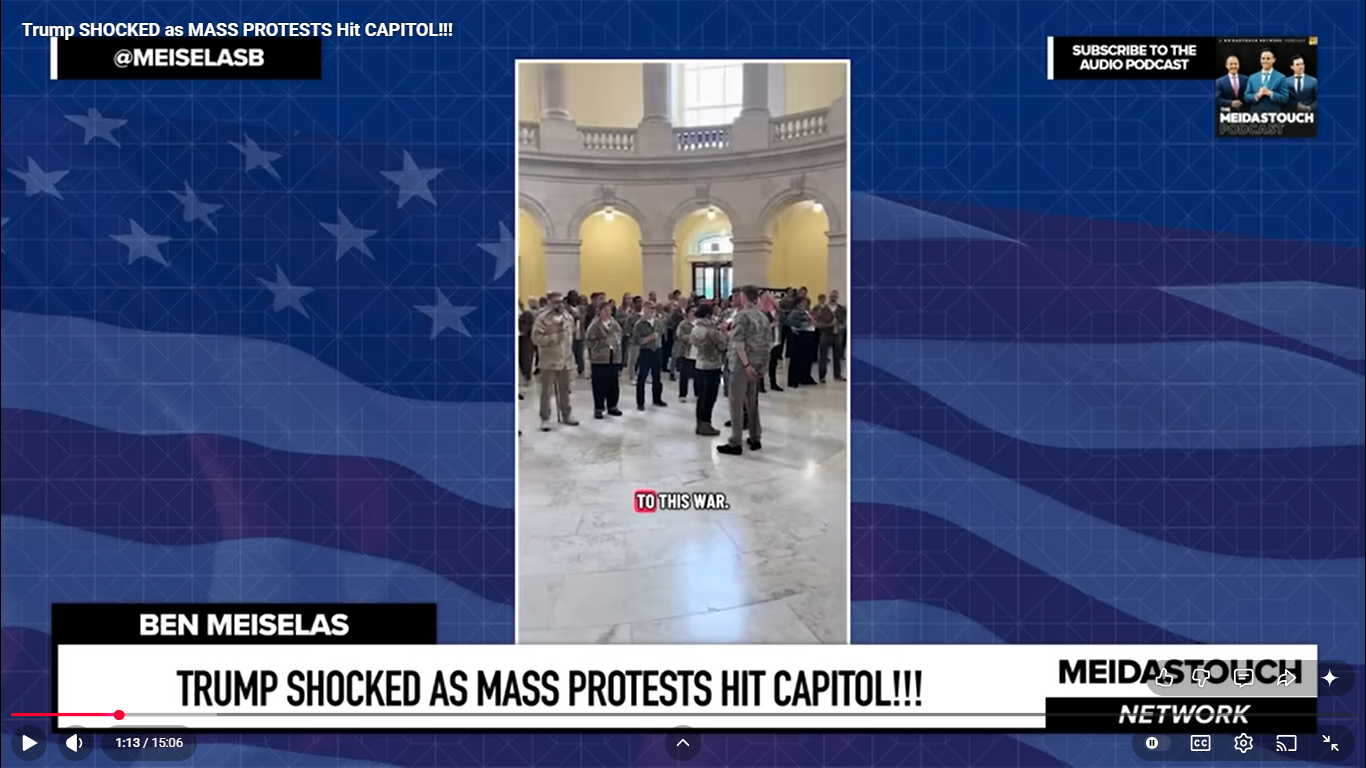
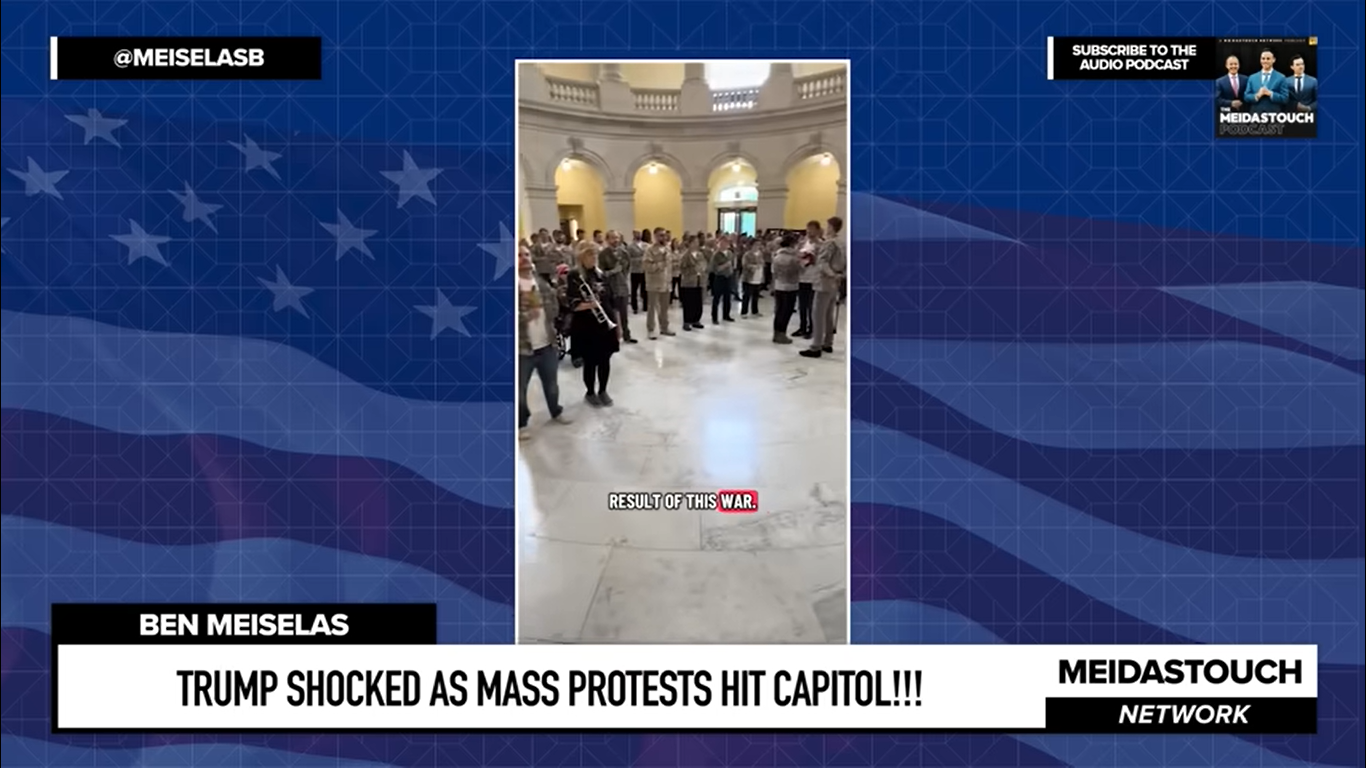
Veterans and disabled veterans arrested in anti-war protest at the Capitol:
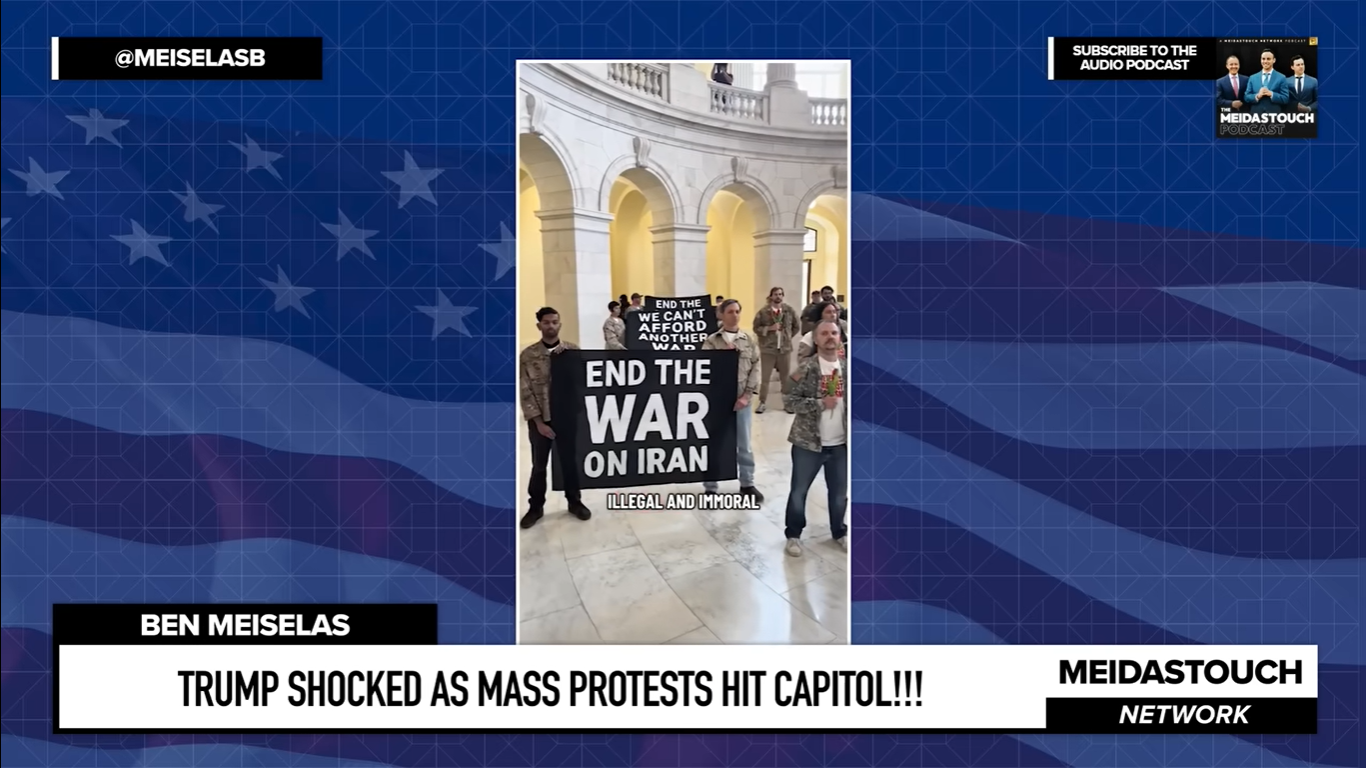
Protestors holding red tulips - a symbol of sacrifice and martyrdom in Iranian culture:

Trump SHOCKED as MASS PROTESTS Hit CAPITOL!!!
Protestors holding red tulips - a symbol of sacrifice and martyrdom in Iranian culture:
Trump SHOCKED as MASS PROTESTS Hit CAPITOL!!!

NOTE KEEPING:
From the US side:
Ceasefire for two weeks (end date "yesterday" the 21st at noon.) then > let's extend it, then > no extension > then indefinite ceasefire > then 3-5 days extension.
From the Iranian side:
Crickets. They have agreed to nothing, in fact have called the ceasefire invalid.
So, is there a ceasefire?
Out of curiosity I check just "when" did Iran fire on the 3 ships. A: today after the ceasefire technically ended, just after midnight on the 22nd. Trump called for the extension a few hours "before" the end of the ceasefire yesterday.
From the US side:
Ceasefire for two weeks (end date "yesterday" the 21st at noon.) then > let's extend it, then > no extension > then indefinite ceasefire > then 3-5 days extension.
From the Iranian side:
Crickets. They have agreed to nothing, in fact have called the ceasefire invalid.
So, is there a ceasefire?
Out of curiosity I check just "when" did Iran fire on the 3 ships. A: today after the ceasefire technically ended, just after midnight on the 22nd. Trump called for the extension a few hours "before" the end of the ceasefire yesterday.

Judge Napolitano and Max Blumenthal share insights on the Israeli conflict (on the Judging Freedom podcast).

 thegrayzone.substack.com
Israel’s ‘yellow line’ turns southern Lebanon villages into empty zones
Apr 22, 2026 #SouthernLebanon #IsraelAttacksLebanon #LebanonBufferZone
Lebanon's Parliament Speaker Nabih Berri has condemned Israel's ongoing occupation of Lebanese land and rejected the so-called Israeli "yellow line" buffer zone, raising fears of a long-term occupation similar to Gaza. In southern Lebanon, the Israeli military's map shows a zone several kilometres deep where it wants to be free of Hezbollah, with Israel asserting control by fire and levelling villages where Shia Muslims live, declaring at least 50 towns no-go zones — unlike during Israel's 18-year occupation that ended in 2000, people are not being allowed back. Hezbollah is relying on guerrilla tactics — near daily attacks and ambushes — to break any military boundary Israel tries to impose. By Israel's own admission, Hezbollah is still south of the yellow line, meaning this is contested territory.
Second French soldier dies of wounds sustained in Hezbollah attack on UN peacekeepers (by Sniper fire )
)
Macron says Cpl. Anicet Girardin succumbed to wounds in France after being hit by gunfire in attack on base in south Lebanon last week

Corporal Anicet Girardin of the 132nd Canine Infantry Regiment in Suippes, repatriated yesterday from Lebanon, where he had been seriously wounded by Hezbollah fighters, died this morning from his injuries. He died for France. The Nation, which will pay tribute tomorrow to Warrant Officer Florian Montorio, fatally wounded in the same ambush, deeply honors the memory of Corporal Anicet Girardin and his sacrifice. It extends its deepest condolences.…
Max Blumenthal: Trump thumps Bible, scuppers Iran negotiations
On Judging Freedom, Max says Israel, evangelical Zionists, and Trump’s inner circle are driving the Iran war, while the Vatican and MAGA revolt expose the whole thing as a civilizational assault dressed up as “negotiation.” And while Trump’s base revolts, Max reveals that Trump will appear that...
thegrayzone.substack.com
On Judging Freedom, Max says Israel, evangelical Zionists, and Trump’s inner circle are driving the Iran war, while the Vatican and MAGA revolt expose the whole thing as a civilizational assault dressed up as “negotiation.” And while Trump’s base revolts, Max reveals that Trump will appear that day at a Bible-reading marathon before his most loyal followers.
Israel’s ‘yellow line’ turns southern Lebanon villages into empty zones
Lebanon's Parliament Speaker Nabih Berri has condemned Israel's ongoing occupation of Lebanese land and rejected the so-called Israeli "yellow line" buffer zone, raising fears of a long-term occupation similar to Gaza. In southern Lebanon, the Israeli military's map shows a zone several kilometres deep where it wants to be free of Hezbollah, with Israel asserting control by fire and levelling villages where Shia Muslims live, declaring at least 50 towns no-go zones — unlike during Israel's 18-year occupation that ended in 2000, people are not being allowed back. Hezbollah is relying on guerrilla tactics — near daily attacks and ambushes — to break any military boundary Israel tries to impose. By Israel's own admission, Hezbollah is still south of the yellow line, meaning this is contested territory.
Second French soldier dies of wounds sustained in Hezbollah attack on UN peacekeepers (by Sniper fire
)Macron says Cpl. Anicet Girardin succumbed to wounds in France after being hit by gunfire in attack on base in south Lebanon last week
Corporal Anicet Girardin of the 132nd Canine Infantry Regiment in Suippes, repatriated yesterday from Lebanon, where he had been seriously wounded by Hezbollah fighters, died this morning from his injuries. He died for France. The Nation, which will pay tribute tomorrow to Warrant Officer Florian Montorio, fatally wounded in the same ambush, deeply honors the memory of Corporal Anicet Girardin and his sacrifice. It extends its deepest condolences.…

Trump has extended the ceasefire with Iran indefinitely after the Iranian delegation failed to arrive in Islamabad. Meanwhile, he said a second round of US-Iran talks could take place within the next three days, though Tehran vehemently denies this.

As expected the US are interdicting ships in the Gulf of Oman but don't have the resources there to enforce a true blockade. That's according to these tanker tracking accounts:

 www.vortexa.com
So far on our list, there are six tankers which have been interdicted by the US Navy and/or Coast Guard in some form or another; be it a hands-off redirection or a physical boarding. Five of these tankers are Iran-flagged belonging to the National Iranian Tanker Company (NITC) while the non-NITC TIFANI (9273337) is flying an unknown flag, according to the United Nations International Maritime Organization (IMO).
Transit or no transit - that’s the question | Vortexa
The US Naval Blockade starting April 13 2026 has increased the challenge for vessels to enter or leave the Middle East Gulf via the Straits of Hormuz
Accordingly, we have to differentiate two distinct and operationally independent blockades:
- Iranian de facto closure of the Strait of Hormuz enforced by the IRGC since 28 February,
- A US naval blockade of Iranian ports initiated by CENTCOM on 13 April, which is not necessarily implemented close to Iranian ports nor within the Strait of Hormuz, but flexibly around an area about 300miles to the West between the Pakistani/Iranian border and the most western “corner” of Oman.
Vortexa has observed the following on the water activity for energy tankers related to the US Naval Blockade, focussing solely on sanctioned tankers and those with Iranian links (loaded from Iranian ports currently or in recent months) (all other tankers from the eastern part of the UAE or Oman are supposedly free to pass).
→ 34 energy tankers with Iranian links transited the area (inbound and outbound) (April 13 - April 21)
→ 6 dark outbound transits were carrying 10.7mn barrels of Iranian crude (April 13 - April 21)
While causing widespread media attention, from a fundamental point of view the US blockade is unlikely to have any meaningful effect on Iranian crude supply to the market in the medium term (2-3 months).
Concerning seaborne crude imports, this is because about 160mb of Iranian crude are on the water, 130mb of which are already outside the US blockade area. This is sufficient to supply about 2.5 months of typical Chinese import needs, and more vessels are likely to trickle through the US net.
And Iranian oil production is unlikely to be immediately constrained because it would take 22 days for Iran to reach its maximum observed fill level since 2020, if it stores 1.5 mbd of crude production in storage tanks. And even more important, ballast tanker supply may be sufficient to sustain production for up to two months in total, albeit precautionary production curtailment is likely earlier. But again these figures are for a case where the US blockade hinders 100% of the Iranian oil traffic, which appears unlikely on the initial indications.

Iran has gotten 3 ships.As expected the US are interdicting ships in the Gulf of Oman but don't have the resources there to enforce a true blockade. That's according to these tanker tracking accounts:
Since there were reports of ships passing through, both took action on it. And to demonstrate just how effective their blockades are, I guess.
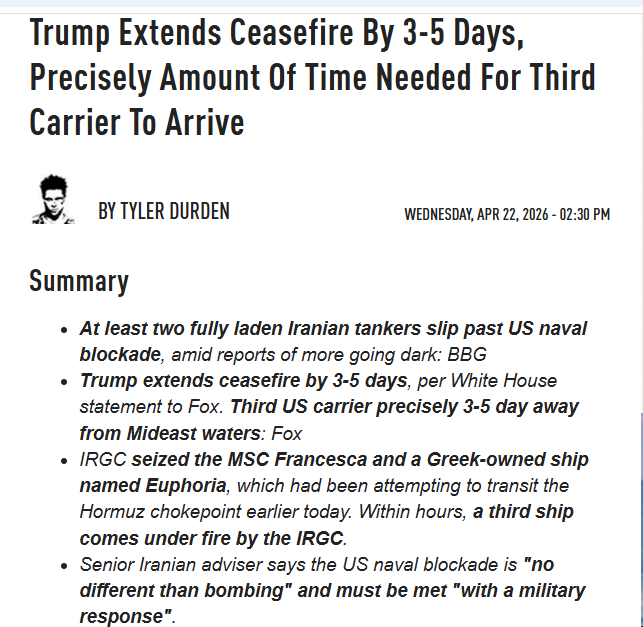
Indefinitely now 3 to 5 days:
 www.zerohedge.com
- Competing narratives emerge over what Iran calls "fake news" as Trump hails "release" of 8 Iranian women said to be facing death penalty.
Plot Thickens, Gets More Bizarre: Iran Denies 8 Women Set to Be Executed
There's been a lot of fresh back and forth over Trump's initial Truth Social Post earlier this week: first he demanded that eight young women he said were on death row in Iran for protesting must be released. Then on Thursday Trump proclaimed that Iran complied.
But Iran is rejecting the whole narrative as fake news from the start. "Trump was misled once again by fake news," the judiciary's official Mizan Online website said. "The women who were claimed to be on the verge of execution, some of them have been released, while others face charges that, if convictions are upheld, would at most result in imprisonment." The Times (UK) picked up on the story, but underscored:
The image Trump recirculated was originally created by the Lawfare Project, a pro-Israel organisation based in the US.
The human rights organisation Hiwa identified the women in the post. They included Panah Movahedi Salamat and Ensieh Nejati.
Trump Extends Ceasefire By 3-5 Days, Precisely Amount Of Time Needed For Third Carrier To Arrive<!-- --> | ZeroHedge
ZeroHedge - On a long enough timeline, the survival rate for everyone drops to zero
www.zerohedge.com
The giant fly in Iran's ointment?
And below, Hendry lays out why Iran is cornered...
With this week's lack of talks (and the US ceasefire/blockade still in play now), the question is how long does Iran have before it folds from pain, or its ideological inability to come to the Infidels' table makes it a shadow of its former self.
The answer is Iran has very limited time left - according to JPMorgan's latest estimates:
Hendry concludes:
And global capital markets have already moved to price that eventuality in.
www.zerohedge.com
And below, Hendry lays out why Iran is cornered...
"Iran’s oil system is not built to pause. It’s built to flow. It’s a flow system.
Oil cannot simply sit in the ground while strategists argue over maps and how much uranium dust to give over. It has to move. Iran and its system has to move continuously from the rock underground to the tanker in the harbor to the Chinese buyer in Asia.
Pause long enough, and the whole machine breaks.
Interrupt that flow. And the problem isn’t just lost revenues of like forty, fifty, sixty billion dollars. It’s the least of your concerns. The problem is physical and is irreversible.
Because when you suddenly shut the well, remember there’s no physical storage. They pump, they load, they ship.
If they can’t load, if they can’t ship, they can’t pump. And when you suddenly shut the wells, the pressure underground drops fucking fast.
Do you know what happens?
The heavy, sticky crap in the oil, it gums up, gums up in the tiny holes within the rocks and becomes like glue. It traps the oil. It makes it really fucking hard to extract. And once that damage is done, it’s permanent. You lose a big chunk of the oil.
The more Iran is actively either through theater or through bluff, the more that it sits in a standoff, the more it is actively destroying the one thing that it actually depends upon.
That’s the trap. And you’re not reading in in the press, but you’re damn well reading it on your screens.
Because this is where the gap between the narrative of the media and the price stops being subtle and irrelevant, and it’s why stock markets have priced something entirely differently.
The Iranian system, the adversary, cannot afford to stay disrupted without hurting itself. That's what's in the equity market's price."
With this week's lack of talks (and the US ceasefire/blockade still in play now), the question is how long does Iran have before it folds from pain, or its ideological inability to come to the Infidels' table makes it a shadow of its former self.
The answer is Iran has very limited time left - according to JPMorgan's latest estimates:
...with a "total export blackout" having effectively started this weekend, Iran now has about 15 days before it has to begin production shut-ins, which then have to be fully completed by day 30, or sometime around May 20.
Hendry concludes:
"...the market has priced the probability.
And right now, the probabilities tell you. Well, what do they tell you? They don’t point to an empowered adversary like Iran dictating terms to a paralyzed American administration.
They certainly do not tell you that.
They point to something simpler, a constrained energy producer hitting the natural limits of its own system. A system put on pause that needs flow. A system that is precariously on the edge of irreversible damage."
And global capital markets have already moved to price that eventuality in.
'Time Is Running Out For Iran': The Market Is Calling 'Bullshit' On Mainstream's Narrative, Hugh Hendry Explains...<!-- --> | ZeroHedge
ZeroHedge - On a long enough timeline, the survival rate for everyone drops to zero
www.zerohedge.com

That is assuming that the US blockade will be more effective and Iranian oil tankers cannot get out. I think the US itself may not be interested in oil prices climbing even higher, at least not the Republicans before the elections.The answer is Iran has very limited time left - according to JPMorgan's latest estimates:
Though with Israeli psychos at their side who finally got their US-Iran war, all bets are off...

I put it here as this is oil related. Can something be really off? Refineries have certainly frequent problems. Are those problems out of statistics?
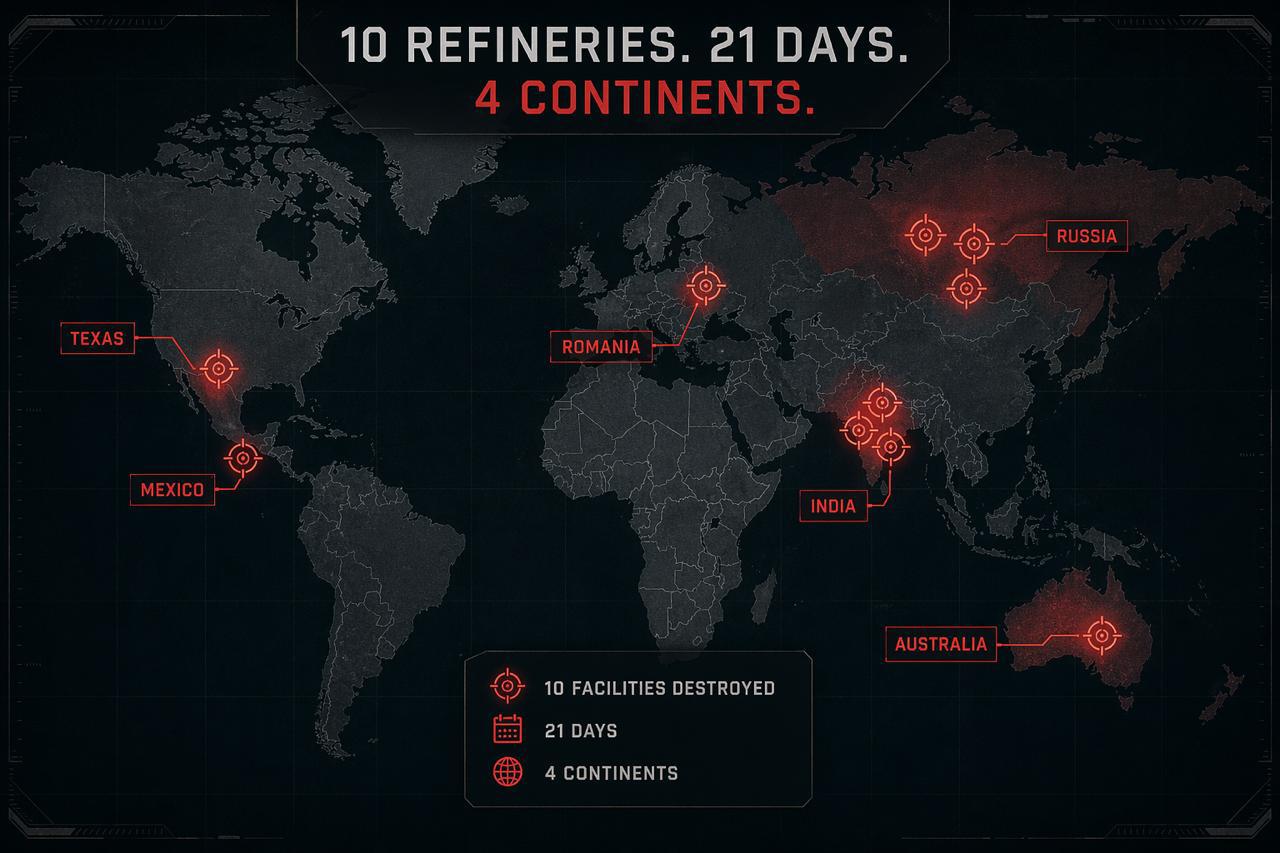
Ten oil refineries have exploded in 21 days. Since April 3rd, ten oil refineries, power plants, and energy facilities in seven countries have been destroyed by "fires," "explosions," and "accidents."
- Russia — THREE facilities destroyed in 21 days
- India — THREE facilities destroyed in 21 days
- Australia — 10 percent of national fuel production CRUSHED in one night
- Mexico, Romania, Texas — ALL lost a major energy site within the same 21-day window
- The Viva Energy refinery in Geelong, Australia, produces 120,000 barrels per day. A fire has taken this offline for months.
- Russian refineries have been hit by drones for 18 months.
- There are approximately 600 operational refineries on Earth. Losing 10 of them in 3 weeks is not statistical noise.
- Global refining has NO spare capacity. Every facility is running at full capacity because post-COVID demand has never decreased. One refinery lost = real shortages within 60 days.
- In 2019, a SINGLE attack on Abqaiq in Saudi Arabia paralyzed 5.7 million barrels per day and sent oil prices up 15 percent in a single session. We are witnessing this same dynamic, spread across the planet.
Last edited:
Trending content
-

-
Thread 'Coronavirus Pandemic: Apocalypse Now! Or exaggerated scare story?'
- wanderingthomas
Replies: 30K -
-

