Can you see what is hidden in those pics ?

Couple of images:

This isn't just a picture of two squirrels on a branch. Can you see two hidden image within?
ardillas2.jpg


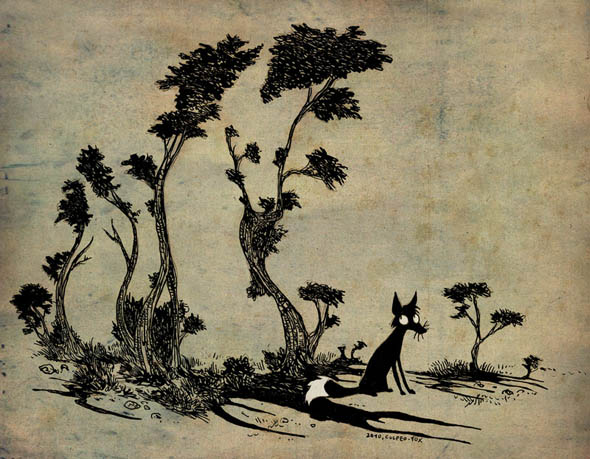
Scan the negative space in this whimsical illusion by Culpeo. Can you see what's haunting this fox?
haunted_by_culpeo_fox.jpg
 
Myrddin Awyr said:
Couple of images:

This isn't just a picture of two squirrels on a branch. Can you see two hidden image within?

Yep, a woman's face and a male's body.

Myrddin Awyr said:
Scan the negative space in this whimsical illusion by Culpeo. Can you see what's haunting this fox?

Not as sure about that one. Looks like it might be a wolf, though. :)
 
Bud said:
Yep, a woman's face and a male's body.

It took a little while for me to see a man in the picture.

Bud said:
Not as sure about that one. Looks like it might be a wolf, though. :)

Yeah, I can see that he is scared of a wolf...or a bigger fox. :)
 
Re: Can you see what is hidden in those cool pics ?

Bud said:
Yep, a woman's face and a male's body.

<snip>

Not as sure about that one. Looks like it might be a wolf, though. :)

I think it's a wolf, too. Isn't it fun to look for hidden images without being told what to look for? :)

Anyway, I found a section in Levine's In An Unspoken Voice where it might be relevant here regarding a "shift" in perception/attention.

page 76-78 said:
Step 2: Support initial exploration and acceptance of sensation

Traumatized individuals have lost both their way in the world and the vital guidance of their inner promptings. Cut off from the primal sensations, instincts and feelings arising from the interior of their bodies, they are unable to orient to the "here and now." Therapists must be able to help clients navigate the labyrinth of trauma by helping them find their way home to their bodily sensations and capacity to self-soothe.

To become self-regulating and authentically autonomous, traumatized individuals must ultimately learn to access, tolerate and utilize their inner sensations. It would, however, be unwise to have one attempt a sustained focus on one's body without adequate preparation. Initially, in contacting inner sensations, one may feel the threat of a consuming fear of the unknown. Or, premature focus on the sensations can be overwhelming, potentially causing retraumatization. For many wounded individuals, their body has become the enemy: the experience of almost any sensation is interpreted as an unbidden harbinger of renewed terror and helplessness.

To solve this perplexing situation, a therapist who (while engaging in initial conversation) notices a momentary positive shift in a client's affect - in facial expression, say, or a shift in posture - indicting relief and brightness, can seize the opportunity and try to direct the client toward attending to her sensations. "Touching in" to positive experiences gradually gives a client the confidence to explore her internal bodily landscape and develop a tolerance for all of her sensations, comfortable and uncomfortable, pleasant and unpleasant.

The client can now begin to allow the underlying disowned sensations - especially those of paralysis, helplessness and rage - to emerge into consciousness. She develops her experience of agency by choosing between the two opposing states: resistance/fear and acceptance/exploration. With a gentle rocking back and forth, oscillating between resistance and acceptance, fear and exploration, the client gradually sheds some of her protective armoring. The therapist guides her into a comforting rhythm - a supported shifting between paralyzing fear and the pure sensations associated with the immobility. In Gestalt psychology, these back-and-forth movements between two different states are described as figure/ground alternations (see Figure 5.1).

vase.jpg

Figure 5.1 This figure demonstrates the alternation of figure and ground perception. Do you see the vase or the face? Keep looking. Now what do you see? You will probably notice that the vase and face alternate but cannot be perceived at the same time. This is a useful concept in understanding how fear is uncoupled from immobility. When one experiences pure immobility, one cannot (like vase and face) also feel fear at the same time.​

This shifting, in turn, reduces fear's grip and allows more access to the quintessential and unencumbered (by emotion) immobility sensations. This back-and-forth switching of attention (between the fear/resistance and the unadulterated physical sensations of immobility) deepens relaxations and enhances aliveness. It is the beginning of hope and the acquiring of tools that will empower her as she begins to navigate the interoceptive (or the direct felt experiencing of viscera, joints, and muscles) landscape of trauma and healing.
 
Myrddin Awyr said:
...I found a section in Levine's In An Unspoken Voice where it might be relevant here regarding a "shift" in perception/attention.

May be. Seems more like a guided "Mindfulness Practice" using a facilitator in a therapeutic setting. If it works and genuinely helps though, they can call it what they want, I reckon.

BTW, speaking of hidden stuff and just out of curiosity, do you see any connections between those illusions, internal considering, the therapy mentioned above and the following quote from Don Juan?


[quote author=Journey to Ixtlan]
To not-do what you know how to do is the key to power. In the case of looking at a tree or bush, what you know how to do is to focus immediately on the foliage. The shadows of the leaves or the spaces in between the leaves are never your concern. Start focusing on the shadows of the leaves on one single branch and then eventually work your way to the whole tree, and don't let your eyes go back to the leaves, because the first deliberate step to storing personal power is to allow the body to not-do. The body likes things like this. You can stop the world using this technique. Once you have succeeded, you must work as if nothing has happened to you and don't mention or even be concerned with any of the events you have experienced.[/quote]

The connections I see relate to what I refer to as distinctions or boundaries.

For example: the boundary between the solid material and negative space in the pictures and the same things for the Don Juan quote; the boundary between the sensations and the interpretations within the therapy setting; and the self-remembering act of noticing one's awareness crossing an imaginary boundary between the perception of phenomena external to the body and the internal thinking space's inner dialog.

For me it was all hard to describe at first, because it was just an intuitive knowing of which way (or to what thing) a particular "boundary line" was assigned as belonging to. That is what seems to be the mechanics of the "shift" in perception/attention as I understand it for the most part. :)
 
Back
Top Bottom