Gravity waves

shijing

The Living Force
I thought the following article might be relevant, given the way in which 'unstable gravity waves' are mentioned in the transcripts:

‘Non-discovery’ of space-time ripples opens door to birth of the Universe (August 20, 2009)

_http://www.timesonline.co.uk/tol/news/science/article6802383.ece_

Scientists have peered further back in time than ever before using instruments designed to search for a phenomenon predicted by Albert Einstein almost a century ago but not yet proven to exist.

An American observatory hunting for ripples in space and time called gravitational waves has produced its most significant results yet, despite not having directly detected any.

The “non-discovery” offers insights into the state of the Universe just 60 seconds into its existence. Previous research has been unable to look back in time further than about 380,000 years after the big bang.

The new window on the dawn of time has been opened by the Laser Interferometer Gravitational-Wave Observatory (LIGO), a network of three detectors that have been seeking evidence of gravitational waves since 2005.

These waves, which are believed to stretch and squeeze space and time as they pass, were predicted by Einstein in his theory of relativity. Violent events, such as a supernova explosion or the collision of two black holes, should make the biggest and most detectable waves. While their existence is accepted by astrophysicists, they have never been directly detected. LIGO has not yet found any gravitational waves either, and this has important implications for astrophysics and cosmology.

Certain theoretical models of what happened in the first moments of the cosmos predict that gravitational waves should be visible in LIGO’s data. As none have been detected, the “non-findings” narrow down possible explanations for the growth of the Universe.

The research, which is published in the journal Nature , also offers proof that gravitational-wave observatories will open up new horizons for astronomy, allowing scientists to examine aspects of the cosmos that have previously been hidden from view, such as supernovas and black holes. The first 380,000 years after the big bang are opaque to conventional telescopes that use the electromagnetic spectrum.

Professor David Reitze, of the University of Florida, the spokesman for the LIGO scientific collaboration, said: “Gravitational waves are the only way to directly probe the Universe at the moment of its birth; they’re absolutely unique in that regard. We simply can’t get this information from any other type of astronomy.”

According to standard theories, the big bang generated a flood of gravitational waves during the first moments of time, which still fill the Universe. The strength of these background ripples in space and time will have been determined by the structure of the young Universe.

LIGO’s failure to detect any signals from these waves in the particular frequencies that it can observe shows the maximum strength that this background can possibly have. The results, therefore, rule out several hypotheses about the early Universe that predict a stronger gravitational-wave background.

The findings should help to explain why and how the Universe acquired its “lumpy” structure, in which matter is concentrated into galaxies with huge areas of empty space in between.

They appear most consistent with the idea that this lumpiness evolved from random fluctuations in the temperature of the Universe when it was microscopic in size. These then became magnified as the Universe inflated.

Professor Jim Hough, of the University of Glasgow, who contributed to the research, said that there was about a one in eight chance that LIGO would detect gravitational waves directly in the next 18 months. If it does not, upgrades to the instruments, which should be ready in 2014, are almost guaranteed to pick them up.

The waves are difficult to detect because the ripples are extraordinarily small. Over the distance between Earth and the star Alpha Centauri — 4.3 light years — a gravitational wave would warp space by as little as the thickness of a human hair.

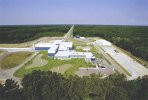
The LIGO detectors are designed to pick up such tiny perturbations using vast L-shaped instruments. There are two detectors in Hanford, Washington, one with arms two kilometers (1.2 miles) long and one with arms of four kilometers, and a four-kilometer facility in Livingston, Louisiana.

When a gravitational wave passes it will cause one arm to shrink while the other lengthens — by a distance of just one ten thousandth of the diameter of an atomic nucleus.

For a wave to be confirmed it must be observed by at least two detectors. Europe also has two detectors — the Virgo facility in Italy and the GEO600 facility in Germany.
 
That's interesting, at the start of the article, I was thinking it must be a piece of equipment in space, but it's actually Earth based. One wonders if there is another reason for creating/installing these detectors.
 
anart said:
That's interesting, at the start of the article, I was thinking it must be a piece of equipment in space, but it's actually Earth based. One wonders if there is another reason for creating/installing these detectors.

Like what?
 
rs said:
anart said:
That's interesting, at the start of the article, I was thinking it must be a piece of equipment in space, but it's actually Earth based. One wonders if there is another reason for creating/installing these detectors.

Like what?

incoming gravitational bodies?
 
1984 said:
There is also this SOTT article from June that might be of interest.

Thanks 1984 -- I didn't find this when I did a search earlier, but its a great complement to the present article.
 
Hi everyone..(I know,..I need to do my intro!) ..but I love reading the threads here, and I just had to comment on this one.

I'm with anart on this one...like so many other things, there's more here than meets the eye. In this case if you look very objectively at the facts, even to the point where you remove the "why and what for" you still have a nice juicy FACT...that is, someone has spent, and is planing to spend, a great deal of time and money on detecting a thing that is hypothetical, or in more simplistic terms, that DOES NOT yet exist!? Please note, I understand ...that's what true scientific research is about.

Ask Ark, or any scientist about securing small (in compassion to these detectors) research grants to prove anything that doesn't lead directly to corporate profits. Its well known that these things are under-funded.

Another thing that comes to mind, is of course, good old human nature, and the tendency to "fiddle while Rome burns". Things like these huge ground detectors, just don't "get done" without a damn good reason. What jumps out at me is this..THEY ALREADY KNOW THAT GRAVITY WAVES EXIST!

They've flashed us a glance at their hole card. They know what we know. I think of these ground detectors just like tsunami detectors and seismographs. i.e., it registers variables that we are already aware of... and like Laura and the C's have stated, the time frame of its arrival is not precisely known. Its all very logical..your aware of the "grand cycle", you know these waves exist, you don't know exactly when they'll arive, but you know its soon, AND you already have a contingency plan to avoid the known effects of said wave, all that's left is to have a functioning detector to give you time to "get outta Dodge"....and here it is, right in front of our eyes.
Its SO obvious.

( It must have been a tough day at STS HQ when they realized they couldn't very well hide these things from the sheep...but I'm sure someone at the BS factory got a gold star on their head when they came up with the Einstein connection/excuse....its the perfect name to drop in case the sheep start asking questions....you know, their eyes just kind of glaze over, and they quickly return to their grazing.)

Anyway..that's my way of looking at it, and I must say its circumstantial conjecture based on one fact...but like the ole' eight ball used to say.."all signs point to yes". Have a wonderful day, D
 
Nomad said:
rs said:
anart said:
That's interesting, at the start of the article, I was thinking it must be a piece of equipment in space, but it's actually Earth based. One wonders if there is another reason for creating/installing these detectors.

Like what?

incoming gravitational bodies?

Good one. Maybe this project was really about the Sun's black twin to begin with.
 
There is also this:


http://www.globus.org/solutions/data_replication/

The Laser Interferometer Gravitational Wave Observatory (LIGO) is a multi-site national research facility whose objective is the detection of gravitational waves. LIGO consists of two facilities, one in Livingston, LA, and one in Richland, WA, operated jointly by the California Institute of Technology (CalTech) and the Massachusetts Institute of Technology (MIT). The LIGO detectors at these two sites work together to detect gravitational waves: tiny distortions of space and time caused when very large masses, such as stars, move suddenly. The LIGO detectors are used together and in cooperation with detectors in other countries to look for coincident signals that may be indications of gravitational waves.


The Challenge
The data generated by a LIGO run must be scientifically analyzed for it to be of any value. The analysis is computationally intensive (some classes of astrophysical searches can require hundreds of Teraflops), and the data volume itself is quite large. Nine sites within the LIGO collaboration (each operated independently) currently provide computing facilities based on commodity cluster computing. The scientists who have the expertise to perform this analysis are spread across 41 institutions on several continents, and this community is growing all the time. The key challenge for LIGO is to get the data from the LIGO detectors to the sites where analysis happens and to make those sites accessible to the participating scientists.

The data management challenge faced by LIGO is therefore to replicate approximately 1 TB/day of data to multiple sites securely, efficiently, robustly, and automatically; to keep track of where replicas have been made for each piece of the data; and to use the data in a multitude of independent analysis runs. The nine sites each use mass storage systems, but different systems are used at different sites. Scientists and analysts need a coherent mechanism to learn which data items are currently available, where they are, and how to access them. More specific requirements include the following.

When high-bandwidth network links (10+ Gb/s) are available, they should be utilized efficiently: there should not be unused bandwidth while data transfers are taking place.
All network links should be used efficiently: there should be no idle time on the network between transfers.
Scientists should be able to to locate data and understand data items using application-level terms (also known as "metadata").
Scientists should be able to locate replicas (copies) of any data item using database queries.
Data transfer endpoints should be authenticated using "strong" security, and data transfers should preserve data integrity.

Results

The LIGO detectors went online and began producing data in 2002. By April 2005, the LIGO team had used LDR to replicate well over 50 terabytes of data to sites including CalTech, MIT, Penn State University, and the University of Wisconsin Milwaukee, along with sites in Europe including the Albert Einstein Institute in Golm, Germany, Cardiff University, and the University of Birmingham.

LDR was developed by Scott Koranda, Brian Moe, and Kevin Flasch at the University of Wisconsin-Milwaukee in cooperation with the NSF-funded GriPhyN and iVDGL projects and the DOE-funded SciDAC Data Grid Middleware project. Many members of the LIGO Scientific Collaboration have contributed to deploying and testing LDR.

Having learned from the LIGO project's success with LDR, members of the Globus Alliance have designed and implemented a Data Replication Service (DRS) that provides a pull-based replication capability similar to that provided in the LIGO LDR system. DRS is implemented as a Web service that complies with the Web Services Resource Framework (WS-RF) specifications. The DRS is available as a technology preview in the Globus Toolkit 4.0, and the LDR team plans to test DRS as a potential replacement for LDR's data publishing component. The long-term goal is for the Globus Toolkit to provide reusable services in this area (like DRS) so that applications like LDR can be created with little or no new code.


http://www.ligo.org/partners.php

Partner Experiments and Collaborations

The GEO600 Experiment / Collaboration
The German/British collaboration for the detection of gravitational waves (GEO) has built a detector of arm length 600m (GEO600) near Hannover in Germany, with the purpose of joining in a worldwide search for gravitational radiation from astrophysical sources and of developing advanced interferometric and suspension technologies for later gravitational wave detectors. An MOU (memorandum of understanding) between the GEO and LIGO science collaborations establishes joint analysis of data from GEO600 and the LIGO interferometers by the members of both collaborations, and thus all members of GEO600 are also members of the LIGO Scientific Collaboration.

The Virgo Collaboration / European Gravitational Observatory (EGO) consortium
The VIRGO collaboration is composed of approximately 200 scientists and technicians coming mainly from the CNRS and INFN laboratories and from EGO. The VIRGO collaboration is responsible for overall scientific exploitation of the VIRGO gravitational wave antenna. The European Gravitational Observatory (EGO) consortium has responsibility for construction, commissioning and operation of the VIRGO gravitational wave antenna, and for current and future upgrades of the VIRGO antenna.

The Large-Scale Cryogenic Gravitational Wave Telescope
The LCGT project aims to construct and operate a single 3km baseline cryogenic interferometer underground in Japan at the Kamioka mine. The aim is to minimize gravitational gradient and thermal noise through underground location combined with cryogenic suspended optics in a kilometer baseline instrument, for the first time. The project is a development of the TAMA300 experiment.


LISA - The Laser Interferometer Space Antenna

LISA is a proposed joint NASA/ESA mission to deploy a constellation of three satellites at the vertices of an equilateral triangle five million kilometers on a side in heliocentric orbits twenty degrees behind that of the Earth. The long baseline allows detection of gravitational waves in the frequency band of approximately 10 microhertz to 100 millihertz. Location in space has the twin advantages of allowing longer baselines and avoiding seismic noise that on Earth's surface precludes sensitive detection below approximately 1Hz. A technology mission, LISA pathfinder, is due to be launched in 2011 to test key LISA technologies.
 

Attachments

  • ligo-livingston.jpg
    ligo-livingston.jpg
    50.5 KB · Views: 28
Dave said:
They've flashed us a glance at their hole card. They know what we know. I think of these ground detectors just like tsunami detectors and seismographs. i.e., it registers variables that we are already aware of... and like Laura and the C's have stated, the time frame of its arrival is not precisely known. Its all very logical..your aware of the "grand cycle", you know these waves exist, you don't know exactly when they'll arive, but you know its soon, AND you already have a contingency plan to avoid the known effects of said wave, all that's left is to have a functioning detector to give you time to "get outta Dodge"....and here it is, right in front of our eyes.
Its SO obvious.

Pryf said:
The Laser Interferometer Gravitational Wave Observatory (LIGO) is a multi-site national research facility whose objective is the detection of gravitational waves. LIGO consists of two facilities, one in Livingston, LA, and one in Richland, WA, operated jointly by the California Institute of Technology (CalTech) and the Massachusetts Institute of Technology (MIT). The LIGO detectors at these two sites work together to detect gravitational waves: tiny distortions of space and time caused when very large masses, such as stars, move suddenly. The LIGO detectors are used together and in cooperation with detectors in other countries to look for coincident signals that may be indications of gravitational waves.

I think that these are really good points -- I have the same feeling about other projects such as the south pole telescope, that is supposedly only used by astronomers for a fraction of the year, but I bet that it gets a lot more traffic than that. I originally posted the original article merely because of the reference to 'gravity waves', but now that this additional information has been posted, it does seem likely that someone has a specific reason to want these detectors to be in place that involves more than the sheer love of science.
 
Thank you shijing, I think we can agree on this...In my experience, ( and I DO see this reflected in my own nature) people and larger organizations, have a tendency to NOT get their ass out of the fire until they start to smell smoke.....or the one word definition...procrastination.

It does appear to be a HUGE expenditure to "look for coincident signals that may be indications of gravitational waves."

I think they know what they're doing.
 
Dave said:
I think we can agree on this...In my experience, ( and I DO see this reflected in my own nature) people and larger organizations, have a tendency to NOT get their ass out of the fire until they start to smell smoke.....or the one word definition...procrastination.

It does appear to be a HUGE expenditure to "look for coincident signals that may be indications of gravitational waves."

I think they know what they're doing.

Yes, and I also agree with everything that you suggested in your first post on this thread. It is hard to nail down really large sums of funding for specific projects like this, so when something like this happens, I think you are right to suggest that there is more going on than meets the eye, and that dual-purpose is involved. Besides the south pole telescope, I bet the Large Hadron Collider falls into this category, as well as the better-known examples of HAARP and the space missions.
 
I visited Caltech's gravity wave detector when they had an open house a few years ago. It's interesting to see, so I hope that some day a video crew will get footage that shows this installation.

It is an underground L shape with each arm something like a hundred feet long. Here is how the guide explained the system. A laser beam is split so that a beam goes down each arm, and is reflected back and forth many times. Then the two beams return to a detector, which measures whether or not the beams arrive back at the same time. Normally they should arrive at the same time, because each beam traveled the same total distance.

If a gravity wave were to pass through the detector, that would be expected to alter the speed of light for one of the arms. As a result, the beams would arrive at the detector at two different times. A gravity wave would pass through the earth. Each of the gravity wave detector installations around the world could compare their results, which would let them figure out the path of the gravity wave. Physicists would then attempt to interpret the data to explain the potential nature and cause of the gravity wave. Such explanations would be beyond the scope of the detection effort.

The most immediately obvious item of interest to the visitor is the laser beams. They are so thin that individual cells in the retina are sometimes set off and sometimes not. As a result, the beams appear to be speckled, but the apparent moving grain pattern is actually an artifact of the human eye's construction. A photograph or video of the beam might also look speckled, if individual film grains or pixels were larger than the actual diameter of the beam. This is true of any narrow diameter laser, but it stood out very clearly in a dark basement room with clean air and long laser beams.

The guide mentioned that the room used construction techniques to isolate it from truck rumblings, or other miscellaneous sources of disruption of the concrete pillars supporting the experimental equipment. I imagine that construction would not have been significantly more expensive than the many recording studios already present throughout the L.A. area. The article mentioned the data collection challenges involved. Other than the basement room and computers, the rest of the equipment did not seem to be particularly exotic or expensive: mostly the laser, optical block and mirrors, and of course the detector.

I'm at a loss to imagine how this could have been a covert disguise for some other type of project. I've talked with engineers who were sincere and I've talked with engineers who had something to hide. The vibe I got at the gravity wave detector was that all of this installation seemed to be exactly as they described it. I believe that the people involved honestly are interested in developing software techniques for high-speed data analysis, and in hoping they're lucky enough to detect a gravity wave some day.
 
Hi Jack, and welcome to the forum --

Jack said:
I'm at a loss to imagine how this could have been a covert disguise for some other type of project. I've talked with engineers who were sincere and I've talked with engineers who had something to hide. The vibe I got at the gravity wave detector was that all of this installation seemed to be exactly as they described it. I believe that the people involved honestly are interested in developing software techniques for high-speed data analysis, and in hoping they're lucky enough to detect a gravity wave some day.

You could be absolutely right. One thing to bear in mind is that in a covert project (or organization), the people on the ground level may never realize that it is covert, and all of the people that you interacted with at the open house could be completely on the up-and-up, but not realize that there are people at higher levels who are manipulating them for their own reasons. I think that happens quite a bit in an organization like the CIA, for example, where you have lower-level employees that have the best of intentions, but nevertheless are cogs in a more insidious machine. Is this the case with the gravity wave detector? I have no idea. Either way, I hope they detect a gravity wave some day too.
 
Back
Top Bottom