Is the Sun really hot?

Laura

Administrator
Administrator
Moderator
FOTCM Member
http://www.alternativescience.com/is_the_sun_hot.htm
Richard Milton


The question is, on the face of it, almost insane. No-one could possibly doubt that the sun is the only source of external heat on earth. And, certainly, the part that we see, the sun's photosphere, is some 5,800 degrees Kelvin. The solar corona, which extends into space, may be as hot as one million degrees Kelvin. But what exactly is underneath this hot atmosphere? The explanation universally accepted without question is that it must be an even hotter mass of hydrogen gas, fusing into helium and other elements at temperatures of 15 million degrees Kelvin in a continuous thermonuclear explosion -- a giant H bomb.

This universal view is based on the mathematical work of Arthur Eddington in the 1930s and Hans Bethe's theoretical confirmation in the 1950s (for which he won the Nobel prize in 1967). Above all else, we have the overwhelmingly awesome experimental confirmation of the nature of nuclear fusion by the test detonations of H bombs in the Pacific.

However, physicists have always been aware of nagging problems with the conventional view of how stars form and how they burn. And now, Italian physicist Renzo Boscoli, has published details of a theory that is staggering: the theory that far from being hot underneath its atmosphere, the sun may, at its core, be a ball of ice in which not hot, but cold fusion reactions are taking place.

The conventional view of how stars form is that a cloud of interstellar hydrogen collapses under gravity until, under enormous pressure, the atoms of hydrogen become so hot they fuse to form helium. Once ignited, the core of the newly formed star burns continuously, transmuting hydrogen to helium, helium to carbon and so on, until the fuel is exhausted and the star's life is over.

There are some problems with this view. For instance, when gases are compressed, as under gravity, they also heat up, and this makes them expand. As temperature increases, the outward force due to expansion will become greater than the force of gravity compressing the gas and the gas will simply dissipate in space again. How then could the condensing hydrogen cloud ever ignite spontaneously?

There are many other puzzling features of the sun: how can a surface at 'only' 5,800 degrees Kelvin give rise to a corona of 1 million degrees Kelvin? Why does the surface rotate faster at the equator than at higher latitudes? Why does the planet Mercury have a strangely perturbed motion?

In two ground-breaking papers published in Infinite Energy magazine, Renzo Boscoli offers some astounding answers to these puzzles.

Boscoli points out a phenomenon discovered in the 1930s but -- like many such anomalies -- virtually ignored since. French physicist Georges Ranque discovered that if you make a body of gas rotate, as in a turbine, the hottest (most energetic) molecules are somehow separated to the outside of the mass, while the gas at the centre gets colder. It is relatively easily experimentally to make a 'Ranque tube' where the difference in temperature between air in the middle and air at the outside is more than 100 degrees C, simply by causing the air to rotate.

This experimental result appears to contradict the laws of thermodynamics and at present remains unexplained. But Boscoli points out that its implications for the formation of stars may be immense.

While a cloud of hydrogen condensing under gravity is an unlikely candidate for a new star because heat would make it expand and dissipate again, a rotating cloud of hydrogen would give rise to a remarkable object -- one where the temperature at its exterior would continue to rise while the temperature at its core would continue to fall. At first the hydrogen core would become so cold it would liquify and finally solidify.

Says Boscoli, 'If this mass of gas . . . would begin to rotate upon itself, it would necessarily assume a progressively flatter ellipsoidal form as its rotational velocity increased. And . . the Ranque effect would begin to be exerted, therefore producing a cooling at the centre and a heating of the periphery of the ellipsoid.'

He adds, 'Due to a constant Ranque effect I see no reason why the centre would not continue to cool towards absolute zero.'

Boscoli first conceived his ideas some thirty years ago. He has published them for the first time because the Arecibo radiotelescope has reported finding an enormous hydrogen cloud that is very cold (around minus 200 degrees C) and that is rotating on its own axis.

Boscoli goes onto add that nuclear reactions such as that of the H bomb are impossible at absolute zero. But he believes that 'cold' nuclear fusion reactions may be possible due to the immense gravitational pressures. The reaction he envisages is that of the gravitational collapse of a proton and electron, producing a neutron.

Boscoli's theory solves the problem of Mercury's strange orbit and the sun's differential rotation. It also explains sunspots as simply holes in the atmosphere. If Boscoli is right, there may after all, be 'something new under the sun.'
 
However, physicists have always been aware of nagging problems with the conventional view of how stars form and how they burn. And now, Italian physicist Renzo Boscoli, has published details of a theory that is staggering: the theory that far from being hot underneath its atmosphere, the sun may, at its core, be a ball of ice in which not hot, but cold fusion reactions are taking place.
Interestingly, but not surprisingly, the PTB has gone a long way to discredit the cold fusion phenomenon, where a fusion process can proceed with lower activation energies than those of extreme heat via catalytic effects and/or high pressure. Conventional science has not even explored if there can be other varieties of fusion that release energy in a more controlled manner, depending on how the activation energies are provided.

In 2001 there were designs of cold fusion devices published by Lawrence Livermore Laboratories, and through other sites of the Internet. Since then these have disappeared and have been classified. It is also known that the Japanese (at least till 2001) have been funding research in cold fusion. Since the subject has become almost as taboo as paranormal research, no mainstream scientist will touch it with a ten-foot pole.

Much work has been done with hydrogen intercalation into palladium, and it is well-known that the palladium surface lattice can break the diatomic hydrogen into its monoatomic form and can be used as a hydrogen storage matrix. It is not too farfetched that it (or other metals) can have a catalytic effect on isotopes of hydrogen as well at the nuclear level and under specific conditions. At least this warrants exploration, but who dares?

Regarding the Sun, science cannot explain why the corona is one million degrees, while the surface is only 6000. Furthermore, there is no evidence that the core is a nuclear furnace. From

http://www.thunderbolts.info/tpod/2005/arch05/050309solar.htm

We take for granted that the Sun's light and heat come from nuclear reactions in its core. Although that theory is less than a century old, it fits so well with so many other theories and it's been verified so often--the theory predicts what we see -- that it must be true. But is this the whole story?

We overlook the intellectual work done in that past century to make the theory fit: Observations were selected and interpreted to conform to theoretical expectations. Theories were modified to account for non-conforming observations. Anomalies-- observations that were "not fully understood"--were set aside to await further elucidation. The million degree atmosphere is one such anomaly.

And we discount speculative work that explores other theories, that asks, "What else could it be?" We can do things with theories only in areas where they work, in domains of data where they are verified. Finding data that falsify a theory means the theory is useless in that larger domain. But it's in these domains of surprised expectations and anomalies that we discover new theories.

Most speculations don't work out. We forget them and the work that went into them. But a few survive the selecting, interpreting, and modifying to become taken for granted in another century.

The Electric Universe theory interprets the Sun as an electrode in a plasma discharge. From this point of view, the x-ray emitting atmosphere is not an anomaly. X-rays are a common signature of electrical activity. As early as the 1960's, Charles Bruce demonstrated how electric discharge phenomena explains five major and thirteen minor anomalies of solar surface behavior. Imagine the Sun not as a nuclear bomb in the sky but as an electric arc-lamp plugged into a galactic power grid.
We take so much for granted, but our closest star is still a mystery, and sticking to the same old same old tried and true paradigms and always "working around them" as if they are untouchable sacred doctrines is anything BUT scientific.
 
This reminds me of Gurdjieff's Beelzebubs Tales to his Grandson:

CHAPTER 17
The arch-absurd:

According to the assertion of Beelzebub, our sun neither lights nor heats

"SO, MY DEAR Hassein, in order that you may have some idea of how completely the function called the 'instinctive sensing of reality,' proper to every three-brained being of the whole of our Great Universe, is lacking in the presence of the three-centered beings breeding on the planet Earth—especially in those of recent periods—it will be enough for the moment to tell you how they understand and explain to themselves the reasons why there occur periodically on their planet the cosmic phenomena they call 'daylight,' 'darkness,' 'heat,' 'cold,' and so on.

"All the three-brained beings of that planet who have reached responsible age, under the influence of the many and various wiseacrings they call 'sciences,' are without exception categorically convinced that these phenomena arrive on their planet completely ready-made, as it were, di-rect­ ly from their own sun and, as Mullah Nasr Eddin would say in such cases, 'no more hokey-pokey about it.'

"What is most peculiar about this is that, apart from certain beings who existed there before the second transapalnian perturbation, not a single one of them has ever had the least doubt about this conviction of theirs.

"Although their Reason, strange as it is, does bear some resemblance to sane logic, none of them has ever yet suspected the causes of these phenomena, nor has anyone manifested in this regard that peculiar trait of their common psyche, proper to the three-brained beings of that planet alone, known as 'fantasizing.' "

Having said this, Beelzebub continued with a bitter smile:

"You, for instance, have the normal presence of a three-brained being and an 'oskiano'—or, as they say on the Earth, 'education'—intentionally implanted from outside in your presence, and founded upon a morality based solely on the commandments and indications of the Uni-Being Himself and the Most Holy
Individuals near Him. And so, if you should chance to be among the beings of that planet, you would be unable to contain your 'being-parkhitrogool,' or what they call 'irrepressible inner laughter,' at their astonishment if they should suddenly sense clearly, and understand beyond all doubt, that not only does nothing like 'light,' 'heat,' and so on come to their planet from their sun, but that this supposed 'source of heat and light' is itself almost always freezing cold, like the hairless dog of our highly esteemed Mullah Nasr Eddin.

"In reality, the surface of their 'source of heat,' like that of all the ordinary suns of our Great Universe, is perhaps \ more covered with ice than the surface of what they call the 'North Pole.'

"Surely this 'glowing hearth' would rather borrow a little 'heat' from some other source of cosmic substances than send part of its own to any planet, least of all to that one which, because of the splitting off of a whole side, has be- come a lopsided monstrosity, and is now a source of 'offensive shame' for that poor system Ors.[...]
 
morgan said:
This reminds me of Gurdjieff's Beelzebubs Tales to his Grandson
Also, what Fulcanelli says on p. 53 of Dwellings of the Philosophers:

Fulcanelli said:
Ancient alchemists, who had, according to traditional sources, more knowledge than we are willing to grant them, assured us that the sun is a cold star and that its rays are dark.
If our Sun really is cold, I wonder which star is dark? ;)
 
Found another person saying something similar, Karl von Eckartshausen in his Magic: The Principles of Higher Knowledge:

Learn to distinguish Fire from Light. Dismiss the notion, the idea, the tremendous prejudice, that the sun burns. Nothing is farther from the truth. The sun is not capable of burning.
Also Sendivogius in The New Chemical Light says:

Everything depends upon the faculty of seeing which we bring to the study of nature. Common eyes, for instance, discern that the sun is hot; the eyes of the Sage see that the sun itself is cold and that it is only its movements which produce heat for; its effect is felt at so great a distance in space.
 
So the sun planet is very cold, but is surrounded by a sort of a "flaming halo"? The atom came to mind, and now i regret being uninterested in school, but i wonder, if the center of the atom is "cold" (being that protons and neutrons are not moving), but the outside is "hot" since the electrons are moving around and create heat.

And if the sun and the atom can be so similar, as above so below etc, then perhaps the human being in its fundamental form, is cold inside (firm, solid, unbending, immovable magnetic center - because if warm can bend right?) but is surrounded by a warm halo type of thing. And perhaps all types of bodies are made to be like that so that their solid interior, their unique essence, is not affected by the external interactions of the bodies with each other and their movements around space, or around each other, and perhaps their exterior heat, is what would designate their place in the cosmos their relationship with each other, attraction, repulsion, eg, certain people with the same kind of external heat would get together and work together etc.
 
Let my first post be on an extinct thread, where it most likely will not be read.

Like the ancient people of this planet, I'm a fanatic of the sun. This post reminds me of a recent theory of the sun. It's located at the following link: http://alternativephysics.org/book/SuperconductingSun.htm

If this post is considered as spam, because I entered a link then I apologize and won't do it again.

Whoever is interested in theories of how the sun works might find it interesting, even if it's not believable. I have a hard time refuting it.

I have a difficult time finding fault with most arguments the site owner makes and only a few I cannot swallow.

What the author says about humans being cold at the center is interesting and I find it poetic. Awesome!
 
Wow, I feel dumb. When opening this thread to read it, I only saw the latest reply and thought it was the only one.
 
Hi 100C,
Welcome to the forum. The plasma physics based electrical model of the sun is quite interesting. Donald Scott's (electric_cosmos website owner) book "The Electric Sky" develops the plasma cosmology in more detail.

We request all new members of the forum to introduce themselves in the newbies board . You can take a look at some posts there to see how others have done it.
 
obyvatel said:
Hi 100C,
Welcome to the forum. The plasma physics based electrical model of the sun is quite interesting. Donald Scott's (electric_cosmos website owner) book "The Electric Sky" develops the plasma cosmology in more detail.

I read that book and it was awesome. They have a much better grasp on how the sun works, but there's something wrong with their explanation of how the sun is powered. My favorite parts of the book were the anomalies with stellar evolution. I hope to find more information about that.

obyvatel said:
We request all new members of the forum to introduce themselves in the newbies board.

Thanks for the information. I will do that.
 
A bit of what Fulcanelli wrote about this subject:

Violle achieved his fame via his work on solar radiation and the establishment of the unit of luminous intensity which bears his name: the Violle. His research on the solar constant and atmospheric absorption led him to consider that the Sun's temperature was much lower than thought at the time, arguing that the higher the altitude, the less dense the atmosphere and lower the temperature. And this is precisely what Fulcanelli wrote in the following terms, in The Dwellings of the Philosophers:


High mountains remain crowned with snow despite the heat of the summer. In the elevated regions of the atmosphere, when the sun reaches the zenith, the cupolas of hot air balloons are covered with frost and their passengers suffer from intense cold. So, experience demonstrates that temperature goes down as altitude increases. Even light is only visible to us in as much as we are placed in its field of radiation. If we are outside the radiant beam, its action ceases for our eyes. It is a well-known fact that an observer looking at the sky from the bottom of a well at noon sees the starry night sky.

Whence, then, do heat and light come from? From the simple shock of cold and dark vibrations against the gaseous molecules in our atmosphere. And since resistance increases in direct proportion to the density of the environment, heat and light are stronger on the surface of the earth than at great altitudes because the strata of air are also denser. Such is, at least, the physical explanation of the phenomenon. In fact, and according to hermetic theory, the opposition to the vibratory movement, the reactions are nothing more the first causes of an effect that translates into the liberation of luminous and fiery atoms from atmospheric air. Under the action of the vibratory bombardment, the spirit, freed from the body, takes on, for our senses physical qualities characteristic of its active phase: luminosity, radiance, heat. [pp. 53-54]

Taken from http://www.sott.net/signs/editorials/signs20061116_HappyBirthdayFulcanelli.php
 
100c said:
Let my first post be on an extinct thread, where it most likely will not be read.

Like the ancient people of this planet, I'm a fanatic of the sun. This post reminds me of a recent theory of the sun. It's located at the following link: http://alternativephysics.org/book/SuperconductingSun.htm

If this post is considered as spam, because I entered a link then I apologize and won't do it again.

Whoever is interested in theories of how the sun works might find it interesting, even if it's not believable. I have a hard time refuting it.

I have a difficult time finding fault with most arguments the site owner makes and only a few I cannot swallow.

What the author says about humans being cold at the center is interesting and I find it poetic. Awesome!

Well, I like it! Doesn't mean it's true, but I came up with a similar explanation myself sometime back in the 80s, what I think of as a primitive Electric Sun model where the interior was super cold and it was the contraction of this coldness that generated electrical pulses or something like that.

One thing seems certain, the nuclear bomb model just doesn't explain a lot of things that the Electric Sun model does. And that goes for the universe as a whole.
 
Laura said:
Well, I like it! Doesn't mean it's true, but I came up with a similar explanation myself sometime back in the 80s, what I think of as a primitive Electric Sun model where the interior was super cold and it was the contraction of this coldness that generated electrical pulses or something like that.

One thing seems certain, the nuclear bomb model just doesn't explain a lot of things that the Electric Sun model does. And that goes for the universe as a whole.

Interestingly enough, temperatures below absolute zero were recently found to be entirely possible:

http://www.sott.net/article/255586-Atoms-reach-record-temperature-colder-than-absolute-zero

Plus, if you factor in the information theory of Tom Stonier, absolute zero becomes total nonsense - theoretically, anyway. Once you get it down to 0K, you just remove entropy and/or add information/order, et voila! -K temperatures!

Stonier also mentions superconductivity in his book:

http://www.amazon.com/Information-Internal-Structure-Universe-Exploration/dp/3540198784/

Put these pieces together, and suddenly the idea of a cold sun doesn't seem anywhere near crazy...
 
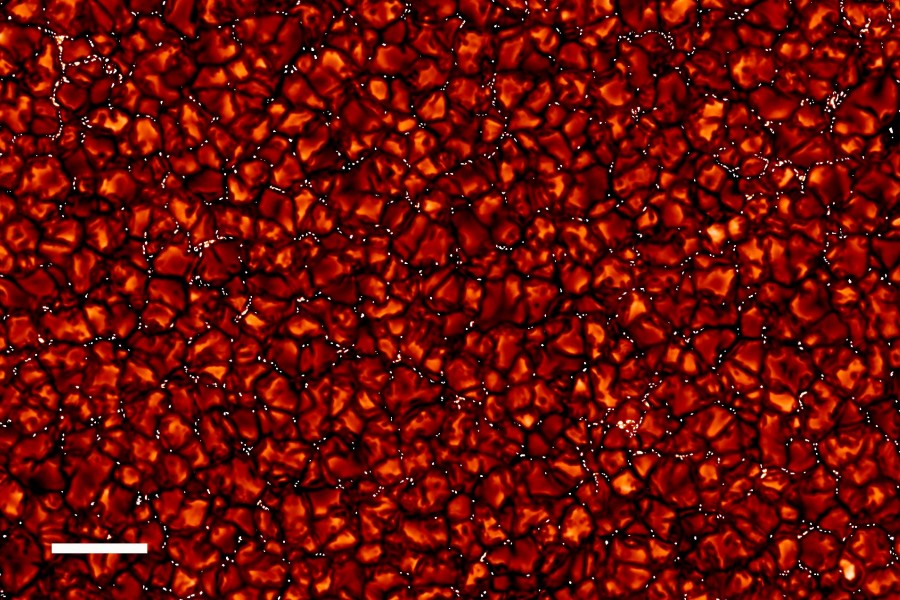
In my amateur understanding, it seems that the surface of the sun is so 'cold' because the surface gases are exposed to the coldness of the space. One explanation why the corona is so hot might be because the gases are 'channeled' from deeper levels of the sun, through these "bright points" that you can see in the image below. But this is just an oversimplified speculation on my part.

SOLmagbrightpoints_almeidaC900.jpg


http://apod.nasa.gov/apod/ap100416.html said:
Up close, the solar surface is a striking patch work of granules in this very high resolution picture of the quiet Sun. Caused by convection, the granules are hot, rising columns of plasma edged by dark lanes of cooler, descending plasma. But the high-resolution view reveals that the dark lanes are dotted with many small, contrasting bright points. Constantly present on the solar surface, the bright points do not seem to be related to sunspots that come and go with the magnetic solar cycle. Nonetheless, the bright points are regions of concentrated magnetic fields and are bright because the magnetic pressure opens a window to hotter deeper layers below the photosphere. For scale, the white bar at the lower left corresponds to 5,000 kilometers across the Sun's surface. The sharp, narrow-band image was recorded in September, 2007 using the Swedish Solar Telescope on the astronomical island of La Palma.

High resolution here: http://apod.nasa.gov/apod/image/1004/SOLmagbrightpoints_almeida.jpg
 
Mr. Scott said:
Interestingly enough, temperatures below absolute zero were recently found to be entirely possible:

http://www.sott.net/article/255586-Atoms-reach-record-temperature-colder-than-absolute-zero

Plus, if you factor in the information theory of Tom Stonier, absolute zero becomes total nonsense - theoretically, anyway. Once you get it down to 0K, you just remove entropy and/or add information/order, et voila! -K temperatures!

Stonier also mentions superconductivity in his book:

http://www.amazon.com/Information-Internal-Structure-Universe-Exploration/dp/3540198784/

Put these pieces together, and suddenly the idea of a cold sun doesn't seem anywhere near crazy...
emphasis/bold = my own

I thought about this as well. Increased information and order coinciding with -k values. Putting two hydrogen atoms together to make a stable (non-flammable and full "psudeo-octet") could be seen as decreasing entropy and adding information all without discarding the notion that hydrogen is the first in the domino effect of creating heavier elements through its fusion.
 
Back
Top Bottom