
You are using an out of date browser. It may not display this or other websites correctly.
You should upgrade or use an alternative browser.
You should upgrade or use an alternative browser.
Learning the Shakuhachi
- Thread starter brandon
- Start date


 So impressive that you made your own Shakuhachi! Thank you for sharing
It works for me, I can uploaded.Ah, I guess the download option is only for the person who posted it..
Uploaded it to the mega.nz file sharing site: here's the link

That's very beautiful, Brandon. Loved the nature sounds in there too.
Very touching for the soul. Thanks for sharing.
Very touching for the soul. Thanks for sharing.

tschai
Dagobah Resident
I installed the Mega app had to fool around a bit to get the file downloaded. I think I got it.Ah, I guess the download option is only for the person who posted it..
Uploaded it to the mega.nz file sharing site: here's the link

I made a shak out of pvc which plays lower register key of D beautifully, upper register not so much, but I can do meri and keri pretty well. Do you read kinko notation? I have tried making my own out of bamboo, so far none have turned out well. I also have a shakuhachi Yuu that I want to learn to play. Flutes in general are awesome, can’t get enough!

Thanks much, everyone :) Glad you likes it!
A reason shakuhachi appeals to me is that it seems to have a very high "skill ceiling", i.e. basically takes forever to get good at it, because of its simple but unconstrained nature. People say that even when you've practised a lot, for years, there is still more to learn. I'm only the teeniest little bit further than complete beginner level. Good fun!
Ah sorry for the hassle.. You should be able to download it from the mega link without having the mega app, I think. I don't currently have any webspace of my own where I can easily put files..
Cool!! I'm amazed by how nice PVC flutes can sound. Oof, the upper register is so difficult.. I've only recently become able to play it consistently, and it still sounds pretty wonky unless I concentrate really hard. It's no good in most of the flutes I've made - for some reason I often get the third note being massively out of tune. Maybe to do with the diameter of the bamboo I have interacting badly with the formula I use for hole spacing. I tried spot-tuning it by sanding down the appropriate places inside the bore, but couldn't get it to make much difference. Thankfully, the two best ones I made are pretty close to being in tune in both registers, so those are the only two I always play.
I started trying to learn to read kinko notation, just from some printed out note charts. But got distracted and have forgotten it all. Must get back to it..I'd love to properly learn honkyoku pieces. For now I just improvise, and try to copy bits & pieces from players on youtube, and try to figure out random folk/pop songs. How long have you been playing for tschai?
A reason shakuhachi appeals to me is that it seems to have a very high "skill ceiling", i.e. basically takes forever to get good at it, because of its simple but unconstrained nature. People say that even when you've practised a lot, for years, there is still more to learn. I'm only the teeniest little bit further than complete beginner level. Good fun!
I installed the Mega app had to fool around a bit to get the file downloaded. I think I got it.
Ah sorry for the hassle.. You should be able to download it from the mega link without having the mega app, I think. I don't currently have any webspace of my own where I can easily put files..
I made a shak out of pvc which plays lower register key of D beautifully, upper register not so much, but I can do meri and keri pretty well. Do you read kinko notation? I have tried making my own out of bamboo, so far none have turned out well. I also have a shakuhachi Yuu that I want to learn to play. Flutes in general are awesome, can’t get enough!
Cool!! I'm amazed by how nice PVC flutes can sound. Oof, the upper register is so difficult.. I've only recently become able to play it consistently, and it still sounds pretty wonky unless I concentrate really hard. It's no good in most of the flutes I've made - for some reason I often get the third note being massively out of tune. Maybe to do with the diameter of the bamboo I have interacting badly with the formula I use for hole spacing. I tried spot-tuning it by sanding down the appropriate places inside the bore, but couldn't get it to make much difference. Thankfully, the two best ones I made are pretty close to being in tune in both registers, so those are the only two I always play.
I started trying to learn to read kinko notation, just from some printed out note charts. But got distracted and have forgotten it all. Must get back to it..I'd love to properly learn honkyoku pieces. For now I just improvise, and try to copy bits & pieces from players on youtube, and try to figure out random folk/pop songs. How long have you been playing for tschai?
tschai
Dagobah Resident
I have been listening to shakuhachi music for years, playing not so much- like you say for such a simple instrument with only five finger holes, it is a decidedly difficult instrument to master. Even those that have played for many years claim they still have not perfected it, and that it’s a form of self discovery and meditation. I find it to be one of the most beautiful sounds in the world.How long have you been playing for tschai?
I made a new Bandcamp page for my shakuhachi music, and put out a new little free album with the above pieces and a couple others, if anyone wants a copy:
Merry Christmas everyone!! Thanks for being here.. May you have a most excellent time! Much love to y'all
Merry Christmas everyone!! Thanks for being here.. May you have a most excellent time! Much love to y'all
I love very very much your baby Felix, sometimes it seems that he purrs very musically.I love these sounds he makes :)
(The flute is pretty good too

Brandon, I am so impressed, I hope more people get the chance to listen to your gifts.
I am listening to the first track for the third time, with Felix communicating what feels like curiosity, joy and delight, his 'purring' and running commentary is adorable, that track is just gorgeous! I think you are naturally gifted, as much as you critique yourself - which is fine because you are wanting to push yourself to explore this complex instrument and fine tune your own gifts more deeply - but wow I think you are doing brilliantly. I notice how my cat responded so positively to that first track too, his whole body went into a state of deep relaxation as soon as I started playing it!
If you felt so inspired, I see that you could easily create an income stream by making an album for babies and parents to listen to, some quieter tracks for meditation. with Felix contributing his own light-love-knowledge. Thank you for sharing.

I am listening to the first track for the third time, with Felix communicating what feels like curiosity, joy and delight, his 'purring' and running commentary is adorable, that track is just gorgeous! I think you are naturally gifted, as much as you critique yourself - which is fine because you are wanting to push yourself to explore this complex instrument and fine tune your own gifts more deeply - but wow I think you are doing brilliantly. I notice how my cat responded so positively to that first track too, his whole body went into a state of deep relaxation as soon as I started playing it!
If you felt so inspired, I see that you could easily create an income stream by making an album for babies and parents to listen to, some quieter tracks for meditation. with Felix contributing his own light-love-knowledge. Thank you for sharing.


Hmm, it's been a year since I updated this thread! I'm still playing shakuhachi whenever I can. I still haven't managed to properly learn any traditional Japanese Honkyoku pieces. Usually when I get a chance to play, there's not much time and I just play whatever comes through, and practice my breath and tone control. I bought a book which teaches the Honkyoku basics and has a lot of sheet music, but have barely tried yet. Maybe next year :) However, I totally love playing the shakuhachi and am quite pleased with my progress so far..
I've made several new flutes.. experimented with making 'hitoyogiri' flutes, which are a precursor to shakuhachi. They are shorter/higher pitched, and made from a piece of bamboo with only 1 node rather than 7 like a shakuhachi...and the tuning is slightly different. It's hard to find info on the tuning, so it took some trial and error, watching youtube videos of people playing them until I figured out the scale, and finding photos of hitoyogiri where the tone holes are visible, and trying to match them up with my piece of bamboo and calculated hole positions to see how close they are, haha! In the end I made a couple which seem to be pretty much the correct tuning. Though, from what I've read, like ancient shakuhachi these flutes are idiosyncratic and each one is unique so variations in the tuning are normal. Traditional hitoyogiri pieces are sort of like haiku, they're very short and simple sort of poems... but require supreme breath control (it seems to me - I learnt one but can't yet play it properly). But the particular scale and fingering for the hitoyogiri is very fun to improvise in.. the slightly different tone hole spacing makes the cross-fingering work completely differently to shakuhachi. (Cross-fingering = when you place fingers on holes in a configuration which isn't in the sequence of the scale, i.e. you have fingers on holes which don't seem like they should affect the note, because those holes are below an open hole so all the air should be leaving the flute before it even reaches them! But because of the physics of how the breath moves through the tube, it DOES have an effect... maybe makes it a slightly different note, or maybe the same note but with a different timbre, or maybe some weird resonance...)
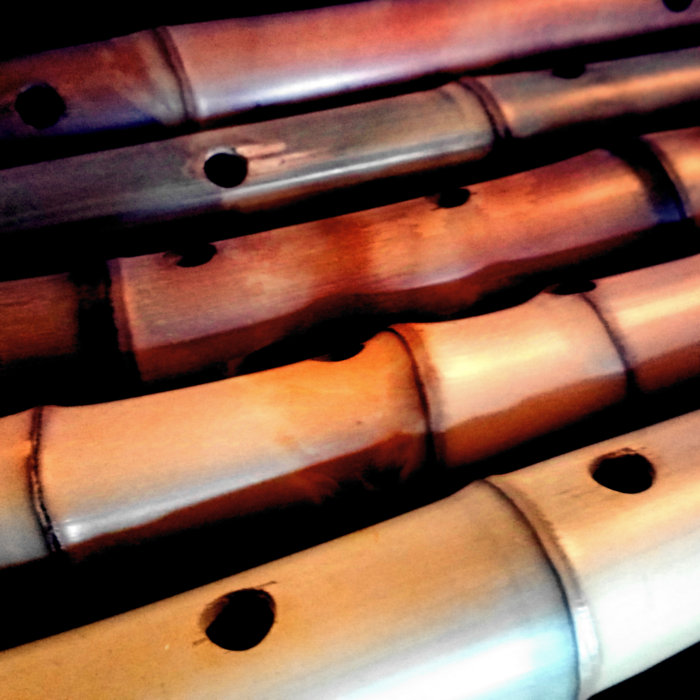
Lastly, I ordered a piece of raw madake bamboo online.. it took a month to arrive.. and then I made it into a big 2 foot 8 inch jinashi shakuhachi, and it came out beautifully! I love how it sounds... Planning to order more of this bamboo when I can, different sized pieces. And perhaps learn how to do some kind of surface finishing (lacquer, etc) - I've experimented with applying tung oil (with varying results) but only on the outside. It would be good to also seal the bore, to guard against moisture. On this newest flute I found that using very fine sandpaper on the exposed (skinless) areas of bamboo, above the blowing edge, AFTER applying tung oil, gave it a lovely smooth and hard feeling which feels like it HAS been lacquered.
My hitoyogiri flutes aren't very pretty to look at, made of green bamboo offcuts, so I didn't take any photos of 'em. But here's the 2.8 root end flute:


And here are some sound samples.. I've been wanting to upload new recordings for ages but keep putting it off because "they're not good enough", I never manage to get a perfect take :D But I know that there's no actual such thing and that's kind of the point! So here are a few little bits I liked from recent practice sessions...
Smallest hitoyogiri, improvisation:
2.8 jinashi, bluesy improv:
Larger hitoyogiri, more improv:
2.8 jinashi, attempted short medley of parts of 'Streets of London' by Ralph McTell and 'Take Me Home, Country Roads' by John Denver:
2.8, another go at some classics, very slow and a bit weird take on Greensleeves and a bit of Scarborough Fair. I must've been sleepy:
A 1.8 foot shakuhachi I made last year, improv:
I've made several new flutes.. experimented with making 'hitoyogiri' flutes, which are a precursor to shakuhachi. They are shorter/higher pitched, and made from a piece of bamboo with only 1 node rather than 7 like a shakuhachi...and the tuning is slightly different. It's hard to find info on the tuning, so it took some trial and error, watching youtube videos of people playing them until I figured out the scale, and finding photos of hitoyogiri where the tone holes are visible, and trying to match them up with my piece of bamboo and calculated hole positions to see how close they are, haha! In the end I made a couple which seem to be pretty much the correct tuning. Though, from what I've read, like ancient shakuhachi these flutes are idiosyncratic and each one is unique so variations in the tuning are normal. Traditional hitoyogiri pieces are sort of like haiku, they're very short and simple sort of poems... but require supreme breath control (it seems to me - I learnt one but can't yet play it properly). But the particular scale and fingering for the hitoyogiri is very fun to improvise in.. the slightly different tone hole spacing makes the cross-fingering work completely differently to shakuhachi. (Cross-fingering = when you place fingers on holes in a configuration which isn't in the sequence of the scale, i.e. you have fingers on holes which don't seem like they should affect the note, because those holes are below an open hole so all the air should be leaving the flute before it even reaches them! But because of the physics of how the breath moves through the tube, it DOES have an effect... maybe makes it a slightly different note, or maybe the same note but with a different timbre, or maybe some weird resonance...)
Lastly, I ordered a piece of raw madake bamboo online.. it took a month to arrive.. and then I made it into a big 2 foot 8 inch jinashi shakuhachi, and it came out beautifully! I love how it sounds... Planning to order more of this bamboo when I can, different sized pieces. And perhaps learn how to do some kind of surface finishing (lacquer, etc) - I've experimented with applying tung oil (with varying results) but only on the outside. It would be good to also seal the bore, to guard against moisture. On this newest flute I found that using very fine sandpaper on the exposed (skinless) areas of bamboo, above the blowing edge, AFTER applying tung oil, gave it a lovely smooth and hard feeling which feels like it HAS been lacquered.
My hitoyogiri flutes aren't very pretty to look at, made of green bamboo offcuts, so I didn't take any photos of 'em. But here's the 2.8 root end flute:
And here are some sound samples.. I've been wanting to upload new recordings for ages but keep putting it off because "they're not good enough", I never manage to get a perfect take :D But I know that there's no actual such thing and that's kind of the point! So here are a few little bits I liked from recent practice sessions...
Smallest hitoyogiri, improvisation:
2.8 jinashi, bluesy improv:
Larger hitoyogiri, more improv:
2.8 jinashi, attempted short medley of parts of 'Streets of London' by Ralph McTell and 'Take Me Home, Country Roads' by John Denver:
2.8, another go at some classics, very slow and a bit weird take on Greensleeves and a bit of Scarborough Fair. I must've been sleepy:
A 1.8 foot shakuhachi I made last year, improv:


Wandering Star
The Living Force
That sounds great, thanks for sharing.
I agree with 987baz, the 2.8 is the one that has the sound that "resonates" with me the most.
I agree with 987baz, the 2.8 is the one that has the sound that "resonates" with me the most.
Trending content
-

-

-
Thread 'Coronavirus Pandemic: Apocalypse Now! Or exaggerated scare story?'
- wanderingthomas
Replies: 30K -

