iyan
Padawan Learner
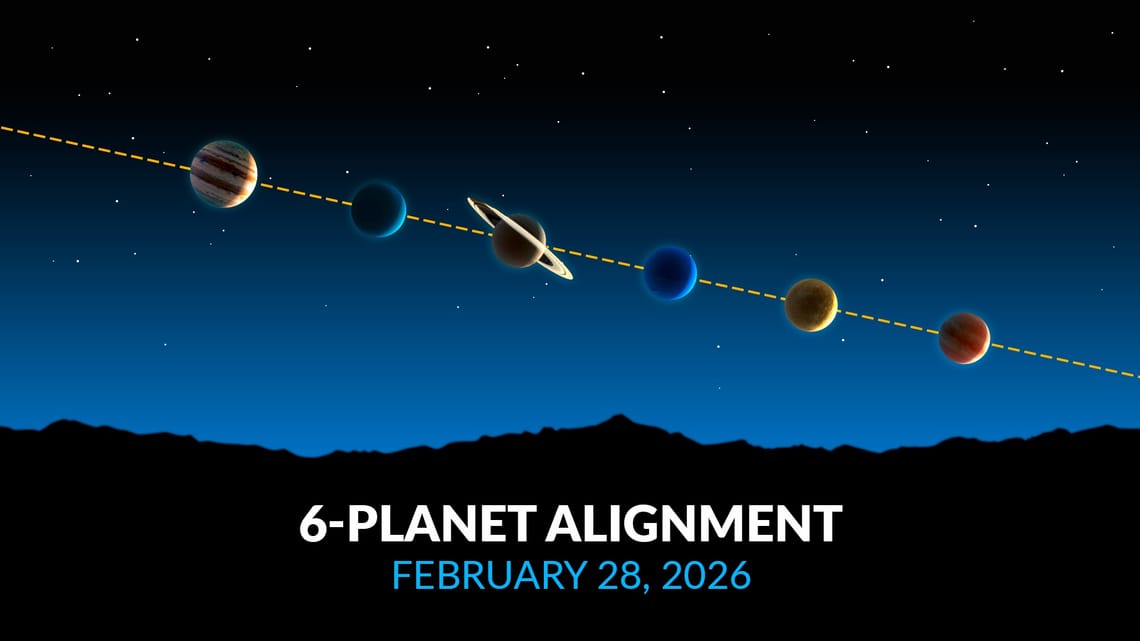
Tonight,February 28 , we will see not one, not two, but six planets in the evening sky. Mercury, Venus, Neptune, Saturn, Uranus, and Jupiter will appear shortly after sunset. Four of those planets will be visible to the unaided eye, weather permitting, but only those with optical assistance will be able to view Uranus and Neptune (Mercury can sometimes be harder to spot, too).
This rare cosmic event symbolizes a major turning point for humanity, a universal synchronicity that transcends chance and heralds profound transformations.
Never before has such a configuration occurred, and the experiences we are currently undergoing are unprecedented in human history. The choice of this precise date is suspicious, highlighting that we are at the heart of an intense spiritual war, where celestial and terrestrial forces intertwine in a battle for the collective soul.
Mercury: Often represents the Law (as God's witness) or the divine mediator. Close to the Sun (symbol of God), it evokes Christ as mediator between God and humanity (Galatians 3:19; 1 Timothy 2:5), swift messenger and divine light.
Venus: Symbol of the Prophets or of revealed truth. Known as the Morning Star, it is linked to Christ himself (2 Peter 1:19; Revelation 22:16), representing love, beauty, spiritual fertility, and birth "from above" (John 3:3).
Jupiter: Represents the Messiah or the King (the largest planet, linked to justice and abundance). Often seen as a symbol of Jesus Christ, the King of kings, redemption, and divine glory (associated with the "king" in some interpretations of the Star of Bethlehem or celestial majesty).
Saturn: Symbolizes the glorious Church or the covenant between God and his people. It evokes promises, discipline, faithful submission, peace, and spiritual rest after the coming of the Messiah (linked to the “new creation” or the submissive Church).
Uranus: Represents the Church in decline or under judgment. Symbol of rebellion, spiritual decline, and divine judgment on testimony (linked to “Ouranos” = sky in Greek, but in a sense of fall or test).
Neptune: Symbolizes the Church in secret or hidden, the concealed witness, the final purification/separation. It evokes profound mysteries, spiritual illusion, or the Church being hissed at and purified in the last days.
 These symbols come from interpretations such as the Bible Numbers for Life or Christian videos about planets pointing to Christ and Church history. The planets are God's creation for His glory (Psalm 19:1; Genesis 1:14-16). The alignment is a prophetic sign according to the Bible.
Other astronomical events for the year 2026:
 www.nasa.gov
This rare cosmic event symbolizes a major turning point for humanity, a universal synchronicity that transcends chance and heralds profound transformations.
Never before has such a configuration occurred, and the experiences we are currently undergoing are unprecedented in human history. The choice of this precise date is suspicious, highlighting that we are at the heart of an intense spiritual war, where celestial and terrestrial forces intertwine in a battle for the collective soul.
Mercury: Often represents the Law (as God's witness) or the divine mediator. Close to the Sun (symbol of God), it evokes Christ as mediator between God and humanity (Galatians 3:19; 1 Timothy 2:5), swift messenger and divine light.
Venus: Symbol of the Prophets or of revealed truth. Known as the Morning Star, it is linked to Christ himself (2 Peter 1:19; Revelation 22:16), representing love, beauty, spiritual fertility, and birth "from above" (John 3:3).
Jupiter: Represents the Messiah or the King (the largest planet, linked to justice and abundance). Often seen as a symbol of Jesus Christ, the King of kings, redemption, and divine glory (associated with the "king" in some interpretations of the Star of Bethlehem or celestial majesty).
Saturn: Symbolizes the glorious Church or the covenant between God and his people. It evokes promises, discipline, faithful submission, peace, and spiritual rest after the coming of the Messiah (linked to the “new creation” or the submissive Church).
Uranus: Represents the Church in decline or under judgment. Symbol of rebellion, spiritual decline, and divine judgment on testimony (linked to “Ouranos” = sky in Greek, but in a sense of fall or test).
Neptune: Symbolizes the Church in secret or hidden, the concealed witness, the final purification/separation. It evokes profound mysteries, spiritual illusion, or the Church being hissed at and purified in the last days.
These symbols come from interpretations such as the Bible Numbers for Life or Christian videos about planets pointing to Christ and Church history. The planets are God's creation for His glory (Psalm 19:1; Genesis 1:14-16). The alignment is a prophetic sign according to the Bible.Other astronomical events for the year 2026:
Most Notable 2026 Astronomical Events: A Year of Watching the Skies - NASA
So, get ready to watch the skies with us! Here are the top astronomical events happening this year:
www.nasa.gov