Mystery surrounds supertanker incident in strait

Keit

Ambassador
Ambassador
FOTCM Member
There is a story about Japanese oil tanker suffering an unexplained explosion in the end of July near the Strait of Hormuz oil shipping route. It's a passage through which 40 percent of the world’s oil is shipped, and it is located between Oman and Iran. There was no oil leakage, and some, obviously, point the blaming finger toward Iran. Just like the March story with the sinking South Korean warship, there are all kind of theories, but all inconclusive. Will be interesting to see how they are going to spin it.

_http://www.buenosairesherald.com/BreakingNews/View/41034

A Japanese supertanker that reported suffering an ‘explosion‘ near the Strait of Hormuz oil shipping route may have hit a submarine or a mine, UAE port officials examining the ship said on Thursday.

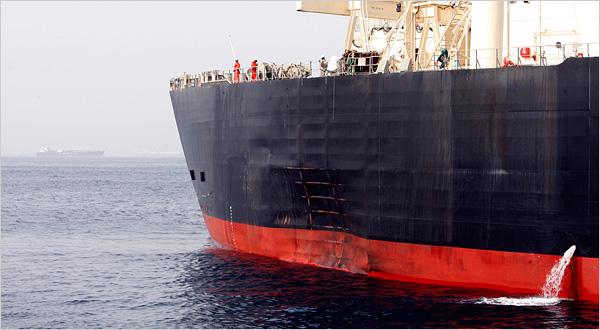
Damage to the massive crude carrier’s hull suggested a collision, although the nature of the incident early on Wednesday was under investigation.

‘What we know is some collision happened. We don’t know what it was,‘ said Captain Mousa Mourad, a general manager at the UAE port of Fujairah.

“It’s possible that it could be a submarine collision, or that it could be a sea mine,” he said.

A Reuters reporter taken to see the damaged supertanker, the M.Star, said there was a very large, square dent and puncture marks on one side of the hull. Photographs also showed a lifeboat missing and smashed windows and doors.

Divers from a Dubai-based marine repair firm were despatched to inspect the crude carrier, which was moored off Fujairah.

Speculation over what might have happened to the ship has included a rogue wave, an aborted hijacking, an internal blast of some kind or a collision with a submarine.[...]

Here is an article that mentions U.S. navy divers examining damaged Japanese oil tanker in UAE.

And here is an article accusing Iran and its floating mines.

There is still much conflicting speculation about what punched a large dent into the side of the M Star tanker, which was on its way back to Japan after filling up in the UAE. Earlier reports that a freak wave smacked the ship have been dismissed, while boat owner Mitsui O.S.K. Lines maintains that its vessel was probably attacked.[...]

Some are pointing fingers at Iran, as it carefully guards its territorial waters and laid thousands of floating mines for that purpose during the Iran-Iraq war – some of which remain today. This week's incident occurred near where five armed Iranian fast boats confronted a flotilla of US Navy ships in 2008 while on patrol about 12 miles from Iranian territory in the Strait of Hormuz, sparking a confrontation.

But what is also interesting, is the following remark by the crewmen:

Crewmen reported seeing a flash of light on the horizon just before an explosion.

So who knows, maybe it was even a meteorite, if not again, a deliberate provocation.
 
Guess what?

Al Qaeda group claims attack on Japanese tanker
_http://thestar.com.my/news/story.asp?file=/2010/8/4/worldupdates/2010-08-04T104525Z_01_NOOTR_RTRMDNC_0_-506131-2&sec=Worldupdates

DUBAI (Reuters) - A group linked to al Qaeda claimed on Wednesday that a suicide bomber from its organisation was responsible for an attack on a Japanese supertanker last week in the Strait of Hormuz.

"Last Wednesday, after midnight, the martyrdom-seeking hero Ayyub al-Taishan ... blew himself up in the Japanese tanker M.Star in the Strait of Hormuz between the United Arab Emirates and Oman," the Brigades of Abdullah Azzam group said in a statement posted on an Islamist website used by militants.

The statement said the attack was a blow to the global economy and the oil market.

Forty percent of the world's seaborne oil passes through the narrow Strait, gateway to the oil-producing Gulf. Al Qaeda has threatened to attack shipping there in the past.

No independent verification of the statement was immediately available.

No immediate comment was available from the ship's owner, Japan's Mitsui O.S.K. Ltd. The company hired a Dubai-based specialist last week to investigate what damaged the M.Star, which is 333 metres in length.

The group's statement said those who had offered other explanations on the possible causes of the tanker incident, ranging from a freak wave to an internal explosion, were trying to cover up what had occurred.

In 2005, a group using the name Abdullah Azzam Brigades said it carried out deadly bombings at the Egyptian resort of Sharm al-Sheikh.

The group also claimed responsibility in 2005 for firing rockets at two U.S. warships in Jordan's Aqaba port. The rockets missed their targets.

Notice that Abdullah Azzam Shaheed Brigade or AASB is a so called militant group affiliated with Tehrik-i-Taliban Pakistan

Here is the picture of the ship and the damage:

30shipspan-cnd-articleLarge.jpg


_http://www.nytimes.com/2010/07/30/world/middleeast/30ship.html?src=mv
The company released photographs on Thursday showing a large, square dent in the black-and-red hull of the tanker and broken railings along its deck, damage that appears unlikely to have been caused by a wave. Photos of the interior show broken ceiling panels and exposed insulation and wiring in one of the dining rooms.

Theodore Karasik, a Dubai-based security analyst, said that the leading theory there was that an old mine was adrift and bumped the ship; if it had degraded, it could have simply produced a pressure blast. There are still mines in the region from the Iran-Iraq war of the 1980s. Another possibility, he said, was a collision with another ship.
 
OMG! That is priceless! "al-Qaeda" are now blowing themselves up on Japanese tankers as part of their "holy jihad", killing no one , spilling no oil, and claiming that they have struck a blow against the world economy!??? Those CIA/Mossad guys are starting to lose their marbles it seems.
 
Here come additional details, including "amazing" :O evidence from our "friends" in SITE intelligence group.

_http://www.npr.org/templates/story/story.php?storyId=129034355
UAE: Terrorists Attacked Japan Tanker In Gulf
Officials in the United Arab Emirates say they found traces of explosives on the hull of a Japanese oil tanker, damaged in an explosion in the Persian Gulf late last month. A little known militant group, the Abdullah al-Azzam Brigades, claimed responsibility for the attack on the tanker, calling it a martyrdom operation. [...]

A number of theories were considered, including a rouge wave or a collision with another vessel. But the UAE's official news agency reported today that investigators found a dent and traces of what were described as homemade explosives on the M. Star's starboard hull, leading them to conclude that a water-borne attack probably caused the blast.


And here is the image provided by SITE:

849-Tanker_Explosion.sff.standalone.prod_affiliate.81.jpg


Do you see it? The alleged "martyr" had an image of Japanese tanker on his desktop! This is just hilarious. Mossad is trying really hard to involve other countries in their manipulations, Japan in this case. But considering the whole amateurish charade, apparently not hard enough.

_http://www.kansascity.com/2010/08/04/2127581/al-qaida-linked-group-claims-tanker.html

An obscure al-Qaida-linked group said Wednesday one of its suicide bombers attacked a Japanese oil tanker in the Persian Gulf last week - a claim that, if true, would be the first time the terror network has attacked the Japanese.[...]

The militant statement identified the purported bomber as Ayyub al-Tishan and carried his picture, showing him dressed in a white Arab robe and head-cover and pointing to a photograph of a tanker on a laptop. It said the bomber was a "martyr" - meaning he had died in the attack. It also said it had delayed the announcement until several group members who were involved in the operation "returned safely to base."

The statement claimed the attack meant to "weaken the international blasphemous system that plundered the wealth of the Muslims" and mocked officials who had said the tanker may have been damaged from an earthquake, describing those remarks as an effort by authorities to conceal the nature of the attack because of the effect it could have on oil prices and world economy.[...]

The group also said in its statement the tanker attack was a tribute to blind Sheik Omar Abdel Rahman, convicted 15 years ago and serving a life sentence for conspiracies to blow up New York City landmarks.

The Brigades have in the past claimed responsibility for the August 2005 firing of Katyusha rockets that narrowly missed a U.S. amphibious assault ship docked at Jordan's Aqaba Red Sea resort but killed a Jordanian soldier. It had also claimed the July and October 2004 bombings at Egypt's Red Sea resort of Sharm el-Sheik and two other resorts that killed a total of 98 people.

Al-Qaida has in the past carried out attacks on oil infrastructure on land in nearby Saudi Arabia, as well as a 2002 suicide bombing against a French oil tanker off the coast of Yemen and the 2000 bombing of the USS Cole in the Yemeni port of Aden.
 
Looks like Mossad's attempt to draw Japan into their "evil terrorists are against you" plan doesn't play out as smoothly this time. What isn't clear, how could terrorist allegations come out of UAE, if they are not good friends with Mossad at the moment. But then, further in the article you read about unnamed (as usual) official saying that there were remnants of explosives on the hall. So who knows what's going on.

Doubts over Japanese tanker terrorist theory
_http://www.radioaustralia.net.au/asiapac/stories/201008/s2980427.htm
Security experts have cast doubt over allegations made by the United Arab Emirates that it was terrorists who damaged a Japanese oil tanker late last month in the Strait of Hormuz. They say an indentation in the hull would suggest the ship collided with another heavy object rather than an improvised explosive device or suicide bomber on a boat.

COCHRANE: Just after midnight on July 28, the Japanese supertanker M Star was carrying two million barrels of crude oil through the narrow Strait of Hormuz - a choke point for oil traffic, squeezed between Iran and Oman.

It was a foggy night but crew members say the saw a flash and heard an explosion - the force smashing windows, blowing a lifeboat off deck and slightly injuring one crewman.

Whatever it was, the impact left a dent in the hull several meters wide and high. But the ship was able to continue on to a port in the United Arab Emirates to assess the damage.

From that point, speculation swirled.

BATEMAN: One of the first ideas was that it might have been an internal explosion. Secondly, there could have been a collision with a floating object, perhaps a sea container of something like that. A sea mine or torpedo, but on the other hand if that had happened it would have done much more damage. Another possibility was a floating improvised explosive device and then of course we have the favoured scenario of a small boat suicide attack.

COCHRANE: That's Professor Sam Bateman from the Australian National Centre for Ocean Resources and Security at the University of Wollongong.

He describes the terrorist theory as the favoured scenario because the United Arab Emirates state news agency quoted an unnamed coast guard official as saying they found the remnants of handmade explosives on the hull and that terrorists were to blame.

But Professor Bateman is sceptical.

BATEMAN: It would reflect quite badly on the ship's crew if they weren't aware of a small boat coming in to attack the ship.

COCHRANE: Sam Bateman says it's more likely the ship hit an improvised explosive device or perhaps a floating object, such as a container that might have fallen off a cargo ship.

The Strait of Hormuz is a thoroughfare for around 40 per cent of the world's seaborne oil and is patrolled by US warships and submarines.

In the past, Al Qaeda has threatened to attack ships in the Strait but it was the little known militant group Brigades of Abdullah Azzar that claimed responsibility for what they said was a suicide bomb attack using a small boat.

Scott Stewart is vice president of tactical intelligence at Stratfor, a global security analysis company based in Texas.

STEWART: That is far outside of the operational radius that one would expect for a group that was operating in the Sinai to be able to then launch an attack in the Persian Gulf - that's showing quite a transnational operational reach.

COCHRANE: Mr Stewart believes the damage to the M Star's hull was probably caused by a collision.

If it was suicide bomber, the explosive device would have pieced the hull or at least caused visible damage from shrapnel.


STEWART: If there was a small launch or a small boat containing a bomb, parts of that boat itself would be hurled outward from the site of the explosion and it would push pieces of those things through metal objects.

COCHRANE: So, if it was a collision, as both analysts suggest, why would the other ship not report the damage to its vessel?

Scott Stewart, says the answer may lie in the illegal activities that occurs in the Strait of Hormuz.

STEWART: There's a lot of stuff that should not be getting into Iran that's taken over there in violation of those sanctions. We have oil being stolen by some of these militant groups and sold. And then there's arms trafficking throughout the region. There just a lot of shady commerce that goes on and a lot of phantom ships that are not going to be interested in reporting any sort of collision.

COCHRANE: The investigations into what really did damage the M Star supertanker are continuing.
 
Dent found below waterline on tanker in suspected attack in strait
_http://mdn.mainichi.jp/mdnnews/news/20100819p2g00m0dm072000c.html

A large dent has been found below the waterline of a Japanese tanker that was damaged in a suspected attack in the Strait of Hormuz in late July, the transport ministry said Wednesday.

There was also soot radiating outside at the damaged part above the waterline, it said, raising the possibility that something exploded near the surface of the water and slightly apart from the tanker.[...]

A visible dent found on the tanker's starboard side above the waterline is about 6 meters long and about 11 meters wide, while the newly reported dent below the waterline is about 16 meters long and about 23 meters wide.[...]

The tanker's voyage data recorder showed that at the time of the incident, it was moving in a northeasterly direction about 25 kilometers per hour. Radar images, captured every 15 seconds, showed there were three other large ships and three small ships in the vicinity right before the impact.

None of the small ships was identifiable, the ministry said. Two of them were situated 6 and 7 km ahead of the tanker on the right, while the third was increasingly apart from the tanker's left side and rear.

Japan opens probe into tanker attack in Strait of Hormuz
_http://www.ibtimes.com/articles/43943/20100818/japan-iran-strait-of-hormuz-oil-tanker-attack-oil-trade-crude-uae.htm

The Japanese tanker 'M Star' was damaged by the explosion and one crew member had suffered minor injuries. According to Japanese and UAE officials, who first put out the blast news, the ship was possibly attacked by an explosive-laden boat near the shores of Oman.

A small boat, which was sailing away from the tanker suddenly "made a U-turn toward the tanker and then disappeared off the radar for three and a half minutes before the blast," according to an official. [...]

Iran has of late ratcheted up tension in the region saying it would block the vital oil route in case of an attack on it by Israel or the U.S.

However, many analysts feel that Iran could not possibly go for a prolonged disruption of the strategic pass as its own oil trade could be hampered by such an action.

In fact, Iran's daily oil exports amount to around 2.5 million barrels, most of which pass through the Strait of Hormuz.
 
Back
Top Bottom