THE DEEPENING MYSTERY OF THE MARCH FIREBALLS: If you love a good mystery, look no further than the night sky in March 2026.
There were no major meteor showers scheduled for March, yet suddenly fireballs started appearing everywhere.
"During the month of March, reports of very bright fireballs to the American Meteor Society (AMS) suddenly doubled," says Mike Hankey, who manages the AMS's
fireball reporting system. "Many of them were visible in broad daylight and created loud sonic booms."
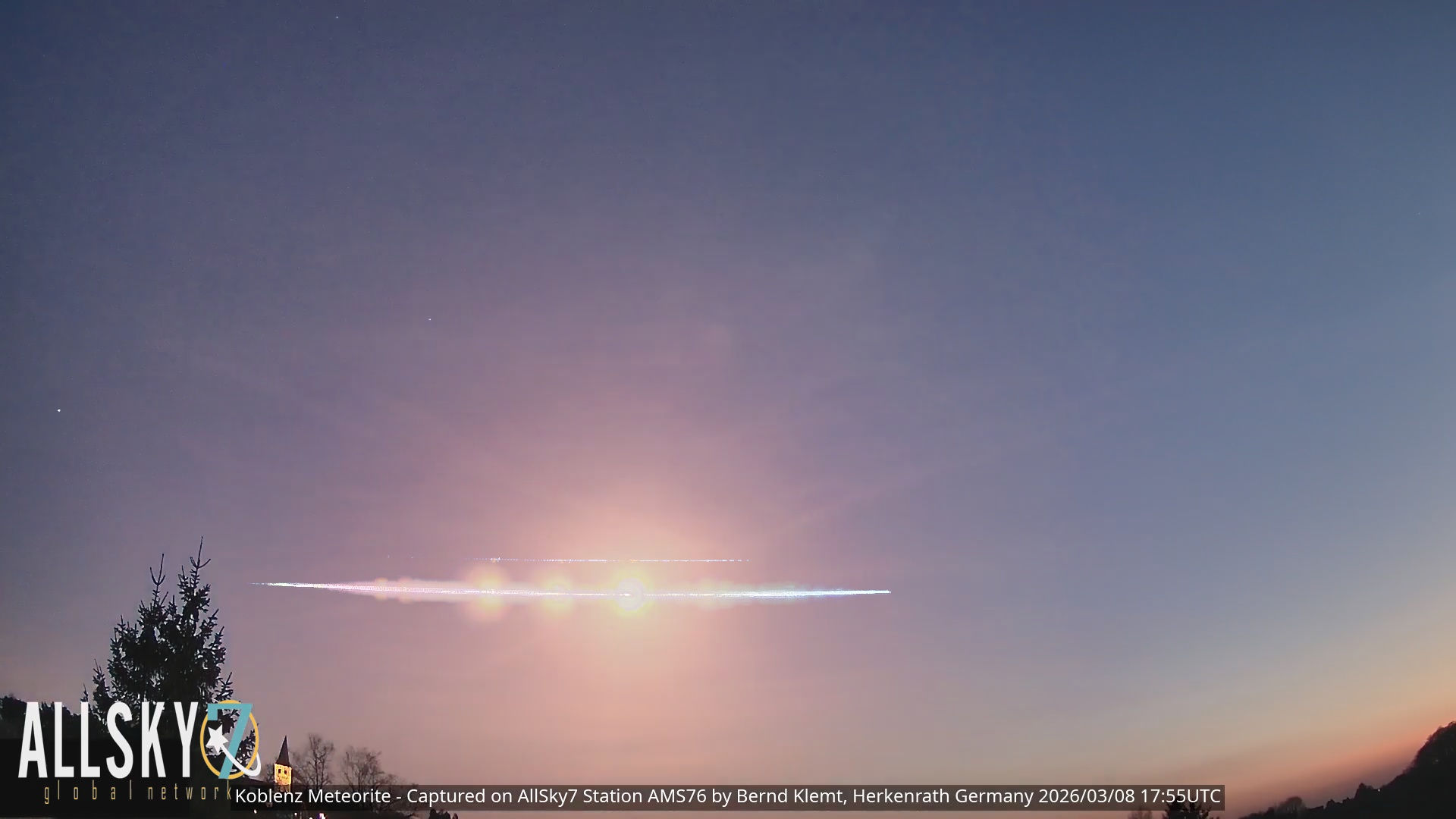
Above: The fireball over Koblenz, Germany, that started the "March Madness." [
movie]
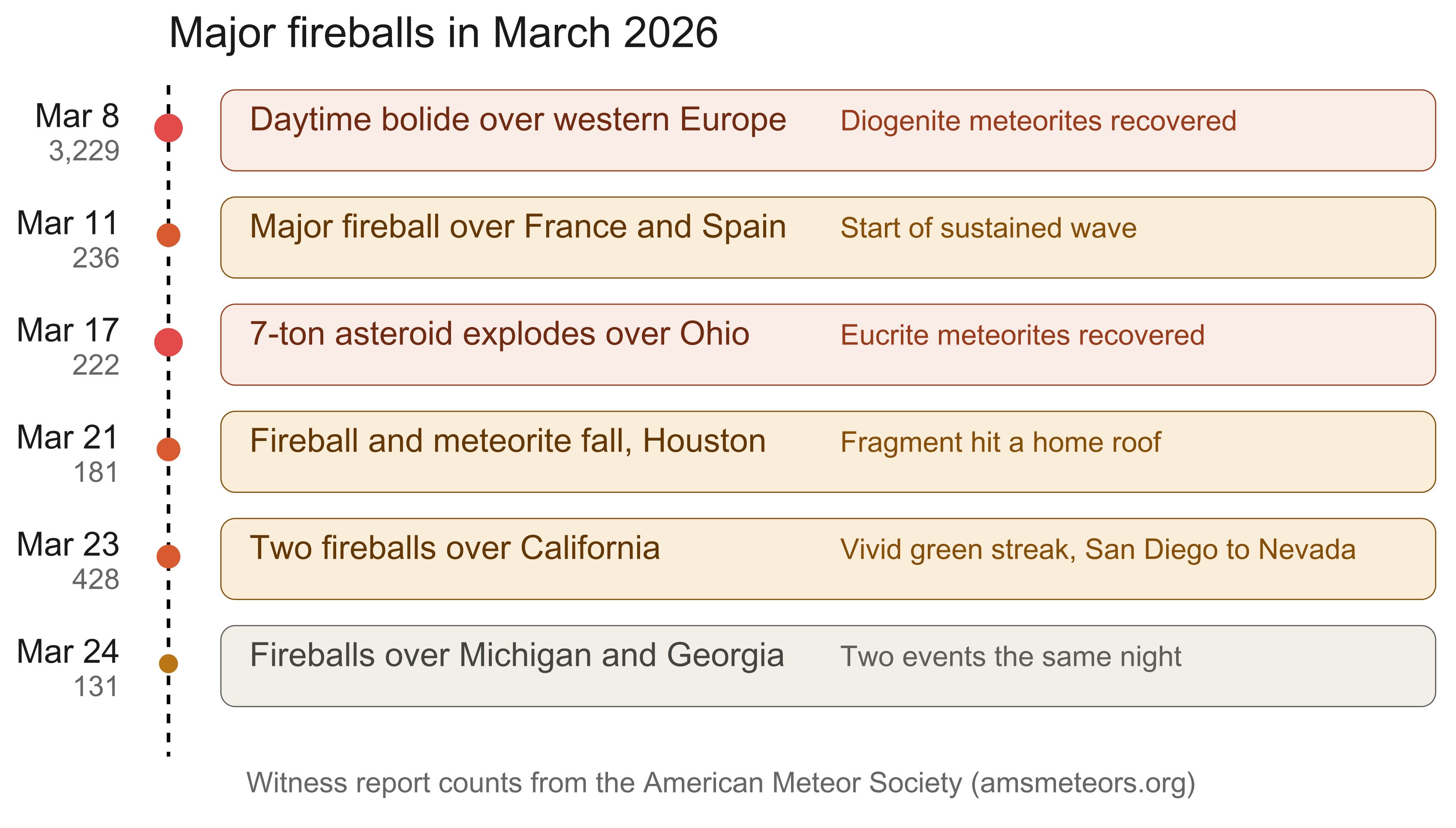
A daytime fireball over Western Europe on March 8th drew more than 3,200 witness reports. Nine days later, a 7-ton asteroid exploded over Ohio with the force of 250 tons of TNT. On March 21st, a fireball broke apart above Houston, sending a fragment through the roof of a house. And those were just the headliners.
Hankey has been running the fireball reporting system for nearly 15 years (indeed, he wrote much of the software himself), so he knew something unusual was happening. When the reports kept piling up,
he dove into the data -- and what he found is genuinely puzzling.
"
The total number of fireballs people saw was not dramatically unusual," Hankey explains. "
But the fraction of big fireballs really surged."
At the 50-report threshold (events bright and loud enough to be noticed across multiple states) Q1 2026 produced 40 events, double the historical average. At 100+ reports, the count also doubled. More than 82% of these large events produced sonic booms, indicating objects penetrating deep into the atmosphere.
Hankey wondered if AI might have something to do with it. "People who see fireballs can now talk to their phone and ask AI how to report it," he says. "We naturally wondered if this might be amplifying the number of reports." However, the increase turned on quickly at the start of March, and turned off just as quickly at the start of April--an ON/OFF pattern inconsistent with simple AI amplification.
Digging deeper, Hankey looked at where the fireballs came from. He found not one, but two sources. One cluster of fireballs came from opposite the sun -- the "Anthelion" source. Another came from high declinations -- basically falling upon us from above the plane of the planets. These two directions could not be more different, yet they contributed about equally to the surge.
Predictably, some people wondered if this might have anything to do with interstellar comet 3I/ATLAS. "No," says Hankey. "The meteorites dropped by these fireballs were eucrites and diogenites linked to the asteroid Vesta -- not interstellar material."
As we write this in April, the barrage has ended as mysteriously as it began.
One thing is certain: When March 2027 rolls around, many eyes will be watching the sky to see if it happens again.