
You are using an out of date browser. It may not display this or other websites correctly.
You should upgrade or use an alternative browser.
You should upgrade or use an alternative browser.
Prepping For City Dwellers?
- Thread starter Ursus Minor
- Start date


Came across a couple short videos on X by a woman who specializes in prepping materials. In these videos, she presents a list of 9 essential items to stockpile in your pantry that have an indefinite shelf life, as in they never expire, and the many purposes each item can be used for.
Nothing really surprising in this list, but is presented here for informational purposes...
1. Activated Charcoal
2. Honey
3. Salt
4. Distilled White Vinegar
5. Pure Ethanol
6. Bentonite Clay
7. Baking Soda
8. Corn Starch
9. Sugar
Bonus -10. Pure Vanilla Extract (>35%)
Part 1 (3.5 mins) & Part 2 (2.5 mins)
Nothing really surprising in this list, but is presented here for informational purposes...
1. Activated Charcoal
2. Honey
3. Salt
4. Distilled White Vinegar
5. Pure Ethanol
6. Bentonite Clay
7. Baking Soda
8. Corn Starch
9. Sugar
Bonus -10. Pure Vanilla Extract (>35%)
Part 1 (3.5 mins) & Part 2 (2.5 mins)

Just happened on this video recently which was very timely, since the southern US has had some record cold. While so far we have been fortunate with no power outages - one never knows. This was a brief video taken by a family (Provident Prepper) to show simple ways to stay warm in your home if the power goes out and you don't have a fireplace / generator, etc.
Some notes from the video:
1. Secure your home to keep the heat in and the cold out. (Cover windows/ doors with plastic sheeting)
2. Create microenvironments inside of your home. (Set up a camping tent)
3. Dress appropriately in layers to stay warm.
4. Drink warm liquids and eat hot foods.
5. Get up and move around.
6. Explore potential heat sources. (See below)
Other articles that you might find helpful include:
Surviving a Winter Power Outage – How to Stay Warm https://theprovidentprepper.org/survi...
How to Dress for Extreme Winter Weather https://theprovidentprepper.org/how-t...
Safe Indoor Emergency Cooking Solutions https://theprovidentprepper.org/safe-...
Candles as an Emergency Fuel Source for Warmth, Light, and Cooking https://theprovidentprepper.org/candl...
Terracotta Pot Heater/Cooker – How to Heat and Cook without Electricity https://theprovidentprepper.org/terra...
The following links are for supplies that may come in handy during a winter power outage:
2-3 Man Tent https://amzn.to/37BCweY
Safe Heat https://amzn.to/35qYQ8s
Body warmers • Brilliant Ideas to Light Your World i...
Super hand and body warmers https://amzn.to/3ovzWxk
Hand warmers https://amzn.to/3ol05yJ
Foot warmers https://amzn.to/3mfmThj
Heated socks https://amzn.to/35sSxRN
Some notes from the video:
1. Secure your home to keep the heat in and the cold out. (Cover windows/ doors with plastic sheeting)
2. Create microenvironments inside of your home. (Set up a camping tent)
3. Dress appropriately in layers to stay warm.
4. Drink warm liquids and eat hot foods.
5. Get up and move around.
6. Explore potential heat sources. (See below)
Other articles that you might find helpful include:
Surviving a Winter Power Outage – How to Stay Warm https://theprovidentprepper.org/survi...
How to Dress for Extreme Winter Weather https://theprovidentprepper.org/how-t...
Safe Indoor Emergency Cooking Solutions https://theprovidentprepper.org/safe-...
Candles as an Emergency Fuel Source for Warmth, Light, and Cooking https://theprovidentprepper.org/candl...
Terracotta Pot Heater/Cooker – How to Heat and Cook without Electricity https://theprovidentprepper.org/terra...
The following links are for supplies that may come in handy during a winter power outage:
2-3 Man Tent https://amzn.to/37BCweY
Safe Heat https://amzn.to/35qYQ8s
Body warmers
• Brilliant Ideas to Light Your World i... Super hand and body warmers https://amzn.to/3ovzWxk
Hand warmers https://amzn.to/3ol05yJ
Foot warmers https://amzn.to/3mfmThj
Heated socks https://amzn.to/35sSxRN

This comment has more to do with the heat and humidity, I wonder if before entering an ice environment, flooding and large amounts of water is something that is before or in the middle of entering a full cold era.
Sharing something that could be useful for some who live in places with high humidity or could find themselves in a similar situation.
My family and I have been dealing with toxic mold exposure for the past year in East Central Florida, and we have been living between hotels and rental houses for a short period because the house we lived in still contains mycotoxins that we cannot locate yet to repair.
What I would like to share a few notes that might be helpful for some.
-It is preferable re-wash winter clothes or any type of fabric put them in boxes or sealed plastic bags so that they do not absorb humidity, because that moisture may contain mold spores. That is, clothing that you do not wear frequently should not be left exposed to the open environment inside your home. I am located in the United States and most homes have central air conditioning, a high percentage of which can be contaminated with mold if there is no proper maintenance.
That's why sometimes clothes that smell like wet socks can be mold, and can make you sick, Even in certain population it can cause serious respiratory problems and even arrhythmia.
-Plastic boxes with the essentials, some for clothes, food, others for basic kitchen utensils, another for supplements and medicines, etc., greatly facilitate order and easy transport.
-Lots of plastic zip lock bags, to maintain hygiene and order, too.
-It is very useful to have an indoor air quality meter.
-Keep it basic, useful, and easy to get out of in case you have to leave quickly or evacuate the area.
-In this last year dealing with this personal situation has made me reflect a lot that in emergency situations you have to let go of the attachment to material things, and look to what is important first, your safety, health and your family, physical and spiritual integrity.
-Keep in mind where the rivers of your area flow, to evacuate in time, to make your own decisions.
I found this video which I don't consider to be totally correct, although it gives an idea if the sea level rises considerably.
Sharing something that could be useful for some who live in places with high humidity or could find themselves in a similar situation.
My family and I have been dealing with toxic mold exposure for the past year in East Central Florida, and we have been living between hotels and rental houses for a short period because the house we lived in still contains mycotoxins that we cannot locate yet to repair.
What I would like to share a few notes that might be helpful for some.
-It is preferable re-wash winter clothes or any type of fabric put them in boxes or sealed plastic bags so that they do not absorb humidity, because that moisture may contain mold spores. That is, clothing that you do not wear frequently should not be left exposed to the open environment inside your home. I am located in the United States and most homes have central air conditioning, a high percentage of which can be contaminated with mold if there is no proper maintenance.
That's why sometimes clothes that smell like wet socks can be mold, and can make you sick, Even in certain population it can cause serious respiratory problems and even arrhythmia.
-Plastic boxes with the essentials, some for clothes, food, others for basic kitchen utensils, another for supplements and medicines, etc., greatly facilitate order and easy transport.
-Lots of plastic zip lock bags, to maintain hygiene and order, too.
-It is very useful to have an indoor air quality meter.
-Keep it basic, useful, and easy to get out of in case you have to leave quickly or evacuate the area.
-In this last year dealing with this personal situation has made me reflect a lot that in emergency situations you have to let go of the attachment to material things, and look to what is important first, your safety, health and your family, physical and spiritual integrity.
-Keep in mind where the rivers of your area flow, to evacuate in time, to make your own decisions.
I found this video which I don't consider to be totally correct, although it gives an idea if the sea level rises considerably.

Magnolia
Jedi Master
Unbekoming substack posted an article earlier this week regarding food storage for emergencies.
The whole article is copied below for convenience. Some bolded areas were added for people who want to skim it. Many may know all this already, but it seems like a valuable summary of the key ideas."What follows is a practical guide to building a food supply that holds up under real pressure. The emphasis is on nutritional logic, shelf life, storage physics, and the specific mistakes that cause most food storage plans to fail when they’re needed."
With everything going on in the world — rising geopolitical instability, the real risk of fuel shortages and rationing, and the domino effect that fuel disruption has on food supply — I thought this essay could come in handy. It is not out of the question that we need to start planning for possible hunger. Not as a theoretical exercise. As a practical one.
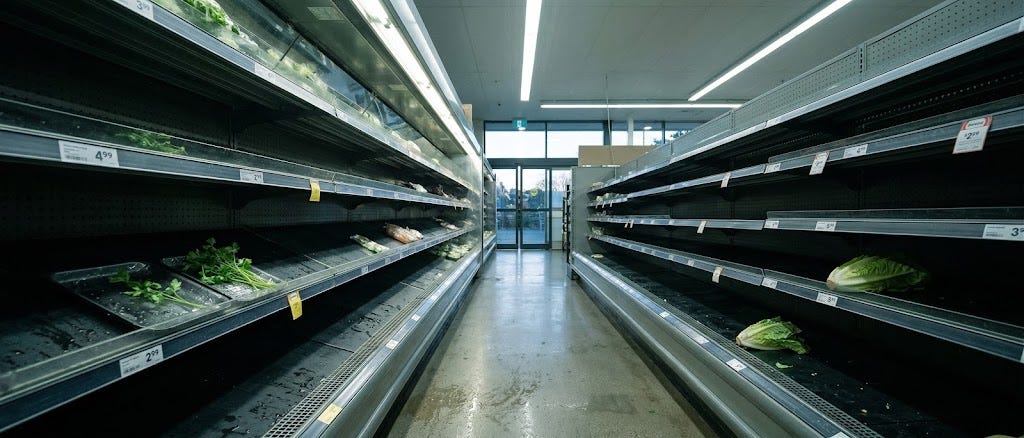
The average grocery store carries about three days’ worth of food for the community it serves.¹ Not three days of backup stock. Three days of flow. Trucks arrive daily to replenish what was purchased hours earlier, and the entire chain depends on uninterrupted diesel, functional highways, operating distribution centres, and stable electricity. Pull any one of those threads and the shelves empty faster than people expect.
We saw this during the early weeks of COVID-19. There was no food shortage — there was a distribution bottleneck. The food existed. It couldn’t reach the shelves fast enough to match the spike in demand. We saw it again in 2014 when a chemical spill in West Virginia left 300,000 people unable to use their tap water.² Bottled water and ice vanished from every store in the region within hours. The spill didn’t destroy water. It broke the assumption that water would always come from the tap.
These episodes expose the architecture. The system is optimised for efficiency, not resilience. The distance between three days of food and three months of food is a measure of how much disruption your household can absorb before you’re standing in a government line hoping someone else solved the logistics.
What follows is a practical guide to building a food supply that holds up under real pressure. The emphasis is on nutritional logic, shelf life, storage physics, and the specific mistakes that cause most food storage plans to fail when they’re needed.
Why Nutrition Matters More Than Volume
Most people who stockpile food stock calories and ignore nutrition. That gap has killed people with full stomachs.
Your body runs on three macronutrients — carbohydrates, fats, and proteins — and each one does different work at a different metabolic cost.³
Carbohydrates are the body’s preferred fuel. They yield roughly 4 calories per gram, metabolise quickly, and require the least water and oxygen to process. Simple carbohydrates — sugars — burn fast. Complex carbohydrates — grains, root vegetables — burn slower and provide steadier energy. Without carbohydrates, the body starts cannibalising its own muscle tissue for fuel. In cold weather, depleted carbohydrate stores mean the body can no longer generate adequate heat, and hypothermia sets in faster.⁴
Fats deliver about 9 calories per gram — more than double what carbohydrates or protein provide. They insulate, protect organs, and are essential for the body’s ability to absorb and use the fat-soluble nutritional factors in food. Without adequate dietary fat, lean protein cannot be fully used by the body. Mountain men in the 1800s ate all the rabbit they could kill and died anyway — full stomachs, plenty of protein, but wild rabbit carries almost no fat. Their bodies couldn’t metabolise the meat without it.⁴ European Arctic explorers died the same way after being rescued by Inuit people. The Inuit fed them what they themselves ate. The Europeans refused the fat and organ meat. The Inuit survived. The Europeans didn’t.⁴ The term for this is “rabbit starvation,” and it describes exactly what happens when protein is abundant but fat is absent.
Proteins yield about 4 calories per gram and the body needs them for tissue repair and the maintenance of bodily resilience. But protein is the most expensive macronutrient to digest in terms of water — its metabolism produces urea, which the kidneys have to flush.³ When water is scarce, heavy protein consumption speeds up dehydration rather than preventing it.⁴
A survival food supply has to contain all three macronutrients working together. A garage full of rice gives you carbohydrates and nothing else. A freezer full of jerky gives you protein that will dehydrate you and no quick energy. The foods you store need to function as a system.
Foods That Last Essentially Forever
A handful of staples, stored properly, outlast you. They form the backbone of any serious food plan because they sidestep the rotation discipline that most households will never maintain.
Whole wheat berries. Not flour — flour goes rancid once the oils in the germ are exposed by milling. Intact wheat berries store indefinitely below 15°C.⁵ Archaeologists found edible wheat in the Egyptian pyramids.⁵ Hard red or hard white varieties give you around 12% protein along with the carbohydrates.⁴ You will need a hand grain mill. Without one, whole wheat berries are animal feed. With one, they become bread, pasta, porridge, and dozens of other foods. Esther Dickey’s Passport to Survival documents everything from wheat-based meat substitutes to desserts and lollipops made from nothing but wheat, honey, powdered milk, and salt.⁴
A detail that modern food preparation has lost: every traditional grain-eating culture soaked, sprouted, or soured their grains before eating them.¹¹ These processes neutralise phytic acid — a compound in grains that binds minerals and blocks their absorption — and make the nutrients in the grain far more bioavailable. This is why traditional sourdough bread, made with a long fermentation, is a fundamentally different food from quick-rise industrial bread made from the same flour. If you are storing wheat berries, learn to prepare them the way traditional cultures did. Soak them overnight before cooking. Make sourdough rather than quick bread. Sprout them. The grain is the same; what your body can extract from it depends entirely on how you prepare it.
One more point on wheat, and it matters: source organic. Since roughly 2006, conventional wheat farmers have adopted the practice of spraying glyphosate — the active ingredient in Roundup — directly onto the crop days before harvest, using it as a desiccant to dry the grain for easier collection.¹⁴ This means the herbicide is on the food at the point of consumption, not washed away by weeks of rain as it was when applied early in the season. The correlation between glyphosate application on wheat and intestinal disease is near-perfect, and the mechanism is biologically plausible: glyphosate selectively kills the gut bacteria — Lactobacillus and Bifidobacteria — that possess the enzymes to break down gluten.¹⁴ A significant number of people diagnosed with gluten intolerance or celiac disease may be reacting not to the wheat itself but to the chemical residue on it. .......when stocking wheat berries for long-term storage, buy organic. The grain you’re storing may be feeding your family for months. What’s been sprayed on it matters.
Honey. Indefinite shelf life.⁵ Crystallises over time — especially raw honey — but gentle heat liquefies it again with no nutritional loss.⁴ Beyond calories, honey is antimicrobial and has been used as a wound dressing for centuries.
Salt. Indefinite if kept dry.⁵ Clumps in humidity, breaks apart easily, loses nothing.⁴ Salt is not optional. The body requires sodium to function, and people in hot climates or doing heavy work sweat out enough to become dangerously depleted.⁴ Salt also enables most traditional food preservation — meat curing, fish preservation, lactic fermentation of vegetables. In a disruption, its value goes far beyond seasoning.
White sugar. Indefinite if dry.⁴ Inhibits microbial growth, which is why it works as a preservative in jams. Also a morale item that’s easy to dismiss from the comfort of a stocked kitchen and much harder to dismiss after three weeks of plain grain.
White rice. Not brown. The husk on brown rice contains oils that go rancid within months. White rice in sealed, oxygen-free containers lasts decades.⁶ Paired with legumes, it forms a complete protein — the dietary foundation of most of human civilisation for good reason.
The LDS (Mormon) preparedness tradition has long identified wheat, powdered milk, honey, and salt as the essential four — a group that covers a workable macronutrient spread and stores long enough that rotation becomes optional rather than mandatory.⁴ Nonfat powdered milk isn’t truly indefinite, but proper cool, dry storage has kept it viable for fifteen years in documented cases.⁴ It serves a real storage function. But it’s worth noting that powdered milk is a heavily processed, industrial product — far removed from the raw, grass-fed dairy that Price documented as central to the health of his studied populations.¹¹ If you have access to raw milk from pastured animals, that is a superior food in every respect. Powdered milk is the compromise for when fresh dairy doesn’t exist.
Protein Without Refrigeration
Dried legumes — pinto beans, lentils, chickpeas, black beans, kidney beans, split peas — are cheap, calorie-dense, and available everywhere. Many varieties run up to 35% protein.⁴ Grains and legumes each carry only a partial amino acid profile. Neither is a complete protein alone. Together, they are. Rice and beans. Lentils and bread. Corn tortillas and black beans. These pairings are the basis of subsistence diets across Latin America, South Asia, the Middle East, and Africa — not by culinary accident, but because the biochemistry works.⁴
Dried legumes keep for years, though older beans take longer to soak and need more fuel to cook.⁴ Cody Lundin tested fifteen-year-old pinto beans still in their original paper sack and found them edible, though he acknowledges he lives in the dry Arizona climate and can’t speak to how they’d hold up in a humid Washington closet.⁴
A note on what to leave off the list: soybeans. Despite being technically a legume, soybeans carry an antinutrient load unlike any other bean in common use — protease inhibitors that are uniquely resistant to cooking, phytate levels three to four times higher than chickpeas, and pharmacologically significant concentrations of plant estrogens (isoflavones) that disrupt thyroid function and hormonal balance.¹³ The other legumes on this list don’t share these problems. Traditional Asian cultures consumed soy only in small amounts, only after lengthy fermentation that neutralised many of these compounds, and only as condiments — never as a primary protein source.¹³ Modern processed soy products (soy protein isolate, textured vegetable protein, soy flour) bear no resemblance to those traditional preparations. Do not stock soybeans or soy-based protein products as part of your food supply.
Canned meats and fish are the other protein source worth stacking deep, and their advantage is total simplicity. Tuna, chicken, sardines, corned beef, spam — no water needed, no cooking, no fuel, no preparation beyond a can opener. Lundin drives this point hard: people consistently underestimate how difficult cooking becomes under stress.⁴ A campfire requires dry fuel, an ignition source, fire-building knowledge, a safe location, a fireproof container, water, and significant time. While someone is fiddling with all of that, the person with canned tuna and crackers has already eaten. In the first hours and days of a real disruption — when nothing is certain and your family is scared — food that requires zero infrastructure is worth more than anything that needs cooking.
The SAS Survival Handbook recommends stocking simple products over complex ones. Corned beef keeps better and is more versatile than beef stew with dumplings.⁵
Bone broth. This is one of the most valuable and most overlooked foods in a survival context. Bones are the scraps most people throw away — or in a disruption, the parts of an animal that can’t be eaten directly. Simmered in water for hours with a splash of vinegar (which helps draw minerals from the bone), they produce a rich, mineral-dense broth that extends the nutritional value of every animal protein source you have.¹¹ Traditional cultures universally made use of the whole animal, and broth was a primary way of extracting nourishment from what would otherwise be waste. In a disruption where meat is scarce, this skill means nothing gets discarded. Stock apple cider vinegar alongside your food stores — it keeps well and serves this purpose along with many others.
A note on hidden soy in packaged foods. When stocking canned goods and other packaged foods, read labels. An estimated 60% of processed foods contain soy derivatives, often under names that don’t reveal their presence: hydrolyzed vegetable protein, natural flavoring, vegetable broth, lecithin, mono- and diglycerides.¹³ Soy oil is used as a cheap frying and processing medium across the food industry. The simpler and less processed a canned product is, the less likely it is to contain hidden soy — which is another reason to favour straightforward products like canned fish, corned beef, and plain canned vegetables over complex prepared meals.
Fats: Where Most Plans Fail
Most food storage plans are thin on fat. You feel like you’re eating enough — because you are — but without fat, the body can’t use what it’s getting. The rabbit starvation deaths weren’t slow declines. Those men were eating full meals when they died.
Fats are hard to store because oxygen attacks them aggressively. Oxygen is eight times more soluble in fat than in water, so rancidity proceeds fast.⁴ Heat and light accelerate it further. Every time you open a container, fresh oxygen enters and the degradation picks up speed. This is the central challenge of fat storage, and the solution is to prioritise the fats that traditional cultures actually relied on — the same ones that sustained the populations Weston Price studied.
Lard and tallow (rendered animal fats) store well for a year or more when properly rendered, sealed, and kept cool and dark. These are the fats human beings have eaten for hundreds of thousands of years. If you have access to pastured animals or a good butcher, rendering your own lard and tallow is a skill worth learning now. Ghee (clarified butter) is butter with the milk solids removed, which is what makes butter go rancid quickly. Properly made ghee stores for a year or more at room temperature and much longer when refrigerated or kept cool. It was the fat storage solution across South Asia for millennia. Coconut oil is naturally resistant to oxidation due to its high saturated fat content and stores well for one to two years.
Cod liver oil deserves special mention. It was one of the most important traditional foods across Northern Europe and one of the concentrated sources of fat-soluble nutritional factors that Price identified as critical to the health of the populations he studied.¹¹ A small daily amount goes a long way. It stores better than most liquid fats — roughly two years unopened if kept cool and dark — and in a disruption where dietary variety has collapsed, it covers nutritional ground that grains and legumes cannot.
Extra virgin olive oil — cold-pressed from a fruit, not industrially extracted from a seed — is the one plant-based liquid fat worth storing alongside animal fats. It holds for twelve to eighteen months unopened and should be bought in the smallest dark containers practical, since both light and oxygen degrade it after opening.⁴ Peanut butter provides both fat and protein and keeps reasonably well but should be rotated within a year.
A note on what to avoid: industrial seed oils — canola, sunflower, soybean, corn, safflower — are not traditional foods. They are modern inventions, extracted from hard seeds using chemical solvents like hexane, then subjected to high-temperature processing, bleaching, and deodorizing to make the resulting product look and smell like something edible.¹² No traditional population in Price’s research consumed these oils, because they didn’t exist until the late 1800s when stainless-steel roller presses made their extraction possible. Seed oils are high in polyunsaturated fatty acids — particularly linoleic acid — which are chemically unstable and oxidise aggressively when exposed to heat, light, or air.¹² This is the same oxidation problem that makes all fats hard to store, except that seed oils are uniquely vulnerable to it because of their chemical structure. They oxidise in the bottle, they oxidise during cooking, and they continue to oxidise inside your body after consumption, producing toxic compounds that contribute to chronic inflammation.¹² The modern Western diet derives over 25% of its calories from these oils — a figure that was close to zero before 1900.¹² Do not store them. Do not cook with them. Build your fat supply around the animal fats and olive oil described above.
As an absolute last resort, canned hydrogenated shortening can last six to eight years unopened.⁴ But be clear about what it is: an industrial product, heavily processed, with a fatty acid structure that bears little resemblance to anything found in traditional diets. The populations Price studied didn’t eat hydrogenated fats — and there are good reasons to think these fats cause harm over time. Store it if you must, as concentrated shelf-stable calories for a situation where every other fat source has failed. But build your fat storage around traditional animal fats first.
Treat fat as the weak point of your entire plan and rotate it more aggressively than anything else.
The Overlooked Items
Herbs, spices, bouillon, and hot sauce. Appetite fatigue is a real and documented problem.⁴ People stop eating adequate calories — not because food is unavailable, but because the monotony becomes physically repulsive and the body starts refusing meals. Spices, bouillon cubes, and gravy mixes cost next to nothing and weigh less than a single can of beans. The difference between eating enough and slowly wasting while food sits in the cupboard can come down to whether the rice has any flavour at all.
Dehydrated soup mixes punch above their weight — a single pouch produces around eight cups of soup and turns scraps into something worth eating.⁶
Baking mixes that need only water. Most baking mixes call for milk, eggs, and shortening — ingredients that won’t exist during a serious disruption. Stock the ones that require water and nothing else.⁶ Biscuits alongside a pot of bean stew is a proper meal.
Sprouting seeds — your single most important defence against dietary degradation. Mung beans, alfalfa, and clover seeds sprout in a glass jar in three to five days using nothing but water.⁶ What you get is fresh, living food — carrying the full complex of nutritional factors that only exist in a living plant — at a time when nothing fresh has been available for weeks.
The history on this is unambiguous. Sailors who ate fresh citrus fruits recovered from scurvy. Sailors who drank processed citrus concentrate — which should have contained the same active compounds — did not.¹⁰ Whatever it is in fresh, living food that keeps the body functioning, processing and isolation destroy it. The conventional explanation names a single molecule — ascorbic acid — as the active agent, but that explanation has never accounted for why the isolated compound fails where the whole food succeeds.¹⁰ What we know for certain is that people who go weeks without fresh food get sick, and people who eat fresh food don’t. Sprouts give you fresh food from a shelf-stable starting point. That’s the fact that matters.
Sprouts matter for a deeper reason too. Traditional populations that maintained extraordinary health — Weston Price documented Swiss Alpine villagers with no tuberculosis during an era when TB was Switzerland’s leading cause of death — did so by eating whole foods prepared by traditional methods.¹⁰ Butter, cheese, organ meats, fermented vegetables, fresh produce. They didn’t isolate compounds or calculate molecular intake. Something in those whole foods sustained health, and it lives in the living matrix of the food itself — the intact web of compounds, enzymes, and factors that exist together in the whole plant or animal and that cannot be separated out without being destroyed.¹⁰ Sprouts are as close as you can get to that living matrix from a shelf-stable starting point. A jar of dried mung beans takes up almost no space, lasts years, and produces fresh, living food on demand. Stock them deep.
Multivitamins — a hedge, not a solution. The Survival Medicine Handbook recommends stockpiling them because dietary collapse is one of the earliest consequences of any prolonged disruption.⁸ They’re worth having as insurance.
But it’s worth understanding what they actually are: isolated synthetic chemicals, manufactured in laboratories, separated entirely from the living food matrices where their natural counterparts supposedly occur. Whether these isolated chemicals do what whole foods do is doubtful — the evidence suggests they do something else entirely.¹⁰ The discoverer of what we call vitamin C, Albert Szent-Györgyi, found that pure ascorbic acid failed to cure hemorrhagic conditions that whole paprika resolved.¹⁰ The isolated compound and the whole food were not interchangeable. Conventional nutritional science treats nutrients as discrete chemical entities that can be extracted, synthesised, and swallowed as pills. My own investigation points to a different conclusion — that what sustains health in whole food is not reducible to individual molecules at all.¹⁰
The practical direction follows from this directly: whole foods first, traditional preparation methods, the widest dietary variety you can manage. Sprouts, fermented vegetables, organ meats if you can get them. The pill bottle is the last resort when those options have genuinely run out — not the foundation of your nutritional plan.
The Water Problem
Here is a detail that defeats well-meaning preppers regularly: many of the foods marketed for long-term storage — freeze-dried meals, dehydrated foods, dry grains, powdered milk — require water to prepare. The packaging rarely emphasises this. The assumption is that water will be available. But water runs on the same infrastructure as food — pumps need electricity, treatment plants need chemicals and functioning equipment, pipes need pressure. When the grid fails, water and food tend to fail together.
In the 2014 West Virginia spill, 300,000 people lost usable water overnight.² Every one of them still had food in their kitchens. Anyone whose food plan depended on boiling rice or reconstituting freeze-dried meals was in trouble — not because the food was gone, but because the water to prepare it was.
This means a meaningful share of your stored food needs to be edible straight from the package with no water and no heat: canned goods, peanut butter, dried fruit and nuts, crackers, hard candies, energy bars, canned fruit in syrup. These aren’t the backbone of your nutrition. They’re the fallback for the days when cooking isn’t possible and every litre of water is being rationed for drinking. If all of your stored food requires preparation, you don’t have a food plan — you have a food plan plus an unacknowledged water dependency.
Storage Physics
The food you buy is only as good as the conditions you store it in, and the physics here are precise enough to quantify.
For every 10°C rise in storage temperature, shelf life halves.⁴ That single rule governs more of your food plan than anything else. A can of beans in a 12°C basement lasts twice as long as the same can in a 22°C hallway closet. Move that can to a 32°C garage in summer and the shelf life halves again. The same food, the same can, the same seal — just heat, silently degrading what’s inside. Optimal storage temperature is around 4°C, which most homes can’t achieve for bulk quantities.⁴ A basement is the best option most people have. A north-facing room or cool attached porch comes next. Garages are unreliable unless you’ve measured their temperature across all four seasons and know what happens in the worst week of summer.
Beyond temperature: dark, dry, off the ground, in food-grade containers sealed against air, insects, and rodents.⁵ Date everything. Use the oldest stock first. Discard any canned goods that are bulging, rusted, or damaged — compromised cans in anaerobic conditions are genuinely dangerous and not worth the gamble.⁶
The best storage system isn’t a hidden cache of emergency rations ageing in a back closet. It’s an expanded version of your regular pantry.⁴ Buy more of what your family already eats. Use the oldest items first. When you draw down to your emergency buffer, restock. The food stays fresh, the family stays familiar with it, and nothing expires forgotten behind a wall of rice buckets.
How Much
Jim Cobb opens his long-term survival guide with a fictional diary entry set months after a collapse. The writer describes a community where most families have exhausted their stored food. Whatever was picked or caught that day is dinner that night. A few families appear to have deeper pantries than they’re letting on, but they aren’t sharing — and the writer can’t blame them. The makeshift gardens are just starting to produce, barely enough to keep people going. Nobody knows what they’ll do through winter.⁶
That passage earns its place at the front of the book because it describes the scenario that actually unfolds when stored food runs out: not dramatic starvation, but a grinding, demoralising slide into dependence on whatever can be scrounged that day. The point of stored food is to keep your family out of that slide long enough for other food sources — gardens, preserved food, community networks — to come online.
Two to four weeks of no-cook food in the house at all times is the floor.⁴ That covers most short-term disruptions — storms, blackouts, supply chain hiccups — and keeps your family out of the relief line during the chaotic early days when institutional responses are still being organised.
Three months is a serious baseline for longer disruptions.⁶ Supplemented with a garden, foraging, or other food production, three months of stored food can stretch to six or beyond.⁶ The stockpile isn’t meant to sustain you forever. It’s a buffer for the weeks when the garden underperforms, the fish aren’t biting, or the first round of preserved food doesn’t take.
To calculate how much you actually need: track everything your household eats for a month, then multiply by the number of months you want covered.⁴ Generic food storage charts are nearly useless because they can’t account for your family’s real consumption. Teenage boys burn through calories at a rate that “average servings per day” calculations dramatically undercount.⁴ Elderly family members, small children, and people with dietary restrictions all have different needs. Your plan has to reflect your household, not a statistical average.
Plan on the high side. In a crisis, you will likely end up feeding people beyond your immediate household. And keep your preparations private — every survival author in the literature converges on this point.⁴ During a serious disruption, hungry people remember who mentioned a well-stocked pantry. Every historical food shortage on record includes forced sharing, hoarding accusations, and theft. Generosity from a position of sufficiency is worth cultivating. Being targeted because you talked too freely is an avoidable problem.
Seeds
A stockpile buys time. Seeds buy a future.
Heirloom, not hybrid. Hybrids may not breed true in the second generation — one harvest, and the genetic line is finished.⁶ Heirloom varieties produce seeds you can save, dry, and replant indefinitely, turning you from someone consuming a finite supply into someone producing a renewable one.
The corrective that needs stating plainly: a lot of people stockpile heirloom seeds with a vague plan to “start a garden when things get bad.” Jim Cobb puts it directly — there’s a widespread assumption that you toss seeds in the ground and wait for food to appear.⁶ Growing food from scratch is hard physical labour requiring knowledge of soil, climate, pests, spacing, watering, and timing, all of which takes seasons to learn by doing. Starting a garden for the first time when your family’s nutrition depends on the outcome is a bad bet.
Start now. A small plot this year teaches you what no book can. Save seeds from what grows well. Learn which varieties suit your soil. Build the knowledge while the stakes are low.
Store seeds the same way you store food: cool, dark, dry, sealed.⁶ If using a freezer, bring the sealed container fully to room temperature before opening — condensation on cold seeds will destroy them.⁶
Preservation Without Electricity
A garden produces food seasonally. Preservation carries that food through the months when nothing grows.
Three methods dominated food preservation for centuries before refrigeration and industrial canning, and all three work without electrical input.⁹
Cellar storage is the simplest — root vegetables, tubers, apples, and pears kept in a cool, dark, ventilated space around 2–4°C hold for months with no processing at all.⁹
Drying removes moisture and concentrates nutritional value. Below 5% moisture content, most moulds can’t grow.⁵ Meat is cut thin and dried by sun, wind, or low fire heat. Fruits are sliced thin and dried the same way. Dried corn, dried beans, and mushrooms ground to powder all store well in sealed, mouseproof containers.
Lactic fermentation does something no other preservation method does — it actually enhances the nutritional value of food rather than merely holding it in stasis. Enzyme content increases. The bioavailable nutritional complexity of the food rises compared to the unfermented original.⁹ This makes fermented vegetables not just a preservation strategy but a nutritional strategy: sauerkraut, kimchi, and other lacto-fermented foods are among the few storable items that deliver living, bioavailable nourishment months after preparation. The fermentation process preserves and amplifies whatever it is in whole food that sustains health — the very thing that isolation and processing destroy. Historically, this method covered a far wider range of vegetables than the sauerkraut most people think of. It requires only salt, the vegetable itself, and an anaerobic environment. If you are storing food against a long disruption, learning to ferment is one of the highest-value skills you can develop — it addresses both the shelf life problem and the nutritional degradation problem simultaneously.
Smoking coats meat with a protective antimicrobial layer while dehydrating it.⁵ Cold smoking — low heat, heavy smoke — is the method that preserves. Hot smoking, the kind people know from backyard smokers, is cooking and doesn’t meaningfully extend shelf life.⁶ A full day of cold smoking keeps meat for about a week. Two continuous days extend that to two to four weeks.⁶ Hardwood only — softwoods like pine ruin the flavour.⁶ Apple and hickory are ideal.
Salt curing is among the oldest preservation techniques known. Rub salt into flesh, hang the meat in a cool, airy place.⁵ High salt concentration halts microbial growth. Nothing else required.
Home canning remains the standard for preserving food long-term without electricity. Water bath canning handles acidic foods — fruits, pickles, tomatoes. Everything else requires pressure canning, which reaches temperatures high enough to kill botulism spores that survive boiling.⁶ Running a pressure canner over an open flame takes practice but people have done it reliably for generations.⁶ Invest in reusable canning lids so you’re not dependent on a supply chain for disposables that may not be there when you need them.⁶
The Starting Point
Go to the grocery store this week and buy more of what you already eat. Enough to push your household from a few days of food to a few weeks. Put the oldest items in front. Use them first. When you hit your buffer, restock.
That single habit puts you ahead of nearly every household around you. Most families operate on the quiet assumption that the trucks will keep arriving tomorrow. They always have before.
The question worth sitting with is what your plan is for the day they don’t.

Bronwen
Padawan Learner
I put together a little to do list for myself, and I thought I would share. This isn't an exhaustive plan. It excludes things already in my possession, like a bicycle and trailer, a guard dog, a fence around my property, gardening books, camping gear, etc. I've also focused on my personal interests and talents, inspired by The C's comments on 16 Oct 1994 and JEEP's reply in the 21 March 2026 thread. I think any good prep plan is going to be highly individualized, and ideally when you look back over it, it will seem like an enjoyable pursuit, not a chore list.
Some of the items listed are short-term. For example, I'm going to start back stocking shelf-stable pantry staples immediately. Other things are long term, like falconry. It's something I've been interested in, but I'm as yet only in the information gathering phase. It's legal in Indiana, but apprenticing a falconer is a serious commitment and I won't be ready for a while. A medium-term item is converting half my garden shed to a chicken coop and getting some hens. I was doing a little research in this area, and found a DIY chicken coop heater set up (which in turn got me into thinking about off-grid solar systems).
I'm happy to talk further about individual points if anyone is interested. I'd also be grateful to receive recommendations on specific books for each topic I listed.
Q: (L) Well, the story of Noah tells us that Noah was told to build an ark.
A: Symbolic.
Q: (L) Yet Noah built an ark. Was it true that certain individuals, whoever they were, built boats or did things to survive that terrible cataclysm?
A: No. Look at it this way. Noah built a boat because it seemed like an enjoyable enterprise and when the flood came it came in handy, see?
Q: (L) So, you are saying that if we do what we do because we enjoy it that we will be in the right place at the right time, doing the right thing when whatever happens happens, right?
A: Close.
Q: (L) Are you saying that we will be led to do what we should be doing and be where we should be?
A: You will just fall into it but if you force things you run the risk of going astray.
And I think that input by the Cs is what we need to follow - for example:
A: No. Look at it this way.NoahJohn Doe built aboatGEET Fuel Processor engine because it seemed like an enjoyable enterprise and when thefloodenergy crisis came, it came in handy, see?
Or, @hoosiermystic planted a garden/stockpiled firewood/acquired some chickens because it seemed like an enjoyable enterprise and when the food shortage/energy rationing came, it came in handy, see?
Or, so and so (fill in the blank) because it seemed like an enjoyable enterprise and when the (fill in the blank) came, it came in handy, see?
Handicrafts:
- Gardening
- Saving seeds
- Canning and pickling
- Knit/crochet
- Basket weaving
- Rain barrels
- Chickens
- Solar panel
- Charge controller
- Rechargeable batteries
- Lanterns/headlamps
- Ham radio (BaoFeng UV-82HP)
- Walkie Talkies
- Smoker
- Travel Berkey
- Hand carders and drop spindle
- Distillation apparatus
- Coffee and grain mills
- Binoculars
- Ferro rod
- Firewood
- Charcoal
- MSR Fuel for stove
- Rice
- Corn
- Dogfood
- Heirloom seeds
- Coffee
- Jerky
- Salt
- Wood chips
- Iodine
- Gauze, tape, H2O2
- Raw wool
- 18 gauge shells
- Danner laces
- Beginner Ham Radio
- Beginner solar off-grid systems
- Simple engineering projects
- First Aid reference
- Survival skills reference
- Textile reference (knit, crochet, sewing)
- Survival skills
- Homesteading
- Aikido/Jodo
- Falconry
- Hunter/fisher
- Builder
- Farmers (wool, beef, pork)
- Beekeeper
- Coordinate radio check-ins
- Get local radio frequency for fire ambulance rescue
- Tobacco and moonshine
- Eggs, vegetables, and baskets
- Canned goods, pickles, ferments
- Smoked rabbit and squirrel (falconry game)
Some of the items listed are short-term. For example, I'm going to start back stocking shelf-stable pantry staples immediately. Other things are long term, like falconry. It's something I've been interested in, but I'm as yet only in the information gathering phase. It's legal in Indiana, but apprenticing a falconer is a serious commitment and I won't be ready for a while. A medium-term item is converting half my garden shed to a chicken coop and getting some hens. I was doing a little research in this area, and found a DIY chicken coop heater set up (which in turn got me into thinking about off-grid solar systems).
6 Best Solar Powered Chicken Coop Heaters For Winter For Off-Grid Coops - FarmstandApp
For the homesteader on a tight budget, a DIY approach offers the most bang for your buck. You can assemble a perfectly functional system by sourcing components individually. A small, affordable solar panel from a company like ECO-WORTHY, paired with a cheap charge controller and a small battery, forms the core of your system.
The real trick is finding a low-power, 12V DC heating element. Look no further than the reptile hobby. Low-wattage 12V reptile heating mats are widely available and inexpensive. They are designed for safe, continuous operation and are perfect for placing under a roost or in a nesting box for a bit of extra warmth.
This method requires more research and a basic understanding of 12V wiring. You have to ensure your components are compatible and properly fused for safety. But the result is an incredibly efficient, low-cost system tailored exactly to your needs, using direct DC power without the energy loss of an inverter.
I'm happy to talk further about individual points if anyone is interested. I'd also be grateful to receive recommendations on specific books for each topic I listed.

I think the best preparation for city dwellers is to have a piece of land in the countryside where they can retreat to. Some kind of community or maybe extended family there is even better to support each other.
Personally I like the idea of a food forest that provides fruits without much work, but it can take time and a lot of initial work to set up. I have been doing that for almost a year now.
An off-grid solar system is probably a very good idea - for light, freezer, heat, water pump, etc. Plus, if things look like moving to the countryside full-time will be necessary, then it is time to get some chickens and planting annual crops - the chicken coop can be prepared in advance just in case.
Some supplies do need to be stocked, eg. salt (unless you are next to an ocean), tools, heirloom seeds, etc.
Personally I like the idea of a food forest that provides fruits without much work, but it can take time and a lot of initial work to set up. I have been doing that for almost a year now.
An off-grid solar system is probably a very good idea - for light, freezer, heat, water pump, etc. Plus, if things look like moving to the countryside full-time will be necessary, then it is time to get some chickens and planting annual crops - the chicken coop can be prepared in advance just in case.
Some supplies do need to be stocked, eg. salt (unless you are next to an ocean), tools, heirloom seeds, etc.

Sindy-T.S.R
Jedi
I think the best preparation for city dwellers is to have a piece of land in the countryside where they can retreat to. Some kind of community or maybe extended family there is even better to support each other.
Personally I like the idea of a food forest that provides fruits without much work, but it can take time and a lot of initial work to set up. I have been doing that for almost a year now.
An off-grid solar system is probably a very good idea - for light, freezer, heat, water pump, etc. Plus, if things look like moving to the countryside full-time will be necessary, then it is time to get some chickens and planting annual crops - the chicken coop can be prepared in advance just in case.
Some supplies do need to be stocked, eg. salt (unless you are next to an ocean), tools, heirloom seeds, etc.
In this Substack, No1 offers excellent advice for anyone interested in starting a vegetable garden; when it comes to raising animals, however, that would require a different set of skills and resources.
Personally, I agree with this paragraph; ever since I was a child, being around plants and herbs has brought me a great sense of calm.
"Getting your hands dirty is not a metaphor. The contact with soil microbiota has been linked to serotonin production - there’s a bacterium, Mycobacterium vaccae, found commonly in garden soil, that activates the same neural pathways as antidepressants. You’re literally touching something that makes you feel better, and the mechanism is biological, not psychological."
Farming 101
Plant something. Anything. Now.
No1
Apr 05, 2026
Iran is blockading the Strait of Hormuz. Urea exports out of the Persian Gulf are non-existent. Sulfur - the unglamorous backbone of phosphate fertilizer production - is just… sitting there. Planting season is closing fast. The global nitrogen supply chain, already under strain since Russia’s 2022 export restrictions, is looking at yet another shock. And China halted key fertilizer exports until at least August.
I know, I know. This sounds like the opening of yet another doom piece. But bear with me.
The reason I bring this up isn’t to scare you into stockpiling tinned beans in a bunker. Although at this point in time: why not?
It’s actually much simpler than that: food prices are going to go up. They’re going to go up whether the war stops today or drags on into autumn.
The fertilizer disruption I mentioned in previous articles (most recently here) won’t hit your supermarket shelf tomorrow. It’s lagged, so somewhere in the next 6 to 18 months, that’s when it’ll hit. Because THIS season’s harvest will THEN come up short. Or the next one. This lag is long enough that most people won’t connect the dots. They’ll just notice that tomatoes cost twice what they did.
You can either watch that happen, or you can do something about it.
Trending content
-

-
Thread 'Coronavirus Pandemic: Apocalypse Now! Or exaggerated scare story?'
- wanderingthomas
Replies: 30K -

-

