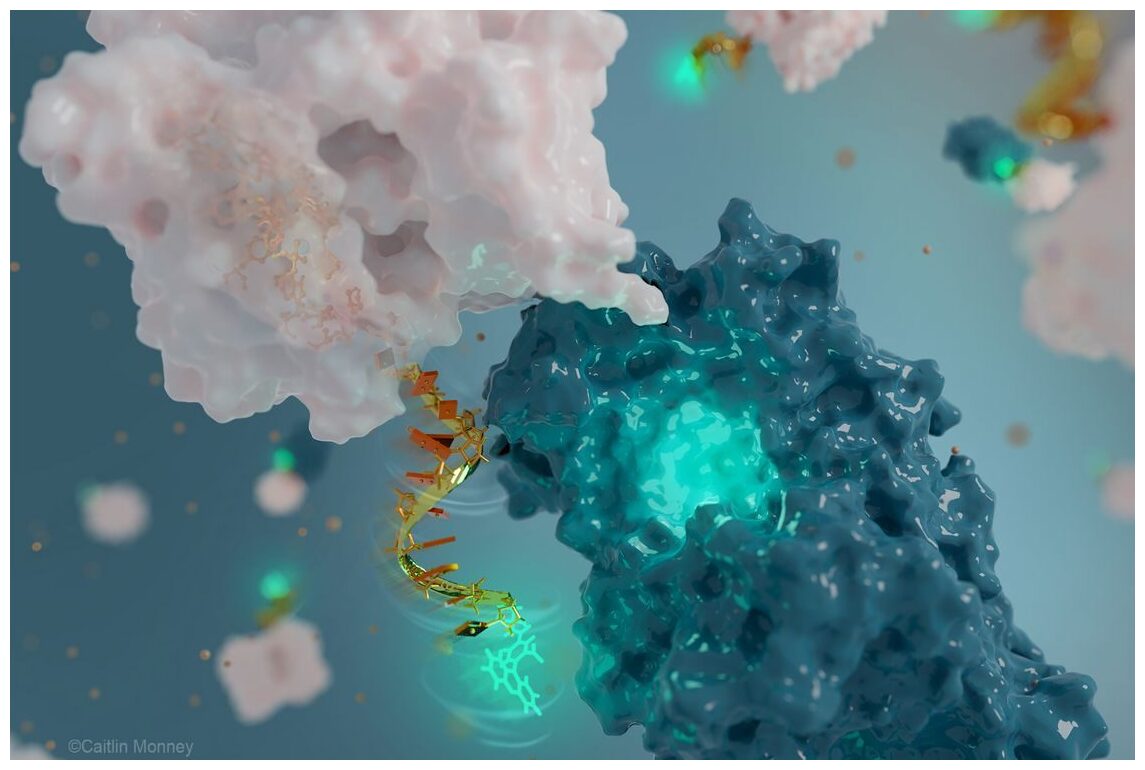
Scientists use DNA molecules to create world's tiniest antenna capable of monitoring proteins in the body

Alejo

Ambassador
Ambassador
FOTCM Member
Hi guys,

As i was doing my nightly news round, i came across this article that may or may not be important, but the wording of it caught my attention, particularly since the C's have mentioned our DNA being antennae, and so I found it interesting that someone has recognized this out there, the purpose that they're using it for seems rather simple, but I daresay the principle might be similar to how our DNA aligns with certain information?

I also found it interesting that the DNA antenna they're creating works by receiving and sending light signals.

Now I also realize that this recognition of the antenna capabilities of DNA could also be used for nefarious purposes.

The microscopic invention attaches itself to the designated target and receives and returns light signals in different colors for easy identification. Scientists consider this a very promising breakthrough for science.

Canadian scientists have found a way to turn deoxyribonucleic acid (DNA) into the world's tiniest antenna, capable of transmitting data about structural changes in certain proteins within an organism.

As reported last week by the University of Montreal, these nanoantennas are flexible, easy to assemble and make it possible to monitor the functionality and movements of the target proteins to be tracked.

More than 40 years ago, the first DNA synthesizer was created to design molecules that encode genetic information, recalls the press release. In recent years, says professor and lead author of the invention, Alexis Vallée-Bélisle, chemists "have realized that DNA can also be used to build a variety of nanostructures and nanomachines."

This researcher and his team were inspired by "the Lego-like properties of DNA, whose building blocks are typically 20,000 times thinner than a human hair." The DNA antenna is five nanometers long and fluorescent. It receives light at one wavelength and, depending on the behavior of the protein it is chasing, returns that light at a different wavelength, i.e. a different color, a change that the researchers can distinguish.

The invention holds great promise for biochemistry and nanotechnology, as the team was able to detect "in real time and for the first time the function of the enzyme alkaline phosphatase with various biological molecules and drugs." "This enzyme is associated with many diseases, including several types of cancer and intestinal inflammation," said researcher Scott Harroun, the first author of the scientific paper on the subject published at the end of last December.

The inventors are ready to found a company to commercialize this nanoantenna and make it accessible to as many researchers as possible.

Translated with www.DeepL.com/Translator (free version)

Here's a link to the original article in French from the University of Montreal.
 
If I have to think of an evil purpose for such technology, the first thing that comes to mind is the vaccine and the production of the spike protein.

Suddenly you see that it is about saturating the body with small antennae, multiplying its effect.
I thought about that too, I mean their recognition of the potential of genetic editing and things as such was turned into a way to control people, instead of reducing suffering.

So, I can imagine that this development will eventually be weaponized, however, seeing their ignorance and hubris, despite their resources, I also am remaining open to the possibility that if they were to try to make something nefarious out of tiny DNA Antennae, it would backfire spectacularly.
 
I thought about that too, I mean their recognition of the potential of genetic editing and things as such was turned into a way to control people, instead of reducing suffering.

So, I can imagine that this development will eventually be weaponized, however, seeing their ignorance and hubris, despite their resources, I also am remaining open to the possibility that if they were to try to make something nefarious out of tiny DNA Antennae, it would backfire spectacularly.
By definition of capitalism that funds these researches and the way current medical system works, it will only be used for profit. If some thing cures disease, they squash it. So it will always for the nefarious purposes only. I know it is pessimistic view. As long as current situation continues, I don't see any different outcome.
 
more on antennae

dear forum.
i believe that the article below can be of interest:


indeed, i was always intrigued by the signification of labyrinths on cathedral floors, and i found the analogy of their patterns with new antennae in microcircuits striking.

also, the cass have insited on dna antennae and various other ones in the human body.

i was also always intrigued by the phase of medieval cathedral construction, which represented an enormous effort on the part of the population and by the resulting complexity of the achieved building.

i suggest there is food for thought in these events.

as an afterthought, i also reminds me of "shape power", as practised in fengshui...
 
Hi, just to say (to admins) that this thread could be merged with this one :
(if yes, maybe found a good "title" that matches ... + remove this post ... :)
 
Hi, just to say (to admins) that this thread could be merged with this one :
(if yes, maybe found a good "title" that matches ... + remove this post ... :)
hmm, may not be directly related, but let's see what others think. I do believe that both discussions could be held separately, but let's wait for someone else's opinion.
 

Wasn't this caused - mainly in the beginning of the Covid-19 injection rollout - as Big Pharma used microscopic metallic / magnetic beads, in the attempt to clean/separate DNA (which was responsible for creating a modRNA copies) - so that later only RNA would remain. Albeit in reality, the magnetic beads also went into people's bodies - giving the infamous magnetic effect on the site (arms) of injection.

Later this procedure was changed, and magnetic beads abandoned, in favor of other procedures. But we also know that it was equally sloppy, due to the vast amount of DNA contaminations later found. Not to mention the absurdly dangerous addition of SV40 enhancers, assuring that the foreign DNA contamination would be translated into the human genome

On top - Big Pharma also used wrong "measuring procedures" - which aimed at to show/prove that the modRNA were purified. Which they where not ( or far from enough). So, it was just a cover up - by using wrong measuring methods. A play for the galleries, so to speak. Like everything else... Kind of like:

"Oben hiu und unten pfui", my German Grandmother would to say.
Something like:
"Upstairs Yeah Wow, but down below nasty and dirty"

Albeit my grandmother said those words in the sense of a persons overall looks; nice hair do (above), but my shoes (below) tended to be on the ugly side (I didn't care so much about how clean my shoes were) *LOL*
 
hmm, may not be directly related, but let's see what others think. I do believe that both discussions could be held separately, but let's wait for someone else's opinion.
Just an idea.
I searched on "nano" on title thread and found this little one that is also related.
A thread like "Nanotechnologies in vaccines", or a broader one named something like "Nanotechnologies & transhumanism" but in the context of human goods in general, I mean not only vaccines, but food, water, air (chemtrails), drugs, ... and the fact that it's hidden to the population. I do not like long thread titles but sometimes it's necessary to well figure out the topic, so, a better title would be "Hidden nanotechnologies in human goods - transhumanism agenda" - but again, it's an idea, maybe better to separate per sub-topics ?

For instance, i still have doubts about nano put in food, as some clips i watched with, for instance, someone showing a brand new bag of coffee (from nestle, one of the evil companies) and demonstrated that there are things in it that stick to a magnet.
Similar to this, i just made a search on Odysee, here, a clip of 2021 showing something that react to magnet in the membrane of a pill. Is it linked to this topic ? I can't answer.
 
I found an interesting youtube video that showcases a crystallization of protein inside a cyanobacteria. When scientists discovered this, they experimented with altering the protein structure slightly so it wouldn't crystalize to see if it would have any effect on the growth of the bacteria. It appeared not to, but then again based on our understanding of the function of proteins connecting to the information field I have trouble believing they have definitively captured all possible effects the protein crystal has on the rest of the bacterium.

 
I have trouble believing they have definitively captured all possible effects the protein crystal has on the rest of the bacterium.
Good point,

I believe they would need to understand that form follows function and not the other way around, but scientists tend to be rather materialistic, and believe the mind follows the brain so, attempting to put together the ingredients of something to generate an outcome misses the point.

Birds have wings because they fly, they don't fly because they have wings. Without chaining that paradigm, I have a feeling they will miss most meaning from their experiments.
 

Globalist-"sponsored" scientists are so obsessed with controlling the mind that they conducted a study where a remote magnet would be able to manipulate the brain – even one's appetite – without any invasive procedure performed.

Researchers at South Korea's Institute for Basic Science (IBS) are in the very early stages of development of hardware that utilizes nanoparticlesto control the minds of mice. It is a brain remote control that they claimed is "long-range" and "large-volume" and switches using magnetic fields.

According to the "science experts," the technology dubbed Nano-MIND (Magnetogenetic Interface for NeuroDynamics), allowed researchers to control the emotions and appetites of mice from afar and could be used to treat neurological disorders like depression. They tested the "innovation" by inducing "maternal" instincts in their female test subjects. In another test, the researchers exposed a test group of lab mice to magnetic fields designed to reduce appetite, leading to a 10-percent loss in body weight, or about 4.3 grams

The scientists manipulated a complex network of over 100 billion neurons by magnetically twisting a tiny actuator to pull or push nanoparticles implanted in the mice's brains. According to studies, this network is crucial for understanding cognition, emotion and social behavior.
 
AI-designed DNA: Scientists can now control genes in healthy cells with unprecedented AI precision
05/09/2025 // Lance D Johnson

Artificial intelligence is now being used to genetically engineer and will supposedly "perfect" human DNA. This will lead scientists into the delusion that they are god, creating a perfect human DNA that resists all disease and death. In this delusion, they will be trusting AI to eliminate human disease and imperfections by turning genes on and off when the time is right. This is the fantasy, at least, and these advancement in gene editing might have some positive applications. But with the catastrophes of recent mRNA vaccine experiments, it's hard to say whether mankind should trust artificial god-like advances in gene editing or believe that those who control the technology have their best interests at heart.

Key points:
  • Generative AI has successfully designed synthetic DNA sequences that control gene expression in healthy mammalian cells for the first time.

  • The technology allows scientists to turn genes on or off in specific cell types, paving the way for highly targeted gene therapies.

  • Researchers used AI to create entirely new DNA "enhancers" that do not exist in nature, offering a new way to fine-tune gene activity.

  • The breakthrough could lead to safer, more effective treatments by reducing unintended side effects in healthy cells.

  • The study, published in Cell, marks a major milestone in generative biology, expanding beyond protein design into gene regulation.

AI as the new architect of genetic control​

For the first time, scientists have harnessed artificial intelligence to design synthetic DNA sequences capable of precisely controlling gene expression in healthy mammalian cells. Published in the journal Cell, the groundbreaking study from the Centre for Genomic Regulation (CRG) in Barcelona demonstrates how AI can craft custom DNA "enhancers"—tiny genetic switches that turn genes on or off—with unprecedented accuracy. This breakthrough could revolutionize gene therapy, allowing researchers to fine-tune treatments to avoid harmful side effects while correcting faulty gene activity.

Gene expression—the process by which DNA instructions are converted into functional proteins—is regulated by enhancers, short DNA sequences that act like molecular switches. Until now, scientists have relied on naturally occurring enhancers, limiting their ability to create highly specific genetic interventions. But AI has changed the game.

Using a machine learning model trained on massive datasets, researchers instructed the AI to design synthetic enhancers that activate a fluorescent protein gene in certain mouse blood cells while leaving others unaffected. The AI-generated sequences were chemically synthesized, inserted into cells, and performed exactly as predicted—a feat previously thought to be years away.

"It's like writing software but for biology, giving us new ways of giving instructions to a cell and guiding how they develop and behave with unprecedented accuracy," said Dr. Robert Frömel, lead author of the study.

A new era of precision medicine​

The implications for medicine are profound. Many diseases, from cancer to autoimmune disorders, stem from faulty gene regulation in specific cell types. Current treatments often affect healthy cells, leading to severe side effects. AI-designed enhancers could allow therapies to target only malfunctioning cells, minimizing collateral damage.

For example, a patient with a genetic blood disorder might receive a therapy that activates a corrective gene in red blood cells while leaving platelets untouched. This level of precision was previously unattainable.

"We set out to decipher these grammar rules for enhancers so that we can create entirely new words and sentences," explained Dr. Lars Velten, the study’s corresponding author. "Now, we can design genetic switches that nature never invented."

The dark side of genetic engineering: Who controls the code?​

While the potential for healing is immense, the power to rewrite genetic instructions raises ethical and safety concerns. If AI can design DNA sequences that override natural gene regulation, what prevents this technology from being weaponized or misused? What if human imperfections serve a purpose in our lives? What if the architects decide upon master characteristics, and attempt to cleanse the human race of undesirable traits to create a "perfect" race of people?

History offers cautionary tales. The CRISPR gene-editing revolution, once hailed as a medical miracle, has faced backlash over unintended mutations and ethical dilemmas surrounding human germ-line editing. Similarly, AI-generated enhancers could be exploited for unethical purposes—such as engineering biological agents or manipulating human traits. The recent mRNA vaccine experiments wrought deadly consequences on humanity, re-instructing human cells to produce spike proteins that persisted and caused damage to the heart and other organs.

The researchers acknowledge these risks but emphasize that their work is still in early stages. "We’re just scratching the surface," Velten said. "There are over 1,600 transcription factors in humans and mice. We’ve only begun to explore this landscape."

As AI reshapes the boundaries of genetic engineering, society must confront a critical question: Will this technology be used to heal—or to control? The same tools that could cure disease might also enable unprecedented biological manipulation. The future of AI-designed DNA is here. The question is, who will wield it responsibly? What are the repercussions of manipulating DNA this way and will there be irreversible issues that result?

Sources include:

ScienceDaily.com

Cell.com

CRG.eu
 
Back
Top Bottom