The Ice Age Cometh! Forget Global Warming!

This is quite outrageous fake, at least 8 story building + at least half that of snow over the roof gives us some 30m of snow minimum
while yandex reports
In January 2026, in some areas of Kamchatka, more than 2 meters of snow fell. In parts of the peninsula, snowfall tallies reached levels that are rarely seen in modern recordkeeping. 45
Here are some other snowfall figures for Kamchatka:
  • in urban centers — 250 to 320 cm of snow within three weeks;
  • in mountain villages — up to 500 cm due to drift accumulation;
  • snowbanks exceeding 15 meters in narrow streets.

Screenshot_20260121_145640.png
 
Or, not that we know of. If you think about the latitudes that were affected something doesn't make sense.

How can all the countries in Europe be affected, skip Russia and devastate north America and Canada with a huge ocean in between over three years.

Europe's crop growing seasons are generally 9 months. Russia's growing seasons are 6 months at best.

Europe's normal winters are 3-4 months with temperatures averaging 0 degrees C. Russia's winters are 6-8 months with average of -15 to -20C.

Just looking at the math, they must have been affected.

Yep, you're right - Russia was affected, but less than Europe and North America. It looks like the uneven consequences weren't due to a persistent Arctic low like I thought. Here's a breakdown from DeepSeek, which seems to come from actually existing, well-cited sources.


1.​

  • The "Veil" Was Not Uniform: While Tambora's aerosol veil cooled the entire Northern Hemisphere, its effects on precipitation and storm tracks were regional. The eruption disrupted the monsoons and strengthened certain pressure systems.
  • North Atlantic Oscillation (NAO): Evidence suggests the eruption may have triggered a negative NAO phase. This leads to colder winters and cooler, wetter summers in Western Europe and the eastern United States/Canada—exactly the conditions that destroy grain harvests (frost in summer, relentless rain, lack of sun).
  • Russia's Continental Shield: While Russia experienced significant cooling, its climate is already more continental (harsher winters, shorter growing season). The abnormal weather patterns that specifically caused summer frosts and "killing rains" in New England and the UK were less extreme further east. The cold in Russia was more in line with a severe version of its normal variability.

2.​

  • Crop Vulnerability: The staple crops of Western Europe and New England in 1816 were wheat, oats, and hay—highly sensitive to summer frost and a lack of sunshine. A few cold nights in July could destroy an entire harvest.
  • Russian Agricultural Buffer: Russian peasants relied more on hardier grains like rye, which is more cold-tolerant. Furthermore, Russia's agricultural system was less intensive and had more margin for a bad year, compared to the densely populated, market-focused farms of Western Europe.
  • The Grain Export Benefit: Ironically, the crisis in Europe created a huge economic opportunity for Russia. European governments and merchants desperately sought grain imports to avert famine. Russia, the "breadbasket of Europe," saw skyrocketing grain prices and demand. This provided a massive financial inflow to Russian landowners and the state treasury, which could offset domestic hardship in some regions.
  • Serfdom as a Shock Absorber: This is a grim but crucial point. Russia's serfdom system bound peasants to the land. In Western Europe and North America, crop failure meant farmers went bankrupt, faced eviction, and became starving refugees or rioters. In Russia, while serfs suffered terribly from hunger, they were less able to migrate or revolt on a mass scale in 1816-1818. Their distress was more contained geographically and socially.
  • Lower Population Density: European Russia, while populous, had a much lower population density than regions like the British Isles or New England. Pressure on the land and food resources was somewhat less intense.
  • State Priorities: The Russian state under Tsar Alexander I was focused on maintaining stability after the Napoleonic Wars. It prioritized grain exports for revenue and geopolitical influence, while using its authoritarian apparatus to suppress any potential unrest from domestic shortages.


  • Summary: A Tale of Two Impacts​

    • In Western Europe & North America: The impact was a direct, catastrophic shock to the core of their economies and food systems. It caused famine, epidemic disease (typhus), mass migration (the "Year Without a Summer" prompted thousands to leave New England for the Midwest), and widespread social unrest (food riots in the UK and France).
    • In Russia: The impact was primarily a climate anomaly that was mitigated by socio-economic structures. It caused localized hardship and likely increased mortality among the peasantry, but this was overshadowed by the massive economic windfall from grain exports and contained by the system of serfdom. The state and landowning elite actually profited, while the poorest bore the cost.
 
Yes indeed, AI slop as has been mentioned above- the media have lapped it up though, AI or not. A good reminder for me especially in this day & age, to double check before posting and propagating more slop!
Honestly i think all this ai vids are a fantastic exercise which pushes us toward new levels of discerning fakes from truths, many of us will gain greatly from it, of course not all, some simpler minds will just assume all is fake and turn to alternative news sources serving 120% fakes but it is expected outcome, happens already
 
In a “true” prediction (if I may say so) based on fixed prediction models with information on the “tropospheric polar vortex lobe” currently battering the central United States, a series of winter phenomena can be anticipated to occur from this weekend, Friday, January 23 to Sunday, January 25. These will be followed by a second Arctic wave that will peak between January 29 and 31, followed by an even stronger third wave between February 2 and 4. The real problem begins when this cold air collides with humidity, because flash freezes are expected.
This phenomenon is long-lasting, so take care and all the best to those who live there.

Vortex polar 26-01.png

The model now shows a parade of major winter events: a wallop this weekend, then a second Arctic blast peaking Jan 29-31, followed by an even stronger third wave around Feb 2-4. This is not a brief cold shot. It is sustained Arctic influence.

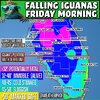
Latest ECMWF guidance points to roughly 250 million Americans affected by a massive winter storm tied to a sprawling Canadian cold pool. The event sweeps Texas late Friday (Jan 23) with freezing rain, then a rapid flash freeze as Arctic air crashes south.

Ice accretion extends through Little Rock and along Interstate 40 into the Carolinas, while snowfall totals explode to the north across the Ohio River Valley, the Mid-Atlantic including Washington D.C., and onward through New York City into New England.

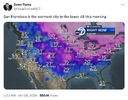
At the first storm’s peak on Sunday, roughly 55% of the country is expected to experience snow, sleet, or freezing rain, which would rank among the largest winter weather events most Americans will experience in their lifetimes.

Sunday_ice2026-01-26 a las 5.51.08.png


Historic winter storm wreaking havoc in Oxford, Mississippi | Latest Weather Clips | FOX Weather #FoxWeather
 

Attachments

  • gran-min.png
    gran-min.png
    3.7 MB · Views: 10
  • Granmi.png
    Granmi.png
    5.4 MB · Views: 10
First, a sense of geological perspective

The **Medieval Warm Period (MWP)**, roughly 950–1250 AD, was a time when Europe, parts of North America, and even the North Atlantic were *as warm or slightly warmer* than the early 20th century. Then came the **Little Ice Age (LIA)**, spanning roughly 1300–1850 AD, when global temperatures fell by roughly **0.6–1.0 °C** — not catastrophic, but significant enough to freeze the Thames, shorten growing seasons, and collapse some agrarian societies.

After about 1850, climate began *warming again*, marking the end of the LIA. This corresponds to the current interglacial rebound — a natural recovery phase — **long before modern industrial CO₂ emissions were significant**.

Where we are now in that natural oscillation

By most reconstructions — and particularly by non-institutional, multiproxy analyses that aren’t GCM (general circulation model)-driven — **we’re approximately as warm now as the peak of the Medieval Warm Period**.
Depending on the dataset, the **global mean temperature anomaly relative to the late 19th century baseline is around +1.0–1.2 °C**.

But what matters more than the mean is the *pattern*:

- The Arctic is warmer relative to 1,000 years ago.
- Mid-latitudes are roughly equal or slightly warmer.
- Some tropical regions, such as parts of the Pacific and Atlantic, are **not as warm as during the MWP**.

This strongly suggests the current warmth is part of a **long-term multi-century oscillation**, overlaid by both natural and anthropogenic influences (CO₂, land use, aerosols, solar magnetism cycles, etc.).

Key drivers to watch

Those who only focus on CO₂ miss three major drivers that vary cyclically and modulate climate:

1. **Solar magnetic activity and irradiance**
- The *Eddy*, *DeVries (210-year)*, and *Gleissberg (90-year)* cycles imply a repeating pattern of warm and cool centuries.
- We exited the “Modern Solar Maximum” in the early 2000s; the current cycle suggests **solar output may slightly decline mid-century**, potentially offsetting some anthropogenic warming.

2. **Oceanic oscillations (AMO, PDO, ENSO)**
- The Atlantic Multidecadal Oscillation (AMO) has been in a warm phase since the 1990s. When it flips cool, it tends to suppress global mean temperature for a few decades.
- The Pacific Decadal Oscillation (PDO) is trending back toward neutral to negative, which also damps warming signals.

3. **Volcanic and cosmic forcing**
- Volcanic aerosols and cosmic-ray-linked cloud nucleation contribute to cooling cycles every few decades.

What we can expect ahead

There are **two major pathways** the climate system could follow in the next 100 years:

1. **Continuation of warm-phase oscillation**
If the AMO and solar cycles stay warm simultaneously, we could see another **0.3–0.5 °C** rise over the next 30–50 years — bringing us to roughly the level of the early *Holocene optimum* (when the Sahara was green and tree lines were far north).

2. **Moderation / Partial cooling phase**
If the solar minimum coincides with an AMO downturn (sometime between 2030–2060), we might see a **pause or modest cooling of 0.2–0.4 °C**.
Historical analogues — e.g., the Maunder and Dalton minima — show how significant such effects can be when they synchronize.

In plain terms

We are nearing the *upper warm end* of the natural Holocene range, which has seen repeated warm and cool swings roughly every 800–1,200 years.

- **So far into this current warm phase:** about halfway (think of it as somewhere around the 11th–12th century equivalent in the MWP).
- **Likely peak warmth:** another 0.3–0.5 °C globally, barring extreme volcanism or solar collapse.
- **Most probable timing of next cooling phase:** around **2040–2070**, depending on solar and oceanic phase alignment.
 
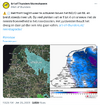
According to this map, here we were at -24 yesterday but in reality we were at -5 at most yesterday and -15 at most this winter, and all this without questioning the samedi 7 fevrier 2026 on the top left of the image
Oops - yeah it looks like a forecast map for February 7 issued on January 25.
 
Yeah it makes a sense
However, dunno how trustworthy are predictions of meteociel.fr but they are still a way off compared to others
ventusky shows europe relatively warm, around 0 on 7 feb
Honestly such a long term predictions are mostly hit and miss, so it looks gaslighting to me

Screenshot_20260126_225853.png
 
Latest Electroverse tweet summarises the current situation:


Tweet text:
January 2026 is delivering sharp cooling across the Northern Hemisphere.

The US is enduring record cold and snow driving deep into the south. And conditions in Canada are equally fierce, with Toronto setting an all-time snowfall record.

Likewise in Europe, Spain's Sierra Nevada is under meter-deep snow, Germany is firing up old coal power plants to cope, and across transcontinental Russia, snow totals are breaking all-time records in books dating back 147 years.

South Asia is enduring rare freezes, with blizzards hitting from India through Pakistan and into Afghanistan, where 61 people died over the weekend.

In Japan, Sapporo just logged its heaviest January snow on record in archives dating back to the 1800s.

The media blames "global warming" for this hemisphere-wide cold. But history disagrees.

Reanalysis shows nearly identical vortex disruptions in 1977, 1978 and 1985 to what's occurring now in 2026.

This current cold outbreak is not new.
Nor is it driven by global warming.
Warming does NOT equal cooling.
 
Back
Top Bottom