The Ice Age Cometh! Forget Global Warming!

Cuba has its first freeze on record

mmmmm
Cuba's all-time record low was set Feb. 3, 2026.

Cuba just had its first freeze on record, and other records were smashed from the Bahamas to Central America from the same cold outbreak that left Florida and the eastern U.S. shivering last weekend.

On Tuesday morning, the Indio Hatuey weather station in Perico, Cuba, reported a low of 32 degrees, a new national all-time record low, according to Cuba's weather service, the Instituto de Meteorología Cuba (INSMET). The previous record of 33 degrees was set in Bainoa almost 30 years ago on Feb. 18, 1996.

Frost was apparently seen on crops around the weather station, according to a Tuesday Facebook post from INSMET.

Other Cuba Records

It appears four other stations in Cuba tied or set new all-time record lows in this cold snap, according to INSMET and weather records expert Maximiliano Herrera:

- Aguada de Passengeros: 37 degrees (3 degrees Celsius)

- Jucarito and Santa Cruz del Sur: 44 degrees (6.8 degrees Celsius)

- Guantanamo Bay: 57 degrees (13.9 degrees Celsius) tied

Six other weather stations tied or set new February records, ranging from 43 to 46 degrees.

More Cold Records

Cuba wasn't the only place shivering.

On Sunday, the high in Freeport, Bahamas, reached only 51 degrees, the coldest high temperature on record anywhere in the Bahamas, according to Herrera. That's more typical of early February in Nashville, over 800 miles northwest of Freeport.

Herrera also found Flores, Guatemala, tied its all-time record low of 48 degrees, while a mountain station (Finca Los Andes, elevation about 5,500 feet) in western El Salvador set its February record of 38 degrees.

Belize had its coldest low since 1968, dropping to 42 degrees, Herrera noted.


At least 6 all-time lows recorded in Japan today:


On Monday, following widespread snowfall across much of Japan including Tokyo, frigid-air drove temperatures to record lows
🥶
Narita and Haneda Airports both logged their coldest mornings on record, with sub-zero temperatures covering over 90% of Japan.

Central Tokyo dropped below −3°C for the first time in 42 years for February.
 
Last edited:
+ The extreme cold wave sweeping across the northern United States and Canada is about to freeze Lake Erie, which is almost completely covered in ice. Over the weekend, the frozen surface opened up dramatically.
A crack stretching more than 80 miles formed Sunday, running from near the Canadian side of the lake toward the Cleveland area. The break opened up after strong winds swept across the Great Lakes Friday and Saturday, pushing and pulling the lake’s ice as another blast of Arctic air poured into the region.
(...)
As of this week, Lake Erie was about 95% ice-covered, according to NOAA’s Great Lakes Environmental Research Laboratory.
Lake Erie has reached 100% ice coverage only three times since record-keeping began in 1973.

"Signs point towards a bit of a warmup in mid-February that may limit the chances of completely freezing," AccuWeather Great Lakes Expert Brandon Buckingham added.


+ On Sunday morning, the temperature in Central Park dropped to 21 degrees below zero, the second lowest RealFeel® temperature recorded in the city since 1990, according to AccuWeather meteorologists.
Extreme cold like this significantly increases the risk of frostbite on exposed skin within 8 minutes, and prolonged exposure can lead to hypothermia.

New York is experiencing a historic cold snap, with temperatures lower than in parts of Antarctica.

The National Weather Service warned of potentially deadly conditions and confirmed that this is the longest period of low temperatures in more than a decade in several regions.
New York continues to experience extreme cold, with temperatures lower than in some parts of Antarctica, amid the advance of a cold air mass that is causing dangerous conditions and wind chill temperatures well below zero across much of the northeastern United States. On Sunday, the city recorded around -16 degrees Celsius and a wind chill of close to -26 degrees.

According to data released by meteorological services, wind chill temperatures close to –40 degrees Celsius were reported in several areas of the northeast of the country. In contrast, the US McMurdo station in Antarctica recorded approximately –6 degrees Celsius, which is about 10 degrees warmer than in New York City during the most critical moment of the weather event.
(...)
The impact of the phenomenon led to extreme cold warnings being issued for more than 43 million people, including large metropolitan areas such as New York and Philadelphia.
NY_26.png

Dan DePodwin, senior director of forecasting operations at AccuWeather, explained that “in many parts of the Northeast, far from the coast, this prolonged period of cold weather is the most extreme in at least the last decade and, in some areas, in the last two decades.” The expert added that “many locations will end up with a streak of days below freezing that will rank among the ten longest on record.”
Translated with DeepL.com

 
Senior meteorologist Alex Sosnowski's current deep dive on AccuWeather 🥶 ❄️

Arctic surge to fuel early-week storm with snow and ice for Midwest, Northeast
Fresh Arctic air will set the stage for a storm early next week that could bring disruptive snow, ice and travel impacts from the Midwest to the Northeast, following several minor rounds of wintry weather.
By Alex Sosnowski, AccuWeather senior meteorologist
Published Feb 25, 2026 6:18 PM CET | Updated Feb 25, 2026 9:36 PM CET
Video Charts and Analysis

Arctic Surge to Fuel Storm With Snow and Ice Next Week
Short intro 🔥🔥🔥

Day two from the Lake Tahoe Daily Tribune.
Mother Nature rules the higher elevations with gusts of Southwest winds 15 to 35 mph, with gusts to 40 mph on open waters. The lake has a forecast for possible lightning and thunder.

LAKE TAHOE, Calif./Nev. – With wind and rain still impacting the Tahoe region, many resort have been impacted. Lift delay, holds, and closers are to be expected throughout the day as wind gusts could reach up to 35 mph. The rain is expected to end by late afternoon. Below is the lift status as of 11 am, February 25:

Homewood Mountain Resort: 1 lift is closed (South Carpet)

Mt. Rose Ski Tahoe: 1 lift is closed (Chuter), 1 lift is on wind hold

Heavenly Mountain Resort: 4 lifts are closed, 1 lift is on wind hold

Sierra at Tahoe: 8 lifts are closed

Palisades Tahoe: 16 lifts are closed, 4 lifts are on hold

Kirkwood Mountain Resort: 3 lifts are closed, 4 lifts are on hold

Northstar California: 6 lifts are closed, 1 lift (Highlands Gondola) is on hold

Diamond Peak: 2 lifts are closed

Boreal Mountain: 4 lifts are closed


Attachments

  • Screenshot 2026-02-25 135452.png
    Screenshot 2026-02-25 135452.png
    122.4 KB · Views: 25
A rare snowfall was observed near Mount Teide in the Canary Islands at 3,718 meters (12,198 ft)


WATCH: Tenerife covered in snow as Storm Therese hits Spain - making winter last a little longer.
March 20 at 11:15 AM Facebook

❄️❄️ As expected, #snow has made a major comeback at lower elevations across all our mountain ranges. About 20 centimeters of fresh snow have fallen at 1,200 meters in the #Vosges and the #Jura, and snow showers will persist until this evening.


🌨️ An upper-level cold pool is currently sweeping across northeastern France. Temperatures are dropping as low as -36°C at an altitude of around 5,300 meters over the North. It hasn't been this cold in France at this altitude during the month of March since 2022.➡️ Real-time tracking: urlr.me/FYHQuP
🤔

High & Low Weather Summary for March 2025

64 °F (Mar 5, 4:30 pm)100% (Mar 1, 3:00 am)30.48 "Hg (Mar 1, 3:00 am)
32 °F (Mar 14, 3:30 am)34% (Mar 6, 3:30 pm)29.45 "Hg (Mar 22, 5:00 pm)
47 °F71%29.99 "Hg
[TR]
[th width="8.6099%"]
[/th][th width="32.3468%"]
Temperature​
[/th][th]
Humidity​
[/th][th]
Pressure​
[/th]​
[/TR]
[th width="8.6099%"]
High​
[/th]​
[th width="8.6099%"]
Low​
[/th]​
[th width="8.6099%"]
Average​
[/th]​
[td]
* Reported Mar 1 12:00 am — Mar 31 11:30 pm, Paris. Weather by CustomWeather, © 2026
[/td]
Note: Actual official high and low records may vary slightly from our data, if they occured in-between our weather recording intervals... More about our weather records

High & Low Weather Summary for April 2025

79 °F (Apr 30, 2:30 pm)100% (Apr 12, 7:00 pm)30.39 "Hg (Apr 12, 7:00 pm)
41 °F (Apr 8, 7:00 am)23% (Apr 7, 4:00 pm)29.42 "Hg (Apr 15, 4:00 am)
56 °F63%29.99 "Hg
[TR]
[th]
[/th][th]
Temperature​
[/th][th]
Humidity​
[/th][th]
Pressure​
[/th]​
[/TR]
[th]
High​
[/th]​
[th]
Low​
[/th]​
[th]
Average​
[/th]​
[td]
* Reported Apr 1 12:00 am — Apr 30 11:30 pm, Paris. Weather by CustomWeather, © 2026
[/td]
Note: Actual official high and low records may vary slightly from our data, if they occured in-between our weather recording intervals... More about our weather records


Winter? Spring? Weather Rollercoaster Continues!
Mar 26, 2026 #forecast #northeast #nyc
The temperature rollercoaster continues as March ends, with cities in the Northeast swinging from winter to Spring, and back again. #forecast #northeast #nyc #update #spring #winter

Published March 26, 2026, 6:26 am EDT
End snip
Winter's last gasp (My money says let's wait and see under the current Solar Cycle)
Most of the rain is expected to be offshore by Saturday morning, but temperatures are plunging behind the storms' associated cold front.

East Low High Low.png

Brief cold blast (FOX Weather)

St. Louis had already dropped 20 degrees on Friday and low temperatures across the Midwest and Northeast will be in the 20s and 30s Saturday morning.

Spring warmth will quickly begin to rebound with warmth returning Sunday and increasing through the first half of the workweek.
 
Extreme snowfall in the mountains of middle Italy
31 March - 3 April 2026

A whopping 2.5 meter snow fell in the middle Region of Italy, due to a low pressure area, which has been circling over Italy for several days. For being April, i would believe that this must be by far, a new record. I have a vague memory of that there was an event more recently - in middle of March (between 2016-18 somewhere) when 1.5 meter came down over middle Italy's mountain region

The top of Vesuvio volcano the other day, showed a "white cap" (light snow cover) the other day.


Snow Emergency in Prati di Tivo: the accumulation exceeds 250 cm, another night of wolves begins

A wave of historical bad weather overwhelms the Gran Sasso massif at the beginning of April, transforming the famous tourist resort into a scenario of isolation and hectic rescue

The town of Prati di Tivo
the pearl of the Gran Sasso d'Italia, is currently experiencing one of the most difficult and incredible pages of its recent meteorological history. What was supposed to be an incipient spring turned into a fierce winter and out of time, dumping over two and a half meters of fresh snow to the ground in a very short period of time. The intensity of rainfall took even the most experienced residents by surprise, creating a white wall that literally submerged the streets and accommodation facilities. Visibility is reduced to a minimum and the force of nature is showing its crudest face, making the clearing and monitoring of the territory extremely complicated.

Avalanches
The situation plummeted dramatically during this terrible day, when the huge snow load accumulated on the overlying slopes gave way. An avalanche hit the Prati residence in Tivo, generating moments of authentic terror. The snowy detachment, fueled by the instability of the cool mantle resting on less compact previous layers, has hit the area with impressive impact force. Fortunately, the rescue machine was activated immediately, despite the prohibitive conditions of the communication routes, to verify the presence of people involved and secure the entire perimeter of the area, which had already been evacuated yesterday in view of the heavy snowfall.

A historical event in April that rewrites the statistics
It is not common to see scenarios of this type in the heart of spring, but the current event in April 2026 is shaping up as a real historical event. The nivometric statistics of the Abruzzo region have rarely recorded accumulations of this magnitude at this time of year, making this disturbance a case study for climatologists and meteorologists. The combination of icy Arctic mining currents and the humidity of the Mediterranean created the perfect mix for a "perfect storm" that chose the Teramano massif as the epicenter of its fury. The range of fresh snow fell exceeded all predictions, blocking all activity and forcing the population to forced resistance against the elements.

A night of storms and fear in the heart of the mountain
As the hours go by, darkness has enveloped the ski resort, but the fury of the elements shows no sign of subsiding. It is another night of storms and fear, characterized by gusts of icy wind that lift the snow reducing visibility to a few centimeters. Images coming from the place show streets turned into trenches, with walls of snow overlooking cars and houses, while the roar of the wind covers every other sound. The risk of further spontaneous detachments remains very high, keeping the alert at the highest level for the entire Gran Sasso area. The fear of the residents is palpable, as the geographical isolation makes every emergency intervention a challenge against time and nature itself.

Meteoweb.eu

neve-marche-3.jpg


neve-marche-5.jpg


neve-marche-7.jpg


31march2026italy.jpg


1april2026italy.jpg


3april2026italy.jpg
 

Throughout March in the West, temperatures surged to unprecedented levels for this time of year, due to a remarkable heat dome.

Then in April, that record-breaking heat shifted east. In D.C., temperatures reached 92 degrees on Thursday, based on temperatures recorded at Dulles International Airport, and the 90s in Baltimore, Philadelphia and near New York.

Want to know how your actions can help make a difference for our planet? Sign up for the Climate Coach newsletter, in your inbox every Tuesday and Thursday.

Now states that have had such record-breaking heat will experience some whiplash, as freezing temperatures hit some of those spots within days.

Those conditions are emerging from one place that’s been a starkly cold and snowy exception: Alaska.

Some of that chilly air is sweeping southward. First, a little snow is expected in Denver on Friday. It was 77 degrees there Thursday. Then, temperatures are forecast to dip into the 20s in parts of the Plains, Midwest and Northeast this weekend into next week — with a chance for snow flurries. Widespread blossom loss is also possible near Salt Lake City, warned the National Weather Service, following an early bloom because of record-breaking winter warmth. It snowed there on Thursday.

Nearly 100 million people can expect freezing temperatures across a wide swath from Boise, Idaho, to Boston and southward to near Philadelphia.

Freezing air from Alaska and Canada will descend into the contiguous United States into early next week. (Ben Noll/The Washington Post; ECMWF)

Very few low-temperature records are forecast to be broken
— and data shows that the recent exceptional warmth in the contiguous United States has not been balanced by unusual cold farther north, considering average temperatures since the start of March.

What’s going on in Alaska?


Since March, about 76 percent of the planet has experienced above-average temperatures. Meanwhile, it’s been colder than average for the remaining 24 percent — including across Alaska and Canada.

That highlights how the unusual warmth has been disproportionate.

Since the start of March, about 76 percent of the planet has experienced above-average temperatures while the remaining 24 percent has had below-average temperatures. This highlights how unusual warmth has been disproportionate. (Ben Noll/The Washington Post; ECMWF/ERA5)

“It was definitely a cold winter up here. Statewide, it was the coldest December to March in 50 years,” said Alaska-based climate scientist Brian Brettschneider.

In his experience, Alaskans typically don’t complain about extended periods of cold.

However, Brettschneider said he “heard more grumbling than typical” during March due to the extended cold. He said it was the snowiest March in Juneau, Alaska, by a wide margin — their fourth-snowiest month on record, which followed the second-snowiest month on record last December.

“People in Juneau were definitely tired of the snow by the end of the month,” he added.

The cause of unusual Alaskan cold was linked to an area of strong high-pressure in eastern Russia. Because air flows clockwise around high-pressure systems, Alaska frequently experienced frigid, northerly wind flows from the Arctic Ocean.

A snowy start to the Iditarod trail sled dog race in Far North Bicentennial Park in Anchorage during early March. (Brian Brettschneider)

As for whether the icy cold in Alaska balances out the unseasonable warmth in the contiguous U.S., Brettschneider added that if you combine the two regions, it was still the second-warmest March on record, behind 2016.

The coverage of above-average warmth greatly exceeded that of below-average temperatures.

26-july-2014
(Turgonl) About the weather here in Canada... It's been fluctuating between hot and cold this summer, and in the winter time. And we were just wondering, is the way the ice age is going to occur, will the summers just start to get cooler and cooler with the precipitation as time goes on over the next few years?

A: No, glacial rebound will fall within months when the tipping point is reached.

Session 23 August 2014
A: You are presently in the process described. It is only a matter of acceleration and the addition of the energy information of more dramatic upcoming events.

Q: (L) More dramatic upcoming events... What kind of more dramatic upcoming events?

A: Earth change variety. That should get the system going in a big way!!

Q: (Perceval) There was a big crack in Mexico.

(L) Well, earth changes doesn't necessarily mean comets. It can mean big earthquakes, volcanic eruptions, superstorms, onset of an ice age, floods, and all kinds of things.

(Perceval) That's all the fun stuff that we don't get to miss. Comets aren't coming before that happens. That would just be lights out! Here's an open-ended question: Isn't there going to be a big earthquake in California? [laughter]

A: Yes.


Session 23 November 2024
(Joe) I hope everybody's got their mukluks.

(L) Yeah, get your snows shoes ready and, plenty of sweaters and blankets and stuff. Because we don't know what's going on...

(Joe) Just in case anybody was wondering, somebody was asking about when the Ice Age is going to arrive? Well, it's in process right now. The weather you're seeing happening right now over the past few years, really, but speeding up today is actually the...

(L) Process of the falling of an Ice Age.

(Joe) The process in earnest, the beginning of an ice age. And it's a process.

(L) Yeah. You don't just wake up one day and it's there. We live in a temporal realm.


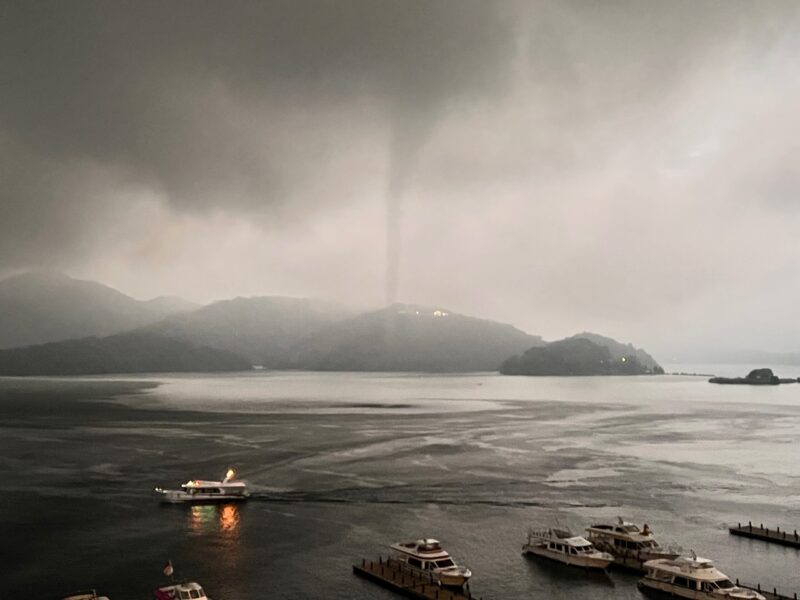
Seattle waterspout! What are waterspouts and how do they form?


Screenshot 2026-04-18 at 12-40-13 Kirkwood Weather Forecast - Snow & Ski Conditions Kirkwood S...png


A drop in temperatures in the north for the weekend

This inactive disturbance will tend to sink a little more over France on Saturday, April 18, the clouds stretching between the Pays de la Loire and the Belgian borders. Some showers will be possible in the morning of Haute-Normandie at Picardy, and from the Île de France to Champagne and the Ardennes in the afternoon. These showers can be locally stormy, and bring up to 15 mm of rain, even if the cumulations are most often weak and heterogeneous. In the wake of this air mass limit, the maximums will move back 1 to 3 degrees on Brittany, Normandy and Hauts-de-France. On the other hand, on the rest of the country, thanks to a rather generous sunshine and a mass of air remaining very soft, the atmosphere will still be warm during the day, with 21 to 26 ° C, and peaks at 27/28 ° C on the southeast quarter, often worthy of a month of June.

On Sunday 19 April, high pressures are on the British Isles and direct the wind to the northeast. The drop in temperatures is spreading over the northern half, but the atmosphere is still generally mild, more in line with the season on the far north. Heat is maintained in southern regions, temperatures can reach 28 to 29 °C around the Gulf of Lion.

During the day, we will find the trace of the inactive cold front between the Gironde, the Auvergne and the Jura massif, with some residual showers on its eastern part. In the north, in the cooler air, the clearings look beautiful. In the warm air that resists the south, cumulus develops on the relief, and can go to the storm locally in the Pyrenees.

Dry weather trend for week of April 20 to 26

The overall dry weather that has been going on for several days, or even weeks depending on the region, and that gives a dry pace to this spring over a large part of the country, should continue next week. On the mercury side, temperatures should be just from season to north, with a sometimes marked morning cool (frozen on the ground possible), while the more you go south and towards the Pyrenees, the longer warm weather for the season will persist.
 
Back
Top Bottom