High Dose Melatonin Therapy

As I can see, the source of this study is the American Heart Association. If we look back at their previous "studies" and their dietary guidelines, for example, I am very suspicious about any "scientific wisdom" that comes from there.

I‘ve thought the same, especially given what I’ve read at one point about melatonin‘s benefits on heart health. Makes sense from their point of view to discredit a helpful substance.
 
Sayer Ji did the favor to look into it:


A Study Designed to Confuse

When we dig into the methods, the implausibility becomes obvious.
The study only counted people with a prescription for melatonin—which is common in the U.K. but almost nonexistent in the U.S., where melatonin is sold over the counter. As the authors admit:

“Everyone taking it as an over-the-counter supplement… would have been in the non-melatonin group.”
This means that millions of people who actually use melatonin nightly were classified as non-users, while the so-called “melatonin group” was composed almost entirely of patients sick enough to have their sleep problems documented and treated in medical systems requiring prescriptions.

That’s not a safety signal — it’s a statistical illusion.

Confounding, Not Causation

Even if the data were reliable, the confounders are overwhelming. Chronic insomnia often travels with anxiety, depression, hypertension, and metabolic dysfunction — each a major risk factor for cardiovascular disease. Matching patients by demographics or comorbidities doesn’t erase the underlying severity bias: those who seek prescriptions tend to be those who are already unwell.

Moreover, the researchers lacked basic data on:

  • Sleep quality and circadian rhythm disruption
  • Lifestyle factors (diet, alcohol, shift work, screen exposure)
  • Supplement dosage and purity
  • Psychiatric medications used concurrently
Without these, there’s no meaningful inference about melatonin itself.

Moreover, the study failed to account for several key pharmacological confounders. While the authors excluded patients taking benzodiazepines, they did not control for other pharmaceutical sleep drugs such as zolpidem (Ambien), eszopiclone (Lunesta), or trazodone — all of which carry well-documented cardiometabolic risks. Nor did they adjust for the use of statins, SSRIs, or antihypertensives, which are both common among insomnia patients and known to alter cardiovascular function (learn more about the cardiotoxicity of statin drugs) and sleep architecture. Failing to isolate these variables makes it virtually impossible to determine whether the observed risks stem from melatonin itself or from concurrent drug exposure.

The Biological Reality: Melatonin as a Protector

For decades, melatonin has been one of the most studied molecules in the realm of oxidative stress and cardiometabolic protection. Peer-reviewed studies have shown that it:

  • Reduces blood pressure and improves endothelial function
  • Protects mitochondria and heart tissue after ischemic injury
  • Mitigates oxidative damage and inflammation across numerous organs
A 2022 meta-analysis in the Journal of Pineal Research found melatonin to be broadly cardioprotective, not cardiotoxic.

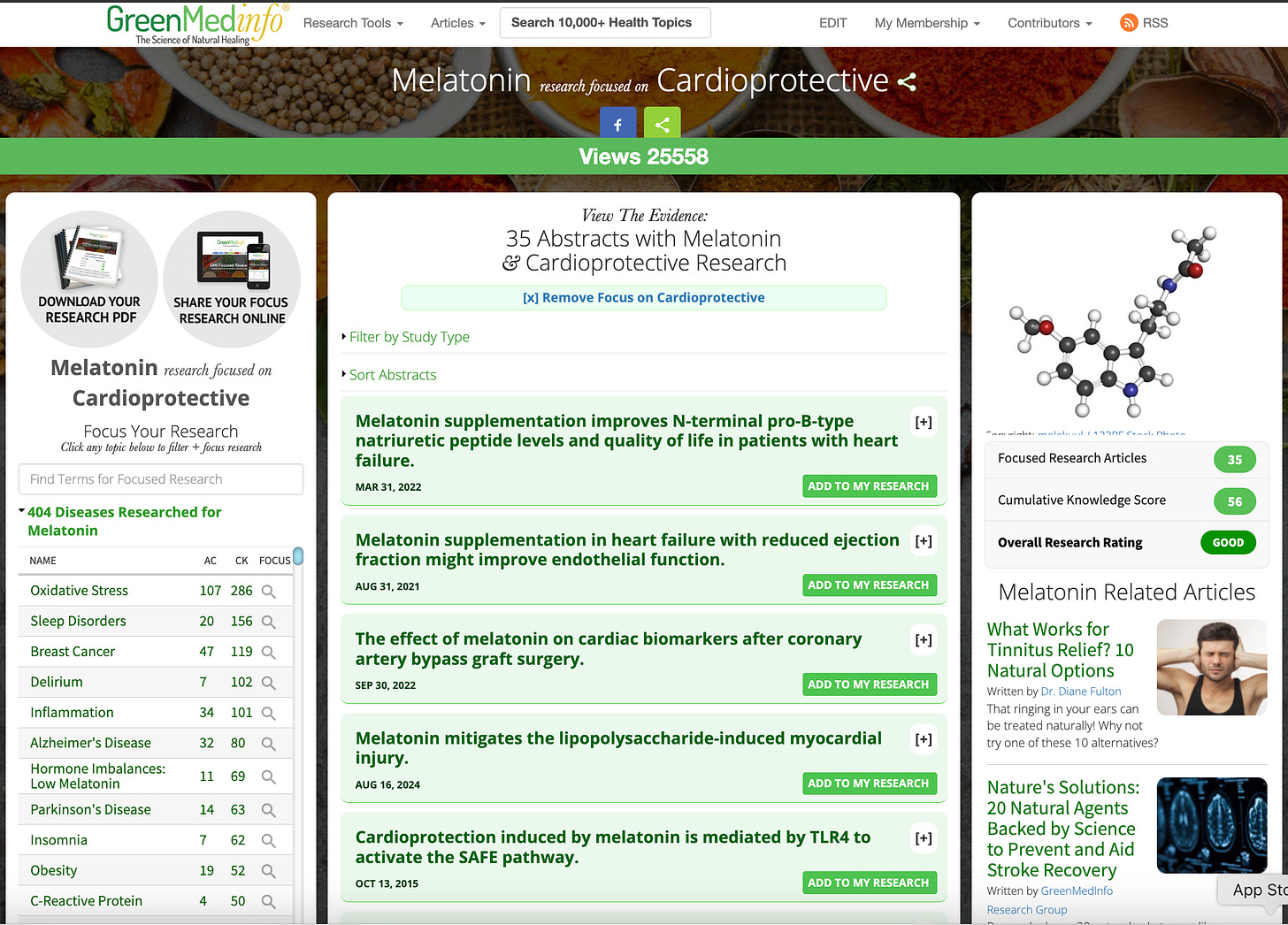
This aligns with the GreenMedInfo research database, which has indexed nearly 1,000 studies on melatonin’s diverse physiological benefits across more than 400 health conditions, and documents up to 130 distinct pharmacological actions of the molecule — including antioxidant, anti-inflammatory, neuroprotective, and cardioprotective effects (see the research compendium here).


Within this body of literature, there are dozens of studies specifically identifying melatonin’s cardioprotective roles — from improving myocardial recovery to reducing ischemia-reperfusion injury and modulating autonomic balance (cardiovascular studies here).

To reverse that entire corpus of evidence based on a five-minute abstract summary would be scientifically reckless.

It's actually quite audacious for the AHA to pick up on melatonin, the one supplement that protects the architecture of the sleeping cycle. I've specialized in sleep disorders and have read a few hundred sleep graphs. One of the worst offenders is a heart drug (ticagrelor), it literally gives you severe central sleep apnea. Then comes the zombie drugs - zolpidem, benzos, etc. It's impossible to have a normal sleeping cycle with those. An abnormal sleeping cycle on a vulnerable person translates into serious health problems. More info on the latter here: The Polyvagal Theory - Stephen W. Porges)
 
Sayer Ji did the favor to look into it:


It's actually quite audacious for the AHA to pick up on melatonin, the one supplement that protects the architecture of the sleeping cycle. I've specialized in sleep disorders and have read a few hundred sleep graphs. One of the worst offenders is a heart drug (ticagrelor), it literally gives you severe central sleep apnea. Then comes the zombie drugs - zolpidem, benzos, etc. It's impossible to have a normal sleeping cycle with those. An abnormal sleeping cycle on a vulnerable person translates into serious health problems. More info on the latter here: The Polyvagal Theory - Stephen W. Porges)
Since ticagrelor and Plavix (Clopidogrel) are both anti-platelet medication, inhibiting the P2Y12 receptor on platelets, does the severe central sleep apnea happen with Plavix too? It says ticagrelor is faster acting and dosed twice a day. But don't think that detail would make much difference since it's the same mechanism of action. Maybe sleep apnea just occurs faster with ticagrelor.

Good grief! That's just awful. Tons of people taking Plavix here in the USA, and tons have sleep apnea.
 
Since ticagrelor and Plavix (Clopidogrel) are both anti-platelet medication, inhibiting the P2Y12 receptor on platelets, does the severe central sleep apnea happen with Plavix too?
It's just described with ticagrelor. They first found the pattern in the intensive care unit, as it's given after stents/heart attacks. Plavix is not associated with sleep apnea. Even Sayer Ji praises plavix over aspirin in another of his articles.
 
It's just described with ticagrelor. They first found the pattern in the intensive care unit, as it's given after stents/heart attacks. Plavix is not associated with sleep apnea. Even Sayer Ji praises plavix over aspirin in another of his articles.

Oh that’s a huge relief. Thanks, Gaby. I’ll have to check out sayer ji on Plavix, especially since he rates it highly.
 
Oh that’s a huge relief. Thanks, Gaby. I’ll have to check out sayer ji on Plavix, especially since he rates it highly.
I take it back. I thought I read it here:


But any reference to it, is gone. I must have gotten the concept from another source.

Anyway, I've seen very old grandmas nearly bleed to death with oral anticoagulants that cardiologists systemically prescribe for atrial fibrillation. I had once a grandma with a little hole in her atrial septum (on top of her atrial fibrillation), which gave her strokes in her youth. I had to make a choice when she was having constant digestive and bladder bleeding that was risking her life. I decided to put her on plavix and some digestive protection like aloe vera. All bleeding stopped and she didn't have a stroke.

This is the very old school way of preventing a stroke in an old person with atrial fibrillation, whom you don't want to anticoagulate. My first boss (heart surgeon) forbade me to anticoagulate anyone over 80 years old after porcine valve replacement, which is systematically done for 3 months. I learned from him only to give blood thinners like Plavix or baby aspirin.

But as Sayer Ji summarizes above, the risk of bleeding is still significant with baby aspirin in old people. Either you take aloe vera, or do aspirin once a week, or switch to pycnogenol. Though I wouldn't do just the later one if there's a high risk of stroke.
 
As I can see, the source of this study is the American Heart Association. If we look back at their previous "studies" and their dietary guidelines, for example, I am very suspicious about any "scientific wisdom" that comes from there.

I wrote an article myself, since The Epoch Times gave melatonin recently bad coverage by reposting the article above.


Whenever the American Heart Association publishes an abstract that is not peer-reviewed for a study that is not even published, you have to turn on your BS meter and apply some good old common sense.

In “Long-term use of melatonin supplements to support sleep may have negative health effects”, they took electronic records and highlighted those who were taking melatonin, correlating with heart failure. Mind you, if you’re in heart failure, you’ll have insomnia because you can’t sleep due to your symptoms. So you’ll need to take something. If you don’t have heart failure, you sleep better and hence don’t require anything. Correlation doesn’t equal causation, making this another case of the firefighters getting blamed for the fire.

Melatonin doesn’t require a prescription in the U.S., hence it is over-the-counter, and this alone could bias the results significantly. This is called cherry-picking data to create your own reality in discordance with objective reality.

If people want to stop taking melatonin based on this abstract, so be it. As is so often the case these days, it’s easier to blame everything except the COVID-19 era (i.e. the vaccine).

From actual peer reviewed and published studies, here are some of the benefits people would be missing:

The pineal gland is a neuroendocrine gland which produces melatonin, a neuroendocrine hormone with critical physiological roles in the circadian rhythm and sleep-wake cycle. Melatonin has been shown to possess anti-oxidant activity and neuroprotective properties. Melatonin has been shown to have cardioprotective activity in multiple animal and human studies.
In short, it’s the one thing that is natural and has proven to be beneficial in cardiovascular disease.

Studies have demonstrated that melatonin has significant effects on ischemia-reperfusion injury, myocardial chronic intermittent hypoxia injury, pulmonary hypertension, hypertension, valvular heart diseases, vascular diseases, and lipid metabolism. As an inexpensive and well tolerated drug, melatonin may be a new therapeutic option for cardiovascular disease.
Also, it doesn’t cost much, it’s natural and virtually free of side-effects, and, on the contrary, it provides only benefit in cases of cardiovascular disease and pulmonary hypertension.

Melatonin efficiently interacts with various reactive oxygen and reactive nitrogen species (receptor independent actions) and it also upregulates antioxidant enzymes and downregulates pro-oxidant enzymes (receptor-dependent actions). Melatonin attenuates molecular and cellular damages resulting from cardiac ischemia/reperfusion in which destructive free radicals are involved. Anti-inflammatory and antioxidative properties of melatonin are also involved in the protection against a chronic vascular disease, atherosclerosis. The administration of melatonin, as a result of its antioxidant features, has been reported to reduce hypertension and cardiotoxicity induced by clinically used drugs.
Melatonin also palliates side effects of commonly used cardiovascular drugs. More on that below. It also targets multiple pathways that are otherwise very costly to target with mainstream drugs.

Melatonin acts through two G-protein–coupled receptors, MT1 and MT2, which are expressed in cardiac myocytes, vascular smooth muscle, and coronary endothelium. Via these receptors, melatonin modulates mitochondrial permeability transition pore (mPTP) opening — a key determinant of ischemia-reperfusion injury — and activates antioxidant enzyme cascades (SOD, GPx, catalase). It also suppresses RAAS (renin-angiotensin-aldosterone system) overactivity and inhibits sympathetic hyperactivation, both of which drive ventricular remodeling in heart failure.
Melatonin, at very low cost, is competing with a multi-billion drug industry that targets the same pathways. Cynics might say that vested interests want to do away with the natural and low-cost competition.

Melatonin functions as a powerful antioxidant and free radical scavenger, protecting cells from oxidative damage. Its diverse physiological roles include maintaining the functional integrity of endothelial cells, thereby preventing atherosclerosis, a major contributor to cardiovascular disease. Additionally, melatonin exhibits antioxidant and free radical scavenging properties, potentially improving metabolic disorders. These combined effects suggest a unique adjunctive therapeutic potential for melatonin in treating cardiovascular diseases.
Not only treating such, but preventing atherosclerosis itself. Again, the statin industry would be affected if there was a natural way to counteract atherosclerosis.

A 2021 meta-analysis of seven RCTs examining melatonin as a cardioprotective agent in humans — all involving patients undergoing coronary revascularization — found that melatonin-treated patients had on average a 3.1% higher left ventricular ejection fraction (LVEF) compared to placebo (95% CI 0.6–5.5, p = 0.01), and significantly lower troponin levels (SMD = −1.76; 95% CI −2.85 to −0.67, p = 0.002). These findings suggest direct attenuation of ischemia-reperfusion-induced myocardial dysfunction when melatonin is given perioperatively.
Studies are actually documenting how melatonin reduces heart failure.

The MeHR trial (Melatonin for Heart Failure with Reduced Ejection Fraction) — a double-blind, placebo-controlled RCT — assigned 90 outpatients with HFrEF to either 10 mg melatonin or placebo for 24 weeks. The results showed that oral melatonin decreased NT-proBNP levels and improved quality of life in HFrEF patients, suggesting a beneficial supplementary role even in established heart failure. A 2025 systematic review and meta-analysis also found improvements in NYHA functional class (OR 4.84; p = 0.05) with melatonin supplementation in HF patients, though ejection fraction changes did not reach statistical significance.
Studies are also finding that people are improving their heart failure symptoms and their blood markers for congestive heart failure when they are on melatonin.

Multiple RCTs have shown that controlled-release (CR) melatonin reduces nocturnal blood pressure, with a meta-analysis of seven trials demonstrating that CR melatonin (but not immediate-release) significantly reduced nighttime systolic BP by 6.1 mmHg (95% CI −10.7 to −1.5, p = 0.009) and diastolic BP by 3.5 mmHg.
If there’s one marker for really bad health: high blood pressure at night. And guess what? Melatonin decreases blood pressure at night.

A landmark crossover RCT by Scheer et al. in 16 men with untreated essential hypertension found that repeated nightly melatonin (2.5 mg) reduced sleep-time systolic BP by 6 mmHg and diastolic BP by 4 mmHg, with a 15–25% increase in circadian amplitude. These are clinically meaningful effects in the context of nocturnal hypertension, one of the most potent predictors of cardiovascular events.
You read that right: high blood pressure at night is the one predictor of a cardiovascular event, i.e. stroke or heart attack. It almost doesn’t matter if your blood pressure is high during the day or at work. It’s got to be normal while you sleep. And melatonin helps decrease blood pressure in those with high blood pressure at night. It can’t get clearer than that.

Most cardiovascular disease patients are users of beta-blockers — a drug class that suppresses endogenous melatonin production. It’s one of those drugs that tells your heart to chill out, which is why it’s used for high blood pressure, heart failure, after a heart attack, etc. However, many report insomnia issues when they first begin these drugs. Melatonin supplementation restores sleep architecture and nocturnal blood pressure control for beta-blocker users: “Repeated melatonin supplementation improves sleep in hypertensive patients treated with beta-blockers: a randomized controlled trial.”

Premature publication of a 300-word abstract into clinical guidance for an unpublished study (i.e., stopping melatonin) is inconsistent with evidence standards. The American Heart Association should have known better. Shame on them and everybody else who followed the unnecessary baseless fears by republishing or mediatizing this abstract. This includes the Epoch Times, which is how I came to learn about it, sent to me by my godmother.

What follows is a post I wrote in 2020, during the COVID lockdown. It’s a summary of a book I’ve read on melatonin, one of my all-time-favorite supplements for the benefits it has had in patients, loved ones, and myself. Melatonin is one of those supplements that people on the spectrum of conjunctive tissue anomalies can’t forgo because of their background of reduced deep sleep and fragmented sleep. It’s a life-saver and, below, you’ll understand why.

The rest, which is pretty fascinating, can be found here. It's a merge of 3 posts I wrote earlier in this thread in the year 2020 from Reiter's book. Melatonin is 500 times more powerful than DMSO as an antioxidant. It's also more efficient than DMSO in radioprotection. Pretty amazing stuff.
 
Back
Top Bottom