
Haiku
Jedi Master
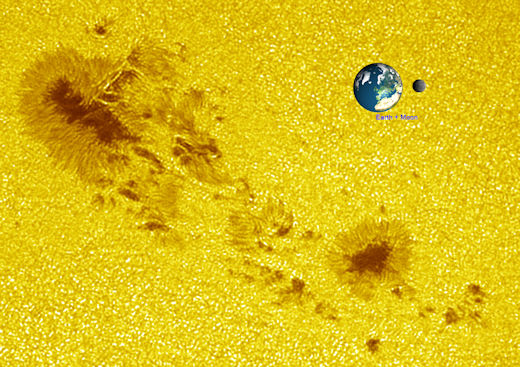
Got a good-sized sunspot 4420, directly facing us for the next three days, bad news if it goes off, Haiku ...
Big sunspot ...
Big sunspot ...


Got a good-sized sunspot 4420, directly facing us for the next three days, bad news if it goes off, Haiku ...

 www.facebook.com

Not all of them, of course, there was comet MAPS earlier this year:Laboratory of Solar Astronomy (xras.ru ) (http://t.me/lpixras )
A surge of activity continues on the Sun, which peaked with two consecutive X-flashes that occurred on April 24 (Лаборатория солнечной астрономии (XRAS) ). There are currently 7 groups of sunspots on the Earth-facing side, at least one of which, with the number 4420, is classified under the highest category beta-gamma-delta. The total reserves of flare energy on the star have decreased slightly over the past day, but it is still enough to produce, say, more than 20 flashes per day yesterday (Солнечные вспышки — 28 апреля 2026 года ). At the same time, the level of the flares themselves is mostly weak and medium, so the star is clearly operating in the "flare spam" mode — burning energy in a variety of small events. There are no signs of a transition to energy storage mode for strong events yet, although the probability of the latter today, according to model estimates, still ranges from 20% to 30%.
Almost all active centers are now located in the northern hemisphere of the Sun, which is generally typical for the current year — almost all solar activity in 2026 is concentrated in the north. This does not seem to be typical for the cycle as a whole (although we need to figure it out), but at least the strongest magnetic storm of the current cycle is in May 2024 (https://xras.ru/image/kp_RAL5_20240512.png ) was produced by region 3664, located in the south.
Thank you for providing the obvious! That the solar flare happened also from the lower left part of the sun, and as they say above, comet MAPS approaches the sun from the lower left...."
In short, Plasma Discharge Comet Theory.
Are coronal mass ejections significant in some way, in a more than just, you know, ‘exploding thing’ sense?
A: Yes.
Q: (L) And what are they exactly?
A: Surges in heliogap field.
Q: (L) Okay. Surges in heliogap field. What… [laughs] I'm gonna do it, what is a heliogap field?
A: Field surrounding solar system.
Q: (L) Okay. So, I read about this Voyager spacecraft that they sent up years and years ago, and it was going into the outer reaches of the solar system and there were some strange effects on it when it started getting close to the reach of the Sun's... What would you call it? Its electrical reach.
(Andromeda) Electromagnetic field?
(L) Yeah, something like that. Yeah.
(Scottie) There's a name for it.
(Andromeda) Yeah, I know...
(L) I don't exactly remember what they call it. Do you know, honey?
(Joe) The heliofield.
(Niall) The heliosphere.
(L) That's it. Okay. So, does this have anything to do with the end of the heliosphere?
A: Yes.
Q: (L) And is there a gap outside this heliosphere?
A: Yes.
Q: (L) And you're saying that there was a surge. Where does that energy come from that surges across this gap and enters the heliosphere?
A: Other systems.
Q: (L) ‘Other systems’, as in solar systems or star systems?
A: Yes. Also galactic current.
Q: (L) So, there is a galactic current that's flowing in the galaxy, yes?
A: Yes.
Q: (L) And this galactic current crosses the gap into our heliosphere?
A: Yes.
Q: (L) And causes surges because it adds energy to our system. Is that it?
A: Yes.
Q: (L) And those surges can cause CMEs?
A: Yes.
Q: (L) And can those surges also cause very, very big ones?
A: Yes. Some surges can cause a star to explode.
Q: (L) Well, that's pleasant. Is that what's going to happen here?
A: No.
Q: (L) How do you know it's not going to happen? [Laughter]
A: Current is not that strong at present.
A: Space invasion soon. Four to six years. Battle between forces good and evil. Wait near. Look far. Listen. Mexico fall; Ethiopia quake; September - both - New Near - January - Paris bomb - London Blizzard - 109 die - Plane down - Tahiti - Cholera - Montana - January 1995 - government US - behind California quakes - Three soon - Oklahoma political abduction - February 95 - Big news.[4]
Q: (L) What is causing the Earth changes?
A: Electromagnetic wave changes.
Q: (L) Can you be more specific?
A: Gap in surge heliographic field.

From what you posted from the 2024 session, does it therefore mean that the Sun could quite quickly be recharged by incoming surge from the galactic current regardless of how many comets discharge the solar capacitor? In other words, just because the sun has now been discharged, it could quickly gather charge potential again. Or am I misunderstanding it?So after the comet zoomed out, no more X flares on the sun for the time being. The bug zapper did his job, though.
I would say, open.From what you posted from the 2024 session, does it therefore mean that the Sun could quite quickly be recharged by incoming surge from the galactic current regardless of how many comets discharge the solar capacitor? In other words, just because the sun has now been discharged, it could quickly gather charge potential again. Or am I misunderstanding it?
[...] However, in recent years, the climate seems to be playing an increasing role in altering Earth's rotation, said study co-author Mostafa Kiani Shahvandi, a geoscientist at...
Next part of the question: Is the galactic current sheet the "wave"?
A: No
Q: (L) Is the sun going to go micro-nova?
A: No
Q: (Joe) That Suspicious0bserver guy is a bit whacky.
(Niall) And he speaks in a tone that's VERY self-assured. Always a red flag...

If this reasoning is on trace of being correct, then it is more probable that the cometary induced uptick in solar activity ala solar flares and/or CMEs, if there is one that is, will happen AFTER the comet passes its perihelion (than when the comet was on its way toward the inner solar system).
Although, if they were really induced by the passage of a particular comet, the locations and directions of solar energy and/or mass ejections of those solar flares and/or CMEs would be expected to point at least in the general direction of the cometary trajectory up to the point when they occured.

Well, according to Wikipedia and other internet sources, that passage happened in 1986, at the start or the time of the minimum of solar cycle 22 (link).In the case of Halley's comet during the last passage, the uptick in solar activity happened before the perihelion.
...
In the case of Halley's comet during the last passage, the solar flares were ejected on the opposite side of the comet location, towards Earth and not the comet.

Solar Cycle Number 22 (1986 - 1996)
Cycle 22 certainly provided many highlights. Early in the cycle the smoothed sunspot number (determined by the number of sunspots visible on the Sun and used as the traditional measure of the cycle) climbed rapidly; in fact more rapidly than for any previous recorded cycle. This caused many to predict that it would eclipse Cycle 19 (peak sunspot number of 285) as the highest cycle on record. This was not to be as the sunspot number ceased climbing in 1989 and reached a maximum in November of that year. Whilst not of record amplitude, Cycle 22 still rated as 9th largest of the recorded cycles and continued a run of large solar cycles. (Cycles 18, 19 and 21 were all exceptional!) A very notable feature of Cycle 22 was that it had the 2nd shortest rise from minimum to maximum of all recorded cycles - just 38 months.

BTW, what was suggested about the cometary induced uptick in solar activity was only sort of a conjecture based on observing what happened just during this last comet's approach, so from statistical PoV the odds of being wrong are more or less the same as being on the right track.
It would be interesting to see time distribution of the flares and CMEs during Halley's comet last passage and what else was there in the skies during that time.
Could you please provide a source for your info, maybe there could also be some additional and more detailed information about solar activity at that time?
Thanks.
A very intense geomagnetic storm, the largest observed in 26 years, was observed in early February 1986 having just been preceded by a series of six solar flares during the period 3–7 February. The storm and its antecedent flares are currently a subject of great interest because of the unusually large magnitude of the various geomagnetic effects that obtained. The fact that the flares were moderate to large in soft X-ray intensity, but much smaller than the largest that the Sun is capable of producing, coupled with the fact that these events occurred near the minimum of the current solar activity cycle, adds to the uniqueness of the overall episode.
This paper describes the special circumstances surrounding these events and offers an interpretation of the cause and effect relationships through a numerical simulation of the dynamical evolutionary processes that may have occurred in interplanetary space.

The solar flares of February 1986 and the ensuing intense geomagnetic storm - Solar Physics
A very intense geomagnetic storm, the largest observed in 26 years, was observed in early February 1986 having just been preceded by a series of six solar flares during the period 3–7 February. The storm and its antecedent flares are currently a subject of great interest because of the unusually...link.springer.com
The major magnetic storm of February 8–9, 1986, was possibly the final burst of activity caused by a protracted sequence of one or more large solar flares that occurred daily February 4–7. There is great interest in the entire sequence of events, as the magnetic storm was one of the largest in 40 years. By using satellite and ground-based near-real-time data, the staff of the National Oceanic and Atmospheric Administration Space Environment Services Center (SESC) provided early alerts about this solar activity and its consequences. This was an opportunity to test many of the interactive data bases available through the new SELDADS II (Space Environmental Laboratory Data Acquisition and Display System).
In this paper, the observational data of Hα, radio, soft X-ray, hard X-ray and γ-ray for the 3B/X3.0 solar flare on February 4, 1986 are collected. This flare is studied comprehensively by using the current loop coalescence model. The results show that the solar flare on Feb. 4, 1986 results from the coalescence instability between the filament current loops, and a sequence of Hα photographs taken at the Urumqi Astronomical Station provide an observational evidence of filament current loops coalescence.
The high energy data for Feb.4, 1986 flare further corrobrate that the coalescence instability is an efficient mechanism for the simultaneous acceleration of high energe particles during the flare.
Well, the Wikipedia says that Halley's comet's perihelion occured at February 8th 1986, which is not so much off in terms of that conjecture.Yep, as they say, every comet is different.
...
I haven't found that there was anything else during that time in the skies. It all happened a few days before perihelion. Here are some articles:
Well, the Wikipedia says that Halley's comet's perihelion occured at February 8th 1986, which is not so much off in terms of that conjecture.
At perihelion on Feb. 9, 1986, Halley was only 0.5871 AU (87.8 million km: 54.6 million miles) from the Sun, well inside the orbit of Venus.


