Ancient maps.

I will reply to the some the posts from the Cosmology thread as it is relevant here
There seems to be something missing here.

South Central Canada is about 40 degrees away from the current North Pole, not 7 degrees. Even Hudson Bay, which many theorize was the previous North Pole, is about 30 degrees away from the current one.

Though the question Pierre asked was specifically about the crustal slippage caused by a cometary impact - and more crustal slippage is needed to get from the North Pole in South Central Canada to the current North Pole.
Good point, This needs some LOT more analysis due to many variables. One possibility is Oronteus Finaeus map (which has old south pole and north pole) could be of later time. the south american eastern coast line of Oronteus Finaeus map in very different from Piri Re'is. It is almost 90 different from the present. Look at the South american east coast lines in these maps. There is some serious evolution in it.
Oronteus Finaeus map , mercator map and Piri Re'is in the above post map.


Only reference point we had is Piri Ries map origin 'Complex, but the origin would date back to 14,000 B.C' . Does it mean there is possible changes it? I am not sure.

There is a saying picture worth 1000 words. In that case, which points are correct and which one was not? He correctly pointed out these maps were created with highly sophisticated projection method which even Ptolemy (who visited Alexandrian library) couldn't replicate w.r.t longitude and latitude. The accuracy can be validated for the coasts that didn't change. For those can't be perfectly matched, which one were correctly represented as it looked at that time and which one is modified?

Hapgood has a very curious data point, that says some of the Atlantarctica areas were ice free until 4000 BCE. How did they kept it thawed for almost 7000 years after Atlantis island in Atlancean ocean disappeared?. One possibility is whatever the source and mechanism they used to thaw it, still available until atleast 4000 BCE.

The idea of a temperate period in the Ross Sea in time so recent as is indicated by this map will, at first acquaintance, be incredible to geologists. It has been their view that the Antarctic ice cap is very ancient, perhaps several million years old, although, curiously enough, it seems that previously in the long history of the globe the climate of Antarctica was often warm and sometimes even tropical (85:58-61).°

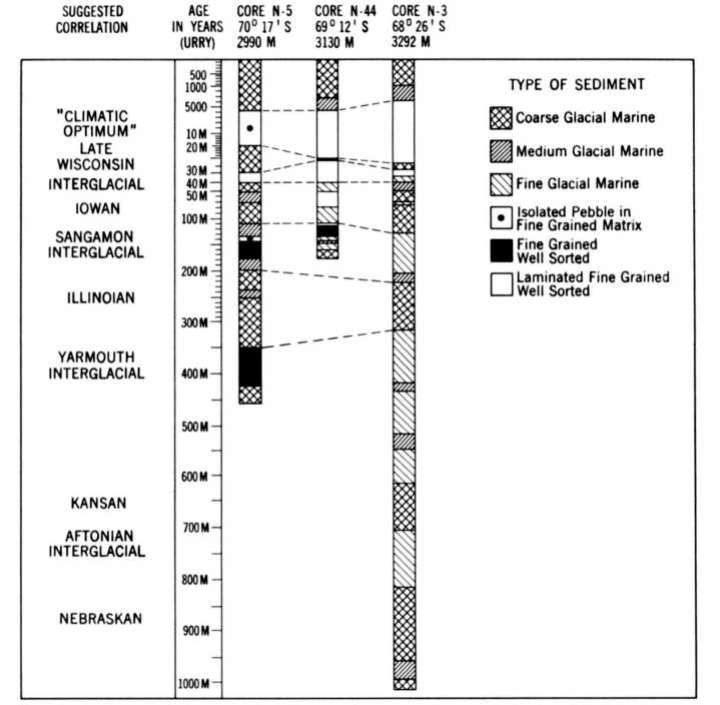
In answer to this possible objection I can cite, in addition to the map itself, only one further piece of evidence, but it is a very impressive piece of evidence indeed. In 1949, on one of the Byrd Antarctic Expeditions, some sediments were taken from the bottom of the Ross Sea, by coring tubes lowered into the sea. Dr. Jack Hough, of the University of Illinois, took three cores to learn something of the climatic history of the Antarctic. The cores were taken to the Carnegie Institution in Washington, D.C., where they were subjected to a new method of dating developed by the nuclear physicist Dr. W. D. Urry.6

This method of dating is called, for short, the ionium method. It makes use of three different radioactive elements found in sea water. These elements are uranium, ionium, and radium, and they occur in a definite ratio to each other in the water. They decay at different rates, however; this means that when the sea water containing them is locked up in sediments at the bottom of the ocean and all circulation of the water is stopped, the quantities of these radioactive elements diminish, but not at the same rate. Thus, it is possible,
when these sediments are brought up and examined in the laboratory, to determine the age of the sediments by the amount of change that has taken place in the ratios of the elements still found in the sediments.

The character of sea-bottom sediments varies considerably according to the climatic conditions existing when they were formed. If sediment has been carried down by rivers and deposited out to sea it will be very fine grained, more fine grained the farther it is from the river mouth. If it has been detached from the earth's surface by ice and carried by glaciers and dropped out to sea by icebergs, it will be very coarse. If the river flow is only seasonal, that is if it flows only in summer, presumably from melting glaciers inland, and freezes up each winter, the sediment will be deposited somewhat like the annual rings in a tree in layers or "varves."

All these kinds of sediments were found in the cores taken from the Ross Sea bottom. As you will see from the illustration (Fig. 57) there were many different layers of sediment in the coring tubes. The most surprising discovery was that a number of the layers were formed of fine-grained, well-assorted sediments such as is brought down to the sea by rivers flowing from temperate (that is, ice-free) lands. As you can see, the cores indicate that during the last million years or so there have been at least three periods of temperate climate in Antarctica when the shores of the Ross Sea must have been free of ice.'
1777078990859.png

Figure 57. The Ross Sea cores.

This discovery would indicate that the glacial history of Antarctica may have been roughly similar to that of North America, where we have had three or more ice ages in the last million years. Let us remember that, if most geologists cannot imagine how Antarctica could have had warm climates at short and relatively recent geological intervals, neither can they explain how North America could have had arctic conditions at equally short intervals and just as equally recently. Ice ages remain for geologists an unsolved mystery (85:35).

The date found by Dr. Urry for the end of the last warm period in the Ross Sea is of tremendous interest to us. All three cores agree that the warm period ended about 6,000 years ago, or about 4000 B.C. It was then that the glacial kind of sediment began to be deposited on the Ross Sea bottom in the most recent of Antarctic ice ages. The cores indicate that warm conditions had prevailed for a long time before that.

Atlantean civilization (including Kantek) and their descendants were collecting solar/cosmic energy using earth's EM grid, storing in the large batteries under the pyramids and using it for "Many things."Power, transport, healing, mind control, climate, et cetera." ( session-5-october-1994). They used "acorn" and "watches" type devices made with bronze and used thoughts to operate. Chronologically as we know it from sessions

Pyramids ( 8.5 K BCE) , stonehenge ( 8K BCE), avebury Henge ( 4233 BCE), Baalbek (3218 BCE), Last time this technology is used 1100 BCE.

I am not sure whether stonehenge and avebury henge are created with this collected energy. Here i am assuming these megalithic constructors are tapping into this collected energy.

i.e. If the other maps hapgood analyzed that has thawed Antarctica and sophisticated projection (Oronteus Finaeus map , mercator map etc.) , it could be any time before 4000 BCE. It doesn't need to be at YD or before.
 
Last edited:
Regarding the probable location of the main island of Atlantis, I tend to agree with Randall Carlson that the Azores plateau makes the most sense, even though it is currently very deep. The triple junction between three continental plates means it is not a stable location and the cataclysms could have let it sink much deeper than currently assumed. Plus, as Randall points out:

1) eustatic forces (more pressure from more water in the ocean forces the plateau further down) and
2) isostatic forces (the land that was under the ice caps goes up and the land around it goes down, including in the North Atlantic)

Some of the boreholes done from ships into the Azores plateau also seem to show that some deep parts of it must have been above water about 10,000 years ago (Randall Carlson talks about this).
It is quite possible that initial big island in the Azore plateau and after split, they might have even drifted. The dynamic nature of these islands in a "very short time" and the amount of energy they are collecting in pyramids that can open dimensions (ex: Bermuda triangle), too many things can happen. C's linked their technology to Philadelphia experiment ( where returned persons got fused to ship- too many things can go wrong in rematerialization) .

In the Cayce's material, it was mentioned that they tried to blow up volcano's to kill beasts and ended up splitting up the continent to pieces. I always wondered how did that happen? With that level of energy collection(and power hungry or competition), too many things can go wrong. That is how it looks to me.
 
Since C's mentioned 68K BCE to the latest plate tectonic alignment which science considers it as a 60 to 30 millions years ago
The C's said that the Jurassic and Triassic continental configurations ("150-200 million years ago") were actually around 70K years ago.

The "60 to 30 million years ago" would be a more recent configuration, probably after the first or second Atlantis cataclysm 50K or 28K years ago.

India seems to be indeed a central question in this rapid continental drift. When did India connect to Asia and create the Himalayas?

It may even be that the 50K war in India happened when India was still an island continent. Maybe that war was actually a major cause for India's fast movement? Some kind of weapon the Atlanteans used?

It is quite a coincidence that India moved by far the quickest and that there was a major war in India before or during the first cataclysm during Atlantean times.
 
It is quite a coincidence that India moved by far the quickest and that there was a major war in India before or during the first cataclysm during Atlantean times.
And we are not even considering here the isostatic adjustment that occurs many times on the planet, where a landmass big or small, goes up and down to adjust and respond to the geological stress on the same side.
Which is what might have occurred for example in the Atlantic Ocean when the ice caps started to melt in North America raising the crust on that region due to weight being lifted because of glaciers melting thus the tectonic plate next to it going down to compensate for that stress.
Current models of continental formation don’t take this model much into consideration, and shows as if the continents, islands and landmasses in general we see today, were always that similar size and similar, and just moved positions and orientations.

 
The C's said that the Jurassic and Triassic continental configurations ("150-200 million years ago") were actually around 70K years ago.

The "60 to 30 million years ago" would be a more recent configuration, probably after the first or second Atlantis cataclysm 50K or 28K years ago.
The issue is missing atlantis in Atlantic ocean. Our simplest question is

When did Laurasian plate split (near what we now call mid-atlantic) and formation of atlantic ocean started? Is it after 78K BCE or 100K BCE or millions of years ago?

Both tectonic plate theory (split of Laurasia) and Atlantis theories rely on this "starting" point.

The Plato's story is placed Atlantis in Atlantic ocean. India has its submerged Dwarika legend at YD period linked to Krishna ( a composite figure from comets and some real person). C's say hundreds of countries at that time and many battles going on. That's is why we needed validation of this 78K BCE (Kantek folks were brought in) , before we tabulate all the events what science considered to be happened with other events.
India seems to be indeed a central question in this rapid continental drift. When did India connect to Asia and create the Himalayas?
We already asked that session-13-january-2024
(seek10) When did Indian plate get connected to Eurasian plate? Is it 70K years ago or after that?

A: Close enough.
C's Paranthas comment takes VERY different meaning session-31-may-1997
Q: Did they transport them in ships, that is some sort of structure. That is, did they load them up, move them into 4th density, reemerge here in 3rd density, or something like that?

A: Close.

Q: And they unloaded them in the area of the Caucasus, is that correct?

A: And regions surrounding.

Q: And, that was what, 79 to 80 thousand years ago?

A: Over 80,000.

Q: As I understand it, Atlantis was already quite a developed civilization at that time, is that correct?

A: Yes, but regions change with waves of immigration, or conquest... witness your own lands.

Q: You also said once that there was a nuclear war in India and that this was what was being discussed in the Vedas when it talks about the 'blue-skinned' people who weren't really blue because they were Celts, and they were flying in aircraft, and they were engaged in this war, etc. Who were the Celts at war with?

A: The Paranthas.

Q: Now, wait a minute! Who are the Paranthas?! Do we have a new player here?

A: Not new.

Q: Do we know them by another name?

A: Choose.

Q: The Atlanteans? Were the Celts of India at war with the Atlanteans in the Atlantic?

A: Atlantis was merely a home base of an advanced civilisation of 3 races of humans occupying different sections of a huge Island empire, which, in itself, underwent 3 incarnations over a 100,000 year period as you would measure it.

Q: The 3 races were the Celts... and who were the second and third?

A: Or Kantekkians.

Q: Are the Kantekkians different from the Celts?

A: Only in the sense of long term racial and genetic blending.

Q: So, Atlantis had the Kantekkians and who else?

A: Race you would call "Native Americans," and a third, no longer existing race, somewhat resembling Australian or Guinean aborigines, only lighter in complexion.

Q: Was this third group destroyed by the other two?

A: One of the 3 cataclysms.

Q: Paranthas. Who were the Paranthas?

A: Nation of race mentioned above.

Q: So, the Paranthas were the antecedents of the Abos of Australia?

A:
Yes, and compare to now existing peoples of India, Pakistan, Sri Lanka, Australia, and New Guinea for similarities, bearing in mind genetic mixing and dilution.
1777114610923.png

WHAT IF Paranthas were the race reciding in these black region before the split at 78K BCE (assuming one island is correct) instead of people migrated to Australia through India from Africa (as the science says)? Atlantis is already "advanced" civilization by then.

This means it could be initial tectonic plate split at 78K and they might also be migration from nuclear war and migrations that is represented in F-M 89 haplogroup .

Current science and genetics version of "Out of Africa" theory is this which C's say more of "Out of Earth"
Link
1777117379817.png

All these "out of Africa" theories depend on the "very slow" tectonic plate movement.
 
Last edited:
And we are not even considering here the isostatic adjustment that occurs many times on the planet
We are considering it, as well as eustatic forces. Isostatic adjustment was mentioned in this thread just a day or two ago:

Regarding the probable location of the main island of Atlantis, I tend to agree with Randall Carlson that the Azores plateau makes the most sense, even though it is currently very deep. The triple junction between three continental plates means it is not a stable location and the cataclysms could have let it sink much deeper than currently assumed. Plus, as Randall points out:

1) eustatic forces (more pressure from more water in the ocean forces the plateau further down) and
2) isostatic forces (the land that was under the ice caps goes up and the land around it goes down, including in the North Atlantic)

Some of the boreholes done from ships into the Azores plateau also seem to show that some deep parts of it must have been above water about 10,000 years ago (Randall Carlson talks about this).
 
When did Laurasian plate split (near what we now call mid-atlantic) and formation of atlantic ocean started? Is it after 78K BCE or 100K BCE or millions of years ago?
According to the C's, the Jurassic configuration ("150 million years ago") was really around 70K years ago. The Jurassic period is when the Atlantic ocean was created:

1000040831.png


However, as you pointed out the C's also said that India connected to Asia also at around 70K years ago (though "close enough" could mean maybe 10-20K years later).

India connected to Asia supposedly 30-60 million years ago. So the whole period of 150-200 million to 30-60 million years ago would have been around 70K years ago (plus or minus 10-20K years in both directions).

The "close enough" comment suggests that these massive continental changes may have taken anywhere from 10,000 to maybe 50,000 years, eg. "200 Mya" = 100 Kya, "30 Mya" = 60 Kya.

Though I think the C's also mentioned at one point that the crust can become more "fluid" or "deformable" during cataclysms, so that major continental reconfigurations could have happened in a very short time.

The candidates for such enormous continental reconfigurations seem to be the 79,000 BC cataclysm caused by the Kantek explosion and the first Atlantean cataclysm around 50,000 BC.

It seems unlikely that India could have travelled the whole way from Gondwana into Asia almost instantly (days, months, years?) during a major cataclysm, though maybe that is exactly what happened.
 
WHAT IF Paranthas were the race reciding in these black region before the split at 78K BCE (assuming one island is correct) instead of people migrated to Australia through India from Africa (as the science says)? Atlantis is already "advanced" civilization by then.
Possibly! or what if there is another race we haven’t asked about that also lived during that time?

There also some residuals of ancient human races on which we have minimal data about such as the Homo Floresiensis and the Homo Luzonensis, apparently these groups also existed by the time of the Denisovans.

The Cs said that Denisovans were similar to today’s abos, and the only records (found in Siberia) we have for this group of humans trace back to neanderthals era, so pretty old, probably these were the Paranthas or more related to them genetically speaking.

According to the C's, the Jurassic configuration ("150 million years ago") was really around 70K years ago. The Jurassic period is when the Atlantic ocean was created:

Somehow related; There was also the supposed continent of Mu or Lemuria, that was supposed to be in a big part of the Pacific Ocean, maybe connected to South America. Could also disappear due to one of the mentioned older cataclysmic events.
 
  • Like
Reactions: axj
A few more thoughts:

India and "volcano-erupting" weapons
If the Atlanteans used "volcano-erupting" weapons as Cayce said about the first Atlantean cataclysm (around 50,000 BC) and they had a major war with the Paranthas in India then - is it a coincidence that the Deccan traps supervolcano eruption and India's fast movement towards Asia also happened at around the same time?

Maybe the Deccan traps eruption was the "nuclear option" against Paranthas in India. And the "volcano eruption weapon" could have caused more mantle pressure under India which propelled it during the 50,000 BC cataclysm when the crust became also more deformable.

The original main island of Atlantis
As to the creation of the 1,354 million sq miles main island of Atlantis (probably Azores plateau or Bahamas), Cayce also mentions that the Eastern seaboard of North America used to be a part of the main island of Atlantis (while the Midwest was under water).

Maybe the Azores plateau and/or Bahamas were initially connected to the Eastern seaboard and that was the large island of Atlantis? The Eastern seaboard (including the continental shelf and Appalachia) is around 300,000 - 500,000 sq miles.

Maybe insular Iberia and/or the Morocco microplate (with Atlas mountains) were also initially connected to that large island when the Atlantic ocean was still tiny. Which would bring the overall area close to 1,354,000 sq miles.
 
Back
Top Bottom