

I will reply to the some the posts from the Cosmology thread as it is relevant here
Oronteus Finaeus map , mercator map and Piri Re'is in the above post map.
Only reference point we had is Piri Ries map origin 'Complex, but the origin would date back to 14,000 B.C' . Does it mean there is possible changes it? I am not sure.
There is a saying picture worth 1000 words. In that case, which points are correct and which one was not? He correctly pointed out these maps were created with highly sophisticated projection method which even Ptolemy (who visited Alexandrian library) couldn't replicate w.r.t longitude and latitude. The accuracy can be validated for the coasts that didn't change. For those can't be perfectly matched, which one were correctly represented as it looked at that time and which one is modified?
Hapgood has a very curious data point, that says some of the Atlantarctica areas were ice free until 4000 BCE. How did they kept it thawed for almost 7000 years after Atlantis island in Atlancean ocean disappeared?. One possibility is whatever the source and mechanism they used to thaw it, still available until atleast 4000 BCE.
Atlantean civilization (including Kantek) and their descendants were collecting solar/cosmic energy using earth's EM grid, storing in the large batteries under the pyramids and using it for "Many things."Power, transport, healing, mind control, climate, et cetera." ( session-5-october-1994). They used "acorn" and "watches" type devices made with bronze and used thoughts to operate. Chronologically as we know it from sessions
Pyramids ( 8.5 K BCE) , stonehenge ( 8K BCE), avebury Henge ( 4233 BCE), Baalbek (3218 BCE), Last time this technology is used 1100 BCE.
I am not sure whether stonehenge and avebury henge are created with this collected energy. Here i am assuming these megalithic constructors are tapping into this collected energy.
i.e. If the other maps hapgood analyzed that has thawed Antarctica and sophisticated projection (Oronteus Finaeus map , mercator map etc.) , it could be any time before 4000 BCE. It doesn't need to be at YD or before.
Good point, This needs some LOT more analysis due to many variables. One possibility is Oronteus Finaeus map (which has old south pole and north pole) could be of later time. the south american eastern coast line of Oronteus Finaeus map in very different from Piri Re'is. It is almost 90 different from the present. Look at the South american east coast lines in these maps. There is some serious evolution in it.There seems to be something missing here.
South Central Canada is about 40 degrees away from the current North Pole, not 7 degrees. Even Hudson Bay, which many theorize was the previous North Pole, is about 30 degrees away from the current one.
Though the question Pierre asked was specifically about the crustal slippage caused by a cometary impact - and more crustal slippage is needed to get from the North Pole in South Central Canada to the current North Pole.
Oronteus Finaeus map , mercator map and Piri Re'is in the above post map.
Only reference point we had is Piri Ries map origin 'Complex, but the origin would date back to 14,000 B.C' . Does it mean there is possible changes it? I am not sure.
There is a saying picture worth 1000 words. In that case, which points are correct and which one was not? He correctly pointed out these maps were created with highly sophisticated projection method which even Ptolemy (who visited Alexandrian library) couldn't replicate w.r.t longitude and latitude. The accuracy can be validated for the coasts that didn't change. For those can't be perfectly matched, which one were correctly represented as it looked at that time and which one is modified?
Hapgood has a very curious data point, that says some of the Atlantarctica areas were ice free until 4000 BCE. How did they kept it thawed for almost 7000 years after Atlantis island in Atlancean ocean disappeared?. One possibility is whatever the source and mechanism they used to thaw it, still available until atleast 4000 BCE.
The idea of a temperate period in the Ross Sea in time so recent as is indicated by this map will, at first acquaintance, be incredible to geologists. It has been their view that the Antarctic ice cap is very ancient, perhaps several million years old, although, curiously enough, it seems that previously in the long history of the globe the climate of Antarctica was often warm and sometimes even tropical (85:58-61).°
In answer to this possible objection I can cite, in addition to the map itself, only one further piece of evidence, but it is a very impressive piece of evidence indeed. In 1949, on one of the Byrd Antarctic Expeditions, some sediments were taken from the bottom of the Ross Sea, by coring tubes lowered into the sea. Dr. Jack Hough, of the University of Illinois, took three cores to learn something of the climatic history of the Antarctic. The cores were taken to the Carnegie Institution in Washington, D.C., where they were subjected to a new method of dating developed by the nuclear physicist Dr. W. D. Urry.6
This method of dating is called, for short, the ionium method. It makes use of three different radioactive elements found in sea water. These elements are uranium, ionium, and radium, and they occur in a definite ratio to each other in the water. They decay at different rates, however; this means that when the sea water containing them is locked up in sediments at the bottom of the ocean and all circulation of the water is stopped, the quantities of these radioactive elements diminish, but not at the same rate. Thus, it is possible,
when these sediments are brought up and examined in the laboratory, to determine the age of the sediments by the amount of change that has taken place in the ratios of the elements still found in the sediments.
The character of sea-bottom sediments varies considerably according to the climatic conditions existing when they were formed. If sediment has been carried down by rivers and deposited out to sea it will be very fine grained, more fine grained the farther it is from the river mouth. If it has been detached from the earth's surface by ice and carried by glaciers and dropped out to sea by icebergs, it will be very coarse. If the river flow is only seasonal, that is if it flows only in summer, presumably from melting glaciers inland, and freezes up each winter, the sediment will be deposited somewhat like the annual rings in a tree in layers or "varves."
All these kinds of sediments were found in the cores taken from the Ross Sea bottom. As you will see from the illustration (Fig. 57) there were many different layers of sediment in the coring tubes. The most surprising discovery was that a number of the layers were formed of fine-grained, well-assorted sediments such as is brought down to the sea by rivers flowing from temperate (that is, ice-free) lands. As you can see, the cores indicate that during the last million years or so there have been at least three periods of temperate climate in Antarctica when the shores of the Ross Sea must have been free of ice.'
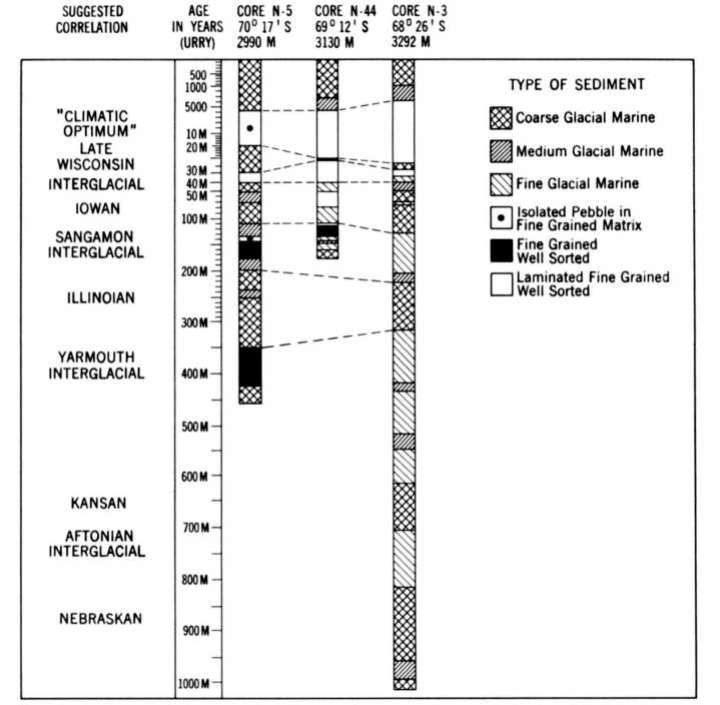
Figure 57. The Ross Sea cores.
This discovery would indicate that the glacial history of Antarctica may have been roughly similar to that of North America, where we have had three or more ice ages in the last million years. Let us remember that, if most geologists cannot imagine how Antarctica could have had warm climates at short and relatively recent geological intervals, neither can they explain how North America could have had arctic conditions at equally short intervals and just as equally recently. Ice ages remain for geologists an unsolved mystery (85:35).
The date found by Dr. Urry for the end of the last warm period in the Ross Sea is of tremendous interest to us. All three cores agree that the warm period ended about 6,000 years ago, or about 4000 B.C. It was then that the glacial kind of sediment began to be deposited on the Ross Sea bottom in the most recent of Antarctic ice ages. The cores indicate that warm conditions had prevailed for a long time before that.
Atlantean civilization (including Kantek) and their descendants were collecting solar/cosmic energy using earth's EM grid, storing in the large batteries under the pyramids and using it for "Many things."Power, transport, healing, mind control, climate, et cetera." ( session-5-october-1994). They used "acorn" and "watches" type devices made with bronze and used thoughts to operate. Chronologically as we know it from sessions
Pyramids ( 8.5 K BCE) , stonehenge ( 8K BCE), avebury Henge ( 4233 BCE), Baalbek (3218 BCE), Last time this technology is used 1100 BCE.
I am not sure whether stonehenge and avebury henge are created with this collected energy. Here i am assuming these megalithic constructors are tapping into this collected energy.
i.e. If the other maps hapgood analyzed that has thawed Antarctica and sophisticated projection (Oronteus Finaeus map , mercator map etc.) , it could be any time before 4000 BCE. It doesn't need to be at YD or before.
Last edited:


