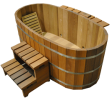
So we’ve been following the cold bath/shower protocol here and have found the baths to be much more bearable than the showers. However with the 4 of us and only one bathtub it became a bit of a chore filling/emptying the bathtub every time (and also wasting water). It’s also not a very large tub so one couldn’t really fully immerse oneself. I looked into getting some sort of "cold tub" that could we could put in the garage and basically just keep it filled and do our cold dips in but everything I found was quite expensive or just too small. Then I looked into those do-it-yourself tubs (or a ‘redneck’ tub) and found that a 2’x6’ stock tank would do the job. However just the tank on its own didn’t look to inviting and with the extreme temperatures the garage would get quite cold in the winter so I figured it would be best to make an insulated box to put the tank in so it would maintain its temperature longer as well as make it look a little nicer.
First thing we needed to do was figure out how much material we need to make the box to the fit the tank so I used a CAD program (like AutoCad) to sketch out the dimensions of the material. Diagrams are attached at the bottom.
Since we didn’t have the tools to make all the cuts we got most of it pre-cut at Home Depot. The first step was to build the outer frame to which the foamboard insulation will be glued to. For this we used wood glue and clamps. We wiped off the excess and let it sit for 24hrs. Since we had only 2 sets of clamps we had to do each side one at a time. You can see here the first set is done and the next were curing.

Here you can see the stock tank at the bottom and the material for the frame sitting on top of it. In the forefront is my trusty caulking gun and extra strength construction adhesive that we’ll use to glue the insulation to the frame.

Here we are running the first bead to get the board attached to the frame…

The long sides are curing and the smaller sides will be next. After that has set, the next step was to run caulking along the insides to make sure it’s air tight.

Once that was done and all set it was time to assemble the sides and begin fastening everything with wood screws. We used 2-1/4” screws but first drilled a pilot hole since we didn’t want to the wood to split and it also made it easier to screw them in.

Next was to install the bottom rails to support the bottom insulation and keep the tank frame off the ground. In the middle the rails were slightly bowing since it as so long and screwed tight so we put a clamp in the middle to help keep everything square and flush with the bottom rails as we screwed those in.

So the frame assembly is complete and what’s left are the side panels and the top (left side of the pic). These will need to be primed and painted and the top will need to have a hole cut for the tub.

So looks like a square fit! At this point the frame became a work table and traced out the oval shape by putting the tub on top of the MDF board. Off to the side the OSB panels sitting waiting to get painted. Once thing to keep in mind is that paint can get pretty expensive fairly quickly so you’ll need to factor that cost in. I think we went through $70-$80 in paint and primer. In this case, we needed to use at least 3 coats of oil primer and 3 coats of paint to get a nice finish (MDF board can be difficult to paint correctly and it had to be water tight). For the sides we just used one coat of each.


Here is a pic of the tank. You can see it is lined with cedar boards to make it a little more comfortable to sit in. I ended up using a polyurethane sealant to adhere the boards to the bottom so they wouldn’t float away. I also gave them a thorough sanding down with 400 grit paper to give it a really smooth finish.

Now the box is painted and in its final resting place. On the floor are supports for the cedar “decking” that will cover the concrete floor and allow access to the tub from the basement door.

With the top on and the tank in place it was time to do several coats of varnish to protect the paint from the water and general use. For this I chose polycrylic. I picked this over polyurethane as it was easier to clean up and didn’t have strong fumes to deal with. We did about 4-5 coats over a few days.

Now there was also a bit of a gap between the top and the tank. In order to fill the gap, more construction adhesive was used to glue a foam gasket to close up the gap. Once that was dry, black silicone sealant was run along the edges and around the gasket to give a nice watertight seal all around.

Using leftover insulation and OSB, a top cover was made. This will keep the water from getting too cold or too warm. Towards the bottom left you can see the completed decking. Since its winter now, we also got a bucket heater to warm up the water should it fall below 10deg C


To give you an idea of how big it is:

Very spacious! Even dugdeep can fully stretch his legs!

Looks like it’s warm enough for a dip!

See those ripples? That’s from me shivering! And if you are wondering what’s in the sandwich bag it’s my IPhone. It’s a great inexpensive way to protect your phone while in the tub and it helps to pass the time.

We did a little upgrade and now have little spa pillow for resting our head. Though it may not be as fancy as the rest of it – it works. All in all, except for the cold, it’s quite comfortable!

So there you have it. A nice cold tub just in time for the nice cold winter. Happy shivers everyone! :P

First thing we needed to do was figure out how much material we need to make the box to the fit the tank so I used a CAD program (like AutoCad) to sketch out the dimensions of the material. Diagrams are attached at the bottom.
Since we didn’t have the tools to make all the cuts we got most of it pre-cut at Home Depot. The first step was to build the outer frame to which the foamboard insulation will be glued to. For this we used wood glue and clamps. We wiped off the excess and let it sit for 24hrs. Since we had only 2 sets of clamps we had to do each side one at a time. You can see here the first set is done and the next were curing.
Here you can see the stock tank at the bottom and the material for the frame sitting on top of it. In the forefront is my trusty caulking gun and extra strength construction adhesive that we’ll use to glue the insulation to the frame.
Here we are running the first bead to get the board attached to the frame…
The long sides are curing and the smaller sides will be next. After that has set, the next step was to run caulking along the insides to make sure it’s air tight.
Once that was done and all set it was time to assemble the sides and begin fastening everything with wood screws. We used 2-1/4” screws but first drilled a pilot hole since we didn’t want to the wood to split and it also made it easier to screw them in.
Next was to install the bottom rails to support the bottom insulation and keep the tank frame off the ground. In the middle the rails were slightly bowing since it as so long and screwed tight so we put a clamp in the middle to help keep everything square and flush with the bottom rails as we screwed those in.
So the frame assembly is complete and what’s left are the side panels and the top (left side of the pic). These will need to be primed and painted and the top will need to have a hole cut for the tub.
So looks like a square fit! At this point the frame became a work table and traced out the oval shape by putting the tub on top of the MDF board. Off to the side the OSB panels sitting waiting to get painted. Once thing to keep in mind is that paint can get pretty expensive fairly quickly so you’ll need to factor that cost in. I think we went through $70-$80 in paint and primer. In this case, we needed to use at least 3 coats of oil primer and 3 coats of paint to get a nice finish (MDF board can be difficult to paint correctly and it had to be water tight). For the sides we just used one coat of each.
Here is a pic of the tank. You can see it is lined with cedar boards to make it a little more comfortable to sit in. I ended up using a polyurethane sealant to adhere the boards to the bottom so they wouldn’t float away. I also gave them a thorough sanding down with 400 grit paper to give it a really smooth finish.
Now the box is painted and in its final resting place. On the floor are supports for the cedar “decking” that will cover the concrete floor and allow access to the tub from the basement door.
With the top on and the tank in place it was time to do several coats of varnish to protect the paint from the water and general use. For this I chose polycrylic. I picked this over polyurethane as it was easier to clean up and didn’t have strong fumes to deal with. We did about 4-5 coats over a few days.
Now there was also a bit of a gap between the top and the tank. In order to fill the gap, more construction adhesive was used to glue a foam gasket to close up the gap. Once that was dry, black silicone sealant was run along the edges and around the gasket to give a nice watertight seal all around.
Using leftover insulation and OSB, a top cover was made. This will keep the water from getting too cold or too warm. Towards the bottom left you can see the completed decking. Since its winter now, we also got a bucket heater to warm up the water should it fall below 10deg C
To give you an idea of how big it is:
Very spacious! Even dugdeep can fully stretch his legs!
Looks like it’s warm enough for a dip!
See those ripples? That’s from me shivering! And if you are wondering what’s in the sandwich bag it’s my IPhone. It’s a great inexpensive way to protect your phone while in the tub and it helps to pass the time.
We did a little upgrade and now have little spa pillow for resting our head. Though it may not be as fancy as the rest of it – it works. All in all, except for the cold, it’s quite comfortable!
So there you have it. A nice cold tub just in time for the nice cold winter. Happy shivers everyone! :P

 Shiver on!