Earthquakes around the world

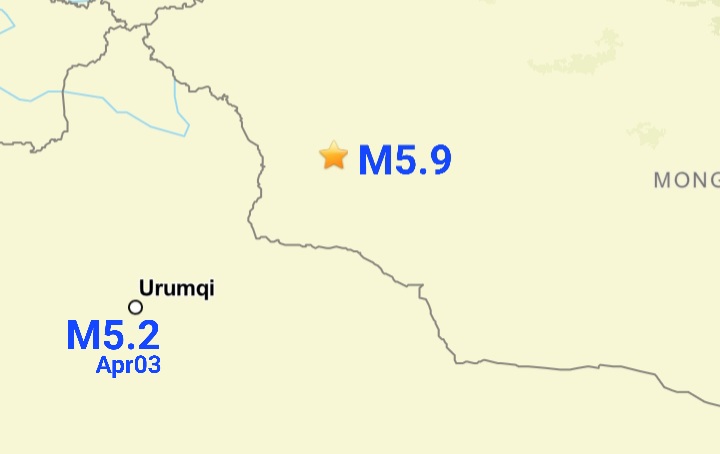
A strong magnitude 5.9 earthquake hit 168 km (105 mi) away from Khovd, Hovd, Mongolia.

M 5.9 - 168 km SE of Khovd, Mongolia
2026-04-26 04:23:24 (UTC)
46.789°N 92.968°E. 10.0 km depth
USGS earthquake alert
Screenshot_20260425-230238_Chrome.jpg
 
Two minor earthquakes shook San Francisco near the San Francisco Zoo, with magnitudes of 2.9 and 2.7, occurring 3 km south-southwest and 3 km offshore in the Pacific Ocean.

From 2025–2026 (according to reports on Facebook), over 300 earthquakes rattled the Bay Area—specifically San Ramon—in late 2025.

Two earthquakes struck off San Francisco's coast Saturday afternoon, with weak shaking reported, according to the U.S. Geological Survey.

A preliminary magnitude 3.0 struck around 4:40 p.m. just off the coast of San Francisco. A preliminary magnitude 2.7 followed minutes later.

There's been weak shaking reported across San Francisco and San Mateo, according to the USGS website.

No damage has been reported at this time.


M 5.0 - 77 km ENE of Miyako, Japan
35.0 km 2026-04-26 09:57:22 (UTC-07:00)
 
A very strong magnitude 6.1 earthquake hit 140 km (87 mi) away from Sapporo, Hokkaido, Japan
Magnitude 6.2 quake hits HokkaidoーNHK WORLD-JAPAN NEWS
Apr 26, 2026
The Japan Meteorological Agency says a magnitude 6.2 quake hit Hokkaido on Monday at 5:23 a.m. Agency officials are urging caution. Following the April 20th earthquake off the northern coast, JMA issued a subsequent advisory for a potential mega quake. At a news conference, JMA explained that the latest quake was not related to the advisory.More stories on disasters: https://www3.nhk.or.jp/nhkworld/en/ne...
 
WORLDWIDE EARTHQUAKE REPORT APRIL 27, 2026

Low levels of seismic activity in the 24 last hours.

There is now a 17-hour seismic silence period for M≥5.0 earthquakes. The last earthquake occurred in Tajikistan​

M 5.1 - 26 km SW of Khorugh, Tajikistan
2026-04-27 06:46:08 (UTC)
37.347°N 71.312°E. 105.1 km depth
USGS earthquake alert
chrome_screenshot_4 abr. 2026 10_52_12 a. m. CST.png


This is the third M≥5.0 earthquake to strike this region since the beginning of the month.

● Situation so far

With Mercury, Mars, and Saturn in planetary alignment, a 5.9-magnitude earthquake hit Mongolia and a 6.1-magnitude earthquake hit Japan.

Tomorrow, April 28, there will be a critical planetary alignment involving Mercury, Venus, and Jupiter, followed by three lunar alignments involving Mars, Saturn, and Neptune.

2026-04-20-overview.png


The low level of seismic activity may change in the coming hours.​
 
Silver Springs, Nevada, has passed well over 300 aftershocks since the M 5.7 on 2026-04-14 01:29:12 (UTC)

M 4.8 - 0 km SE of San Ignacio, Costa Rica
2026-04-27 20:49:47 (UTC-07:00)
62.8 km

What caused a rare earthquake Sunday near US-Canadian border?
Apr 27, 2026
Tremors from a 2.9 magnitude earthquake in Ontario, just south of Detroit, registered across southeast Michigan and northwest Ohio.

Monday Night update: New Earthquake cluster, Northern California, north of Lake Tahoe.
Apr 27, 2026

Judith A Hubbard (an earthquake scientist with a PhD and MS in Geology (Harvard); BS in Geology (Caltech)) shares the rundown of the 7.4 Japan tremor that rocked the country on 2026-04-20 on Substack

Another large subduction earthquake off the coast of northern Japan..Apr 20, 2026
Mid Snip:

Earthquake patterns​

If it feels like you were just reading about earthquakes offshore Japan, there’s a reason for that: it’s been less than a month since we wrote about this area offshore Honshu. That last post addressed a magnitude 6.5 earthquake on March 26th. In it, we commented that we had already written about two large earthquakes in the six months prior: a M6.8 on November 9th, 2025, and a M7.6 on December 8th, 2025. (Those latter two events were two of the earthquakes that led to megaquake advisories.)

Well, we can now add this latest M7.4 to the list. All of these earthquakes are associated with the great subduction zone that underlies northern Japan, where the Pacific Plate is sinking westward beneath the country. Plotting the entire JMA earthquake catalog in this area is interesting: there are around 660,000 events in this map region:

55fdf802-5634-4fce-9b4e-222a8e1cc851_1266x1592.jpg

Figure 3: Seismicity reported by the JMA, colored by depth, with a cross-section across the subduction zone.

This is a beautiful profile that shows off a few important features of the subduction zone: a classic double Wadati-Benioff zone, a region of intense crustal deformation in the forearc (between the coast and the trench), and a locus of shallow earthquakes just outboard of the French, where the slab breaks in tension as it begins to bend downward.

Let’s take a look at how the recent large earthquakes fit into the great mosaic of Japan Trench ruptures. The M6.8 in November was part of a complex sequence, with a week of foreshocks that cascaded upward to the mainshock. That mainshock was located far offshore, near the trench, initiating at a shallow depth of 18 kilometers. It was followed in March 2026 by a M6.5 earthquake, an unusually large, delayed aftershock for an earthquake of its size.

In contrast, the M7.6 in December occurred ~200 kilometers to the northwest, near the Shimokita Peninsula. It had no known foreshocks, and at ~41 kilometers depth, reflecting the geometry of the west-dipping slab interface. The mainshock was followed by two large aftershocks above M6.5 (M6.6, M6.7) in the days afterwards, within the expected range for a M7.6. Note that a M7.6 earthquake releases about 16 times as much energy as a M6.8, so this really was much larger than the earthquake in November.

The recent M7.4 occurred between the two previous clusters: in space, in magnitude, in depth (35 kilometers).

M 4.7 - 184 km SSE of Vilyuchinsk, Russia
2026-04-27 23:23:52 (UTC-07:00)
35.0 km
 
WORLDWIDE EARTHQUAKE REPORT APRIL 28, 2026

More than 24 hours later, the seismic lull was broken by a magnitude 5.2 earthquake in Fiji region

M 5.2 - Fiji region
2026-04-28 15:28:16 (UTC)
18.492°S 177.576°W. 409.0 km depth
USGS earthquake alert

However, significant seismic activity was recorded in Greece, where two earthquakes occurred: M4.7 and M4.8

M 4.7 - 10 km ENE of Argalastí, Greece
2026-04-28 11:12:23 (UTC)
39.267°N 23.329°E. 10.0 km depth
USGS earthquake alert

M 4.8 - 8 km W of Skiáthos, Greece
2026-04-28 13:07:46 (UTC)
39.170°N 23.392°E. 9.8 km depth
USGS earthquake alert

Screenshot_20260428-101946_Chrome.jpg


There is a seismic gap between the Athens region and the island of Crete where no earthquake of magnitude 5.0 or higher has occurred this year.

Screenshot_20260309-171034_Chrome (1).jpg


Screenshot_20260428-104755_X.jpg


This region is highly seismic due to the interaction of the Hellenic subduction plate, the Cyprus arc, and faults in the Aegean Sea.

On July 21, 365 AD, one of the largest earthquakes in the Mediterranean occurred, estimated at M8.5+, near the west coast of Crete. It destroyed nearly all the cities on the island, caused coastal uplift of up to 9 meters, and generated a mega-tsunami that affected Egypt, Cyprus, Libya, and beyond. It is believed that the earthquake caused thousands of deaths.


21st July 365: "Day of Horror" in the Mediterranean
On the morning of July 21st, AD 365 the Eastern Mediterranean was shaken by an earthquake that is generally believed to be the strongest recorded earthquake in the Mediterranean. It probably originated around Crete, Greece and was followed by a tsunami that hit the Mediterranean coastlines causing many deaths. In Alexandria, tsunami devastation was so severe that the day of the event was commemorated as the "day of horror" for centuries after the event.

The earthquake was strong enough to lift parts of Crete by several meters. This upheaval of the island left behind fossil shorelines, which Richard Ott, a scientist at the GFZ German Research Centre for Geosciences, and colleagues studied to reconstruct the event. The new study published in AGU Advances used radiocarbon dating to understand when and how much shorelines on Crete were uplifted and utilized this information to model the source of the earthquakes and tsunamis. Understanding which fault, a fracture in the Earth's crust, the earthquake originated on is important to understanding the hazard of earthquakes and tsunamis in the Mediterranean.

Uplift of Crete and fossil shorelines

A hint to the enormous forces that uplifted Crete can be found at the ruins of the ancient harbor town in Phalasarna in western Crete. People visiting today can explore a beautiful, perfectly preserved wharf of the Roman time harbor. However, this wharf is now several hundred meters away from the sea and approximately seven meters above sea level.

There is another peculiar phenomenon in western Crete. Something that looks like a notch is recognizable in the coastal cliffs running parallel to the sea. This notch is what scientists call a fossil shoreline and marks where sea level used to be in the past. It is now found up to 9 meters above sea level in western Crete.​
 
Back
Top Bottom