#STARLINK IN FORWARD-SCATTER! Ángel Pérez from the Fuenlabrada Astronomy Classroom station warned about a discontinuous trace at 2h01m UT visible in a spectrogram, deciphered by @Josep_Trigo with the help of Nico Janssen @xs4all
Line-2
2) Specifically, there were 50 #Starlinks still in a low orbit (about 350 km altitude) which would in turn be detected by another of our forward-scatter stations in Jaén, operated by Lorenzo Morillas. They were released on February 25 at 16h12 UT
A quote from the second article.

 www.space.com

An artist's illustration of how SpaceX's Starlink satellite internet constellation beams broadband access from orbit. (Image credit: Mark Garlick/Science Photo Library)
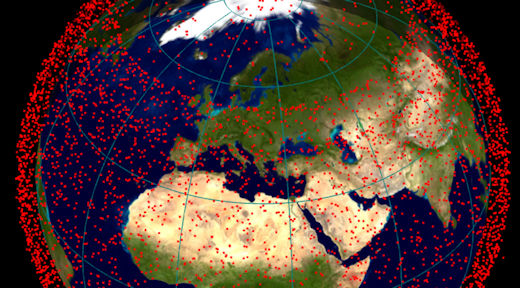
Current Starlink positions:

 satellitemap.space
Line-2
2) Specifically, there were 50 #Starlinks still in a low orbit (about 350 km altitude) which would in turn be detected by another of our forward-scatter stations in Jaén, operated by Lorenzo Morillas. They were released on February 25 at 16h12 UT
A quote from the second article.
It was the fourth launch and landing for this particular booster. The first stage also helped launch the Sentinel-6 Michael Freilich Earth-observation satellite for NASA and the European Organization for the Exploitation of Meteorological Satellites in November 2020, as well as 60 Starlink satellites in May 2021 and NASA's Double Asteroid Redirection Test spacecraft in November 2021, SpaceX representatives said.
Such reuse is a priority for SpaceX and its founder and CEO, Elon Musk. Musk aims to help humanity colonize Mars, and the billionaire entrepreneur believes that fully and rapidly reusable rockets are the key breakthrough needed to make that happen.
Skipping down
The Feb. 3 mission was also notable, but for a very different reason. Shortly after liftoff, a solar eruption triggered a geomagnetic storm on Earth, which increased the density of our atmosphere enough to bring down most of the newly launched satellites via drag. SpaceX has said that it will launch Starlink spacecraft to slightly higher initial altitudes in the future to protect against such storms.
SpaceX has launched more than 2,000 Starlink satellites to date, and many more are slated to go up. The company has permission to loft 12,000 of the broadband spacecraft, and it has applied for approval to launch up to 30,000 more.
Elon Musk says SpaceX's Starlink satellite internet service is active in Ukraine with more terminals on the way
The move comes as Ukraine's internet service has been disrupted by Russia's invasion.
An artist's illustration of how SpaceX's Starlink satellite internet constellation beams broadband access from orbit. (Image credit: Mark Garlick/Science Photo Library)
SpaceX CEO Elon Musk said his space company's Starlink satellite internet service is available in Ukraine and more terminals to use it are on the way.
Musk made the statement on Twitter Saturday (Feb. 26) after being asked by a Ukrainian government official if SpaceX could provide more Starlink services to the country after Russian troops invaded Ukraine last week. Internet services in Ukraine has seen "significant disruptions" in the capital city of Kyiv and across much of the country due to Russian military operations and the ensuing fighting, the monitoring group Netblocks reported on Thursday (Feb. 24).
"@ElonMusk, while you try to colonize Mars — Russia try to occupy Ukraine! While your rockets successfully land from space — Russian rockets attack Ukrainian civil people! We ask you to provide Ukraine with Starlink stations and to address sane Russians to stand,” Ukraine's Vice Prime Minister Mykhailo Fedorov, who is also the country's minister of digital transformation, asked Musk on Twitter Saturday.
"Starlink service is now active in Ukraine," Musk replied. "More terminals en route."
Related: SpaceX's Starlink satellite megaconstellation launches in photos
SpaceX's Starlink service offers high-speed broadband access via a massive constellation of satellites in low Earth orbit and is designed to ultimately provide coverage anywhere on Earth, with a focus on remote areas or underserved regions. Starlink users access the space-based internet service using a satellite dish placed on or near the location where service is needed.
Musk and SpaceX recently sent 50 Starlink terminals to the island nation of Tonga in the Pacific Ocean to provide free internet access to help reconnect remote villages there after a massive volcano eruption and tsunami in January, according to Reuters. The Starlink terminals will help restore communications with some of the hardest hit regions from the natural disaster.
Since 2019, SpaceX has launched over 2,000 of the satellites for the constellation, which is expected to reach up to 14,000 in its initial form. The company's most recent launch occurred on Friday (Feb. 25), when SpaceX lofted 50 new Starlink satellites into orbit from a pad at California's Vandenberg Space Force Base.
SpaceX's next Starlink mission is expected to lift off later this week on Thursday (March 3) from Pad 39A of NASA's Kennedy Space Center in Florida.
Current Starlink positions:
Starlink satellite tracker
Live view of SpaceX starlink satellite constellation and coverage.
satellitemap.space