Imminent Alien Disclosure?

Next they will call for people to stop calling Sasquatch “Big Foot”
"...we have to stop calling them aliens because 'aliens' is a derogatory term for anything..."
This is just someone's subjective opinion. So what is the media's reason for covering it? A psychological ploy to discourage use of the word "aliens" in general. Promotion of Newspeak. Very common now.

Even critical race theory is now called "social emotional learning" - an attempt to escape the backlog of articles and social media commentary against critical race theory.
 
@c.a. ,

The Sarfatti interview is interesting I think. Jack Sarfatti is was in several of the Cs sessions. Trump's uncle had access to all the Tesla papers he says in the interview. Strangely very pro Trump. He has already voted for Trump. He does not mince words. Is he on the right track? I don't know.

Some session references:

Session 26 December 1998:


Session 20 August 2001:


Session 11 August 2018:


There was another mathematical physicist who is probably more credible by the name of (Roger) Ruggero Santilli (kind of thought of him by mistake) He was at one of the Cs sessions and asked very interesting questions at the Cs urging. He in now 85 years old.

There is a lot to reference in other sessions too so I will just use this first session as an example:

Session 27 May 1995:
 
I inadvertently posted the above post before adding my newer discovery of George Bush's involvement with the "Philadelphia Experiment".

Here are some references:

Session 19 November 1994:
Q: (T) Why are they coming out with this story? Besides disinformation...

A: Slow revelation to effect gauge of public response.

Q: (L) Should V____ stand behind Terry and put her hands on his shoulders for energy?

A: Not necessary because Terry has adequate energy of his own. George Bush was involved with Philadelphia experiment.

We are not that far from a president who has had more of a "deep state" awareness of 4D time travel.

I think this may have many implications for the strange turn of events we are witnessing.

Navy aviator George H.W. Bush and his squadron attacked


George H.W. Bush, 41st President, Dies at 94


If a previous president has that much of an awareness of such things as time travel then it makes one wonder how the "deep state" is trying to control public reaction to any disclosure.

In the same 1994 session they ask about Al Bielek and his story:

Q: (L) Is Al Bielek really who he claims to be?

A: No. Was technician but not aboard vessel.

Q: (L) So he did not go back and forth in time?

A: Correct.

Q: (T) So he's trying to make himself out to be more than he actually is?

A: Yes.

Q: (J) He is a wannabe?

A: No. He is an agent of the government.

Q: (T) Is Preston also a government agent?

A: Yes.

Q: (T) Why are they coming out with this story? Besides disinformation...

A: Slow revelation to effect gauge of public response.

I think this a possible reason for the UFO tidbits being released.
 
I realized there was a recent video which might have direct proof of alien technology used on humans. Takeover can also be orchestrated on the nano-level, subduing the target population. Especially if we are an older model, now deemed obsolete and the Lizzies wanna create a new slave model - "build back better" - for their purposes.

Stew Peters Show: EXCLUSIVE Pfizer Vial Images Released - Patriots vs The Machine

Dr. Carrie Madej repeatedly shows mechanical sphere formations and moving mechanical stuff that looks like nano robots in action. There is a transparent glass-like nanorobot, which looks like it has a sort of a Predator-invisibility cloaking turned on
and it mechanically circles a black sphere - in the Pfizer-vial liquid sample - in a ragged, staccato machine-like fashion.
She describes growing formations, where something under the microscope is building tendril-connected structures. What-ever is built there its growing. Besides there is the tentacled Cthulhu alien as well: which at one point appears to have become aware of them - that humans are watching it - and appear to turn its kraken head towards the doctors.

For comparison Dr. Carrie shows a humans-made nano-robot, which looks like low tech, compared to the saucer/clam-shaped thing circling the metal ring (as if it were a train on a rail) in the sample.

She states multiple times, she never seen anything like this - Pfizer vial contents under the microscope - and to her it looks like this is not human science. As if these techniques were borrowed from aliens. The video also feels this might be demonic technology on display. Especially when she recounts parasites swimming happily around in the sample under the microscope. I got the crazy idea / feeling that the earlier video showing a live parasite-bath, which is a vaccine vial sample under the microscope - is (looks like) some amniotic fluid from a demons womb. Considering the spike protein gets concentrated in the womb of women, this appears to be some kind of the demonized / satanized version of the "immaculate conception".

This whole video felt like a script from a Hollywood alien invasion movie, except more creepy, as it is happening in real life before our eyes.

Kevin W. McCairn Ph.D states that the released covid bioweapon has now been aerosolized - like the DDT sprayings of people in the '50s - and is affecting crowd behaviors around the world. Only the sprayer machines are not needed anymore as people are perfectly used to breath out the aerosol. This bioweapon - according to neuroscientist Dr. McCairn - is making people lose their inhibitions (we have Samenow's research about this on the forum here) and helping turning them more aggressive losing all conscious control. Into the new, fast & crazy Hollywood-style zombies?

I stated last year, if I were an alien general, I would spray the targeted planet with an insecticide to make invasion way easier consuming much less war resources. Well, we appear to have reached the point, where it appears that Lizzie Pest Control was turned ON.
 
Last edited:
I watched one small 1m clip this afternoon, among many ones you can watch when you follow some channes on Telegram.
I was not impressed enough to repost it or whatever (or i could spend all day to do so).
But here just read a comment on another post referencing this clip, of a lizard speaking at the UN (united nations !?)
So i searched again on it, found the longer version which is 2m31s, it seems to be produced by a sub group of the UN (UN development), and it's about COP26, here's the tweet and clip :

Is this a kind of predictive programming, using well known "Jurassic Park"s velociraptor" to help people to get used to a smiliar event in the future ?
 
I like what little I know about Jack Sarfatti. He said this:

The material universe has a super-conscious cosmic mind...Also it is testable scientifically - not a matter of faith. "Consciousness" is a simple physical phenomenon like "gravity". I am quite serious here. This is a great discovery - perhaps the greatest ever.
- Dr Jack Sarfatti

With regard to the OP question, Is Alien Disclosure Imminent?, I would say no, because of the danger of disrupting what little is left of orderly civilization. However, I could be wrong. Recently the Director of National Intelligence (DNI), remarked that extraterrestrials could be responsible for UAP phenomena experienced by US Navy pilots. I take it that "extraterrestrials" means the same thing as aliens, but I prefer to think of it as a non-human intelligence, possibly a super-conscious cosmic mind.
 

Pentagon announces new group to investigate reports of UFOs near certain military sites​


ufo-dod-navy-gty-jt-210604_1622833615977_hpMain_16x9_992.jpg

Government report on UFO investigation released
A declassified version of the government report presented to Congress on unexplained a...Read More
U.S. Dept. of Defense via AFP via Getty Images, FILE


November 24, 2021
In the wake of a UFO report last summer, the Pentagon has announced the formation of a new group that will investigate reports of UFOs close to sensitive military areas.

The new Airborne Object Identification and Management Synchronization Group will specifically look at reports of Unexplained Aerial Phenomena (UAP) near U.S. military facilities. UAP is the military term to describe what is known as UFOs or Unexplained Flying Objects.

"Incursions by any airborne object into our SUA (Special Use Airspace) pose safety of flight and operations security concerns, and may pose national security challenges," said a Pentagon press release using the term that includes restricted military airspace, military operations areas, firing ranges and places restricted for national security and other uses.

MORE: Few answers in unclassified UFO report
In a memo outlining the group's formation, Deputy Defense Secretary Kathleen Hicks wrote that unidentified aerial phenomena in special-use areas "represents a safety of flight risk to aircrews and raises potential national security concerns."


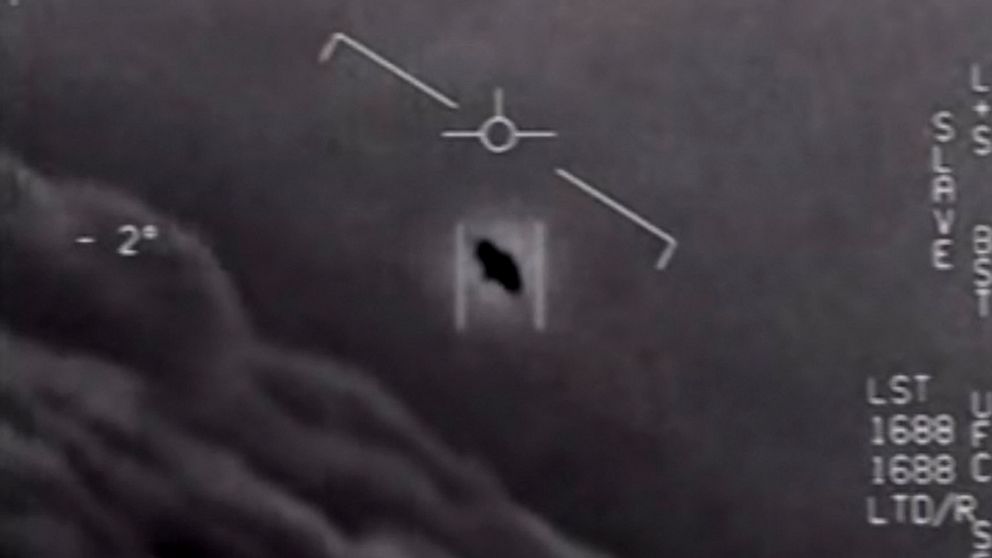
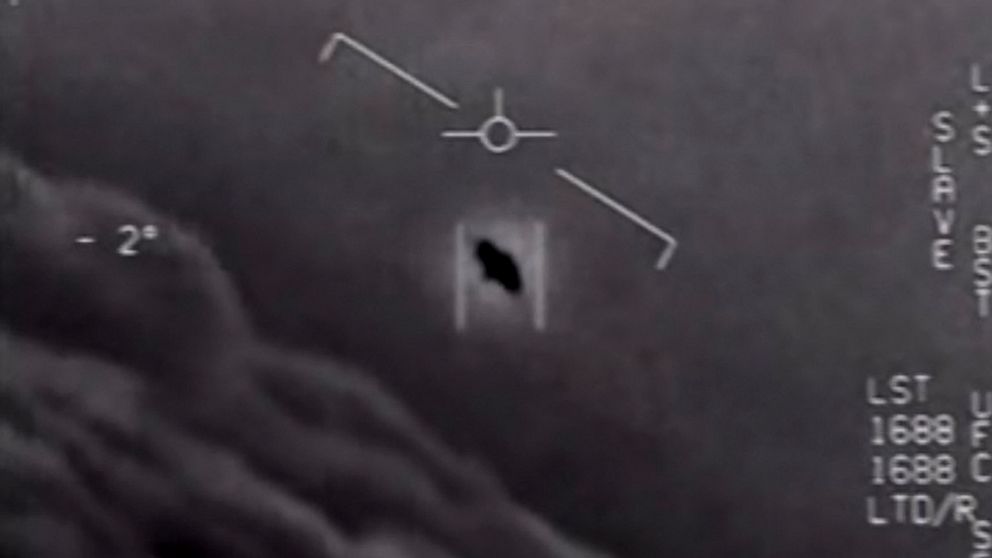
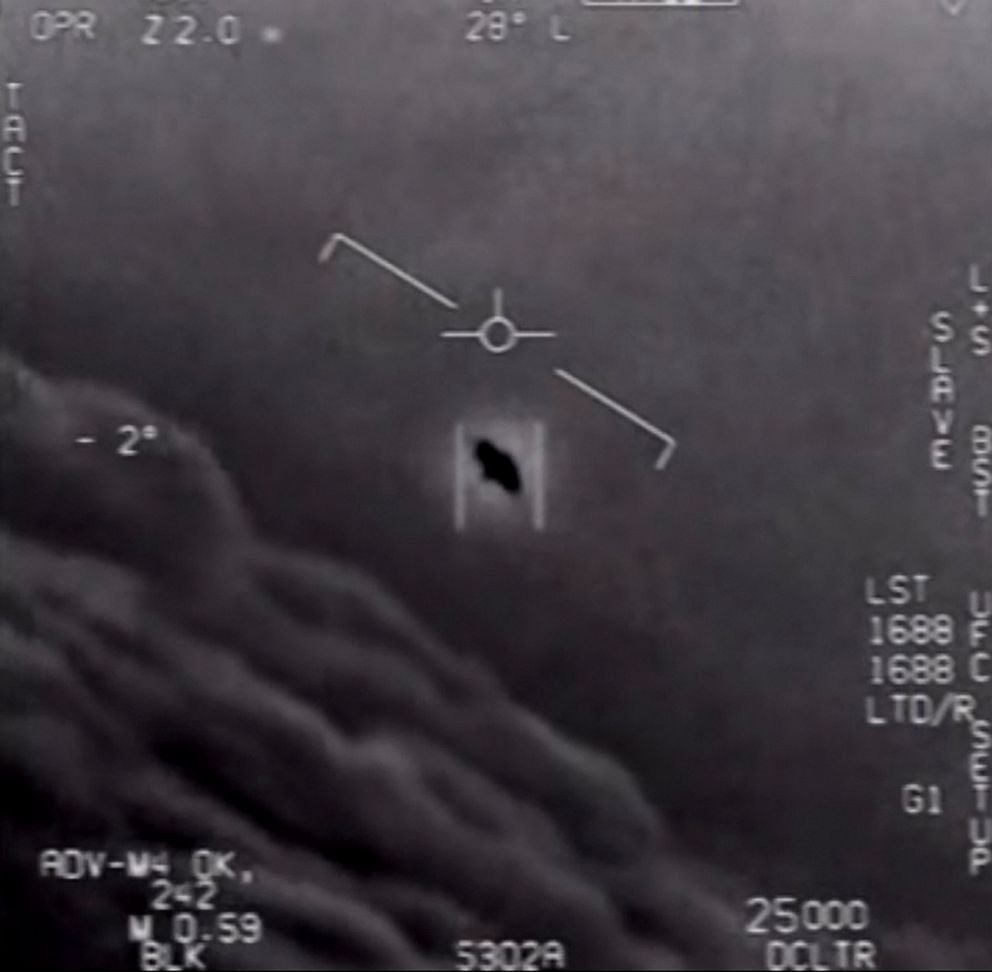
PHOTO: This video grab image obtained April 28, 2020, courtesy of the U.S. Department of Defense shows part of an unclassified video taken by Navy pilots that have circulated for years showing interactions with unidentified aerial phenomena.


U.S. Dept. of Defense This video grab image obtained April 28, 2020, courtesy of the U.S. Department of Defense

The new group will synchronize the Pentagon's efforts with other federal agencies "to detect, identify and attribute objects of interest in Special Use Airspace (SUA), and to assess and mitigate any associated threats to safety of flight and national security."

MORE: Upcoming UFO report to Congress creating lots of buzz
It will be overseen by the under secretary of defense for intelligence, who will head an executive council including the director of the Joint Staff and senior officials from the Office of the Director of National Intelligence.

Last June, the U.S. intelligence community released a report requested by Congress that provided the first unclassified assessment of Unexplained Aerial Phenomena.

MORE: Pentagon declassifies Navy videos that purportedly show UFOs
Compiled by the Navy's Unidentified Aerial Phenomenon Task Force, that report could not explain 143 incidents and said 18 of them appeared "to demonstrate advanced technology." The UAP Task Force will now be absorbed into the newly formed group announced by the Pentagon.

The UAP report also identified the need to make improvements in the Pentagon's processes, policies, technologies and training to improve its ability to understand UAP.
 

NASA 'looks to the heavens' for help: Agency enlists 24 theologians to assess how the world would react to the discovery of alien life on distant planets and how it might change our perception of gods and creation

  • NASA is hiring 24 theologians to take part in its program the Center for Theological Inquiry (CTI) at Princeton University
  • The group will asses how humans will react if alien life is found on other planets and how the discovery will impact our ideas of gods and creation
  • Dr Andrew Davison, a priest and theologian at the University of Cambridge with a doctorate in biochemistry from Oxford, is among 24 theologians
  • Davison believes we are getting closer to finding life on other planets

NASA is looking to the heavens for help with assessing how humans will react if alien life is found on other planets and how the discovery could impact our ideas of gods and creation.

The agency is hiring 24 theologians to take part in its program at the Center for Theological Inquiry (CTI) at Princeton University in New Jersey, which NASA gave a $1.1 million grant to in 2014.

CTI is described as building 'bridges of under understanding by convening theologians, scientists, scholars, and policymakers to think together - and inform public thinking - on global concerns.'

The program aims to answer questions that have baffled us since the begging of time such as what is life? What does it mean to be alive? Where do we draw the line between the human and the alien? What are the possibilities for sentient life in other places?

Now that NASA has two rovers on Mars, several probes orbiting Jupiter and Saturn and is set to launch the James Web Telescope tomorrow that study galaxy, star and planet formation in the universe, it seems that the agency is hopeful it is on the right path to discovering life outside of Earth.

And it needs a little help from above to help those of us living below to understand if that happens.


The Rev Dr Andrew Davison, a priest and theologian at the University of Cambridge with a doctorate in biochemistry from Oxford, is among 24 theologians, The Times reports.

'Religious traditions would be an important feature in how humanity would work through any such confirmation of life elsewhere,' Davidson shared in a blog post on the University of Cambridge site.

'Because of that, it features as part of NASA's ongoing aim to support work on 'the societal implications of astrobiology', working with various partner organizations, including the Center of Theological Inquiry at Princeton.'

Davison is set to publish a book next year, titled Astrobiology and Christian Doctrine, which notes he believes we are getting closer to finding life on other planets.

Davison's book notes: 'The headline findings are that adherents of a range of religious traditions report that they can take the idea in their stride.

'Non-religious people also seem to overestimate the challenges that religious people . . . would experience if faced with evidence of alien life.'

Studies and surveys have shown that US Christians are less likely to believe life exists on other planets, but Davison is not the only 'believer' who does not think the idea of extraterrestrials is impossible.

Duilia de Mello, an astronomer and physics professor at Catholic University, said she has several seminarians in her classes who often bring up theoretical questions about intelligent life in the universe.

'If we are the products of creation, why couldn't we have life evolving in other planets as well? There's nothing that says otherwise,' de Mello told The Washington Post in August.

In 2008, the Vatican's chief astronomer says there is no conflict between believing in God and in the possibility of 'extraterrestrial brothers' perhaps more evolved than humans.

'In my opinion this possibility (of life on other planets) exists,' said Rev. Jose Gabriel Funes, a 45-year-old Jesuit priest who is head of the Vatican Observatory and a scientific adviser to Pope Benedict.

'How can we exclude that life has developed elsewhere,' he told the Vatican newspaper L'Osservatore Romano in an interview in its Tuesday-Wednesday edition, explaining that the large number of galaxies with their own planets made this possible.

Asked if he was referring to beings similar to humans or even more evolved than humans, he said: 'Certainly, in a universe this big you can't exclude this hypothesis'.

However, not all theologians are on board with the idea of life on other planets.

Albert Mohler, president of Southern Baptist Theological Seminary, said in a 2008 interview when asked if there are such thing as aliens: 'The answer is no; that’s speculative.

'We have no reason to believe there is any other story out there. There is nothing in Scripture that says there can’t be some form of life somewhere. But what we are told is that the cosmos was created in order that on this planet Jesus Christ, in space and time and history, would come to save sinful humanity.'

The James Web Telescope, which is set to launch Christmas Day, could however change the way we look at the universe and maybe what is written in scriptures of all religions.

It has been described as a 'time machine' that could help unravel the secrets of our universe, with distant objects emitting light from further back in time.

The telescope will be used to look back to the first galaxies born in the early universe more than 13.5 billion years ago.

The goal of this powerful device is to unravel the mysteries of supermassive black holes, distant alien worlds, stellar explosions, dark matter, and more.
 
Studies and surveys have shown that US Christians are less likely to believe life exists on other planets, but Davison is not the only 'believer' who does not think the idea of extraterrestrials is impossible.
24 theologians to assess, how they could pull off a fake Alien Invasion, before the real one begins. I voiced multiple times on RT already, that I think the invasion is simply New Tenants moving into the Apartment Planet and the earlier tenants = poor lost humanity living on the surface is being evicted. Since like real bums, we can't go anywhere, we must be pest controlled. Like when a new buyer orders a chemical cleansing of the house, so the workers can sweep up the stunned or dead roaches. The new owner wants a clean house, so he clearly wouldn't like us scatter to the winds to try our luck as Cavemen..

Just like with visionary / Nostradamus-type Hollywood projects, namely Star Trek and other excellent invasion movies and TV Shows (Colony 2016-2018), I think we have been adequately warned by our contemporary Nostradamuses, who all seem to have moved to work on scripts at Hollywood, since there is all the money.
 
Last edited:
I‘ve put the article here because (at that moment) I had no idea where else to put it 😉

Maybe moderators can find a betrer/proper place….

And I also think that alien disclosure is not likely; more likely, aliens to come will be in form of meteors/comets …

But I found the aricle interesting with this religion part added to the mix of all this UFO business/offices/… that Gouvernements are currently playing with….
 

NASA 'looks to the heavens' for help: Agency enlists 24 theologians to assess how the world would react to the discovery of alien life on distant planets and how it might change our perception of gods and creation

  • NASA is hiring 24 theologians to take part in its program the Center for Theological Inquiry (CTI) at Princeton University
  • The group will asses how humans will react if alien life is found on other planets and how the discovery will impact our ideas of gods and creation
  • Dr Andrew Davison, a priest and theologian at the University of Cambridge with a doctorate in biochemistry from Oxford, is among 24 theologians
  • Davison believes we are getting closer to finding life on other planets

NASA is looking to the heavens for help with assessing how humans will react if alien life is found on other planets and how the discovery could impact our ideas of gods and creation.

The agency is hiring 24 theologians to take part in its program at the Center for Theological Inquiry (CTI) at Princeton University in New Jersey, which NASA gave a $1.1 million grant to in 2014.

CTI is described as building 'bridges of under understanding by convening theologians, scientists, scholars, and policymakers to think together - and inform public thinking - on global concerns.'

The program aims to answer questions that have baffled us since the begging of time such as what is life? What does it mean to be alive? Where do we draw the line between the human and the alien? What are the possibilities for sentient life in other places?

Now that NASA has two rovers on Mars, several probes orbiting Jupiter and Saturn and is set to launch the James Web Telescope tomorrow that study galaxy, star and planet formation in the universe, it seems that the agency is hopeful it is on the right path to discovering life outside of Earth.

And it needs a little help from above to help those of us living below to understand if that happens.


The Rev Dr Andrew Davison, a priest and theologian at the University of Cambridge with a doctorate in biochemistry from Oxford, is among 24 theologians, The Times reports.

'Religious traditions would be an important feature in how humanity would work through any such confirmation of life elsewhere,' Davidson shared in a blog post on the University of Cambridge site.

'Because of that, it features as part of NASA's ongoing aim to support work on 'the societal implications of astrobiology', working with various partner organizations, including the Center of Theological Inquiry at Princeton.'

Davison is set to publish a book next year, titled Astrobiology and Christian Doctrine, which notes he believes we are getting closer to finding life on other planets.

Davison's book notes: 'The headline findings are that adherents of a range of religious traditions report that they can take the idea in their stride.

'Non-religious people also seem to overestimate the challenges that religious people . . . would experience if faced with evidence of alien life.'

Studies and surveys have shown that US Christians are less likely to believe life exists on other planets, but Davison is not the only 'believer' who does not think the idea of extraterrestrials is impossible.

Duilia de Mello, an astronomer and physics professor at Catholic University, said she has several seminarians in her classes who often bring up theoretical questions about intelligent life in the universe.

'If we are the products of creation, why couldn't we have life evolving in other planets as well? There's nothing that says otherwise,' de Mello told The Washington Post in August.

In 2008, the Vatican's chief astronomer says there is no conflict between believing in God and in the possibility of 'extraterrestrial brothers' perhaps more evolved than humans.

'In my opinion this possibility (of life on other planets) exists,' said Rev. Jose Gabriel Funes, a 45-year-old Jesuit priest who is head of the Vatican Observatory and a scientific adviser to Pope Benedict.

'How can we exclude that life has developed elsewhere,' he told the Vatican newspaper L'Osservatore Romano in an interview in its Tuesday-Wednesday edition, explaining that the large number of galaxies with their own planets made this possible.

Asked if he was referring to beings similar to humans or even more evolved than humans, he said: 'Certainly, in a universe this big you can't exclude this hypothesis'.

However, not all theologians are on board with the idea of life on other planets.

Albert Mohler, president of Southern Baptist Theological Seminary, said in a 2008 interview when asked if there are such thing as aliens: 'The answer is no; that’s speculative.

'We have no reason to believe there is any other story out there. There is nothing in Scripture that says there can’t be some form of life somewhere. But what we are told is that the cosmos was created in order that on this planet Jesus Christ, in space and time and history, would come to save sinful humanity.'

The James Web Telescope, which is set to launch Christmas Day, could however change the way we look at the universe and maybe what is written in scriptures of all religions.

It has been described as a 'time machine' that could help unravel the secrets of our universe, with distant objects emitting light from further back in time.

The telescope will be used to look back to the first galaxies born in the early universe more than 13.5 billion years ago.

The goal of this powerful device is to unravel the mysteries of supermassive black holes, distant alien worlds, stellar explosions, dark matter, and more.
I am of the opinion that if the announcement were made evidence of life on other worlds was found, no one would run screaming into the streets in panic.
That is if that “life” were in the form of micro-organisms either living or fossils. Which if course could open the possibility of higher life forms as
well, but depending on the form they take the general consensus would be-
Those in the know would say “I knew it!”, average joe citizens would be “meh, so what?” And the religious zealots would deny it, denouncing it and life will go on as usual.
Aliens as higher life forms are already “here” no need to “find” them, if they do make their presence known in an overt way it means the final step is in progress and it will not bode well for us.
 

At least 15 lab monkeys implanted with Elon Musk’s brain chips at UC Davis have died


Out of a total of 23 monkeys implanted with Elon Musk’s Neuralink brain chips at the University of California Davis between 2017 and 2020, at least 15 reportedly died.


1645004803728.png


DAVIS, Calif. (KNX) — Out of 23 monkeys implanted with Elon Musk’s Neuralink brain chips at the University of California, Davis, between 2017 and 2020, at least 15 have died.

According to Business Insider, an animal-rights group discovered the daunting mortality rate after reviewing over 700 pages of veterinary records and reports via a public records request at UC Davis.

Neuralink chips were first developed in 2016 with the aim of treating depression and other mental health problems, as well as helping patients recover from brain and spinal cord injuries. Long-term, the chips were designed to be connected to the internet to facilitate direct streaming of music and communication to the human brain.

“Pretty much every single monkey that had had implants put in their head suffered from debilitating health effects,” said Jeremy Beckham, research advocacy director for the animal-rights group Physicians Committee for Responsible Medicine. “They were, frankly, maiming and killing the animals.” [...]
 
Last edited by a moderator:
After six globe-trotting decades spent probing “the phenomenon,” the French information scientist is sure of only one thing: The truth is really, really out there

ON A WHITE restaurant tablecloth in San Francisco, under the glow of a stained-glass dome ceiling with images of laurels, fleur-de-lis, and a ship, rested a portion of metal the size of a shallot. Around it, three men were having lunch one day in the summer of 2018. Jacques Vallée, a French information scientist, was explaining to Max Platzer, editor of a top aeronautics journal, how the metal had come into his possession. The story wound back more than four decades, he said serenely, to an unexplained episode in Council Bluffs, Iowa.On a cold Saturday night in late 1977, firefighters and police had responded to calls about a roundish, reddish object with blinking lights that hovered above the treetops in a public park, then dumped a bright mass onto the ground. When investigators arrived on the scene, they found a 4- by 6-foot puddle of metal, molten like lava, that lit the surrounding grass on fire before cooling. All told, 11 people from four separate groups gave similar accounts of the incident.A piece of this puddle was now sitting a few inches from Platzer’s plate. The mystery, Vallée said, was where the material came from originally. Metallurgical analyses at the time showed that it consisted mostly of iron, with traces of carbon, titanium, and other elements—basically, steel alloy scrambled to what looked like cast iron. It couldn’t be satellite debris or equipment falling from a plane, Vallée pointed out; those wouldn’t have gotten hot enough to melt, and they would have cratered the ground. Nor, for the same reasons, could it be a meteorite. And there wasn’t enough nickel for a meteorite anyway.

Could a hoaxer have poured the metal in place? Unlikely, Vallée said. That would have required an industrial furnace, plus some way of transporting the molten material. A canvassing of the local metal businesses had turned up nothing. Thermite was a possibility; it burns hot enough to melt steel and wouldn’t produce a crater. But to create the cast-iron-like material that Platzer saw before him, the perpetrator would have had to douse the puddle in water, and the water would have frozen, and there was no ice on the scene.

Vallée thought the metal deserved a look with the latest technology. This was where the third man at the table came in.

Garry Nolan, now eating a burger, was a pathology professor at Stanford University School of Medicine. His specialty was analyzing cells, especially cancer and immune cells, but some of his techniques worked on inorganic matter too. His equipment could, for instance, parse a metal sample at the atomic level, telling you not only which elements it contained but also which variants, or isotopes, of those elements, and where inside the sample they occurred. This, in turn, could offer clues as to where the material was manufactured—on Earth? elsewhere? —and possibly even its purpose.

Platzer was not the sort you’d expect to attend a lunch about UFOs. He made his bones working on the Saturn V rocket, the launch vehicle that conveyed humans to the moon, and he taught for three decades at the Naval Postgraduate School. But he had made inquiries into these two men. Nolan’s reputation was “impeccable,” he told me later, and Vallée’s was “outstanding.”

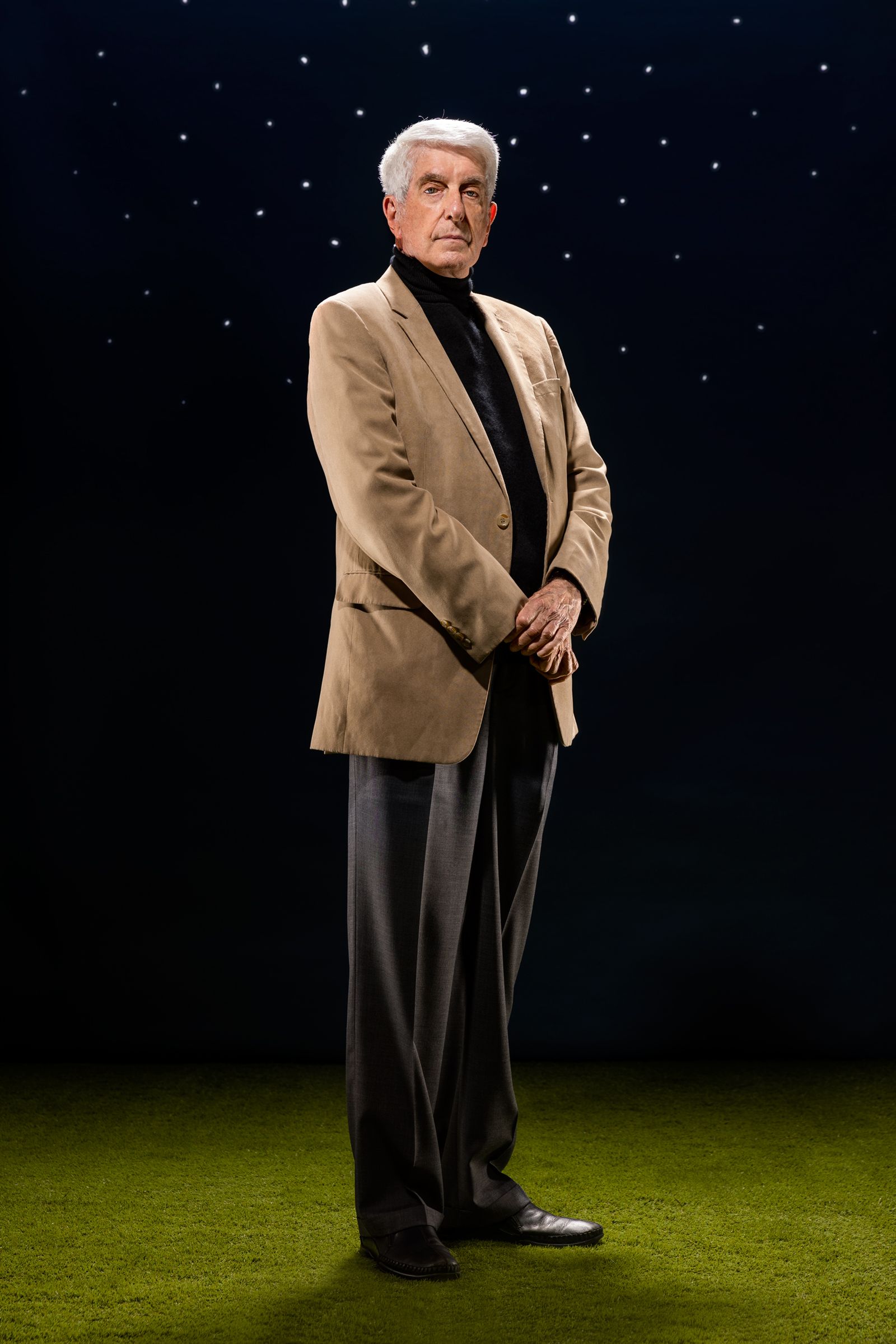
Vallée, who is 82 now, has celestite eyes, a strong nose, and a head of sterling hair that seems to riff on tinfoil hats. Beneath the rare hair is a rarer mind. His recollections from a six-decade career as a scientist and technologist include helping NASA map Mars; creating the first electronic database for heart-transplant patients; working on Arpanet, the internet’s ancestor; developing networking software that was adopted by the British Library, the US National Security Agency, and 72 nuclear power plants around the world; and guiding more than a hundred million dollars in high tech investment as a venture capitalist.

Contacts from Vallée’s long-term Rolodex praise his “seriousness” (Federico Faggin, inventor of Intel’s first commercial microprocessor) and “no-BS” “level-headedness” (Paul Saffo, tech forecaster); they emphasize that he “keeps balance” (Ian Sobieski, chairman of the investment group Band of Angels) and is “not a showboat, au contraire!” (Paul Gomory, executive headhunter); they assure you that he is “very careful” (Peter Sturrock, plasma physicist) and “wants concreteness” (Vint Cerf, Internet Hall of Famer and Google VP). Yet beneath that sober exterior, they may also say, beats “the heart of a poet” (Saffo again).

Vallée has written 12 books on what he and others call “the phenomenon,” the range of surreal experiences that includes UFO encounters. He considers the work a hobby and shrinks from the pseudo-archeologists, credentialed grifters, and conspiracy bros who tend to populate the field. There are beaucoup de bozos in this clown car, and Vallée is a cautious driver. As he sees it, the phenomenon represents both a scientific and a social frontier. When you study it, you must harness numbers, databases, pattern-hunting algorithms—but you must also have an ethnographic streak, an interest in how culture molds understanding. You have to endeavor, in other words, to weigh both hard and soft data, despite the modern scenario “where the physics department is at one end of the campus and the psychology department at the other end.”

Vallée’s papers, entrusted to Rice University, will ultimately include files on some 500 anomalous events that he has personally investigated, from the abduction of Betty and Barney Hill on US Route 3 to a landing that paralyzed a farmer in a Provençal lavender crop. Yet he likes to joke that he is the only ufologist who does not know what UFOs are. He doubts that they are interstellar SUVs—would be disappointed if they were. The truth, he believes, is almost surely freakier than that, more baffling, and more revealing of the nature of the universe. This is why, long ago, when Steven Spielberg consulted him for Close Encounters of the Third Kind, Vallée pushed against the final scene, in which the aliens emerge from their spaceship. Too proscriptive, he thought. Spielberg memorialized Vallée as the film’s French scientist character, played by François Truffaut, but he went with the meet-and-greet ending. It appears to have been what the public wanted: Close Encounters beat out Star Wars at the box office just days after the Council Bluffs incident.

Platzer considered himself neutral on the subject of UFOs. “One has to be very careful in saying that certain things are impossible, because they became possible,” he told me. Think of, you know, the airplane. Reputable science journals like his had always avoided the subject, in a tacit, shared embargo that extends to subjects like flat-Earth doctrine. But Platzer felt that solid experimentation was in order. He agreed to publish Nolan and Vallée’s research if it passed peer review. “It’s time,” he said.

Jacques Valle

Whatever is behind the UFO phenomenon, Vallée says, “it’s a lot smarter than we are, and it uses humor at another level.” PHOTOGRAPH: CHRISTIE HEMM KLOK

VALLÉE’S ARRIVAL ON Earth, in 1939, coincided with a flash—Nazi bombs falling on the suburbs of Paris. His mother was a space exploration enthusiast. His father was a criminal court judge, “used to human testimony in all its colors.” Vallée was never bored as a child. He collected telescopes and gazed at the moon and Jupiter. In 1954, during a three-month wave of flying-saucer sightings in France and Italy, he clipped all the stories with witness interviews and pasted them into a notebook for rereading.
The following spring, when Vallée was 15 years old, he met the phenomenon on a clear, windless Sunday. He was up in the attic helping his dad with some woodworking while his mom was gardening outside. She screamed—he raced downstairs. He saw a gray disc silently parked above the town’s Gothic cathedral. Vallée’s best friend watched it from higher ground through binoculars. “We were the perfect little nerds!” he told me. “I got him to draw it. It was the same thing.” Vallée’s dad was sure the boys and his wife had seen a military prototype—an explanation his son almost swallowed.

Perfect little French nerds weren’t, of course, the only types applying themselves to the UFO question in the ’50s. In the US, the Air Force had set up a public study called Project Blue Book. In Switzerland, the psychiatrist Carl Jung was finding himself “puzzled to death” by flying saucers. In his book on the subject, he likened UFOs to a “technological angel” or a “physicists’ miracle.” They were shaped like mandalas, he wrote, and seemed to have a similar effect on our psyche—a “symbol of wholeness” that appears in “situations of psychic confusion and perplexity.”

Vallée went to the Sorbonne to study math. One day, in a Paris department store, he picked up a book called Mystérieux Objets Célestes, by the philosopher Aimé Michel. In ufology at the time, the vogue was for nonfiction that borrowed from pulp’s plots about civilizations on Venus and Mars; against it, Célestes put forward the field’s first testable hypothesis. According to Michel, if you charted all those 1954 sightings on a map, you’d find that they made straight lines crisscrossing the country. He called the pattern “orthoteny.”

Vallée, thrilled to see a proper theory, sent the author a letter. The teenager questioned whether humans could communicate with these hidden intelligences, which Michel had termed “X.” In his reply, Michel said that he did not have much hope of that. He reminded Vallée that witnesses had seen craft appear out of thin air and shape-shift in split seconds. How could one make sense of visions like that? “Don’t be fooled by the idea of ‘getting to the bottom of things,’” he urged. “That’s only a mirage.” Vallée should instead cultivate his mind as if it were a flower—though he should also remember that “the poppy is a flower” and not get lost in any intoxicating notions.
The advice landed. Vallée began writing a novel called Le Sub-espace, about a team of scientists who flee a world war on Earth, get set up in a lab on the dark side of the moon, and build a machine that allows them to explore alternate realities while dodging “hallucinatory traps.” He published the book under a pseudonym and, under his own name, worked toward a master’s in astrophysics. And he married Janine Saley, a like-minded soul who had trained to be a child psychologist but later switched to IT. (She had moved into the student housing next to his, and through the thin wall they realized that they loved the same records.)

The year Vallée graduated, Le Sub-Espace won the Jules Verne Prize. Despite the honor, awarded at the Eiffel Tower, he kept his sci-fi interests semi-secret. He worked as an astronomer for the French government, based out of a château turned observatory near the capital, where a whining IBM 650 computed the orbits of satellites out in stables once used by the king’s mistress.
Then, in 1962, Vallée took another astronomy job, this time in Austin, Texas. He appreciated the big oaks, big butterflies, and big cars, and learned, he says, that a good scientist is like a rider on the rodeo circuit, with the nerve to reembark on the bull. (He has signed off emails to me “Hook ’em up! Etc.”) But he was also feeling ready to chuck a perfectly fine career in astronomy for what he expected would be a more interesting life in computers—and mysterious celestial objects.

The following year offered the perfect opportunity: J. Allen Hynek, the chair of Northwestern University’s astronomy department, found him a job programming for the school’s Technological Institute. Hynek was also the scientific adviser on Project Blue Book, the US Air Force’s UFO probe. Vallée, barely 24, with a helmet of brunet hair, would serve as Hynek’s unofficial aide-de-camp.
“THERE ARE IN France more real philosophers than in any country on Earth; but there are also a great proportion of pseudo-philosophers there,” Thomas Jefferson wrote in a letter to a friend in 1803. A Gaul’s “exuberant imagination” often “creates facts for him,” the president and gentleman scientist went on, “and he tells them with good faith.”

Earlier that year, the French minister of the interior had sent Jean-Baptiste Biot, a young physicist, to investigate reports of a fireball and a hail of rubble over the town of L’Aigle, in Normandy. The Academy of Science was split over how to explain this phenomenon: Did the stones, as Descartes believed, originate in the atmosphere? Were they, as others thought, disgorged by volcanos or zapped from the ground by lightning strikes? Or were the stones, perhaps, strangers to our planet?

Biot was among a growing fringe that pushed the extraterrestrial hypothesis. Unusually for the time, he traveled to the area to collect his own data. Even more unusually, he spoke to regular folks (“citizens,” in the French Revolutionary argot) about what they had seen. Biot categorized the evidence he collected as either physical (stones, craters) or “moral” (people’s testimony).

According to witnesses, the rocks “broke off a branch of a pear tree,” impacted a meadow so deeply that water welled up, and came “whistling into the courtyard of the presbytery,” bouncing “more than one foot high.” At “a thatched cottage outside the village,” Biot wrote, “I found a peasant of the area who held one in his hands.” The man’s wife “had picked it up in front of their door.” Taken together, the physical and “moral” evidence made the reality of meteorites impossible to deny, at least for those who took the time to read Biot’s report. (Jefferson apparently did not.)

In Chicago, Vallée’s new mentor, Hynek, wanted a UFO event like L’Aigle. He wanted unimpeachable photography or something he could hold in his hands. In meetings of the Invisible College, the discreet ufology club the Vallées hosted at their apartment, he would say, “We have to wait for a really good case to show up.” But Vallée argued that scientific discoveries don’t usually happen that way. Understanding tends to come into view slowly, he said, after methodical study. They shouldn’t wait around for some sensational event that might never happen. They should be gathering every scrap of available UFO data—hard and soft—and truffling out the patterns in it. Solving for that unknown x.

Around the time the Vallées’ first child, a son, was born, the couple compiled a digital database of what they deemed credible UFO observations; it was populated with hundreds of reports from Project Blue Book in the US and thousands more they collected from Europe. Vallée was among the first to bring computers, statistics, and simulations to bear on the phenomenon. One of the things these tools taught him was that orthoteny, the pattern Michel discovered, occurred purely by chance.

Vallée spent 1964 pushing his son’s stroller along Lake Michigan, programming a model of the cardiovascular system for Northwestern’s medical school, pursuing a PhD focused on artificial intelligence, and polishing his first UFO tome, Anatomy of a Phenomenon, in which he argued that witnesses were a rich trove of data and should be taken seriously by scientists. (He eventually designed a classification system that accounted for how credible the source was, whether the site had been examined by investigators, and what possible explanations for the incident might be.) But Vallée was wary of coming off as some loud-and-proud “missionary”: He did not allow his publisher to mention on the dust jacket that he worked for Northwestern, and he refused to aggressively promote the book. Vallée recalls that Carl Sagan wrote to him admiringly about Anatomy, but balked when the ufologist asked whether he could extract a book blurb from the letter. As one UFO-friendly physicist told me, “You have to pay attention to your political situation as a scientist.”
In 1966, under pressure from Congress, the Air Force convened a panel of civilian scientists to decide whether the UFO question warranted further research. The committee was led by Edward Condon, an esteemed nuclear and quantum physicist. As Vallée recalls it, he and Hynek were the first to testify. (Afterward, Vallée watched Condon nap through Hynek’s press conference.) After 18 months and 59 cases sussed, the Condon Committee concluded that study “probably cannot be justified in the expectation that science will be advanced.” Its opinion was endorsed by the National Academy of Sciences and published as a 965-page mass market paperback with a foreword by the science editor of The New York Times.

Long before that book was printed, the Vallées split for Paris in disgust.

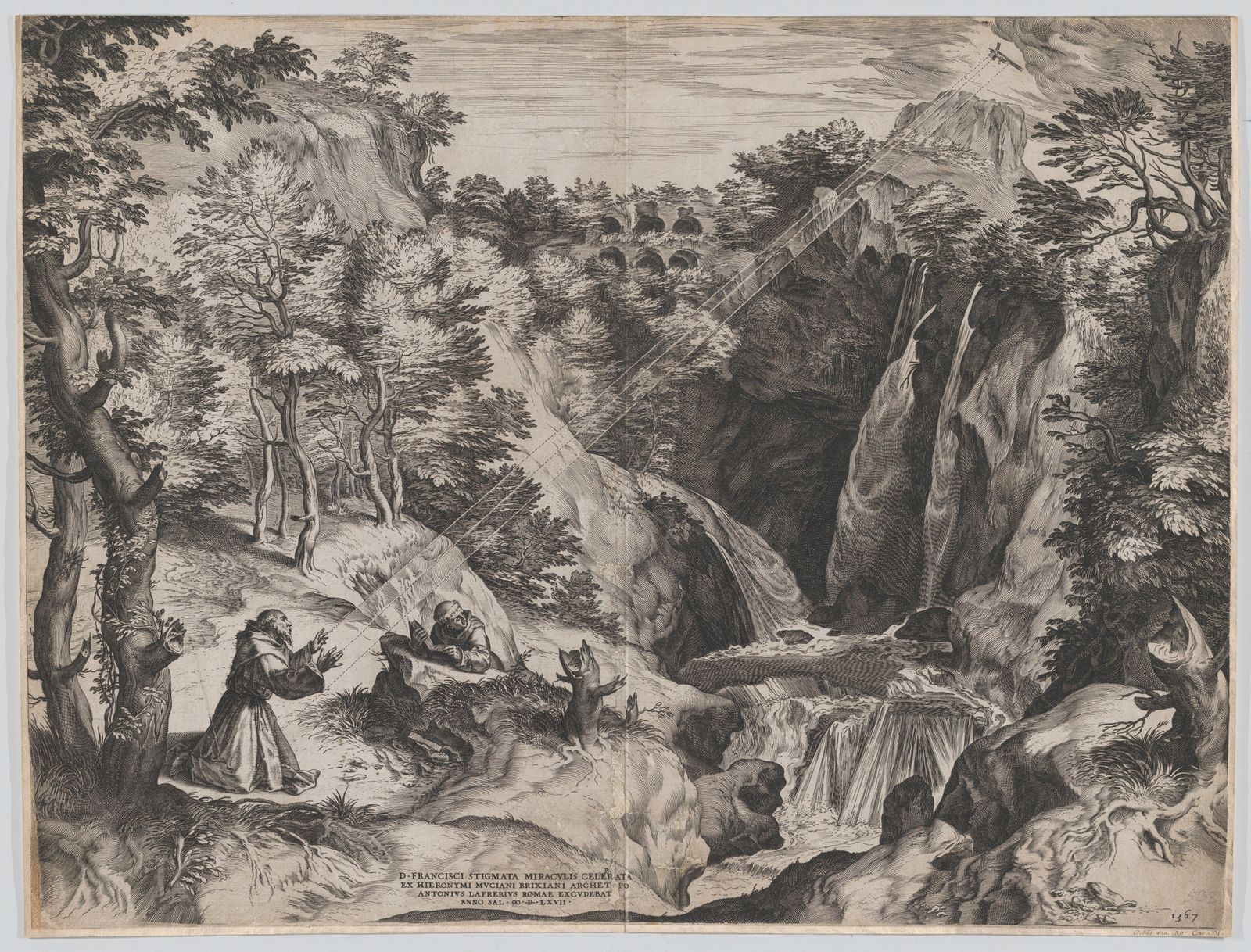
VALLEÉ RESIDES IN San Francisco but keeps a pied-à-terre in the Saint-Germain-des-Prés quarter of the French capital. On one of the afternoons, I spent there with him, over coffee and éclairs, he showed me a lithograph of a 16th-century engraving, which he’d spotted in the window of a nearby seller and “had to have.” It depicted an encounter, around 350 years earlier, between St. Francis and a heavenly seraph.

St Francis Receives the Stigmata

“St. Francis Receives the Stigmata,” 1567. PHOTOGRAPH: HERITAGE IMAGES/GETTY IMAGES

Francis was filled with both joy and pain by the experience. In the engraver’s interpretation, the angel emits a beam of light that brands him with stigmata. Those details remind Vallée of a wave of UFO activity in Brazil in 1977, shortly before the Council Bluffs incident. Victims reported being hit by powerful light beams from boxy craft. Dozens of them, he says, had burns consistent with exposure to radiation

We were in the same part of town that his family had moved to in 1967, when Vallée took a job at Shell. On computers in a basement off the Champs-Élysées, he had built balletic databases that anticipated how much and what kind of gas the French would guzzle in cars, trucks, boats, and trains as they set upon the Côte d’Azur for holidays. That spring, as civil unrest swept France and much of the population went on a general strike, his second child, a daughter, was born. There was chaos, and clarity.

The Condon Report had exposed how the UFO question tended to alternate between two poles: Either you believed that these phenomena were mirages created by bizarro natural events or tricks of human perception (ball lightning, weather balloons), or you believed that UFOs were nuts-and-bolts ships piloted by extraterrestrial starfarers.

Vallée found himself in neither camp. His Jung-accented sense of the phenomenon told him it was more than nuts and bolts. Something about it spoke to people on the level of mythology, engaged their psyches. Reports of sixth-sense experiences, like clairvoyance, were the norm. He hoped that science would eventually begin to explain all this—would explain what kind of technology, from what place, could generate such physical, mental, even spiritual effects. A 3D hologram with mass? A 5D object going through our 4D universe? The psychic equivalent of a film projector, capable of showing one person Bambi and another Godzilla?

And the shallot-sized lump of metal from Council Bluffs? It was made of isotopically ordinary elements, atypically mixed together. The Progress in Aerospace Sciences paper, which was published in December 2021, was never meant to be “a breakthrough about what UFOs are,” Vallée told me. It wasn’t meant, L’Aigle-style, to pummel an entire town with rocks. It is “a template,” he said, “for what serious UFO research could be in the future, if one plays by the rules.” He and Nolan are now studying samples for potential follow-up papers. “You have to open the door first, before you can bring in the packages,” he said.

Whatever the scientific truth here is, Vallée suspects that it may be knotted up with the secret of consciousness itself. The thing that philosophers call qualia—the conscious experience each human has—seems to be more than the sum of our physical parts. There’s an unsolved x there. Vallée’s friend Federico Faggin, for one, argues that consciousness is a basic property of nature, that the dimensions we call spacetime are in fact byproducts of some deeper reality. Maybe UFOs, Vallée suggests, are that reality welling up into ours.

When he read Mystérieux Objets Célestes for the first time, as a teen, Vallée wrote in his diary, “I will probably die without seeing any solution to this immense problem.” A decade later, after watching the moon landing, he copied down a line from Jung’s Alchemical Studies, about how life’s biggest problems “can never be solved, but only outgrown.” It’s still a long way to a place like the Museum of the L’Aigle Meteorite in Normandy, where dark fragments of a proven reality rest, like truffles, under a glass dome.


Authored by Mimi Nguyen Ly via The Epoch Times (emphasis ours),

Dmitry Rogozin, the director-general of Russia’s space agency Roscosmos, said that some sightings of unidentified aerial phenomena (UAP), colloquially referred to as UFOs, could be attributable to extraterrestrial intelligent life.

Rogozin said in a Russian televised interview, aired on June 11, that the Russian Academy of Sciences had been investigating and gathering information about UFO sightings. About 99.9 percent of the sightings were determined to be atmospheric or other physical phenomena and were unrelated to any kind of potentially intelligent life, he said.

But we accept that such phenomena could exist,” Rogozin also noted, according to a translation by Russian state-owned news agency Sputnik.

He also said he has read and viewed reports by Soviet test-pilot veterans, about what they witnessed during flights in the 1970s.

“What we’re talking about usually took place during the first test fights,” he said, according to a translation by state-controlled media outlet RT. He said he had also received similar information from the United States’ space agency NASA, the outlet reported.

The Russian space agency chief acknowledged that some people support the idea that human beings may be the objects of observation by other intelligent life forms, similar to how humans study microbes.

Rogozin’s comments come about a month after a public U.S. congressional hearing was held on UFOs, the first such hearing in over 50 years.

Scott Bray, the deputy director of Naval Intelligence, showed lawmakers two videos of UFOs but said he did not have an explanation for the objects seen in the videos.

There are a small handful [of events] in which there are flight characteristics or signature management that we can’t explain with the data we have,” he said. “Those are obviously the ones that are of most interest to us.”

The hearing came after a nine-page report (pdf) released in June 2021 said that a designated task force within the Pentagon, the UAP Task Force, identified 144 UFO sightings from 2004 to 2021 but could only explain one of them. Bray said that since the release of that preliminary assessment, the UAP Task Force database “has now grown to contain approximately 400 reports.”

Bray noted that some of the reports involved incidents where U.S. military aircraft picked up radio frequency energy from the UAPs, but none of these detections suggested that they were “non-terrestrial in origin.” He did not comment in the hearing about whether any of the remaining reports suggested evidence of extraterrestrial life.

Select Republican lawmakers were vocal in criticizing the hearing, and alleged that Democrats were trying to distract from tangible issues facing Americans such as inflation and a declining oil reserve; and that the Pentagon was withholding information from Americans and wasn’t providing “real answers to serious questions.”

The public hearing was followed by a private session of the committee when lawmakers could hear classified information.

When asked at the public hearing about whether the United States has any sensors underwater in the ocean to detect submerged UFOs, Ronald Moultrie, the Pentagon’s top intelligence official, did not respond to the question but said the matter would be “more appropriately addressed in [the] closed session.”


After six globe-trotting decades spent probing “the phenomenon,” the French information scientist is sure of only one thing: The truth is really, really out there
I'm interested in a catalog of exotic alien species in the Milky Way galaxy. Towering spiders on a desert planet, lizzies, grays, mantises, plant-scientists and those very ugly US-mil-base stinky aliens we already know of. What other intelligent civilizations live out there? Observing their biomechanics in motion and the noises & cries they make in nature would be amazing. Especially so of the fauna on their planets! Comparative studies with Earth flora & fauna in a high-school level course. Just imagine!
A mix of an IKEA / Life / National Geographics [video] catalog would be superb!
 
Back
Top Bottom