Man with level spinal cord injury walks again

Palinurus

The Living Force
Source: _http://www.nltimes.nl/2015/12/31/crowdfunded-robotic-exoskeleton-delivered-just-in-time-for-new-year/

Crowdfunded robotic exoskeleton delivered just in time for New Year

Posted on Dec 31, 2015 by Janene Pieters

Disabled-mans-exoskeleton-749x575.jpg

Robotic exoskeleton helps paralyzed patients walk again (Photo: Screenshot/YouTube)

Nijmegen man Ruben de Sain received his crowdfunded robotic exoskeleton just in time for the paralyzed man to celebrate New Year’s on his feet. The suit was delivered on Wednesday afternoon, according to Dutch newspaper AD.

De Sain first got his hands on a robotic exoskeleton during a test on the device by the Sint Maartens Clinic in Nijmegen. The suit enables paralyzed people to stand and walk. After testing the suit out for two weeks, De Sain decided that he could not imagine being stuck in a wheelchair again.

He launched a crowdfunding project and managed to raise the 86,900 euros necessary for his own suit. His project was one of the Crowdfunding Hub’s top 12 crowdfunding projects in the Netherlands this year.

The Nijmegen man’s next goal is to convince health insurers to compensate these robotic exoskeletons.

Happy New Year everybody !
 
Some cool news coming out of Brazil - a new injection of polylaminin has resulted in paralyzed patients recovering their mobility to some extent!


Brazilian public university makes breakthrough that could reverse spinal cord injuries​

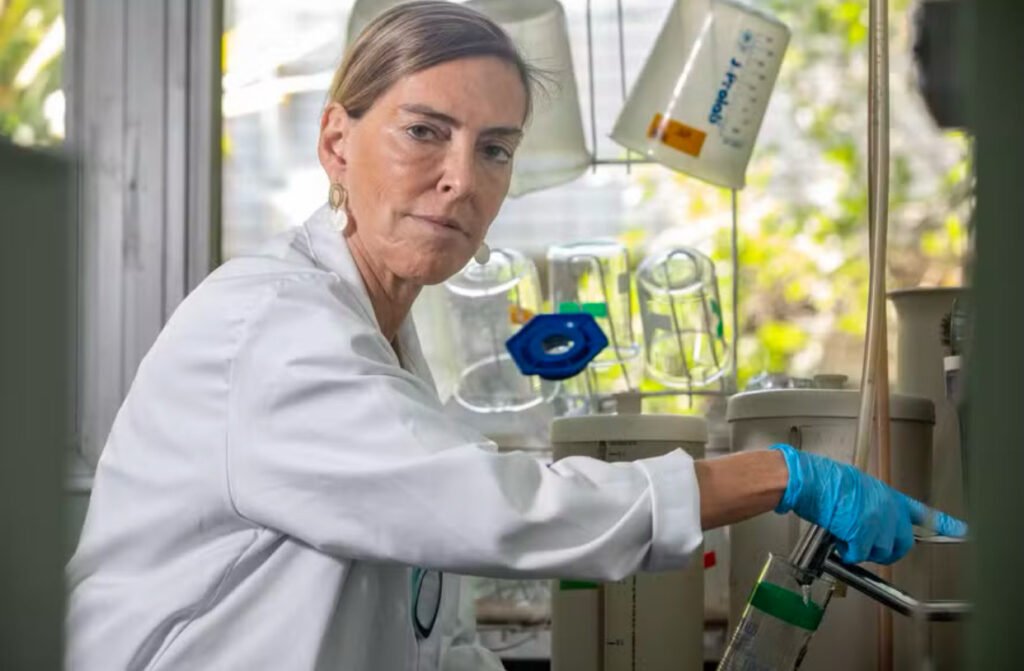
Tatiana Sampaio, head of the Extracellular Matrix Biology Laboratory at UFRJ and responsible for polylaminin, an experimental drug with the potential to repair spinal cord injuries. — Photo: Ana Branco / O Globo

In September, a study presented by the Federal University of Rio de Janeiro (UFRJ), in Brazil, revealed a discovery that could change the lives of patients with spinal cord injuries. The research, conducted at the public university, uses a protein extracted from the human placenta called polylaminin.

The study represents hope for those who suffer from spinal cord injuries, a condition that can cause partial or total loss of limb mobility and, until now, has had no treatment capable of reversing the damage.

It is expected that, when applied to the injured area, polylaminin will stimulate nerves to create new pathways and enable partial recovery of movement. The experiment has already shown promising results in animals and small groups of volunteers.

The research is coordinated by the Carlos Chagas Filho Foundation for Research Support of the State of Rio de Janeiro (FAPERJ) and has been ongoing for over 20 years. It is currently in the testing phase but already raises great expectations for the future of medicine. The study also received support from Cristália Laboratory, which invested R$31 million (about US$5.6 million) in the project.

The goal is to recreate the natural protein laminin, produced during embryonic development and responsible for communication between neurons. The lab-produced medication aims to replace this protein, which becomes scarce in adulthood.

Researchers discovered that it is possible to recreate it from proteins extracted from the placenta, forming a kind of mesh that reestablishes communication between nerve cells. Polylaminin is applied directly to the injured area through a single surgery, preferably performed within 72 hours after the accident, which increases the chances of recovery.

Researchers are optimistic that, as the study progresses, people who have been paralyzed for years may also regain movement and mobility.

Recent studies have also shown that polylaminin, when combined with other therapies, can be effective in chronic spinal cord injury cases.

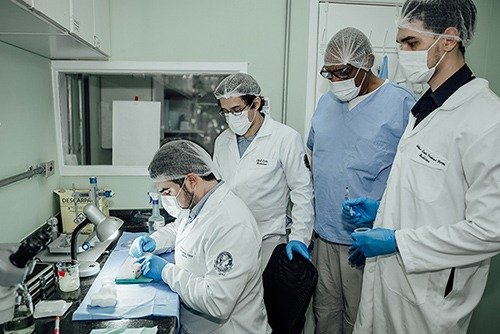
Researchers from UFRJ conducting studies on laminin repolymerization


Researchers from UFRJ conducting studies on laminin repolymerization. Photo by Luciana Sposito.

Results

The research is led by Tatiana Sampaio, biologist and researcher. In an interview with FAPERJ, she explained that the choice of polylaminin was due to its better cost-effectiveness, ease of production, and safety regarding the predictability of the cellular reaction, compared to stem cell therapies, which are more complex.

“We are simply imitating nature, since this protein is naturally produced by the body during the development of the nervous system,” she explained.

In August, a study published in Frontiers in Veterinary Science tested polylaminin on six paraplegic dogs. Even after surgeries and months of physiotherapy, the animals remained unable to move their legs.

After applying the protein directly to the lesion, four dogs showed improved balance and managed to take a few steps, while the other two had more modest progress. All were monitored for six months and showed no side effects.

In addition to animal testing, the medication was applied to an experimental group of Brazilian volunteers. In total, eight people participated in the study, carried out under academic protocols.

Among the patients, some fully recovered mobility, something considered unlikely without intervention, while others reported significant improvements, such as trunk control and the ability to walk with assistance.

Among the volunteers is Bruno Drummond, a banker who, in 2018, suffered a severe cervical injury after an accident that crushed part of his spinal cord. With his family’s authorization, Bruno participated in the experiment using cells extracted from the human placenta.

Initially, he had no movement in his limbs, but only two weeks after the procedure, he was already able to move a toe. Years later, Bruno regained much of his mobility and managed to resume an independent life.

In an interview with TV Globo, he said:
“Nowadays, I can move my whole body—of course, with some limitations. My leg is moving. I can stand, walk, dance, fly. I’ve regained my independence.”

Expectations

The National Health Surveillance Agency (Anvisa) reports that there is still no request for approval for the clinical use of polylaminin. So far, the results presented correspond to non-clinical stages, that is, laboratory tests and preliminary observations.

Among those following the progress with hope is Alexandre Costa, 51, who was shot in the shoulder during a robbery in 2018 and became paraplegic. After seven months in the hospital, he began his so-called “real battle,” the process of rehabilitation and adaptation to a new life.

Even with family support, he faced difficulties accessing treatment and public healthcare. The pandemic interrupted his rehabilitation efforts, and new health complications forced him to pause therapy more than once. “There are many problems that come with the ‘spinal cord injury package,’” Alexandre says.

Costa reports not only physical but also emotional effects of the injury: “I sank into depression, lost the will to live, and just let life carry me.”

In 2024, a new health complication led to the need for an ileostomy, which he makes a point of mentioning:

“These are different disabilities, but it’s important that people are aware […] the second can be avoided in some cases.”

Because of this, he now runs an Instagram profile (@falailesionado), where he seeks to raise awareness, share his experience, and receive feedback from other people with spinal cord injuries.

In an interview with Yuvoice, he says he watches research like UFRJ’s polylaminin study with caution but also hope:

“I’m hopeful that maybe I can be one of the volunteers. I haven’t signed up yet. I’m waiting for things to advance a bit more. But I’m optimistic, because even a small improvement in your condition, any gain in quality of life, is already a big step forward.”

The road to making the medication publicly available is long. First, laboratory studies must be completed and safety proven in animals. Then, with Anvisa’s approval, large-scale human trials can be conducted, evaluating both acute and chronic injuries. Only after full regulatory approval can the drug be marketed.

The progress observed in animals and volunteers provides an optimistic outlook for improving quality of life and the future of medicine. However, until the research is complete, there is still no definitive treatment for spinal cord injuries.

That was last year. Below is an update on the authorization for immediate compassionate use, and a tricky situation that's a mix of ethical concern and corporate greed when it comes to moving past the experimental stage.

Brazil has been abuzz with an issue that is relevant to the whole world: the possibility of paralytics with complete spinal cord injury fully recovering their movements.

In recent months, Brazil has been abuzz with an issue that is relevant to the whole world: the possibility of paralytics with complete spinal cord injury (and only them) fully recovering their movements if they receive a certain injection into the spinal cord within 3 days of the accident and undergo physiotherapy.

Brazil began paying attention to the issue when, in September 2025, the press published the incredible story of Bruno Drummond: in 2018 he broke his neck in a car accident, became quadriplegic, and agreed to be a guinea pig in a pilot study. In less than 24 hours, he received the spinal cord injection and today he can walk. He went directly from classification A (no movement) to D (strength and sensitivity for almost all movements), an unprecedented fact in medical literature. This pilot test had six patients. The remaining five patients jumped from A to C (with some strength and mobility). The research was being developed by researchers at the Federal University of Rio de Janeiro (UFRJ), led by Prof. Tatiana Sampaio, in partnership with the Brazilian laboratory Cristália.

Brazil was thrilled, and internet users repeatedly said she deserved the Nobel Prize. Faced with the news, the patients’ families, desperate, began to go to court to request the compassionate use of the drug being tested. And then another very important story emerged: a certain Diogo Brollo was working installing windows in a building when he fell, suffered a total spinal cord injury, and his sister obtained a court order for him to receive treatment under compassionate use. In just fifteen days, he was able to move his foot and leg. By February 22, there were 55 court requests, of which 30 were accepted.

Patients who take the drug under compassionate use do not count as clinical cases. Thus, the question remains: if the legal battle continues, and the treatment continues to have favorable results, how will the research procedures proceed?

And then we have the controversy that set Brazilian Twitter ablaze. A neoliberal economist who writes for the country’s most traditional right-wing liberal newspaper tweeted a 28-second clip from Professor Tatiana Sampaio’s interview on Roda Viva in which she said: “Let’s suppose a hypothesis: that these 30 people who received it for compassionate use, all walk again. Would you have the courage to conduct a controlled clinical trial?”, to which an interviewer replies, impassively, that it is necessary to follow all the procedures and go through all the phases. Along with the video, the economist posted the ironic comment “Now the Nobel Prize is coming”. Immediately afterwards, the same actors who defended the wonders of Pfizer’s “vaccine” began to treat Professor Tatiana Sampaio as a charlatan or a simpleton who does not know science.

In the same interview, however, Tatiana Sampaio explained the problems of conducting clinical trials in this particular case, as well as in general. Let’s start with the specifics: every time a patient wins the right in court to undergo the test, the Cristália laboratory has to send a neurosurgeon to the location to perform the invasive procedure of injecting polylaminin into the spinal cord. In the double-blind test, whose purpose is to eliminate the placebo effect, the medication is given to one group of test subjects and a placebo to another, in order to compare the results. Now, it is unethical to subject a patient to an invasive procedure to inject a liquid that is, at best, innocuous into their spinal cord. Furthermore, even if it were a simple procedure and easy to replace with a placebo, time is important for the effectiveness of the treatment, so the one who received the placebo would be doomed to a wheelchair. (To this we add: if the paralytic can obtain the medication through legal means, why would they agree to be a test subject in a double-blind trial?)

Given the fact that it is difficult to follow existing procedures ethically, Professor Tatiana Sampaio says that it is necessary to think about new models. And this is not the only bureaucratic issue that calls for reflection.

The issue of patents and the cost of clinical trials

Another piece of news that caught attention is that the scientist had to pay for the patent out of her own pocket. UFRJ has had serious administrative problems for a long time that no authority wants to solve. I will limit myself to observing that it has one billion dollar’s budget but, even so, allowed the National Museum to catch fire due to the precariousness of the electrical grid – and the rector even blamed the firefighters. The Egyptian mummies of the emperor turned to dust; fossil collections were lost. At least the Bendegó Meteorite could not be destroyed. Thus, UFRJ was not going to pay for the renewal of the Brazilian, American and European patents, and asked the professor if she herself did not want to pay so as not to lose them. She only paid for the Brazilian one and the others were lost. Then she found Cristália.

In the interview on Roda Viva, she explained that this was a blessing in disguise, because if the United States patent were still valid, it would probably have been bought by a first-world laboratory, which would have dismissed the Brazilian researchers, conducted a battery of tests very quickly, and sold the product for a fortune. With the Brazilian patent in hand, she and the laboratory Cristália hope that in the future the drug will be sold to the SUS (the Brazilian NHS). We are invited to consider, then, how many countries around the world do not fund national scientists so that a large company can buy the patent for their research in its initial stages, finish developing it, and set an absurd price to be paid by these same countries when they go to buy the drug. The damage that Reagan did by allowing public research funds to become private patents has been globalized.

Furthermore, it is worth highlighting the cost and reasonableness of clinical trials, which is precisely what led the Pfizer puppets to attack the scientist after her interview on the Roda Viva program. I conclude by quoting Professor Tatiana Sampaio: “A patent is very important when you are going to sell something. Imagine that you have a proposal for a new drug and then you want to do a clinical study to test if it really works. To do this clinical study, you need a very large budget, because clinical studies are very expensive. And then you need someone to be interested in doing that clinical study. And that someone, as a rule, will be interested in doing this study if they have the prospect of a very large profit from the commercial exploitation of it. That is why they need the patent to ensure that only they can make money from it. All this dynamic is how the wheel turns. But I have to tell you that I don’t think it’s an ideal situation, in my opinion. I think this ends up creating a large market reserve for large corporations.”

The interviewer asks if the ideal solution would be for the state to fund it, to which she replies: “I don’t know, the ideal is something new that we have to do. We don’t need to be afraid of that. We have to build something new, because this paradigm of: you get the patent, and then you sell the patent to someone who has a lot of money and who will invest a lot of money, and who will… We have to ask ourselves this: in the eagerness to protect people from being used as guinea pigs, aren’t we also creating a market reserve for an entity that has a very high expectation of profit?”

Dr. Sampaio's website states that a small clinical trial is underway:

Phase 1 -- Safety​

In January 2026, ANVISA authorized the first human study: 5 volunteers (18-72 years) with acute and complete thoracic spinal cord injury (less than 72 hours after trauma) will receive a single surgical injection. This initial test aims only to confirm that the substance does not cause serious adverse reactions.

Phase 2 & 3 -- Efficacy​

Only after success in Phase 1 can controlled studies in larger groups be conducted to assess real benefit. Double-blind trials with placebo and controlled groups (the gold standard of medical research) are expected. This complete process may take several years until the drug is registered.

Pre-clinical Research​

In parallel, Dr. Sampaio's team is investigating the use of polylaminin in animal models of chronic injuries. Studies with dogs, for example, are underway to assess whether the molecule can help with older injuries.

Dr. Sampaio estimates that, if regulatory stages proceed without setbacks, polylaminin could reach the market in 2 to 3 years. If approved, Cristalia laboratory plans to offer it through SUS (Brazil's public health system), making it available to paralyzed patients.
 
Back
Top Bottom