Moon Landings: Did They Happen or Not?

And so it begins, or not.

NASA's Artemis 2 mission: Everything you need to know

Artemis 2 will be the first mission to carry humans to the moon's vicinity since 1972.
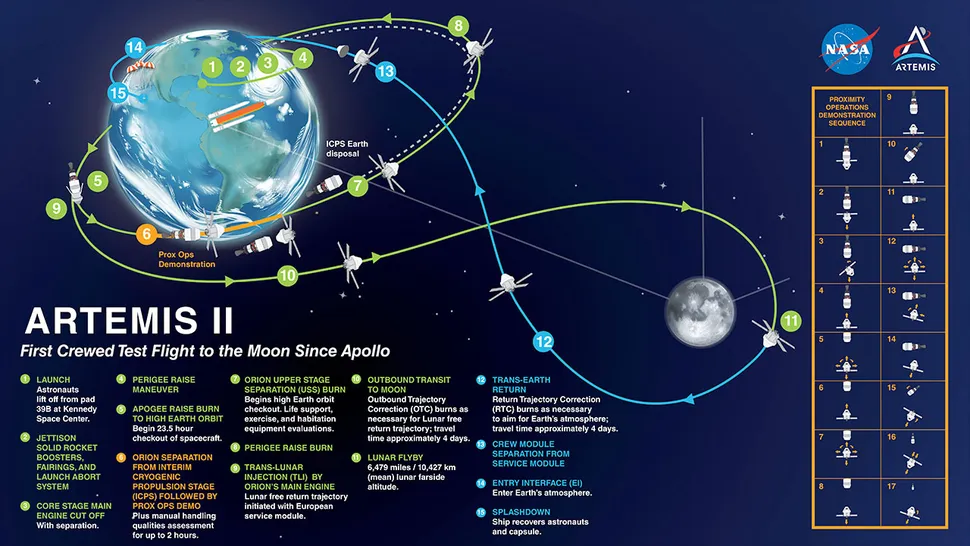
P8AyHqZQNTon9HrPvw2iFh-970-80.jpg.webp


However, whether they land on the moon or not in 2027 is pretty much open.

Following the mission, engineers and flight controllers will spend months analyzing data to determine readiness for the next phase of Artemis.

The next planned mission, Artemis 3, which will land on the surface of the moon in 2027, if all goes according to plan.

However, NASA's Office of the Inspector General has expressed skepticism about that timeline. There have been delays in getting the human landing system ready, which will use SpaceX's Starship, due to technical and legal reasons. In addition, there were development delays in the spacesuits that NASA was creating; the agency has pivoted to commercial suppliers to fill the gap.

Starship has faced various development challenges, including environmental permits and a failure during its debut launch to space in April 2023. SpaceX has pledged to refly Starship quickly. But approval from the Federal Aviation Administration and other factors may push the Artemis 3 landing later in the decade.
 
An acknowledgement that the Chinese are way ahead, at least several years, and that in conjunction with the Russians, they'll be studying micrometeorites in the moon and plasma physics near the surface of the moon. Hmm.

China's next moonshot: Chang'e 7 could search the lunar south pole for water this year"

The Chinese will be ahead of everyone else by at least one year, but probably several years."

China's next robotic moon mission is scheduled to launch later this year, helping set the stage for the nation's planned multi-phased lunar outpost.

The Chang'e 7 mission is on tap to reconnoiter the moon's south pole, making use of an orbiter, lander, rover and a water-seeking, well-instrumented lunar hopper.

This upcoming moon trek will also help advance the International Lunar Research Station (ILRS), a collaboration involving China, Russia and a number of other countries to set up a base near the lunar south pole.

Rigorous schedule
"Programmatically, the Chang'e series is on a rigorous schedule. They all launched as scheduled," said Norbert Schörghofer, a senior scientist for the Planetary Science Institute who's based in Honolulu, Hawaii.

"It's hard to know for sure what China is planning in the longer term, but since they have a successful lunar exploration program and lots of government resources, I'd fully expect they will construct a lunar base soon, perhaps using their own advanced robots," Schörghofer told Space.com.

It is likely that the Chang'e 7 lunar lander will touch down near Shackleton Crater, Schörghofer advised, outfitted with an international array of scientific instruments. "Chang'e 7 is destined to find water ice and make the first in-situ measurements of water ice on the moon," he said.

A critical question is where to build the first base on the moon, said Schörghofer. Ideally, it should be near significant water ice deposits.

"Chang'e 7 will not settle how water ice is exactly distributed geographically, but it will certainly make relevant discoveries," Schörghofer said. "The Chinese will be ahead of everyone else by at least one year, but probably several years. Chang'e 7 is a key mission for the study of lunar volatiles," he added, "but we need more missions."

Foreign payloads

Chang'e 7 is reportedly scheduled for liftoff in the second half of 2026.

Last year, a memorandum was signed by Russia's space agency Roscosmos and the China National Space Administration (CNSA). Chang'e 7 will carry a Russian scientific instrument called Dust Monitoring of the Moon, which will study dust components and dynamics of the near-surface exosphere of the moon; registration of micrometeorites and secondary particles of lunar regolith; and the parameters of low-energy plasma near the surface of the moon.


That Russian instrument will be integrated into Chang'e 7, along with other foreign payloads from such countries as Egypt, Bahrain, Italy, Switzerland and Thailand.

Wide-field telescope

On Chang'e-7's manifest for the moon is a telescope, a collaboration between the University of Hong Kong’s Laboratory for Space Research and the International Lunar Observatory Association (ILOA) based in Waimea, Hawaii.

Steve Durst, the founding director of ILOA, told Space.com that the ILO-C is a small, wide-field telescope designed for the Chang'e 7 lunar lander. The instrument has successfully passed all flight model testing, securing its acceptance as a payload, he said.

"This advanced astronomical camera is set to launch aboard China's Chang'e 7 mission, scheduled to land near the illuminated rim of Shackleton Crater in the lunar south pole region in November 2026," Durst said. "The telescope aims to capture stunning images of the galactic plane, contributing to lunar science and inspiring future generations."

Research Hotspot

Water ice in the lunar polar regions has emerged as a major research hotspot in lunar science, observed Yang Liu of the National Space Science Center in Beijing.

Yang and colleagues detailed Chang'e 7 mission goals at the 2nd Lunar Polar Volatiles Conference, which was held last November in Honolulu, Hawai'i.

Chang'e 7's candidate landing site is near the rim of Shackleton Crater at the lunar south pole. One of the mission's primary scientific tasks is to conduct remote sensing and on-the-spot investigations of water ice at the lunar south pole.

Chang'e 7 features an orbiter, a lander, a rover and a mini-flying probe or hopper, which together will tote to the moon a total of 18 scientific instruments.

The lander will deploy China's inaugural deep-space "landmark image navigation" system to ensure a safe and precise landing.

Mission intent, Yang stated, is to explore the environment and resources in the lunar south polar region by conducting a series of steps: orbiting, landing, roving and mini-flying. [...]

The Chinese have a rigorous schedule and a track record to sticking to it. And they say that they will land on the moon on 2030.

If the U.S. already admitted that it's unlikely they'll be ready for 2027, who is going to be first this time around?

Chang'e 7 will help pave the way for bigger things to come, if all goes to plan. Those "bigger things" include a crewed lunar landing, which China aims to achieve by 2030.

The follow-on Chang'e 8 robotic mission in 2028 will test technologies for building habitats using lunar soil, said Wu Weiren, chief designer of the Chinese Lunar Exploration Program. Both Chang'e 7 and Chang'e 8 are seen as key enablers of the ILRS, which China wants to start building in the 2030s.

"We hope that on the basis of phase four of our lunar exploration program," Wu said, "there will be a large international scientific-technological research project initiated by China, with the participation of multiple countries."

The research station at the lunar south pole will be capable of automatically supplying power for itself and making telecommunications available on site.


Centered around the lunar south pole, the ILRS would be equipped with multiple systems including lunar rovers, landers, hoppers and networks. "Once assembled, we will be able to conduct long-term unmanned exploration there, as well as accommodate short-term human presence," Wu said.

Wu added that he believes that, ultimately, the construction of a lunar research station will serve China's future Mars missions. "I believe this is a very important goal for us," Wu said in an interview last year with the China Global Television Network.

They sound like they're ready to stay on the moon if SHTF.
 
However, whether they land on the moon or not in 2027 is pretty much open.
Sometime in 2028 thanks to Starship delays, if not longer.
According to an internal SpaceX document obtained by Politico, the company is targeting June 2026 for the first orbital refueling demonstration between Starship vehicles, and an uncrewed lunar landing in June 2027. If Starship manages to breeze through those qualification tests and stick to its current timeline, SpaceX estimates the earliest first attempt to complete a crewed mission to the surface of the moon could take place in September 2028.
Got to get to LEO first. The Human Landing System is nowhere near ready either.
“The HLS schedule is significantly challenged and, in our estimation, could be years late for a 2027 Artemis 3 moon landing,”
Fuel problems, might need to go back to aerozine and nitrogen tetraoxide.
A major issue, he said, is demonstrating cryogenic propellant transfer, needed to refuel Starship in low Earth orbit before heading to the moon. That work has been slowed by delays in version 3 of Starship
Might have to dust off and de-mothball the Lunar module itself!
However, NASA's Office of the Inspector General has expressed skepticism about that timeline. There have been delays in getting the human landing system ready, which will use SpaceX's Starship, due to technical and legal reasons. In addition, there were development delays in the spacesuits that NASA was creating; the agency has pivoted to commercial suppliers to fill the gap.
Starship has faced various development challenges, including environmental permits and a failure during its debut launch to space in April 2023. SpaceX has pledged to refly Starship quickly. But approval from the Federal Aviation Administration and other factors may push the Artemis 3 landing later in the decade.
Some rather dated links here but still relevant, things haven't changed that much and they're looking pretty ordinary.
China is sticking to a plan that makes sense. It looks a lot, in fact, like what the United States did for Apollo," Griffin said. "We have stuck to a plan that does not make sense."
" The former NASA administrator reiterated a previous recommendation he made to Congress, arguing that NASA's Artemis 3 mission, currently planned for 2027, should be canceled  — along with every other Artemis mission  — so NASA and the U.S. government can rethink the whole plan for America's return to the moon.
Musk making his usual claims, gonna build three Starships a day!
"Yes, at massive volume," Musk said. "Maybe as high as 10,000 ships per year,"
Be easier resurrecting the Saturn V or use multiple launches of the existing space shuttle based system.
Why all the problems with the spacesuits? They had robust and reliable suits on the moon 56 years ago and presently have wonderful suits on the ISS; if the TV is to believed but they struggle make a moonsuit. They've got one to swimming pool stage but we'll never see it being tested in a vacuum chamber. We never do for some reason, not even the latest Artemis II outfit. the Orion Crew Survival System as its called. We can see some of the systems used to test them but never see them undergoing the testing themselves. The best suit testing I can find is Max Baumgartner's custom made suit and its pretty sparse but there's nothing remotely equivalent from NASA or any other space agency.
1767936456803.png
1767993318244.png


Can't see those gloves working that well under pressure, no knuckle joints in the bladder. Speaking of bladders they're designed to sustain life for 144 hours in case the capsule fails. Apparently they have a built in toilet, here's hoping they don't have to use it. God Speed Artemis!
RIP Max.
 
The Chinese have a rigorous schedule and a track record to sticking to it. And they say that they will land on the moon on 2030.

If the U.S. already admitted that it's unlikely they'll be ready for 2027, who is going to be first this time around?

An admission for a delay here:


Artemis 2 is the first crewed spaceflight in the mission program. Four astronauts will take a 10-day flight around the moon and back to Earth, testing systems ahead of the Artemis 3 mission, which aims to deliver astronauts to the lunar surface by 2028.

They're aiming 2028, while the Chinese look like they're about ready. Overall, it's good that Chinese are a diplomatic people. We don't want to see unnecessary accidents for rushing things up.

NASA previously announced that the launch window for Artemis 2 could be as soon as Feb. 5, 2026, but no later than April 2026. However, the Artemis mission has previously experienced delays and, as with all spaceflight missions, the latest proposed dates are subject to change.

They chose the timing of the perihelion for "the brightest comet of the year". I'm not sure it's a good omen, they should probably give the benefit of the doubt to all that plasma discharge theory background.

NASA will delay the rollout if weather conditions are unfavorable or there are technical issues. The space agency noted that its engineers have been troubleshooting in the lead-up to launch.

Well that is all very sensible. Good luck to them.
 
Back
Top Bottom