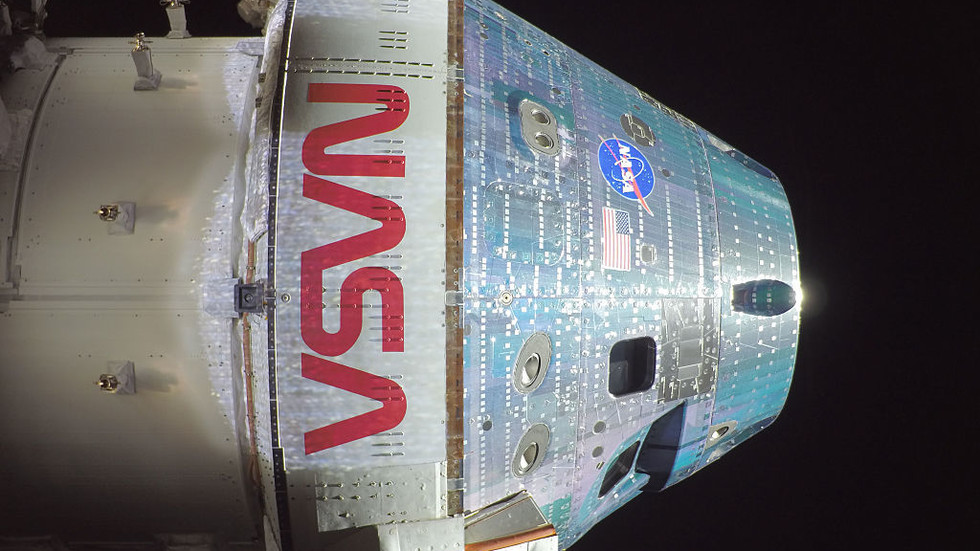
The American Orion spacecraft, part of the Artemis II mission, has reached the Moon. The journey took around four days, excluding the first day spent in Earth orbit, and the return will take roughly the same time.
Yet unlike the Apollo missions of half a century ago, Orion will not enter lunar orbit. Instead, it will follow a so-called free-return trajectory, looping around the Moon and using its gravity to swing back toward Earth. This is the same maneuver that saved the crew of Apollo 13.
The choice is deliberate. Artemis II is, above all, a test flight. NASA has opted to minimize risk. Rather than sending Orion directly to the Moon, the spacecraft first entered low Earth orbit using the rocket’s upper stage, and then set off using its own relatively low-thrust engine.
Had that engine failed, Orion would simply have re-entered Earth’s atmosphere after a few orbits and landed. Its trajectory was deliberately conservative: at its lowest point, the spacecraft skimmed just 185 kilometers above Earth, effectively “clinging” to the atmosphere. Once the engine had fired successfully, however, repeated burns became less critical.
This cautious approach comes at a cost. Orion hasn’t passed particularly close to the Moon. Its nearest approach was about 6,500 kilometers, nearly twice the Moon’s diameter. As a result, expectations of spectacular imagery should be tempered. The mission’s lunar science component is largely symbolic. Its real purpose is to test systems and procedures.
Even so, Artemis II has set a record. Never before have humans travelled so far from Earth. The previous record, set by Apollo 13, was surpassed on Monday. As Orion passed behind the Moon, communications were lost for around 40 minutes. Splashdown in the Pacific is scheduled for Saturday.
So far, the flight itself has proceeded without major incident. A few technical glitches have been reported, but nothing unusual for a mission of this complexity. On the ground, however, the situation is far less stable.
The most significant recent development is not in space, but in Washington. The US lunar program is undergoing a fundamental overhaul.
On March 24, NASA Director Jared Isaacman unveiled the ‘Ignition’ initiative. In practice, this marks the end of Artemis as it was originally conceived in 2019.
The first sign of change came with the announcement that Artemis III, previously scheduled for 2028, would be brought forward to 2027, but without a lunar landing. Instead, the mission will focus on testing lunar landers in near-Earth orbit.
Two competing systems are currently under development: one by SpaceX, the other by Blue Origin. If at least one is ready, NASA will proceed. Orion will dock with the lander or landers, conduct maneuvers, and test control systems. The mission could last up to three weeks.
A human landing is now pushed back to Artemis IV, planned for 2028. That mission, if it proceeds on schedule, will see two astronauts spend up to a week on the lunar surface, while two others remain in orbit, comfortably exceeding the Apollo 17 record of three days.
There are also tentative plans for an Artemis V mission in the same year, although given the program’s history of delays, this seems optimistic at best. More striking, however, is what has been removed. The Lunar Gateway, a small space station intended to orbit the Moon, has effectively been cancelled.
This isn’t entirely surprising. The Gateway concept has long attracted criticism. Its highly elliptical orbit would place it far from the Moon for most of the time, limiting its usefulness for surface operations. In some scenarios, even evacuating astronauts from the Moon to the station would have been impractical.
Yet the Gateway was deeply embedded in US planning. Its origins go back to earlier programs under the Obama administration, when it was conceived less as a lunar outpost and more as a stepping stone to deep space. The Moon, in this context, was merely a convenient staging point.
Integrating Gateway into the Artemis program created additional complications. Orion, for example, was designed with a relatively weak engine, optimized for reaching the Gateway’s energy-efficient orbit rather than operating flexibly around the Moon.
Meanwhile, the size of SpaceX’s proposed lander raised serious technical questions about docking with such a small station. Despite these issues, significant funds have already been invested in Gateway. To address concerns about wasted resources, NASA now plans to repurpose its components.
One proposal is particularly ambitious: combining the station’s propulsion system with a prototype nuclear reactor and a descent module equipped with four helicopters, creating a new spacecraft designated SR-1 Freedom. This would be sent to Mars as early as December 2028.
In theory, it would become the first unmanned interplanetary station powered by a nuclear reactor. In practice, the timeline appears highly optimistic. Even by the standards of the space industry, such a project would be challenging. And NASA’s budget remains constrained, with priority still given to achieving a lunar landing.
At the same time, the United States is planning a major expansion of unmanned lunar missions. By the end of 2028, more than twenty landers are expected to be sent to the Moon, carrying equipment for the early stages of a permanent base. These include rovers, lunar vehicles, and so-called “hopper” drones; rocket-powered craft designed to survey terrain where conventional drones cannot operate. Additional communications and observation satellites are also planned for lunar orbit.
Looking further ahead, US ambitions remain expansive. By around 2033, according to current plans, a permanent lunar base could be established, with astronauts working there for up to a month at a time. The base would be powered in part by a small nuclear reactor, and its primary purpose would be to test the use of lunar resources.
All of this aligns with the broader direction of US space policy. In December 2025, President Donald Trump signed an executive order titled ‘Ensuring American Space Superiority’. The objective is clear: to secure technological and strategic dominance in space.
The scale of these ambitions is impressive. But so too are the uncertainties. Artemis II may be proceeding according to plan. The program as a whole is not.
This article was first published by Kommersant, and was translated and edited by the RT team.


 What a set of idiots.

 Europe is driving