Mysterious 'Interstellar Tunnel' Found in Our Local Pocket of Space

Ellipse

The Living Force
FOTCM Member
So the next question is: When can we use it? ;-)

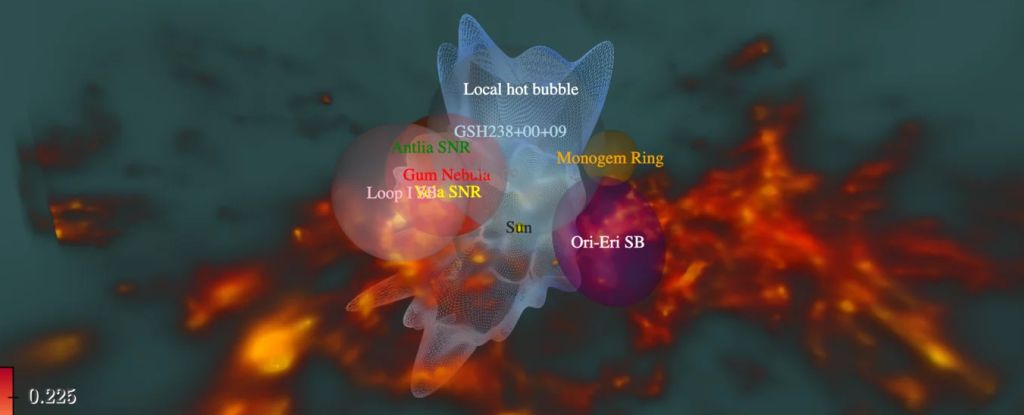
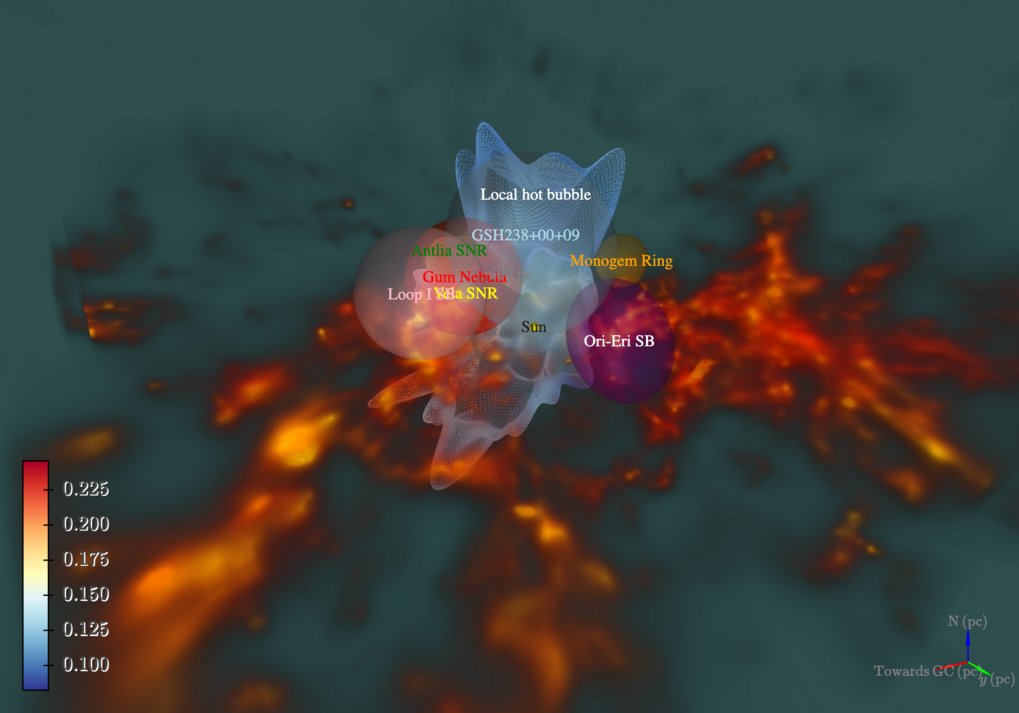
Now a team of astronomers has mapped the bubble, revealing not just a strange asymmetry in the pocket's shape and temperature gradient, but the presence of a mysterious tunnel pointing towards the constellation Centaurus.
[...]
It could also be a clue that the galaxy consists of a whole connected network of hot bubbles and interstellar tunnels, an idea proposed in 1974, and for which little evidence has yet emerged. We might be on the brink of finding that network now – and this, in turn, could help us learn more about the recent history of our galaxy.

 
Cosmic tunnels between our Sun and other stars

Abridged from the Max Planck Institute article
Also Journal Astronomy & Astrophysics

Researchers have discovered "interstellar tunnels" that create direct pathways from our solar system to distant stellar regions. Using advanced X-ray telescope data, scientists at the Max Planck Institute have mapped these cosmic channels that cross the galaxy, revealing a network connecting star systems. The discovery was revealed from data by the eROSITA X-ray telescope, which orbits the Sun-Earth Lagrangian point L2. These channels appear as regions of exceptionally hot, low-density plasma that create pathways through the surrounding cooler interstellar medium.
original-1730188940.png

Local Hot Bubble (LHB) of the solar system​

The solar system exists within a cavity of approximately 300 light-years known as the Local Hot Bubble, filled with million-degree plasma. This bubble is claimed as resultant from supernova explosions that occurred between 10 and 20 million years ago, creating that called as a "supernova graveyard." This bubble is not uniform in temperature and structure, claims the Max Planck Institute report.

This discovery identified tunnel-like structures extending from the Local Hot Bubble toward particular constellations. The most noticeable tunnel points directly to the constellation Centaurus, the nearest stellar neighbors including the Alpha Centauri. Another identified tunnel leads toward the constellation Canis Major, linking the solar system with the Gum Nebula located approximately 1,500 light-years away.

These cosmic highways extend potentially connecting new solar systems that are being born. The supernova explosions that created our Local Hot Bubble also collected gas and debris at their expanding edges, creating ideal conditions for new star formation. These new stars then produce their own jets of hot gases and radiation, which continue pushing outward until they encounter other stellar bubbles and star-forming regions.

And speaking on other subtler “stellar paths:”​
March 4, 1995 Session
(L) What is the source of energy generated by stars?
A: Transfer points cause friction thus producing energy.

Q: (L) Transfer points of what; from what to what?
A: Dimensions.
…………….
A: Stars are transition and communication points.

June 15, 1996 Session
A: We have told you before that planets and stars are windows. And where does it go?
Q: (L) The windows?
A: The gravity.
…………….
Q: (L) Well, where does gravity go. The sun is a window. Even our planet must be a window!
A: You have it too!!

Q: (L) So, gravity is the unifying principle... the thing that keeps things together, like the way all the fat pulls together in a bowl of soup.
A: Gravity is all there is.​
 
Back
Top Bottom