
You are using an out of date browser. It may not display this or other websites correctly.
You should upgrade or use an alternative browser.
You should upgrade or use an alternative browser.
Nayib Bukele, the savior of El Salvador?
- Thread starter benkostka
- Start date
-
- Tags
- el salvador

I think it could be a bit of both, or maybe both entirely.
What I mean is, everything that Bukele has done in El Salvador does not deny gang members traveling to the US, maybe because of his efforts, some upon noticing that the tide was changing might've simply changed branches and moved to LA or elsewhere in the US. Abandoning ship instead of staying and being captured.
Perhaps Bukele would not want to disclose this information outright to not ruffle the feathers of his people, or maybe it is known and no one cares, so long as they do not live in the country and aren't allowed back in. And in fact, in that interview with Tucker, Bukele himself made mention of Spain not deporting one of the gang members they had captured, so if one of the got captured in Europe, it means that dozens must've flown in that direction as well, which means that the US, which is the first destination because it is so close, has to be undergoing a similar process of accepting gang member refugees.
But then, Trump was back on campaign mode and he loves to make such large statements and declarations to appeal to his base, so there might be some fiction mixed in there too.
Definitely. When Bukele started doing his housecleaning, a bunch of criminals fled El Salvador. And they would have chosen the US first. But who is to blame for that? The gangsters had been trained and groomed in the US or by US backed institutions! I wouldn't be surprised if they have green cards. And the US borders are what they are. So, I just hear Trump boasting and campaigning.
There could be some "deals" with Americans who wanted the criminals in the US territory as well, for sure. But then again, blaming Bukele alone for that is ignoring what goes on in Trump's own country. The CIA and others are American institutions, and THEY are responsible for those criminals to begin with, OSIT.
So, if I had to guess, I'd say it's probably Trump knowing some details, yes, but most of all, boasting and just showing a very incomplete picture of the situation, because of his own ignorance.

El Salvador offers to house violent US criminals and deportees of any nationality in unprecedented deal
CNN - El Salvador has agreed to house violent US criminals and receive deportees of any nationality, US Secretary of State Marco Rubio announced Monday, in an unprecedented – and legally problematic deal – that has alarmed critics and rights groups.
Rubio unveiled the agreement after meeting with Salvadoran President Nayib Bukele, as part of a tour of several Central American countries intended to consolidate regional support for the Trump administration’s immigration policy.
“In an act of extraordinary friendship to our country … (El Salvador) has agreed to the most unprecedented and extraordinary migratory agreement anywhere in the world,” Rubio told reporters Monday.
The country will continue accepting Salvadoran deportees who illegally entered the US, he said. It will also “accept for deportation any illegal alien in the United States who is a criminal from any nationality, be they MS-13 or Tren de Aragua and house them in his jails,” he said – referring to two notorious transnational gangs with members from El Salvador and Venezuela.
In addition, Bukele “has offered to house in his jails dangerous American criminals in custody in our country, including those of US citizenship and legal residents,” Rubio said.
Looks like a win-win situation. Trump has a 'magical solution' for another pressing problem and El Salvador gets his prison system financed while averting high tariffs.
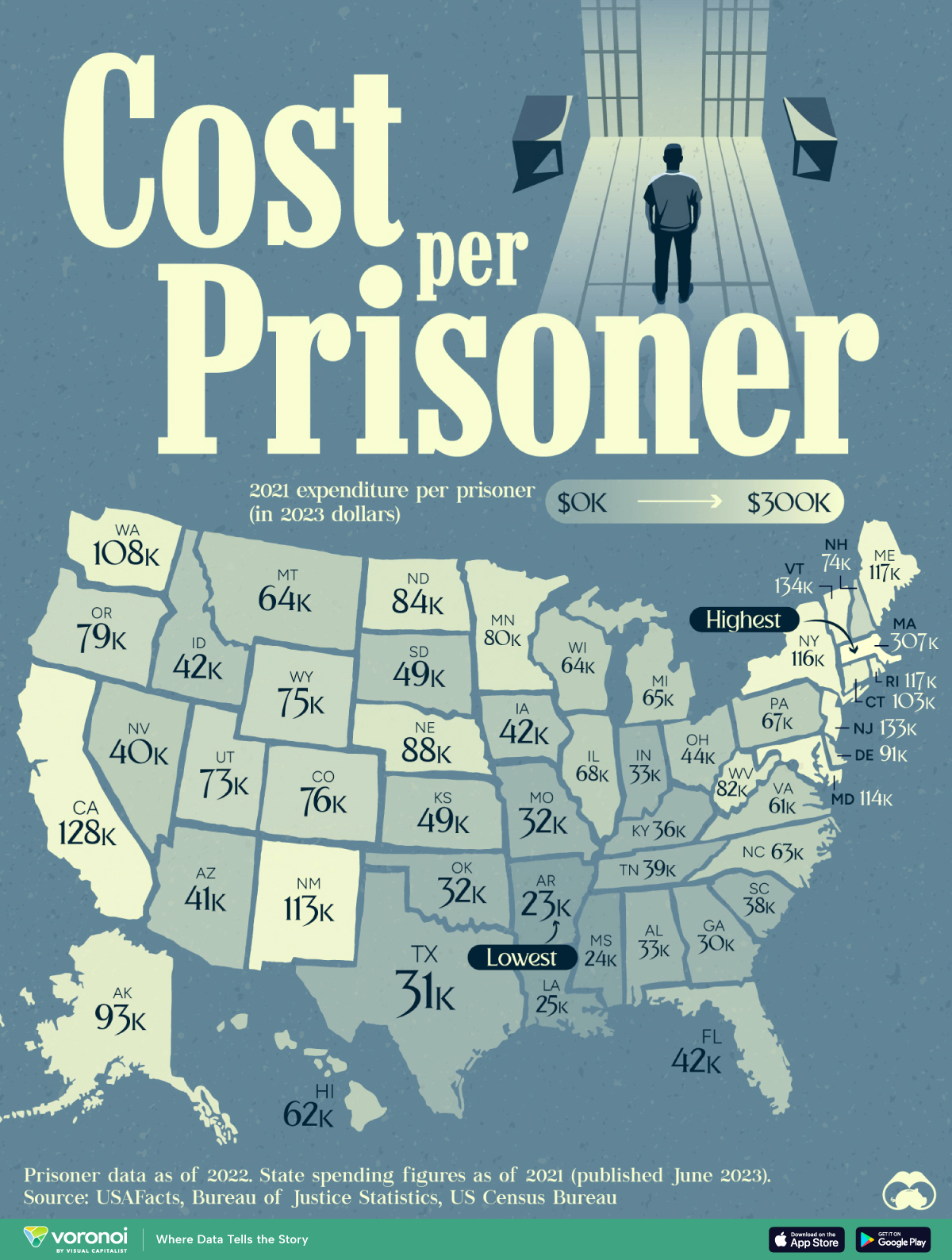

Today's prisons are for profit. And, the El Salvadorian supper prison stinks to high heaven of totalitarian rule and profit off of the suffering of others.
I wrote of this on the first page of this thread, and I knew this subject wasn't going to go away. Its to tempting for the PTB, who I'm sure built that prison. Its the concept they want to be bought into by other countries before building more. And the US pundits continue to comment about what a great system it is.
I wrote of this on the first page of this thread, and I knew this subject wasn't going to go away. Its to tempting for the PTB, who I'm sure built that prison. Its the concept they want to be bought into by other countries before building more. And the US pundits continue to comment about what a great system it is.

Many US prisons are for profit but I don't think that the prisons in El Salvador are - unless you have different information.Today's prisons are for profit. And, the El Salvadorian supper prison stinks to high heaven of totalitarian rule and profit off of the suffering of others.
El Salvador may be overdoing it with inhumane harshness towards prisoners, but it is also a fact that Bukele reduced crime dramatically and to a degree nobody thought was possible in that country.
Many US prisons are for profit but I don't think that the prisons in El Salvador are - unless you have different information.
Same here. As far as I know, they are heavily funded by the government, and prisoners' families must pay something like 170USD per month, or less, and it's still optional.
El Salvador may be overdoing it with inhumane harshness towards prisoners, but it is also a fact that Bukele reduced crime dramatically and to a degree nobody thought was possible in that country.
Yes. Although to my knowledge at least, there has also been a lot of propaganda saying that Bukele is basically a dictator, that those prisons are a nightmare (not true according to some independent journalists who visited and interviewed prisoners), etc.
I wrote of this on the first page of this thread, and I knew this subject wasn't going to go away. Its to tempting for the PTB, who I'm sure built that prison. Its the concept they want to be bought into by other countries before building more. And the US pundits continue to comment about what a great system it is.
That may be the case, but I doubt it. They already have waaaay worse prisons (witness Guantamo, Abu-Ghraib, prisons in Israel and a lot more we never hear about). When you know what those gangs were doing, and who was funding and training them, you can't help but feeling that Bukele's methods were the only approach he had left.
People aren't told that these gangs were formed and trained in Los Angeles (CIA funding, most likely). They hire very young children, and turn them into sociopaths. They make them do "initiations" that break their spirit at a very vulnerable age, so that all they are left with is a deep hatred towards others, and a sense of "safety" within the gang alone. To get "promoted" they have to murder someone. Rape, butting body parts, trafficking, etc are just their daily routine.
And, something else that is often left out is that the gang members were deported by the thousands, from the US back into El Salvador, once they were well trained. So, the US/CIA was perfectly fine deporting illegals or criminals, yet they let a massive number of illegal immigrants in. Doesn't that speak of double standards? When it suits them to drive illegals out, they have no problem doing it, especially if those same people are gang members ready to create chaos abroad.
Today's prisons are for profit. And, the El Salvadorian supper prison stinks to high heaven of totalitarian rule and profit off of the suffering of others.
Just another thought that occurred to me when reading the above. I think what bothers me also is the propaganda job on Americans themselves. For years (actually decades), the US (CIA) did exactly what you are saying: they profited off of the suffering of others, ABROAD. The gangs are super profitable for them, and they generate enough instability in "Amerca's back patio" that they can then make even more profit by forcing said country to make unfair deals with them.
Another thing is, whose suffering are we talking about? The gangsters in these prisons are treated VERY strictly, yest, but do you know the amount of suffering they themselves inflicted? We're talking about the entire population having been terrorized for years, their loved one killed and dismembered for no reason. Many of those prisoners proudly confessed to having raped and killed 50 some people each. It's easy for the Western media to only tell one side of the story, and portray them as victims. Well, I think many of them ARE, but only in the sense of never having been given a chance to develop a healthy psyche, and having been groomed as small children. They actions though, are very difficult to distinguish from those of born psychopaths with sadistic tendencies.
I could be wrong, of course. But I think we have to try to look at it from a broader perspective.
I agree of course on the subject of the gangs. If I were king, I could consider even harsher methods. The issue I have is a prison system where no crime need be committed, just a suspicion from a pissed off neighbor can have a citizen arrested, and given a life sentence, without a case hearing, lawyer, judge…nothing, just life sentence in prison. Can’t imagine any country’s citizens wanting that form of penal system. And what a boon for a totalitarian government. Opposition and decent would easily be silenced.
My concern is more for the average citizen than the gang member. And now they are mix together in prison for life. Prison is for separating the belligerents, the sociopath, etc. from society. Once neutralized into a cell, I see no need for revenge or torture. The US penal system was ostensibly built for rehabilitation, and well, even the discussion of that is gone. Now it appears to be a punishment system.
Having said that, after the Patriot Act, any American citizen can be arrested without charge and go away forever, and any country can do the same one way or the other. But what make this ES thing different to me is the boasting of it, leaving out the inconvenient part, only the positive part, and people like T. Carlson and many other saying how great it is without bringing up the complete lack of citizens rights.
Anyway, I don’t need to beat a dead horse. That’s my opinion. If there is disagreement, fair enough. I’ll keep an open mind while continuing to monitor this situation. For me its not an easy one, and I appreciate the comments…thanks.
My concern is more for the average citizen than the gang member. And now they are mix together in prison for life. Prison is for separating the belligerents, the sociopath, etc. from society. Once neutralized into a cell, I see no need for revenge or torture. The US penal system was ostensibly built for rehabilitation, and well, even the discussion of that is gone. Now it appears to be a punishment system.
Having said that, after the Patriot Act, any American citizen can be arrested without charge and go away forever, and any country can do the same one way or the other. But what make this ES thing different to me is the boasting of it, leaving out the inconvenient part, only the positive part, and people like T. Carlson and many other saying how great it is without bringing up the complete lack of citizens rights.
Anyway, I don’t need to beat a dead horse. That’s my opinion. If there is disagreement, fair enough. I’ll keep an open mind while continuing to monitor this situation. For me its not an easy one, and I appreciate the comments…thanks.

Assuming Bukele did this recent move on his own innovative, I think it is a pretty smart thing to do that might involve long term thinking. By this move Bukele is positioning himself and his country into a favorable position toward Trump and company and making sure from the get-go that no tariffs will hit that small country, which is probably very vulnerable towards something like that. It seems to be a good move considering the circumstances and if you want to continue to let your country prosper.
But, of course, it also comes with significant dangers to let so many criminals into the country.
But, of course, it also comes with significant dangers to let so many criminals into the country.
I agree of course on the subject of the gangs. If I were king, I could consider even harsher methods. The issue I have is a prison system where no crime need be committed, just a suspicion from a pissed off neighbor can have a citizen arrested, and given a life sentence, without a case hearing, lawyer, judge…nothing, just life sentence in prison. Can’t imagine any country’s citizens wanting that form of penal system. And what a boon for a totalitarian government. Opposition and decent would easily be silenced.
I agree, it can be easily abused. In El Salvador's case, from what I saw, a big part of the problem was that the gangs were everywhere, and unless they showed their tattoos, people had no way of knowing who they were dealing with. The most horrible cases were those of children at school, open markets, etc. They would be spying while pretending to be innocent normal kids, then they'd tell their leaders that someone didn't like the gangs, and boom! A bunch of new people were killed. A decision was made to act quickly, without a trial, and that was one of the reasons. They wanted to shock the gangs out of commission, so to say. Bukele HAS promised that this won't last forever though, and it was only to get the worst criminals out of the streets, which he has done. But we'll see...
My concern is more for the average citizen than the gang member. And now they are mix together in prison for life. Prison is for separating the belligerents, the sociopath, etc. from society. Once neutralized into a cell, I see no need for revenge or torture. The US penal system was ostensibly built for rehabilitation, and well, even the discussion of that is gone. Now it appears to be a punishment system.
Having said that, after the Patriot Act, any American citizen can be arrested without charge and go away forever, and any country can do the same one way or the other. But what make this ES thing different to me is the boasting of it, leaving out the inconvenient part, only the positive part, and people like T. Carlson and many other saying how great it is without bringing up the complete lack of citizens rights.
Yes... I understand your point better now, thanks. I guess we have to see how it plays out in every country, because every situation will be different. At least it should be easier to know where we stand on this one, unlike many other things that get abused and corrupted without people's knowledge (like the Covid scam "science").

Sindy-T.S.R
Jedi
Until proven otherwise, whatever they say, I admire this president very much!

At least one good news in this world!...
Bukele: Starting Today, the So-Called ‘Inclusive Language’ Is Prohibited in All Public Schools
President Nayib Bukele announced that starting today, the use of so-called “inclusive language” is prohibited in all public schools across El Salvador. The government emphasized that the measure seeks to ensure clear institutional communication and protect students from ideological interference.
The Ministry of Education, Science, and Technology confirmed that the restriction applies to educational materials...

The latest Venezuela thing might be the next “separating the wheat from the chaff“. Or, exposing of “false prophets“ if you will. Take a look how Bukele is handling it:
Just saying, that if a miracle sounds just a bit too unlikely to be true as portrayed, it possibly is:
Namely, that the most dangerous drug and likely CIA infested country, (and at the same time, one of the smallest countries, right next to the empire) suddenly is able to make a one-hundred-eighty in a very short period of time becoming “the exact opposite“.
Just saying, that if a miracle sounds just a bit too unlikely to be true as portrayed, it possibly is:
Namely, that the most dangerous drug and likely CIA infested country, (and at the same time, one of the smallest countries, right next to the empire) suddenly is able to make a one-hundred-eighty in a very short period of time becoming “the exact opposite“.

President Bukele's statements from his February 5, 2026, speech at the National Prayer Breakfast, as reported by sources like Fox News. He discussed gangs' involvement in satanic rituals, with documented evidence from arrests.
Bukele is not only a dictator, he is also a gangster and a Trumpist bootlicker, just like Milei in Argentina. Bukele has a long tail, and this is just one example:
I'm quite surprised by this statement. Are you sure you aren't basing this is the huge amount of propaganda about him? What you posted to back your claim actually contradicts your statement, IMHO, and what I've seen from Bukele also does. Asking Grok is not helpful, because it will follow the mainstream narrative. When you see the difference between El Salvador before, and after Bukele's "dictatorship", is night and day. I don't see any possible comparison with psychiatric-patient-potential Milei. Nor do I see a dictator/gangster. As for a "Trump booklicker", what I see is quite some strategy. My guess is that in order to be allowed to accomplish what he did in El Salvador, he had to make some concessions (like commit to not exposing the real involvement of the US/CIA in the building and supporting of the gangs.) I could be wrong, of course.

When you see the difference between El Salvador before, and after Bukele's "dictatorship", is night and day. I don't see any possible comparison with psychiatric-patient-potential Milei. Nor do I see a dictator/gangster
I am not the first to call Bukele a dictator.
Bukele's dictatorship shows its fangs
Ruth Leonora López, a well-known human rights activist, was imprisoned by the Bukele regime. El Salvador is a dictatorship, and Bukele is a dictator.
Ruth Leonora López, one of the most prominent and consistent activists for human rights and transparency in El Salvador, was arrested on Sunday night by Nayib Bukele's regime. She is, without a doubt, a political prisoner. Perhaps the most famous political prisoner of Bukelism to date.
Sometimes it seems that nothing is enough and that the world is only tremulous and calculating. Or lukewarm and timid. When Bukele took over the Legislative Assembly surrounded by military personnel and cameras in February 2020 and threatened to dissolve the first organ of the state, many said it was too early to call him authoritarian. When Bukele, after winning an absolute majority in the Legislative Assembly, occupied it in 2021 to illegally replace the attorney general who was investigating him and the Supreme Court justices who were ignoring him and impose officials loyal to him, many said it was too early to call him an autocrat.
He has given himself this title: "coolest Dictator"
How Nayib Bukele is becoming "the coolest dictator in the world"
Since becoming president on June 1, 2019, Nayib Bukele has consolidated his political power through strategies that have eroded democracy and the rule of law. Earlier this year, the ruling party achieved a qualified majority in the Legislative Assembly, allowing it to pass laws without negotiating with the opposition and to completely renew the Constitutional Chamber, whose rulings had been adverse to it. The impact of this measure was soon apparent when the new judges enabled presidential reelection despite it being expressly prohibited by the Constitution.
For the moment, nothing seems to be denting the high popularity of the president, who describes himself on his Twitter account as "the coolest dictator in the world." What's more, this served as an argument for the new judges of the Chamber to argue that "the rules on alternation are aimed at overcoming cases of presidents who no longer enjoy the approval of the people." However, recent weeks have seen unprecedented scenes of social unrest that could herald a change in the local climate.
I asked Grok to provide some context for journalist Erick Gutierrez's opinion. Bukele has turned El Salvador into a golden cage. Perhaps for some or all Salvadorans, this is fine.
I base my opinion of Bukele on comparing him to the Mexican experience and the main point I want to make is that the Bukele Model is not applicable to Mexico. IMHO the reason given by journalist Gutierrez is valid: "It is not the same to dismantle gangs as it is to try to contain criminal economies embedded in global chains."
The CJNG operates not only as a criminal group but also as a corporation, It operates under a scheme similar to that of franchises. Unlike the gangs, the CJNG's economic power allows it to buy not only heavy weapons but also allegiances.
I base my opinion of Bukele on comparing him to the Mexican experience and the main point I want to make is that the Bukele Model is not applicable to Mexico. IMHO the reason given by journalist Gutierrez is valid: "It is not the same to dismantle gangs as it is to try to contain criminal economies embedded in global chains."
The CJNG operates not only as a criminal group but also as a corporation, It operates under a scheme similar to that of franchises. Unlike the gangs, the CJNG's economic power allows it to buy not only heavy weapons but also allegiances.
CJNG. Its financial muscle: drug trafficking, money laundering, tourism, protection rackets, mining, and fuel theft.
Drug trafficking and territorial control were the seeds, but the Jalisco New Generation Cartel (CJNG) is far from being a criminal organization solely dedicated to drug trafficking, extortion, and contract killings. With a franchise scheme, the empire of Nemesio Oseguera Cervantes, alias El Mencho, extends to activities ranging from mineral trading to entertainment services that blend with the "formal economy."
According to U.S. Treasury documents and information from the Financial Intelligence Unit (UIF), this cartel consolidated a money laundering scheme that turned into investments in tourism, restaurants, real estate, mining, agriculture, and finance, among others. In 2018 alone, its connections with promoters of cockfighting arenas and fairs were reported.
Beyond the CJNG's increased involvement in "non-drug trafficking activities, such as gasoline theft, extortion, and real estate fraud," to diversify the drug trafficker's sources of income and protect its assets from seizure, in its most recent National Assessment, the U.S. Drug Enforcement Administration (DEA) highlighted the growing "infiltration of legitimate industries."
In Mexico, we experienced this "Bukele Model" during the period of the PRI dictatorship (1929-2000) It was possibly even harsher during the presidency of Gustavo Diaz Ordaz (1964-1970). Then we had the neoliberal experience in the 1980s and up until the presidency of Enrique Peña Nieto (2018). During this neoliberal period, the power of the state in economic matters was dismantled, or what Milei calls "chainsaw." Yes, we have also experienced it. Incidentally, during those periods, Mexico had no significant problems with the US; there were no threats of intervention. Mexico was cool.
The Bukele clan (of Palestinian origin) has seized power in El Salvador, and since becoming president, the family has become landowners.
Corruption in El Salvador: Bukele's double game
The process of power concentration and democratic degradation that El Salvador is experiencing is accompanied by opaque management of resources and the weakening of control bodies. With institutions co-opted or neutralized and a government operating with impunity, Nayib Bukele is far from his electoral promises of transparency.
Since coming to power in 2019, Bukele has strived to surround himself with loyal people. Upon taking office, the "millennial president" assembled his new government by including cousins, family friends, and former classmates. However, his inner circle of influence consists of his three brothers, Karim, Yusef, and Ibrajim Bukele. Although they do not hold any official public office, they play a leading role in most of the president's decisions, including political strategy, the economy, and the appointment of public officials. Since then, they have served as key strategists, emissaries, and negotiators for the presidential administration. This set the tone for Bukele's presidency, which was dominated by the decision to strengthen his authority and undermine oversight institutions.
Unlike the Mexican government, which extradited drug traffickers, Bukele's government refuses to extradite Maras leaders to the US. What are they trying to hide? Have they made a deal with the Maras and it's all a sham?
"Delay, interfere, undermine"
A lengthy US investigation into MS-13 has uncovered evidence that does not align with Bukele's reputation as a crime fighter. The investigation, which began as an attempt to dismantle the gang's leadership, expanded to focus on whether Bukele's government had made a secret pact with MS-13 in the early years of his presidency.
Reporting Highlights
Investigation Blocked: Despite President Nayib Bukele's image as a crime fighter, his top officials blocked the extradition of MS-13 leaders, according to officials.
Money Laundering Suspicions: U.S. agents prepared a request to examine whether Bukele and senior officials had diverted USAID funds to help MS-13 gang members.
Threats to U.S. Allies: Salvadoran justice and security officials had to flee El Salvador after being harassed and threatened by the country's government.
Without a doubt, Bukele has more dark sides than bright ones. So there are cool dictators like Bukele and there are not-so-cool dictators like Kim Jong-un. What makes them different? The blessing of the United States?
Trending content
-

-

-
Thread 'Coronavirus Pandemic: Apocalypse Now! Or exaggerated scare story?'
- wanderingthomas
Replies: 30K -
