Rare asymmetric supernova may have created black hole

Palinurus

The Living Force
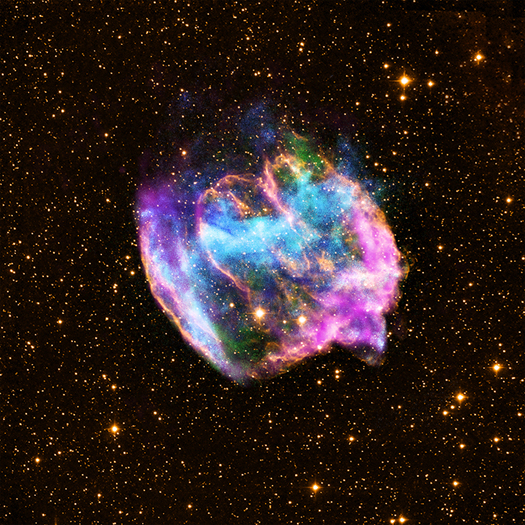
w49b_w11.jpg


NASA's Chandra Suggests Rare Explosion Created Our Galaxy's Youngest Black Hole

New data from NASA's Chandra X-ray Observatory suggest a highly distorted supernova remnant may contain the most recent black hole formed in the Milky Way galaxy. The remnant appears to be the product of a rare explosion in which matter is ejected at high speeds along the poles of a rotating star.

The remnant, called W49B, is about a thousand years old as seen from Earth and located about 26,000 light-years away.

"W49B is the first of its kind to be discovered in the galaxy," said Laura Lopez, who led the study at the Massachusetts Institute of Technology. "It appears its parent star ended its life in a way that most others don't."

Usually when a massive star runs out of fuel, the central region of the star collapses, triggering a chain of events that quickly culminate in a supernova explosion. Most of these explosions are generally symmetrical, with the stellar material blasting away more or less evenly in all directions.

However, in the W49B supernova, material near the poles of the doomed rotating star was ejected at a much higher speed than material emanating from its equator. Jets shooting away from the star's poles mainly shaped the supernova explosion and its aftermath.

[...]

Source: _http://www.nasa.gov/mission_pages/chandra/news/w49b_remnant.html

W49B is a highly distorted supernova remnant, produced by a rare type of explosion.

Instead of radiating out symmetrically, W49B's exploding star shot more material out from its poles versus from its equator.

There is evidence that W49B left behind a black hole - not a neutron star like most other supernovas.

If confirmed, W49B would be the most recent black hole formed in our Galaxy.


The highly distorted supernova remnant shown in this image may contain the most recent black hole formed in the Milky Way galaxy. The image combines X-rays from NASA's Chandra X-ray Observatory in blue and green, radio data from the NSF's Very Large Array in pink, and infrared data from Caltech's Palomar Observatory in yellow.

The remnant, called W49B, is about a thousand years old, as seen from Earth, and is at a distance of about 26,000 light years away.

The supernova explosions that destroy massive stars are generally symmetrical, with the stellar material blasting away more or less evenly in all directions. However, in the W49B supernova, material near the poles of the doomed rotating star was ejected at a much higher speed than material emanating from its equator. Jets shooting away from the star's poles mainly shaped the supernova explosion and its aftermath.

By tracing the distribution and amounts of different elements in the stellar debris field, researchers were able to compare the Chandra data to theoretical models of how a star explodes. For example, they found iron in only half of the remnant while other elements such as sulfur and silicon were spread throughout. This matches predictions for an asymmetric explosion. Also, W49B is much more barrel-shaped than most other remnants in X-rays and several other wavelengths, pointing to an unusual demise for this star.

[...]

Source: _http://chandra.si.edu/photo/2013/w49b/

Might as well be interesting as an article for SOTT. ;)
 
Very interesting find!

And about that part:

By tracing the distribution and amounts of different elements in the stellar debris field, researchers were able to compare the Chandra data to theoretical models of how a star explodes.

Do you or anybody know anything about a theory following the electric model that hypothesize how stars explodes and/or how black holes form (or what they are)?

I've read stuff about the EU theory but haven't been able to find anything objective about this. Many debunkers that would not only debunk the classical model but say that "the existence of blacks holes is as absurd as alien abductions" or "quantum theory and multiverses are BS, I know everything bla bla bla". Etc.

So that's not quite the kind of attitude I find really objective.

Very nice picture as well. They always bring a special feeling inside of me when I look at them. One of nature's finest!

NASA said:
not a neutron star like most other supernovas

Neutron stars? :rolleyes:

Peace!
 
I've always thought of Black Holes as nature's recycling bin. I wonder if to keep things in balance, what is created must be destroyed for some things to start anew; if that is indeed what black holes do. Or perhaps they store that recycled material for 'future' use or suck it through a bubble into another universe.
Fascinating and mystifying - and beautiful.
 
Facinating indeed. Here are some quotes from the C's.

Session 10 Decembre 1994 said:
(L) In terms of major STS, this may or may not be related, could you tell us the nature of a Black Hole?

A: Grand Scale STS.

Q: (L) Is it like a being that has achieved such a level of STS that it has literally imploded in on itself in some way?

A: Close analogy.

Q: (T) Possibly an entire civilization of STS?

A: No.

Q: (L) Well, maybe a civilization can't do it because that implies working together. It must need to be an individual being.

A: Black Holes are a natural force reflection of Free Will consciousness pattern of STS. Notice that Black Holes are located at center of spiral energy forces, all else radiates outward.

Q: (L) Now, you say "spiral" energy forces, and you also have said that this wave is a spiral. Is the central point of this wave that is spiraling, a black hole?

A: No.

Q: (L) Is it a radiating wave?

A: All in creation is just that: a radiating wave.

Q: (L) Where does the energy go that gets sucked into a black hole?

A: Inward to total nonexistence.


Q: (L) Well, if a black hole continues to suck stuff in, is it possible that it would eventually suck in the entire creation?

A: No.

Q: (L) Why is that?

A: Universe is all encompassing. Black holes are final destination of all STS energy.

Q: (F) So, does this mean that we, or anyone else who is classified as STS, remains on said path, that we will eventually end up in a Black Hole?

A: Close.

Q: (L) Well, that is pleasant. And what happens to energy that is "total non-existence"?

A: Total non-existence balances total existence. Guess what is total existence?

Q: (L) Well, is it kind of like a balancing force?

A: "God."

Q: (T) Are we talking about the creator god as in the Pleiadians?

A: Not Pleiadians. Prime Creator.

Q: (T) What is the difference between the Prime Creator and "God?"

A: None. As long as you exist, you are of the Prime Creator.

Q: (L) Now, this stuff that goes into Black Holes, that goes into non-existence, is that, then, not part of the Prime Creator?

A: Correct.

Q: (L) How can Prime Creator lose any part of him or itself?

A: Prime Creator does not "lose" anything.

Q: (L) Well, then, how would you describe this energy that was in existence and then is no longer in existence because it has become or gone into a Black Hole?

A: Reflection is regenerated at level 1.


Q: (L) So, this energy goes into a Black Hole and... does it come out on the other side?

A: No.

Q: (L) Does it become like a primal atom?

A: No.

Q: (T) Does it go back into the cycle?

A: No. Reflection regenerates as primal atoms.

Soluna said:
I've always thought of Black Holes as nature's recycling bin. I wonder if to keep things in balance, what is created must be destroyed for some things to start anew; if that is indeed what black holes do. Or perhaps they store that recycled material for 'future' use or suck it through a bubble into another universe.
Fascinating and mystifying - and beautiful.

As far as I understand this part, what is sucked into a black hole goes inwards towards total nonexistence (non-being reflection of the Creation) and what "dissapeares" is somehow regenerated in the form of primal atoms (how it happens though is another story). So yes, it seems that everything is balanced, all the time.

But I don't think anything is created nor destroyed, merly "recycled" and re-organised. Everything is counsciousness, including matter which is the "sleeping-half of creation". Nonexistence cannot "physically" exist per se but as a thought form, yes. So matter could then simply go into another "state" which is the nonexistence state, in the form of a thought. I know it must not make a lot of sense but I hardly can put words on this. Or perhaps I'm missing the point.

Session 1 March 1997 said:
A: What is the nature of neutron stars, supernovae, "black holes," et cetera?

Q: (L) You go in a black hole, and you come out a pulsar?!

A: All are the junction of matter/antimatter... the borderline between realities as you know them... material realms/etheric realms, density level junctures, realities. One can pass through these windows with ease; remember, the stars and planets are windows too.

Now what's interesting here is that they put "black hole" in quotes. I guess this is because our mainstream science is uneble to really explain how they work. That's why I have tried to find a black hole model in the EU universe theory but it seems that many in that area think they simply don't exists and are only predicted by maths alone to make the equation work. So perhaps they are also missing a point, or maybe I am.

Both a supernovae and "black hole" represent windows. Ok. A supernovae seems to radiate plasma, elements and light. Black holes then suck everything. So they are kind of two opposite but linked by the same phenomenon which is the death of a star, osis from what I understand. So perhaps this is the end/beginning of a new sub-cycle in a way. They have also said (1st quote in red) that they are at the center of spiral energy forces (galaxies?) so they might act as a balance since they suck things while the rest radiates outward. And on the metaphysical level, STS balances STO.

FWIW
 
Thanks for pointing out those sessions! Connecting the dots is always a great learning exercise and I appreciate you taking the time.
 
Back
Top Bottom